

12 min 55 sec
Available in: English
 ไทย
EnglishไทยSimplicity Parenting: Using the Extraordinary Power of Less to Raise Calmer, Happier, and More Secure Kids
Shows parents how to ease the stress that builds up and leaves children anxious, controlling and fragile. The method is to cut back toys, activities, screens and adult news, and to add a steady daily rhythm.
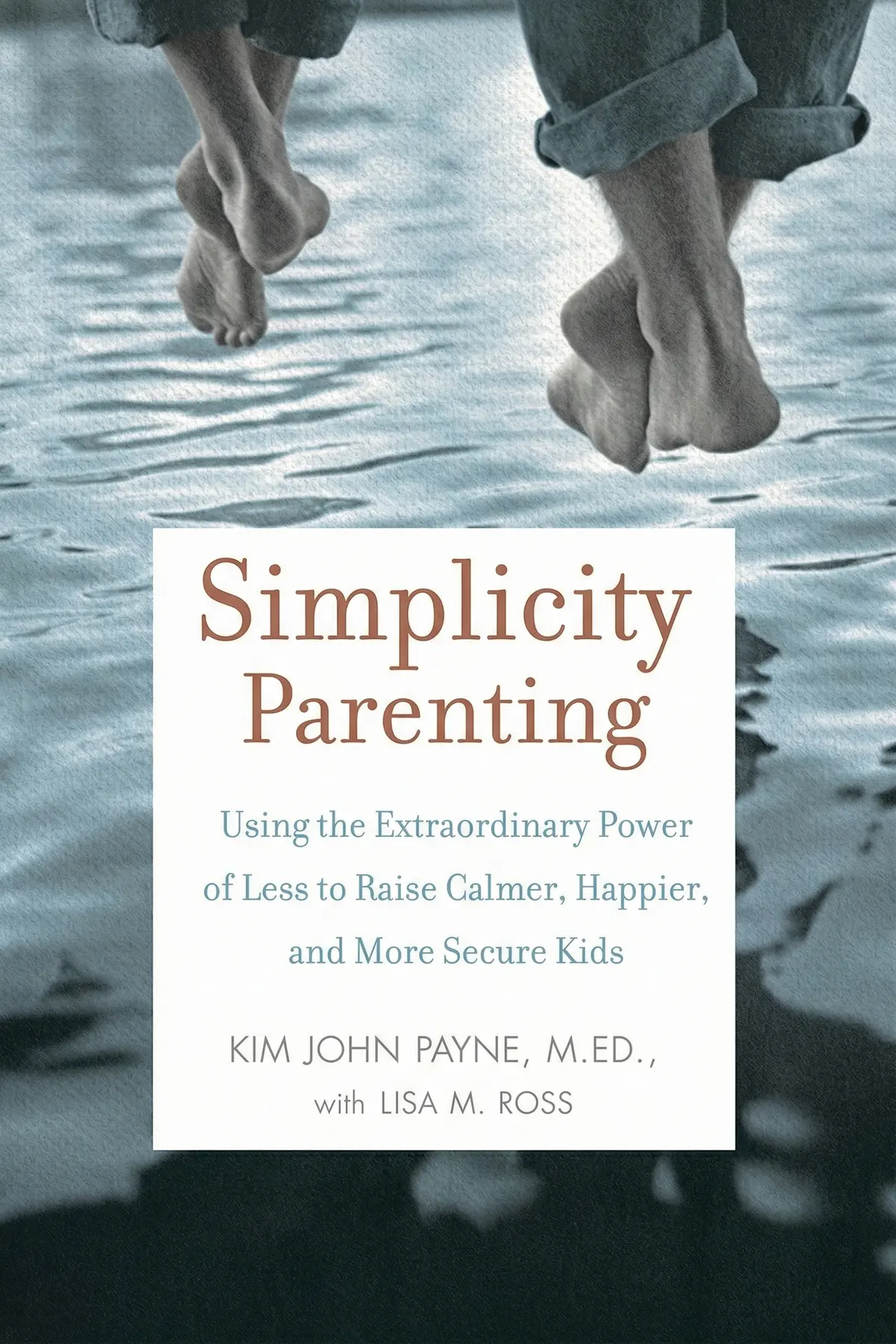
Table of Content
1. Introduction
1 min 07 sec
A child surrounded by too much stuff, too many plans and too much adult noise can start to show real signs of stress: nervousness, a need to control everything, very little ability to bounce back. In Simplicity Parenting, family counselor Kim John Payne and writer Lisa M. Ross argue that the cure is mostly subtraction. Payne calls the problem cumulative stress reaction, and he has seen it again and again in his counseling work.
The book’s case is that children become calmer and more secure when parents strip back what crowds their lives and put rhythm and free time in its place. That means fewer toys, a predictable day, a lighter calendar and a home where the adult world mostly stays outside. Each change is concrete and can start this week. By the end, you will know how to cut a toy pile down in three rounds, how a short preview at bedtime can calm a worried child, and why an empty afternoon may be the most useful thing on a child’s schedule.
2. Spot the overload behind a child's anxiety
2 min 08 sec
A jumpy, bossy child who falls apart easily may not have lived through anything dramatic at all. Payne traces the problem to something so ordinary in many homes that parents have stopped noticing it.
3. Halve the toy pile for deeper play
2 min 08 sec
The average child gets a new toy more than once a week, yet many end up bored, demanding and pulling their dolls apart. Payne’s fix for an overflowing shelf is blunt, and it comes with one firm warning.
4. A predictable day that helps children settle
2 min 05 sec
A six-year-old decided the safest place in the world was his own bed, and stopped getting up. What brought him out again took his parents only a few minutes each night.
5. Make room for doing nothing at all
2 min 09 sec
Soccer, karate, auditions and clubs all look like gifts to a growing child. Payne sees a hidden cost in the total, and two families show how a small pause changed a child’s behavior.
6. Keep the adult world off your home's screens
2 min 03 sec
Most homes now hold several screens, each pouring adult worries and stimulation into a child’s day. Payne names the one he considers the worst, and explains why even a partial cut is worth making.
7. Conclusion
1 min 15 sec
Simplicity Parenting asks parents to do something that feels backward in a culture that always wants more: give children less, and trust the space left behind to do its own work. In Payne’s account, a stressed child is usually worn down by a steady drip of toys, plans and headlines that never pauses long enough for recovery. Stop the drip and a child’s natural resilience can grow again.
None of this needs a total overhaul at once. This weekend, you could halve the toy pile while your child is out, starting with anything broken or too finished to spark play. Each night you could give a short preview of what tomorrow holds for certain. You could look at the week ahead and protect at least one open afternoon, especially after something loud or exciting. And when you feel ready, you could decide which screens stay in the house and which go.
The picture worth keeping is Justin, a six-year-old staying under his covers because the day felt too unpredictable to face. He got up again once someone told him how he would get to school and who would be waiting for him. Sometimes a child does not need more. They need to know what comes next.
About this book
What is this book about?
Many children today grow up surrounded by piles of toys, packed calendars, glowing screens and a constant stream of adult news. Family counselor Kim John Payne argues that this steady overload can wear children down until they show real signs of stress: nervousness, a need to control everything and very little resilience. He calls the pattern cumulative stress reaction. Payne and writer Lisa M. Ross don't add another technique for parents to master. They take things away. The book sets out four areas to simplify. Cut the toy collection down in three rounds. Give each day a predictable rhythm. Balance organized activities with open, unplanned time. Keep the adult world, and especially television, out of the home as much as possible. The case is built on family stories, one of them drawn from Payne's own work as a consultant. One boy was too anxious to learn to ride a bike. Another refused to leave his bed. A girl was overwhelmed at a family holiday, and a small boy turned aggressive after monster truck shows. Each story comes with simple steps parents can start this week.
Book Information
Who it's for
Feeling crowded at home
Parents of young children whose homes feel crowded with toys, noise and rushed days.
Worried about their child
Mothers and fathers worried about a child who seems anxious, controlling or easily overwhelmed.
Balancing activities and play
Families trying to balance sports, lessons and screen time with plain, unplanned play.
About the Author
Kim John Payne
Kim John Payne is a school and family counselor, consultant and researcher who has helped children, teenagers and adults with sibling conflict, attention and behavior issues, defiance and low self-esteem. He directs the Simplicity Parenting Project and the Center for Social Sustainability, has advised schools and clinics in many countries, and also wrote The Games Children Play and Beyond Winning. Lisa M. Ross worked as an editor and literary agent before becoming a full-time writer, and her long interest in Waldorf education led her to collaborate with Payne.
Ratings & Reviews
Ratings at a glance
What people think
Listeners find this parenting resource offers excellent advice suitable for both toddlers and older children, while remaining straightforward to comprehend and use. The text provides hands-on instructions and significant daily routines for families, which helps lower stress levels and fosters a more tranquil home life. Listeners value the wise counsel regarding slowing down and the focus on removing distractions and tension. They appreciate the book’s concepts, with one listener noting their children's creativity has flourished.
Top reviews
Pridi
After hearing about this approach on several podcasts, I finally dove into the full text. The idea of establishing a "rhythm" in a household sounded like another chore, but it actually became our family's liberation. We started implementing the specific daily rituals Payne suggests, and the shift in my daughter’s behavior was almost immediate. She’s less reactive, more focused, and actually plays with her blocks for more than five minutes now. I appreciated the specific advice on "soul fevers" and taking a mental health day when things get too heavy. It’s a call to slow down in a world that demands we constantly speed up. To be fair, some of the sections on toy decluttering felt a bit extreme at first glance. However, seeing how my children’s creativity flourished once the plastic mountain was gone made me a believer. It’s not just about cleaning up; it’s about giving them space to breathe.
Show moreNarongrit
This book should be handed out at every maternity ward as a survival guide for the 21st century. We’ve all felt that creeping anxiety that our kids have too much stuff, but Payne gives you the permission—and the method—to actually change it. The "half the toys, then half them again" rule sounded brutal, but my kids didn’t even notice the missing items. Instead, they started inventing new games with the few items that remained. It’s amazing how much more peaceful our living room feels without a thousand flashing plastic gadgets everywhere. I also took his advice on limiting media to heart, and bedtime has become so much smoother. Frankly, it’s a relief to know that "doing less" is actually the best thing I can do for my children’s development. It’s a deep, meaningful read that challenges you to prioritize connection over consumption.
Show moreJoe
As someone who has always leaned toward minimalism, I didn't think I'd learn much new here, but I was wrong. Payne’s concept of the "soul fever" changed how I view my son's bad days. Instead of seeing a tantrum as a behavior to be corrected, I now see it as a sign that he’s overwhelmed and needs a "quiet day" to reset. This shift in perspective has been incredibly healing for our relationship. The book is data-driven enough to satisfy my need for evidence while remaining very accessible and warm. I loved the sections on simplifying books—it felt like sacrilege to prune the shelves, but now my kids actually read what’s there. It’s a powerful reminder that our children don't need a perfectly curated life; they just need us to be present. Truly a must-read for the modern parent.
Show moreAlice
Wow, I didn't realize how much the 'clutter' of our daily schedule was affecting my kids' behavior until I started reading this. One of the biggest takeaways for me was the "prescription for boredom." I used to feel guilty if my kids weren't constantly entertained, but now I see boredom as the precursor to creativity. Since we stopped the constant stream of movies and toys, my son has started building elaborate cardboard cities in the garage. The house is more peaceful, and the kids are playing together much more harmoniously. It’s a beautiful book that offers a different way of living that feels much more natural than the current rat race. If you’re feeling burnt out as a parent, this book will give you the permission to just stop and simplify everything. It’s a breath of fresh air.
Show morePichaya
The chapter on filtering out the adult world was exactly what I needed to hear as a parent in today's political climate. We often forget how much our children absorb our own anxieties and the constant noise of the news. Payne’s advice on keeping kids under nine protected from these adult concerns is vital for their emotional security. Since implementing the suggestions in this book, the "vibes" in our home have shifted from chaotic to calm. It’s not just about getting rid of toys; it’s about creating a predictable world where children feel safe to explore. I especially loved the section on "rhythm" as it helped us establish a much better evening routine. My kids are sleeping better, and I’m finally enjoying parenting again instead of just managing it. This book is a true gift for any family.
Show moreNutnicha
Ever wonder why your kids are constantly melting down despite having everything they could ever want? Payne argues that our modern environment is essentially a "pot of boiling water" for children’s nervous systems. The book is dense with research that explains why over-scheduling and constant media exposure lead to behavioral issues. I found the chapter on the four pillars of simplification—environment, rhythm, schedules, and filtering out the adult world—to be incredibly insightful. My only real gripe is that the writing can be quite repetitive, almost as if he’s trying to hit a word count. He makes the same point about "less is more" for a hundred pages. Still, the core message is vital for any parent feeling the weight of the digital age. We’ve cut back on extracurriculars and the difference in our family’s stress level is palpable.
Show moreChamp
Picked this up because I was tired of the constant chaos in our playroom. There is a lot of wisdom here about how we over-stimulate our kids without even realizing it. The advice on not over-explaining feelings to young children under nine was a total game-changer for me. I used to think I was being a "good mom" by processing every emotion, but it turns out I was just overwhelming them. Look, I’ll be honest: this book could have been about 150 pages shorter. It wanders into some preachier territory in the second half that didn't quite land for me. But if you can look past the fluff, the practical guidance on creating a "predictable rhythm" is gold. My toddlers are definitely more settled since we started following a stricter daily routine. It’s a solid resource for anyone looking to simplify their life.
Show moreWatcharin
Finally got around to reading this after seeing it referenced in almost every parenting group I belong to. It’s a very grounding read that makes you question why we’ve let childhood become so hectic. The focus on reducing distractions is particularly relevant for those of us with older children who are starting to navigate the world of social media. I appreciated how Payne connects physical clutter to mental clutter; our house feels much more serene since we did a massive toy and book purge. I did find the "masculine" tone a bit odd in certain sections, but the overall message is sound. It’s not about being a perfect parent, but about creating a "sanctuary" for your kids in a noisy world. It’s definitely helped me feel less stressed about my kids "falling behind" because they aren't in ten different sports.
Show moreTitiluck
Not what I expected, as it felt less like a 'how-to' and more like a philosophical manifesto against modern culture. While I agree that kids have too many toys and too much screen time, the author's tone can be quite condescending. He often ignores the reality of working-class families who can't necessarily afford the "slow life" he champions. To be fair, the specific strategies for decluttering and establishing meal rhythms are helpful and easy to apply. However, I struggled with the constant repetition and the way he compares middle-class over-scheduling to actual PTSD. It felt a bit tone-deaf and hyperbolic at times. I’m glad I read it for the practical takeaways, but I had to skim through several chapters that felt like filler. If you want the meat of the book, just read the first three chapters and you'll get the gist.
Show moreYulia
The irony of a book about simplicity being this incredibly long and repetitive is not lost on me. In my experience, this felt like a collection of common-sense blog posts stretched into a full-length book. Do we really need a dozen pages explaining that kids shouldn't watch too much TV? It’s all part of the current minimalism fad that treats "throwing things away" like a religious experience. While the core message is fine, the author’s tone is often preachy and judgmental toward parents who work long hours or have a messy house. I found it quite dull and struggled to finish the second half because it just kept saying the same thing over and over. You could honestly get the same information from a ten-minute YouTube video on decluttering. Skip the book and just go buy some storage bins.
Show moreQuestions about this book
What is the main idea of Simplicity Parenting?
Kim John Payne argues that the overload of modern life, with too many toys, activities, screens and adult worries, can leave children with a cumulative stress reaction. They turn anxious, hypervigilant and controlling, and they lose resilience. His remedy is to simplify: cut down toys, build a predictable daily rhythm, balance activities with free time, and keep the adult world, especially television, out of the home as much as possible.
How many toys should a child have according to Simplicity Parenting?
Payne gives no fixed number. He suggests halving the toy collection twice, or even three times. First remove broken toys and toys that are too fixed to spark imagination, like a doll that ends up taken apart. Next donate more, or store the ones you can’t part with. Finally keep only the toys your child truly loves. He advises doing it without children under nine.
What is cumulative stress reaction in children?
Cumulative stress reaction, or CSR, is Payne’s term for what happens when a child faces constant stress from noise, clutter and adult information. Ordinary bumps, like falls or quarrels with friends, build resilience. Nonstop stress wears it down instead. Children with CSR become hypervigilant and overly controlling, and they show little resilience or empathy, like the boy James, who was too afraid of falling to ride a bike until eight.
How can I apply Simplicity Parenting at home?
Start small. Clear out broken and overly fixed toys while your child is away. Keep meals, play, bath and bed in the same order each day, and each night tell your child a few things tomorrow will certainly bring, as Justin’s parents did. After intense activities, plan calm free time. When you feel ready, set clear limits on screens, especially television.
Readers also enjoyed

AUDIO SUMMARY AVAILABLE
Listen to Simplicity Parenting in 15 minutes
Get the key ideas from Simplicity Parenting by Kim John Payne, plus 5,000+ more nonfiction titles.
- 5,000+ titles
- Listen as much as you want
- 7-day free trial
- Cancel anytime









