Legendary Service: The Key Is To Care
Ken Blanchard
 English
Shows managers how to lead by serving: set a clear vision and boundaries, then support each person with specific praise, fair correction and steady behavior, and build or repair the trust that makes teams perform.
1 min 00 sec
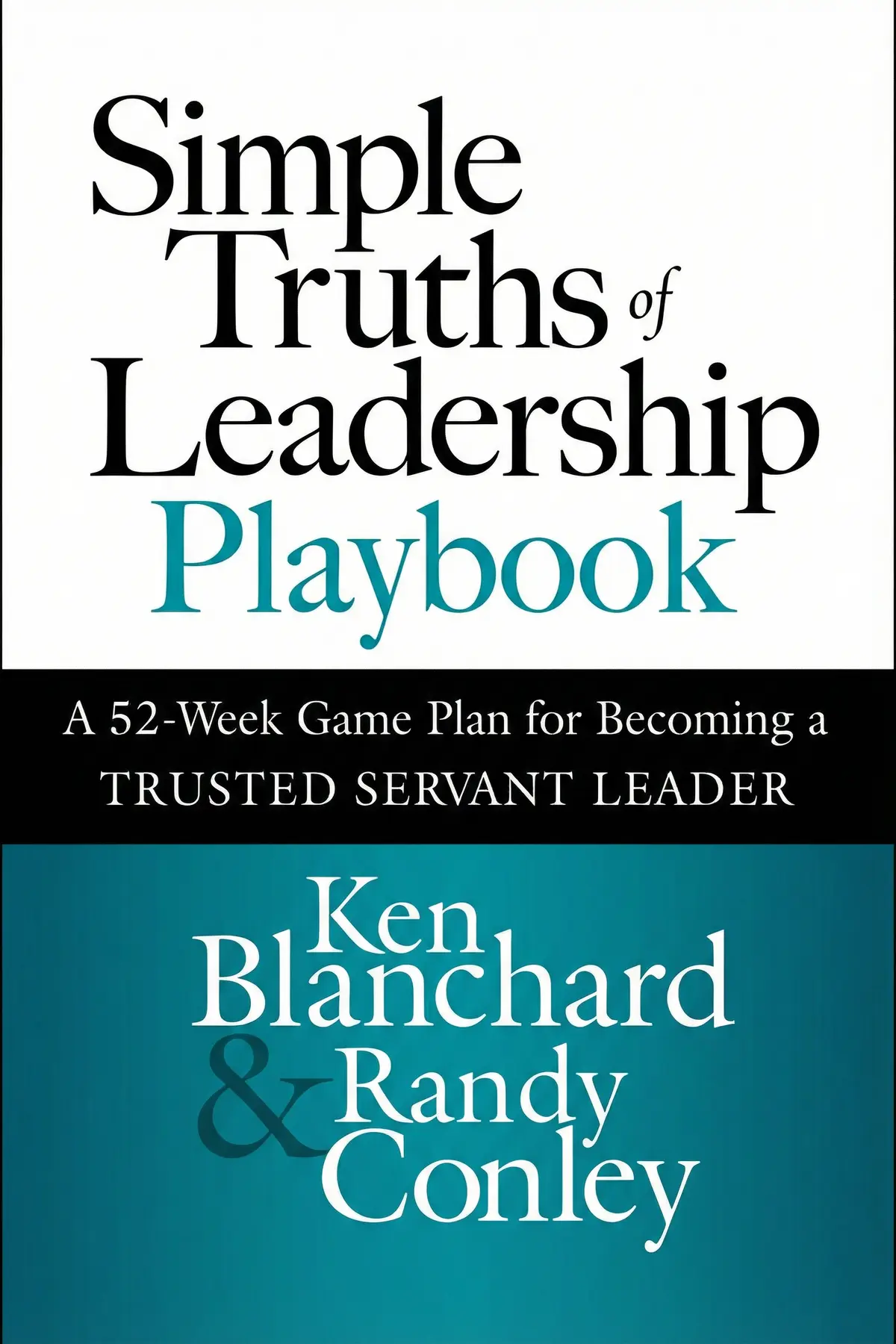
Most new managers are promoted for doing the work well, then discover that leading people is a different job entirely. In Simple Truths of Leadership, Ken Blanchard and Randy Conley offer an answer that sounds backward: the best leaders act as servants, putting employees and customers first and themselves second. That does not mean going soft. It means doing two jobs together, setting a clear direction and then spending your days helping people reach it.
The book gathers 52 short truths, and the strongest share one thread. Service pays off only when people trust you, and trust is built in small, repeatable moments: how you praise, how you correct, how you react to a mistake, how you say sorry. What follows is a set of tools a team lead can use on Monday, from three questions that turn a vague mission into a vision to an apology that can repair a damaged working relationship.
1 min 35 sec
In most companies, everyone works to keep the boss happy. The authors call that a mistake and propose a different order, one that makes the people you manage matter more than you might expect.
1 min 41 sec
Telling people they are free to do whatever they think best sounds generous. The authors argue it often leaves a team stuck, and they use a river to show what is missing.
1 min 33 sec
Many managers appear only when something has gone wrong, and their teams learn to dread the visit. The authors offer a short, specific routine that changes what people expect when the boss walks over.
1 min 37 sec
The same mistake from two different people can deserve two very different responses. The authors explain how to tell which one you are facing, and why half of all leaders never adjust.
1 min 39 sec
A team that trusts its leader behaves very differently from one that does not. The authors name what that trust rests on, and suggest a direct way to find out where you stand.
1 min 41 sec
Some bosses believe a little fear keeps people sharp. The authors argue it produces something else entirely, and that the remedy is far more ordinary than most leaders expect.
1 min 40 sec
Every leader eventually lets someone down, and the damage can feel permanent. The authors argue it rarely is, but only if the apology avoids a few small words most people use without thinking.
1 min 07 sec
Blanchard and Conley’s book adds up to a simple trade. A leader gives up the top of the pyramid and gets back a team that offers ideas, admits mistakes and serves customers well because it feels served itself. Nothing in that trade depends on charisma. It depends on many small moments handled the same way every time: a clear answer to what the business is really for, specific praise, a redirect for someone still learning, a please and a thank you, an apology with no if attached.
The river image is worth keeping. Goals, standards and shared information are the banks that give a team’s energy force and direction, and the leader’s work is to build them and then help people move within them.
A good place to begin is writing your own answers to the three vision questions and sharing them with your team. Before your next hard conversation, decide whether the person in front of you needs a reprimand or a redirect. And soon, ask your people how much they trust you, then listen without defending yourself. Leaders who serve this way rarely need to demand that people follow.
Many managers are promoted for doing the work well, then find that leading people is a different job. Ken Blanchard and Randy Conley argue that the best leaders treat it as a job of service, putting customers and employees ahead of themselves. Their version of servant leadership has two halves. First comes direction: a vision built from three questions about purpose, success and values, plus the goals, standards and policies that work like riverbanks for a team's energy. Then comes daily support: specific praise, reprimands for people who know better, redirection for people still learning, and a style matched to each person's competence and commitment. Holding it all together is trust. The authors describe the trusted leader as competent, honest and warm, show how fear makes people hide mistakes, offer the Five P's of Ethical Leadership and explain how to apologize so that a damaged relationship can recover. Readers get short, practical tools they can use in their next team meeting.
New managers who were promoted for their skills and now have to lead people.
Team leads whose staff hide mistakes or wait to be told what to do.
Founders and HR leaders who want a simple, shared language for trust and feedback.
Ken Blanchard writes and speaks on leadership and management and co-founded The Ken Blanchard Companies in San Diego in 1979, where he is Chief Spiritual Officer. He holds a PhD from Cornell, teaches on an executive leadership master's program at the University of San Diego, and Grand Canyon University's business school bears his name. Randy Conley has served as Vice President and Trust Practice Leader at the same firm, co-authored its Building Trust training program and writes the award-winning Leading with Trust blog.

Listeners enjoy the way this book organizes effective leadership ideas and find the material very straightforward to follow. One listener highlights that the 52 practices are presented briefly, which makes this a useful expansion for their leadership bookshelf.
Picked this up because I’ve always been a fan of Ken Blanchard’s previous work, and this collaboration with Randy Conley does not disappoint. The layout is brilliant in its simplicity: a core truth on the left and a practical application on the right. You can really see how these 52 truths are meant to be digested over a full year, though I found myself racing through them because the insights were so sharp. I especially appreciated the distinction between self-serving leaders and those who prioritize their staff. It’s one thing to talk about servant leadership, but it is quite another to provide actionable steps like the 'Making Common Sense Common Practice' sections included here. This is exactly the kind of distilled wisdom I want on my desk for daily reference. It focuses heavily on building warm, supportive relationships, which is often the missing ingredient in high-stress work environments today.
Show moreWow, the section on trust really changed my perspective on how I interact with my direct reports. Conley and Blanchard have created a distilled guide that feels both timeless and incredibly relevant to the current workforce's needs. One of the best ways to show you value your people is to share information openly, and this book provides a roadmap for doing exactly that. I love that the authors use the term 'servant leaders' instead of just 'bosses,' as it sets a completely different tone for the relationship. The 52-week structure is a great way to ensure these principles actually stick. Each page spread offers a mini-coaching session that challenges you to be better. Even if the cover looks a bit old-school, the content is fresh and essential for anyone who wants to build a culture of excellence. I’ve already started gifting copies to my colleagues.
Show moreA leadership book that actually focuses on the heart of the matter—the people. Blanchard and Conley have provided a cheat sheet for anyone who wants to lead with integrity and build a culture where trust is the default. The idea that leaders should extend trust first is a powerful one, and it’s something I’ve started implementing with my own team immediately. The brevity of the chapters makes it easy to fit into a morning routine. I’ve been reading one truth a day and spending a few minutes thinking about the suggested common practice. It’s amazing how much of an impact these 'simple' changes can have on morale. This isn't about being a soft leader; it's about being an effective one who recognizes that their staff are their greatest asset. Highly recommended for any leadership library.
Show moreEach page spread is like a mini-coaching session with two of the best in the business. I love how the book is split between Ken Blanchard’s focus on servant leadership and Randy Conley’s focus on building trust. The Discussion Guide at the end is an added bonus that makes this perfect for a book club or a leadership retreat. The authors remind us that leadership isn't about the power of the position, but the opportunity to serve others. That’s a powerful mindset shift. I found the actionable advice on sharing information freely to be one of the most practical takeaways. If you keep your staff in the dark, they will create their own negative stories, so transparency is key. This book is a wonderful reminder that being a great leader starts with being a trustworthy human being. It's a quick read but a lasting resource.
Show moreTo be fair, much of the advice here falls into the category of things we *should* know, but rarely actually do. The book is structured around 52 simple truths, making it a perfect tool for a leadership team to discuss once a week. I found the section on trust by Randy Conley to be particularly enlightening, specifically the idea that the opposite of trust isn't actually distrust, but control. That single insight forced me to re-evaluate how I manage my own department. While the tone can feel a bit repetitive if you read it all in one sitting, the brevity of each chapter is a massive plus for busy professionals. It’s a modern, reasonable guide that emphasizes sharing information freely to avoid the rumor mill. Not every chapter is groundbreaking, but as a compilation of leadership concepts, it’s a very valuable addition to my library.
Show moreIn my experience, the biggest hurdle for new managers is knowing where to start, and this book provides a perfect entry point. The 'Simple Truth' format is extremely easy to navigate, with clear calls to action that make 'common sense' actually happen in the workplace. I particularly liked the focus on admitting mistakes and owning up to what you don't know. It’s refreshing to see leadership experts advocate for humility rather than the traditional 'command and control' style. My only minor gripe is that the authors suggest at the very end of the book to read one chapter a week, which would have been helpful to know at the beginning! Still, the insights on apologizing and forgiveness in a professional setting are top-notch. It’s a helpful book that emphasizes that leadership is about the people you serve, not your title.
Show moreEver wonder why common sense isn't common practice in your office? This book seeks to fix that by breaking down leadership into 52 manageable pieces. The authors argue that if leaders were more commonsense in their approach, workforce engagement would skyrocket, and after reading this, I’m inclined to agree. I found the section on 'Making Common Sense Common Practice' to be the most valuable part of each chapter because it forces you to reflect on your own style. The focus on coaching and praising instead of just commanding is a vital shift for any modern leader. While some of the stories are a bit trite, the core messages about building trust and being transparent with information are solid. It’s a quick, helpful read that provides a great framework for anyone looking to improve their soft skills.
Show moreTruth is, I was skeptical about the 52-week format until I started using it with my direct reports during our weekly check-ins. It provides a fantastic jumping-off point for discussions about our team culture and how we can better support one another. The authors do a great job of explaining why we often fail to do the things we know we should, like giving feedback without judgment. Randy Conley’s insights on how fear kills trust really resonated with me, as I’ve seen that happen in previous companies I’ve worked for. The book feels modern and reasonable, even if some of the concepts have been around for a while. It’s a great way to keep these principles top-of-mind. I would have liked a bit more on high-performance metrics, but as a guide for servant leadership, it’s quite successful.
Show moreIt’s a fine book, but don't go in expecting deep psychological insights or complex organizational strategies. The 52 rules are brief and straightforward, which is good for a quick skim, but I felt some of the 'Simple Truths' were a bit too 'Duh!' as the authors themselves admit. For instance, the advice to be honest and speak openly is great, but it doesn't give much guidance on how to do that when the news is bad or the situation is sensitive. The format is the real winner here, with the left-hand page presenting the concept and the right-hand page explaining it. It’s a very manageable read for someone with a short attention span. I think it would be most effective for student leaders or those in their first management role. For seasoned executives, it might feel a little bit like a refresher course on basic manners.
Show moreFrankly, this felt like a collection of platitudes better suited for a church group or a high school counselor's office than a high-performance corporate environment. While I appreciate the intent behind servant leadership, the execution here is almost too basic for anyone actually trying to navigate complex organizational politics. It lacks the gritty nuance required for real-world coaching sessions where the stakes are high and people are difficult. Most of these 'truths' are things you’ve already heard a thousand times, yet the authors present them with a certain moralizing tone that feels a bit out of touch with modern business realities. If you are a brand new supervisor, you might find some value in the layout. However, for experienced leaders looking for deep strategic wisdom, there just isn't much substance here to chew on. It's fine, just incredibly simple.
Show moreKen Blanchard and Randy Conley argue that great leaders are servants who put customers and employees ahead of themselves. That means two jobs: giving people a clear vision, goals and boundaries, then supporting them every day with praise, coaching and fair correction. The whole approach rests on trust, which the authors say depends on a leader’s competence, integrity and warmth, and which can be repaired with a well-made apology.
The authors suggest asking what business you are really in, what success looks like and which values will guide you. They use Disney as the example: it describes itself as being in the business of happiness, measures success by guests smiling from arrival to departure, and ranks safety first, then courtesy, then putting on a great show for visitors.
It depends on the person. Someone who has the skills but underperformed deserves a short reprimand aimed at the behavior, not the person. Someone still learning needs a redirect: walk through the work step by step, spell out the goal and the path to it, and reassure them that a single error says nothing final about them and that your confidence in them remains.
Take responsibility without excuses or conditional words like if and but. Show that you understand the hurt you caused without minimizing it. Give the person room to describe the impact and listen. Then commit to not repeating the behavior, because the authors say an apology is worth something only if the trust-breaking action does not happen again.
It suits new and experienced managers who want practical habits instead of theory: people leading teams that hide mistakes, avoid big goals or wait for orders. The tools are short and concrete, such as a five-step way to praise, the competence and commitment check for choosing a leadership style, and the Five P’s of Ethical Leadership.


Margaret Heffernan





Joseph A. Maciariello



Deborah Gruenfeld
AUDIO SUMMARY AVAILABLE
Get the key ideas from Simple Truths of Leadership by Ken Blanchard, plus 5,000+ more nonfiction titles.