

15 min 26 sec
Available in: English
Security Analysis: Principles and Techniques
Shows how to judge a company by its debts, cash, balance sheet and honest earnings, and why buying well below that value, with room for error, protects your money when markets crash.
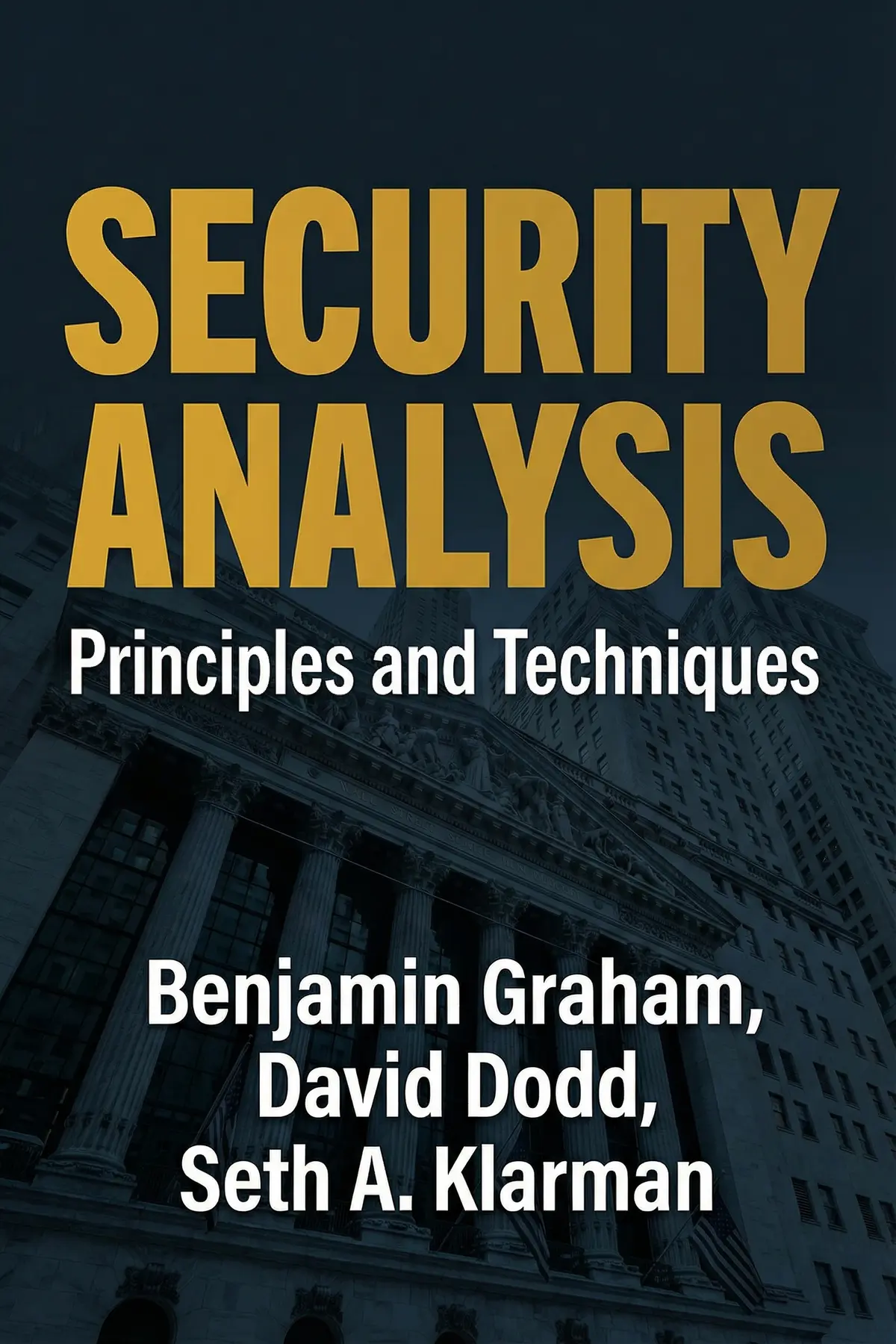
Table of Content
1. Introduction
58 sec
Most people buy shares the way they choose a busy restaurant: they follow the crowd and hope. In Security Analysis, first published in 1934, Benjamin Graham and David Dodd argue that results depend far more on the method behind a choice than on the stock chosen. A real investment, they say, must keep your money safe and earn a fair return; anything else is speculation. The modern edition, edited by value investor Seth A. Klarman, carries that test from the Great Depression into today’s markets.
The throughline is easy to say and hard to practice. Price follows the market’s mood, value follows the business, and the careful investor profits by measuring the gap and buying with room for error. A shirt maker worth less than its cash, a railroad whose cushion vanished in three years and a manufacturer that doubled its profits on paper each become a check you can run before buying.
2. Tell real investing apart from gambling
1 min 52 sec
Two people can hold the same shares in the same crash and walk away with opposite fortunes. The difference has nothing to do with luck, and very little to do with which stock either of them picked.
3. Check whether a company survives its worst year
1 min 49 sec
A railroad that could cover its interest several times over in 1929 was scraping for cash three years later. One overlooked figure on the balance sheet explains who kept paying and who did not.
4. Trust a strong business over strong contract terms
1 min 54 sec
Plenty of companies in the Depression had bond contracts full of protections, and many defaulted anyway. One telephone company never missed a payment, and its contract had little to do with it.
5. Spot the moments when price falls below value
1 min 54 sec
During the Depression, buyers could own an entire clothing company for less than the money sitting in its bank. Graham and Dodd explain how gaps like that open, and where else they hide.
6. Build a margin of safety into every purchase
1 min 58 sec
A fraud scandal sent investors fleeing from a famous company in 1940. Those who stayed calm and bought tripled their money, and the reason they could act lies in a lesson borrowed from bridge building.
7. Read earnings the way an owner would
1 min 58 sec
One manufacturer doubled its profits without selling a single extra product. Another hid regular losses for years until a downturn exposed them. The clues were printed in the reports all along.
8. Use the balance sheet to see who survives
1 min 55 sec
While investors fretted over falling earnings, a truck maker was priced as if its whole business were worth less than nothing. A single financial snapshot told the calmer and truer story.
9. Conclusion
1 min 08 sec
Graham and Dodd wrote in the wake of the great crash and the Depression, and their answer to it was not a forecast but a discipline. Seth Klarman, editing the modern edition, puts the lesson plainly: skill in investing comes from a method that protects money first and earns a steady return second.
That method turns market noise into something you can check. A share price is a claim about a business. The working capital ratio, the debt load, the balance sheet and years of honest earnings are the evidence. When the claim falls far below the evidence, as it did for Manhattan Shirt and White Motor, the careful buyer gets value plus a cushion against being wrong.
The habits that follow are modest. Before buying, ask how the company would pay its bills in its worst year. Read past the special charges and extraordinary items to the earnings an owner would recognize. And buy only when the price leaves room for your own mistakes.
The crash did not choose between the two investors by luck. It simply checked their homework.
About this book
What is this book about?
Many people put money into shares because of tips, trends or a rising price, and only learn in a downturn what they actually owned. Benjamin Graham and David Dodd, writing in 1934 after the great crash, offer a different discipline. An investment, they argue, must protect your principal and earn a fair return, and the only way to know whether it can is careful analysis of the business behind the price. The book uses bonds as its training ground, asking whether a company can keep paying in bad years. It then moves to stocks, where market mood often pushes price far from value. Cases from the Depression era carry the argument: a shirt maker selling for less than its cash, a railroad whose interest coverage evaporated, a truck maker priced below nothing, and companies that dressed up their profits with special charges. Readers learn to read coverage ratios, working capital, debt levels and earning power over many years, to spot accounting tricks, and to insist on a margin of safety. The modern edition, edited by Seth A. Klarman, presents these principles for today's markets.
Book Information
Who it's for
Individual investors
Individual investors who buy on tips or momentum and want a method that holds up in a crash.
Learning to read financials
Finance students and analysts learning to read income statements, balance sheets and bond coverage.
Business owners
Business owners curious how outside investors judge a company's real strength.
About the Author
Benjamin Graham
Benjamin Graham finished his studies at Columbia University at 20, worked on Wall Street, founded the fund Graham-Newman Corp. and taught investing at Columbia Business School, where Warren Buffett was one of his students. He also wrote The Intelligent Investor. David Dodd, a young Columbia instructor, took the notes in Graham's classes that became the basis of this book. Seth A. Klarman founded the Boston investment partnership Baupost Group in 1982, wrote Margin of Safety and led the editing of the 2008 edition.
Ratings & Reviews
Ratings at a glance

What people think
Listeners find that this work provides a profound look at value investing. That said, opinions on its accessibility vary, as several listeners mention that it is not an easy read.
Top reviews
Bae
After hearing so much about the 'Bible of Investing,' I finally dove into the 6th edition, and it is a masterpiece of fundamental analysis. While many modern finance books offer quick tips, Graham and Dodd provide a rigorous, scientist-like approach to the market that feels incredibly substantial. The inclusion of the 1940 second edition text alongside modern commentary from Seth Klarman adds layers of depth that I didn't expect. Yes, the language is dense and lacks any trace of flamboyance, but that is precisely the point. It is a textbook for those serious about finding a true margin of safety rather than chasing speculative bubbles. Buffett’s introduction alone is worth the price of admission, offering a heartfelt tribute to the man who literally invented the discipline. You have to be prepared for a long haul, but the intellectual rewards are massive.
Show moreSomchai
The depth of technical analysis found here is simply unmatched by the superficial finance literature we see today. Graham and Dodd were true wise men who approached the stock market with a skepticism that is sorely missing in our current era of tech-heavy speculation. I was particularly struck by the warnings against buying into new flotations, which feels eerily relevant to the dot-com bubble and recent IPO frenzies. The authors emphasize that figures can be used to make things look 'mathematically sound' even when they are not, a warning every investor needs to hear. It is a thick book, and I wouldn't recommend it to everyone, but the clarity it provides on cash flow versus reported earnings is essential. It essentially provides a candle in the dark for anyone trying to navigate irrational markets. Truly the gold standard.
Show moreKru
Wow, this is essentially a scientist’s approach to the market, and I am here for it. Graham was clearly a teacher at heart, avoiding any fluff to focus on quantitative statements that can be verified and delimited. Unlike many modern gurus, he is never afraid to challenge the opinions of the crowd or admit where a method might have doubts. I loved the emphasis on finding securities at a discount to their working capital, which is the purest form of value investing. It teaches you to be a contrarian and to have the strength of character to act in the opposite fashion from the crowd. If you have the patience to wait for opportunities that are years apart, the advice in this book is your best friend. It’s dry, yes, but the truth usually is. Highly recommended for the serious student.
Show moreNora
Every serious investor needs this on their shelf, even if they only consult specific chapters for their technical rigor. The 6th edition is a wonderful tribute to the original 1940 text, and the annotations by modern value investors help bridge the gap between Graham’s era and our own. I was fascinated by the discussion on how the future is often no respecter of statistical data. It’s a humbling reminder that no matter how much we analyze, we must always account for the unknown. The focus on free cash flow after capital expenditures over simple reported profits is a lesson that has saved me plenty of money. It is comprehensive, original, and acts as a brilliant counterbalance to the irrationality of the day-to-day market. Don't be intimidated by the size; just take it one chapter at a time.
Show moreSai
What strikes me most is how Graham was willing to challenge the status quo of his era and bluntly point out the flaws in popular thinking. This book is the definition of thorough fundamental analysis, covering everything from warrants to the minutiae of bankruptcy proceedings. I particularly enjoyed the sections where the authors admit that even the best analysis can be thwarted by a management team pursuing questionable accounting policies. It's a sobering read that drains the excitement out of 'hot' stocks and replaces it with a disciplined, business-like mindset. Reading this after almost a century, I’m amazed at how many of the 'new' tricks in the market were actually identified and condemned by Graham and Dodd back in the 30s. It is still the best technical book on stock picking ever written, hands down.
Show moreJai
Is it outdated or timeless? This is the question that haunted me as I navigated through several hundred pages of detailed analysis on railroad issues and public utilities from the 1930s. To be fair, the specific industries discussed have changed drastically, but the underlying logic regarding intrinsic value remains as sharp as ever. I found that I had to filter out the historical minutiae to find the golden nuggets of wisdom tucked away in the chapters on bond indentures and capitalization structures. It is certainly not an easy read, and I suspect most people would find 'The Intelligent Investor' more digestible for daily use. However, for those who want to see the blueprints of value investing, this book provides an insightful perspective that you simply can't get anywhere else. It’s a dense, heavy tome that requires real patience.
Show moreNew
Picked this up to better understand value investing beyond just the basics, and it definitely delivered on that front. The way the authors break down the difference between investment and speculation is a good nudge for common sense in a world that often ignores it. I did find the sections on fixed-income securities and bond analysis a bit tedious, as those markets have evolved so much since the Great Depression. However, the overarching theme of maintaining a margin of safety is a concept that will never go out of style. I'd suggest reading this alongside a more modern text on software or tech companies to balance out the historical examples. It’s a grind, but finishing all 900+ pages felt like a genuine achievement. Great for perspective, even if the readability is a bit of a mixed bag.
Show moreGift
To be fair, you shouldn't expect a beach read when opening a 900-page tome on bond indentures and capitalization structures. The truth is that this book is a heavy lift, and I found myself skimming some of the more archaic sections on 19th-century public utility accounting. That being said, the sections on 'purposive' accounting and the games management plays with earnings are still incredibly relevant today. It teaches a healthy skepticism toward reported per-share earnings that I haven't seen explained better anywhere else. It’s less of a book and more of a technical manual for a craft that requires extreme discipline. I gave it four stars because while the wisdom is five-star, the accessibility is a bit of a struggle for anyone not working in finance full-time. Still, it's a foundational text.
Show moreJiraporn
As someone who prefers qualitative analysis, I found the heavy emphasis on quantitative data a bit overwhelming at times. Graham is clearly uncomfortable with the intangible, preferring to stick to things he can count and verify on a balance sheet. While this provides a very safe floor for investing, I do think it misses some of the nuances of modern tech-driven businesses. However, the core principles of seeking a margin of safety and avoiding speculative ventures are lessons I keep coming back to. The book provides the basic tools to evaluate intrinsic value, which is the first step any responsible investor should take. It is not an easy read by any stretch of the imagination, but it is well worth the time and effort if you want to move beyond mutual funds. A solid, if somewhat dated, classic.
Show moreCee
Look, I wanted to love this because of Graham’s legendary reputation, but it is an absolute slog that feels more like a chore than an educational experience. The facts are rooted so deeply in the 1920s through the 1940s that I struggled to stay engaged with the endless pages devoted to defunct railroad companies. While the core philosophy of value investing is solid, the presentation is incredibly dry and lacks the modern updates found in newer editions of other classics. Even some of the co-authors admitted they hadn't finished the book until they were asked to contribute! I honestly think you can find the same principles summarized more effectively in contemporary blogs or shorter books. Unless you are a historian or a professional analyst with a penchant for punishment, this is probably too much outdated information for the average person.
Show moreQuestions about this book
What is the main idea of Security Analysis by Graham and Dodd?
Graham and Dodd argue that a true investment must keep your money safe and earn a fair return, and that only careful analysis can tell you whether it will. They separate a stock’s price, which swings with market mood, from its value, which comes from the business. The investor studies debts, cash, balance sheets and earnings over many years, then buys well below value to leave a margin of safety.
What is a margin of safety in Security Analysis?
It is a cushion against your own errors. The book likens it to building a bridge rated for 30 tons when the heaviest truck that crosses it weighs only 10. For an investor, it means paying so little for an asset that even a partly wrong judgment does not cause a permanent loss. In the 1930s crash, the authors report, investors who had bought at deep discounts were the ones who protected their money.
Why does Security Analysis start with bonds?
A bond is a simple promise to pay interest and return the principal, so it shows clearly whether a business is strong. The authors use the coverage ratio and working capital to test whether payments survive bad years. New York Central’s coverage fell from three and a half times in 1929 to barely enough by 1932, while AT&T’s steady telephone revenue kept every payment on time.
How can I apply Security Analysis as an individual investor?
Before buying, check how a company would pay its bills in its worst year, look for at least two dollars of current assets per dollar of short-term debt, and track that ratio over time. Judge earnings across many years and question special or extraordinary charges. When a sound company’s shares fall sharply, compare its market value with its cash and assets, and buy only well below its worth.
Readers also enjoyed






AUDIO SUMMARY AVAILABLE
Listen to Security Analysis in 15 minutes
Get the key ideas from Security Analysis by Benjamin Graham, plus 5,000+ more nonfiction titles.
- 5,000+ titles
- Listen as much as you want
- 7-day free trial
- Cancel anytime









