

13 min 05 sec
Available in: English
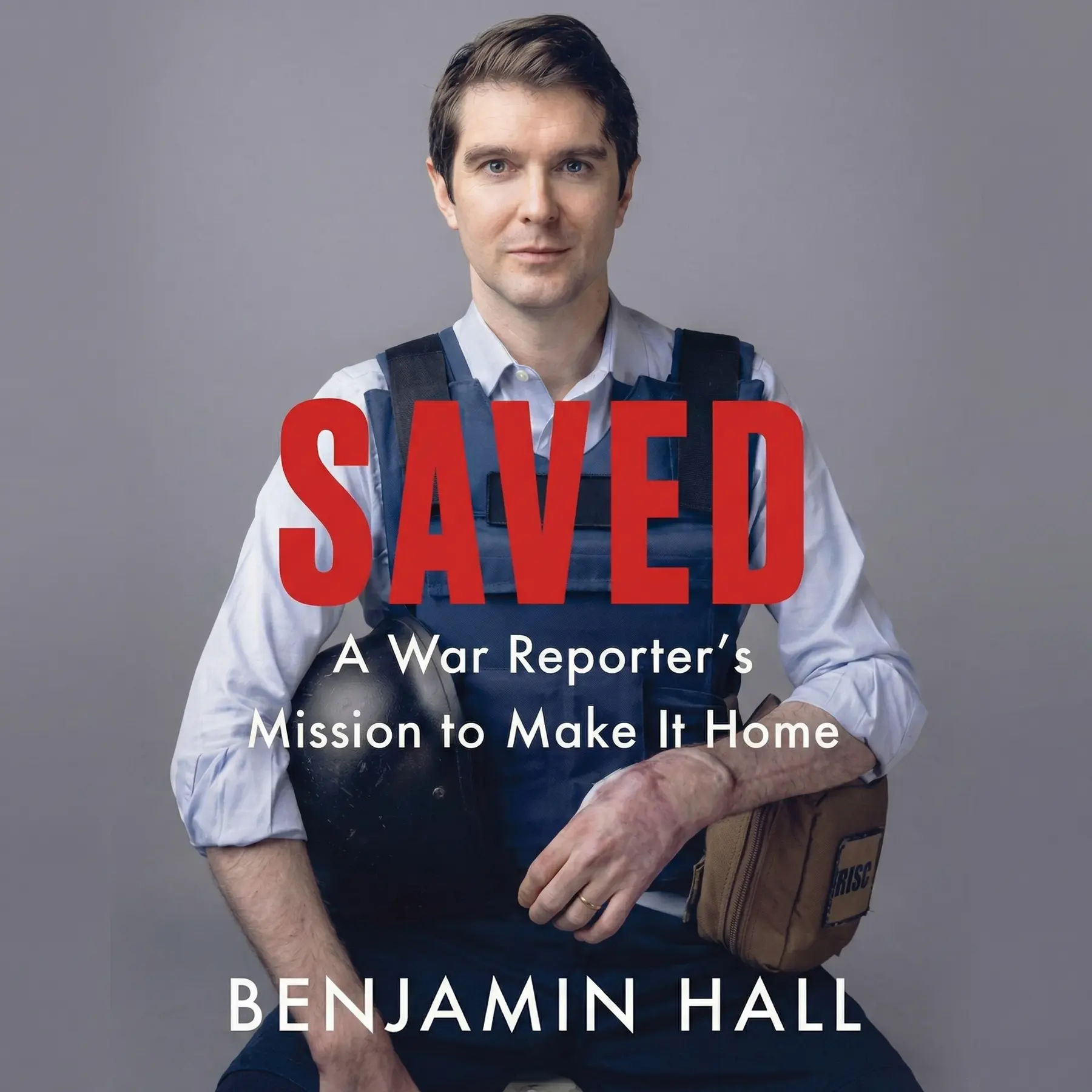
Saved: A War Reporter’s Mission to Make It Home
Benjamin Hall's account of surviving a Russian bombing outside Kyiv in 2022, and of the colleagues, rescuers, diplomats and doctors who got him out of Ukraine and helped him walk back to his family.

Table of Content
1. Introduction
58 sec
Most of us picture war reporting as the dangerous part and getting home as the easy part. Benjamin Hall’s memoir Saved shows that it can be the other way around. On March 14, 2022, a Fox News crew on the edge of Kyiv was struck by Russian bombs, and Hall, the correspondent in the back seat, was the only one who lived.
Surviving the blast took luck. Getting him out of Ukraine and back on his feet took a chain of colleagues, strangers, diplomats, soldiers and surgeons, plus a will that nobody else could supply for him. That chain is the thread followed here: every link had to hold, and each depended on the one before it.
Along the way you will see what a real extraction from a war zone looks like, why the first escape is only the beginning, and how a debt to the people who saved you can become the reason to heal faster than any doctor predicted.
2. Find the one reason that gets you moving
1 min 37 sec
Badly wounded and feeling nothing at all, Hall sat in a burning car with seconds to spare. What finally made him move had nothing to do with training or courage, and it came from far away.
3. Learn how hard it is to leave a war zone
1 min 47 sec
Hall woke in a clean hospital convinced his nurses were spies. The real problem was getting out, something he had never had to consider when he entered the country, and millions of fleeing refugees were already finding it slow and hard.
4. Look like you belong to pass every checkpoint
1 min 57 sec
Two old ambulances, a crew of volunteers and a set of medical uniforms crossed a city full of nervous soldiers. The rescuers’ main tool was a way of behaving that most people would never think to use.
5. Start moving before the permission arrives
2 min 00 sec
The safest way out of Kyiv was a heavily guarded train that the rescuers had no right to board. Every hour the city closed a little more, and waiting for a yes could mean missing it entirely.
6. Plan for the long recovery after the rescue
1 min 53 sec
Crossing the Polish border felt like the end of the ordeal. For Hall it turned out to be the opening of a much harder stretch, measured in operations and years instead of hours.
7. Turn gratitude into the fuel for healing
1 min 46 sec
His doctors predicted two years of surgery and rehabilitation. Hall walked out of a Texas hospital far sooner, and the reason lay in the faces he kept in mind on the worst days.
8. Conclusion
1 min 07 sec
Saved follows one survivor, yet its real subject is how many people it takes to keep one person alive. The bombs took seconds. Bringing Hall home took a daughter’s voice in the dark, a stranger’s hand on his jacket, a correspondent across an ocean, a rescue group with a long record, an operative in an old ambulance, a surgeon, a fixer, a Polish train, photos of his children and the skill of medical teams in Poland, Germany and Texas. Hall is open that a great deal of luck played its part too.
The story leaves some things worth carrying. Before you step into any risk, think about the way out as carefully as the way in. In a crisis, move on the best chance available instead of waiting for perfect certainty, as Seaspray did when the train was still unconfirmed. And when a recovery is long, give it names and faces.
Hall’s answer was simple. The people who saved him, and the two colleagues who never came back, became his reason to walk again sooner than anyone predicted. Their effort got him out. His own effort got him home.
About this book
What is this book about?
In March 2022, weeks after Russia invaded Ukraine, a Fox News crew was hit by bombs on the outskirts of Kyiv. Correspondent Benjamin Hall was the only one who survived. He had lost part of a leg, an eye and much more, and he was trapped in a country where buses were full, rail lines were targets and the US government had told remaining civilians they were on their own. Saved is Hall's account of what happened next. It follows the colleague who raised the alarm from across an ocean, a rescue group called Save Our Allies, an operative known as Seaspray, a former naval surgeon, two old ambulances and a diplomatic train that offered the only safe way out of Kyiv. Then it follows the much longer road through military hospitals in Poland, Germany and Texas. Readers get a close view of what an extraction from a war zone really involves, and of why surviving the first moment is only the start. Hall also shows how a sense of debt to the people who saved him, and to the colleagues who died, became the reason to recover faster than his doctors thought possible.
Book Information
Who it's for
Curious about war reporting
Readers curious about what frontline journalism and war-zone rescue really involve.
Facing a long recovery
People facing a long medical recovery who want a story of sustained resolve.
Crisis planners and managers
Managers and crisis planners interested in how a scattered team pulls off a rescue under pressure.
About the Author
Benjamin Hall
Benjamin Hall is a former freelance war correspondent who also worked as a journalist at Fox News. Over his career he has written for many outlets, among them the New York Times, the BBC and Agence France-Presse. In Saved he turns that reporter's eye on his own story: the 2022 bombing near Kyiv that killed his colleagues and nearly killed him, and the long effort to bring him home.
Ratings & Reviews
Ratings at a glance
What people think
Listeners find this book to be a remarkable narrative with a gripping and authentic account of endurance. The prose is expertly written, and listeners value the way it highlights human kindness while recording the harshness of combat. Listeners call it moving and touching, noting it brought them to tears, while also commending the author's grit and path to healing.
Top reviews
William
Few memoirs hit with the visceral force of 'Saved.' Hall doesn’t just recount a tragedy; he maps out the grueling, painful architecture of a miracle. The descriptions of the missile strike in Ukraine are terrifyingly vivid, yet the narrative never feels exploitative. I found myself tearing up during the chapters detailing the 'Save Ben' extraction mission. It shows a side of humanity we rarely see in the news—absolute strangers risking everything for one colleague. While the recovery sections are long, they are necessary to understand the sheer scale of his determination. This is a testament to the human spirit that everyone should read.
Show moreElan
Wow. I finished this in two sittings because I simply couldn't look away from Hall's story. We often see reporters on screen and forget they are real people with families waiting at home. This book shatters that barrier. The way he describes the loss of his colleagues, Pierre and Sasha, is heartbreaking and handled with such grace. You can feel the weight of his survivor's guilt on every page. It’s a harrowing reminder of the price of truth in modern warfare. This isn't just a book about war; it’s a love letter to his wife and the people who refused to let him die.
Show moreAlice
Picked this up after seeing Hall on TV and I was blown away by the sheer detail of his rescue. Look, the logistics of getting a critically injured man out of a war zone are insane. The collaboration between different groups to save him reveals the best in humanity during the worst of times. I appreciated how he didn't sugarcoat the 'hero' narrative. He talks about the pain, the multiple surgeries, and the mental toll of losing limbs. It’s a heavy read, for sure. If you’re looking for a shallow adventure story, this isn't it. This is a raw, emotional documentation of survival.
Show moreManop
The grit on these pages is palpable. Benjamin Hall takes us through the 'before' and 'after' of his life with such clarity that you feel the heat of the explosions. Frankly, the description of his injuries—the loss of his eye, hand, and legs—was difficult to get through. Yet, his refusal to give up is what makes this book so powerful. It serves as a stark reminder of the risks journalists take to bring us the truth from places like Kyiv. The writing is sharp and professional, reflecting his background, but the emotional core is what truly resonates. It’s a must-read for anyone interested in the human cost of conflict.
Show moreDome
It’s rare that a book makes me cry, but the account of the Fox News team rallying for their own was overwhelming. This memoir goes beyond the individual; it’s about the community that forms in the face of tragedy. Hall’s gratitude toward his bosses and the extraction teams is palpable throughout the narrative. I particularly liked the sections describing his early freelance days because they showed his genuine passion for the craft. The transition from the chaos of Ukraine to the sterile walls of a recovery ward is jarring in a way that perfectly mirrors his experience. Truly an inspiring piece of work.
Show moreAstrid
Gotta say, the audio version read by the author himself adds an extra layer of authenticity to this already gripping story. Hearing Hall's voice describe the moment the bombs hit his vehicle is chilling. He doesn't hold back on the realities of war or the grueling nature of physical therapy. Some parts are definitely not for the faint of heart. The book manages to be both a thriller and a meditative piece on what truly matters in life. It’s an emotional rollercoaster that highlights the bravery of those who stand on the front lines. I highly recommend this for anyone who appreciates true testimonies of courage.
Show moreSoontorn
Ever wonder what it takes to report from a literal war zone? Benjamin Hall provides a brutal, honest answer in 'Saved.' The book perfectly captures the frantic energy of the invasion and the sudden, violent shift when everything goes wrong. I was particularly struck by the themes of self-discovery and how his perspective on life shifted after the attack. He makes it clear that while his job was his life, his family is his reason for living. The writing is well-crafted and keeps you engaged even during the slower medical chapters. It’s a compelling, heart-warming story that stays with you long after the final page.
Show moreSaranya
Benjamin Hall’s journey from a seasoned war correspondent to a patient fighting for his life is nothing short of incredible. Truth is, the first half of the book is a masterclass in tension and reporting ethics. I was fascinated by his early career in places like Syria and Libya, which provided much-needed context for his drive. However, the pacing slows down considerably once he reaches the hospital. Some might find the medical minutiae a bit tedious, but his gratitude for the medical staff is genuinely touching. It’s a solid read, though a bit more editing on the recovery chapters would have kept the momentum high.
Show morePita
After hearing about Hall's ordeal on the news, I wanted to understand the full scope of his recovery journey. The book does a fantastic job of illustrating the 'heroic measures' taken by doctors to save his life and limbs. My only real critique is that the middle section drags as he moves from one military hospital to another. It’s a lot of medical jargon and repetitive recovery milestones. Still, the underlying message of resilience and the importance of family support is incredibly moving. Hall's story is a vivid example of how fate can change in a heartbeat. I’m glad I read it.
Show moreSavannah
To be fair, this is a deeply polarizing read depending on what you want from a memoir. While the story of survival is objectively miraculous, the tone occasionally veers into the self-aggrandizing territory some other readers have mentioned. He spends a lot of time listing names and high-level connections, which can feel a bit like a professional resume rather than an intimate reflection. I also wished we had more direct perspective from his wife, as her strength seemed to be the real backbone of his recovery. It’s an informative look at the dangers of journalism, but the narrative voice felt a bit detached at times.
Show moreQuestions about this book
What is Saved by Benjamin Hall about?
It is Hall’s memoir of being bombed near Kyiv on March 14, 2022, while reporting for Fox News. His colleagues Pierre Zakrzewski and Sasha died, and Hall was gravely wounded. The book follows his rescue by the group Save Our Allies, his escape from Kyiv on a diplomatic train, and his treatment in Poland, Germany and Texas until he finally returned home.
How was Benjamin Hall rescued from Ukraine?
After colleague Jen Griffin raised the alarm, Sarah Verardo of Save Our Allies sent an operative nicknamed Seaspray and former naval surgeon Dr. Rich Jadick. They drove two old ambulances to Kyiv in medical uniforms, persuaded doctors to release Hall, and got him onto a guarded diplomatic train that had brought Poland’s prime minister to Kyiv. Permission to board came through almost as they reached the train.
How long did Benjamin Hall's recovery take?
Doctors estimated at least two years of surgery, skin grafts, rehabilitation and prosthetic fittings. Hall had lost part of his right leg and an eye, suffered burns and a fractured skull, and his left leg was badly damaged. Driven by gratitude to his rescuers and by the colleagues who died, he left Brooke Army Medical Center in Texas five months after arriving.
What lessons does Saved offer readers?
The story suggests planning your exit from any risky situation as carefully as your entry, acting on the best available chance in a crisis instead of waiting for certainty, and anchoring a long recovery to the people you are doing it for. Hall’s daughter’s voice got him out of the car, and his rescuers gave him a reason to heal fast.
Who should read Saved?
It suits readers interested in war reporting and in what it takes to get someone out of a conflict zone, people going through a long recovery who want an account of determination, and anyone curious about how colleagues, volunteers, diplomats and military doctors can coordinate under pressure to save a single life.
Readers also enjoyed
Age of Anger: A History of the Present
Pankaj Mishra

A Promised Land
Barack Obama

Age of Propaganda: The Everyday Use and Abuse of Persuasion
Anthony Pratkanis


A River in Darkness: One Man’s Escape from North Korea
Masaji Ishikawa

A Spy Among Friends: Philby and the Great Betrayal
Ben Macintyre

21 Lessons for the 21st Century
Yuval Noah Harari


AUDIO SUMMARY AVAILABLE
Listen to Saved in 15 minutes
Get the key ideas from Saved by Benjamin Hall, plus 5,000+ more nonfiction titles.
- 5,000+ titles
- Listen as much as you want
- 7-day free trial
- Cancel anytime









