All About Love: New Visions
bell hooks
 English
Shows how the belief that marriage is always good and divorce always shameful pressures people through vows, advisers, self-blame and misread statistics, and how to make your own choice about staying or leaving.
1 min 00 sec
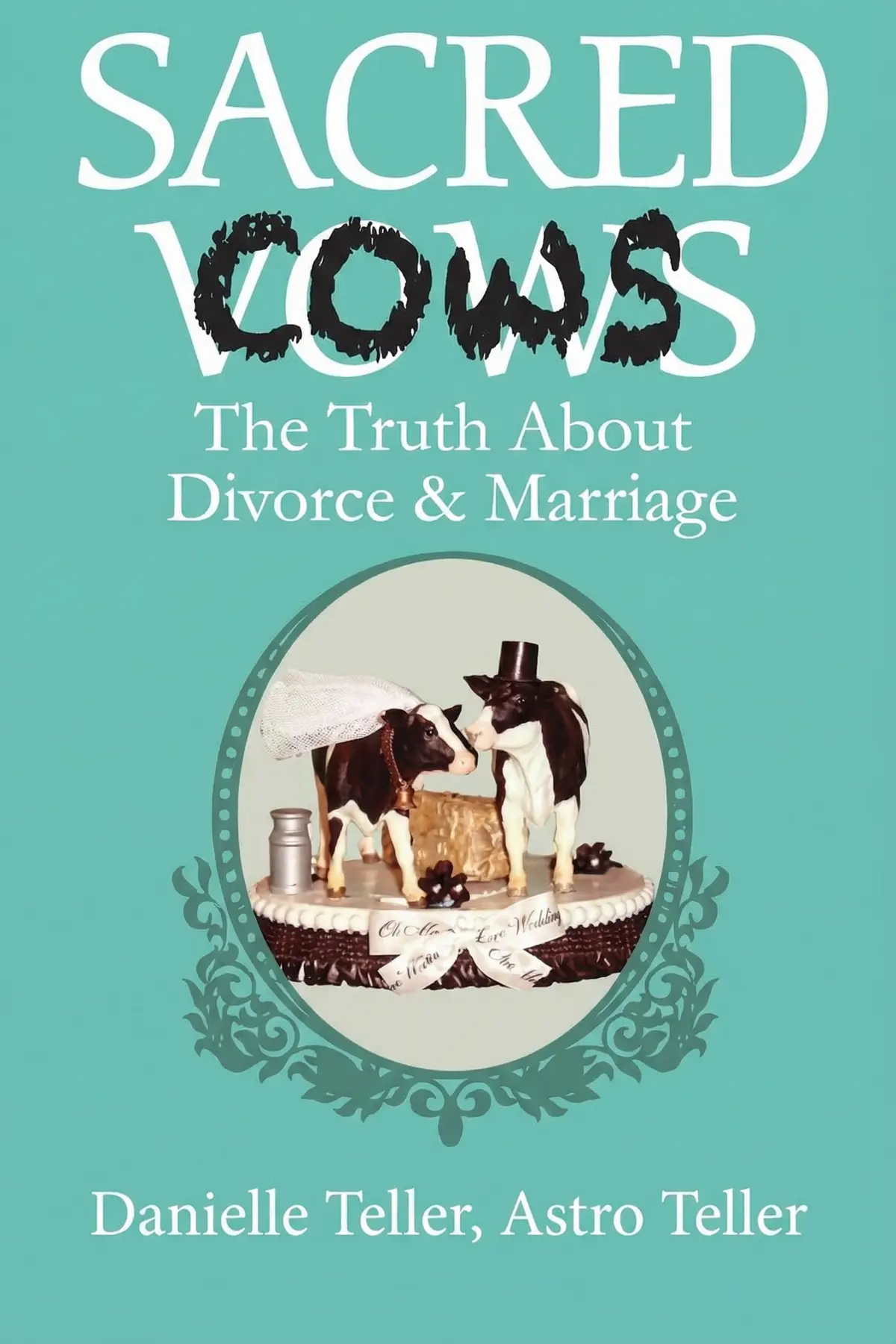
If you have ever lain awake wondering whether to end your marriage, part of the weight you feel may not be yours at all. In Sacred Cows, physician turned writer Danielle Teller and computer scientist Astro Teller argue that much of the guilt around divorce comes from a cultural assumption so familiar it passes for fact: that marriage is good by nature and divorce bad by nature. They call such unexamined beliefs sacred cows, and they give this one several faces, each with its own way of making a person feel weak, broken or selfish for wanting out.
The Tellers’ case is that once you can recognize these voices, you can hear your own again. Whether you stay or go matters less to them than whether the choice is truly yours. Along the way come a coat you can never take off, a counselor who will not listen, and a lesson about horses and money that makes guilt-laden divorce statistics fall apart.
1 min 52 sec
For thousands of years most people took something for granted that turned out to be false, and questioning it was not easy. The authors argue a similar unexamined rule shapes how we judge every marriage and every divorce today.
1 min 41 sec
A beautiful coat, a freezing day and one strange condition at the checkout. The authors use a simple shopping story to expose what goes wrong when a promise tries to cover feelings nobody can predict.
1 min 56 sec
A couple sits down with a marriage counselor, one partner says something completely clear, and the counselor steers somewhere else entirely. The authors explain what went wrong and what to settle before any appointment.
1 min 39 sec
A woman has tried everything to bring back her desire for her husband, and the advice she gets keeps finding new faults in her. The authors argue the advice itself is the problem.
1 min 39 sec
One claim about children of divorce gets repeated so often it sounds settled. A story about horses and wealth shows why it proves far less than the people quoting it want you to believe.
1 min 08 sec
The book’s real target is the belief that one kind of life is morally superior and that anyone who leaves it owes the world an apology. Each cow the Tellers describe is that belief in different clothes: the promise that cannot be broken, the expert with one answer, the friend who finds the fault in you, the statistic that turns a correlation into a verdict. Society, as they see it, puts conformity ahead of the person, and then makes the person feel bad for noticing.
Their payoff is clarity. Seeing these pressures for what they are lets you decide for yourself, and the authors are plain that the right answer may be to stay. What they ask is that the choice come from your own needs. In practice that means naming what you actually want before you seek help, testing any number about divorce for cause versus mere connection, and noticing when shame is doing the deciding.
A coat bought for winter was never meant for August. Wearing it anyway is allowed, as long as you are the one choosing.
Many people who think about ending a marriage carry a weight of guilt that goes beyond their own situation. Danielle Teller and Astro Teller argue that much of it comes from a sacred cow: a cultural assumption so familiar that it feels like fact. This one says marriage is good in itself and divorce is a sign of moral failure. The authors give that belief several faces. The Holy Cow insists that a vow of forever must be kept whatever happens to your feelings. The Expert Cow offers the same counseling script to every couple. The Defective Cow decides that any trouble in the marriage is your personal flaw. The Innocent Victim Cow uses statistics about children to make you feel guilty, mixing up correlation and cause. Readers learn to recognize each of these pressures and to answer it. The book does not tell anyone to divorce. Its promise is narrower and more useful: to clear away shame and borrowed rules so that the decision to stay or go is truly your own.
People quietly weighing divorce who feel judged, selfish or broken for even considering it.
Parents told to stay together for the children who want to test that claim.
Anyone about to start couples counseling who wants to know what to ask for first.
Danielle Teller began her career as a doctor before making writing her second career. She has published two novels, All the Ever Afters and Forged, along with a range of nonfiction, and lives in California. Astro Teller studied computer science at Stanford University and earned a doctorate in artificial intelligence at Carnegie Mellon University as a Hertz fellow. He wrote the science fiction novel Exegesis, co-founded three companies during nearly a decade in Pittsburgh, and joined Google in 2010, where he has overseen Google[x], its moonshot factory for ambitious projects.

Listeners describe the work as thought-provoking, shedding light on common myths surrounding marital separation and presenting a straightforward perspective on the subject. Furthermore, the content is engaging and accessible, as one listener points out that this isn't the standard type of book regarding divorce. In addition, listeners value its humorous approach and readable style.
As someone who has navigated the messy waters of a second marriage, this book felt like a massive weight being lifted off my chest. The Tellers provide an incredibly candid look at the cultural scripts we all follow without questioning. They expose the 'sacred cows'—those deeply held assumptions that make people stay in soul-crushing situations out of a misplaced sense of duty or fear of social stigma. I found the 'dictionary of divorce talk' to be particularly hilarious and spot-on. To be fair, the humor might not be for everyone, but for me, it made a heavy topic much more accessible and even entertaining. It’s not your typical, dry self-help book; it’s a refreshing challenge to the 'marriage is hard work' mantra that often keeps people trapped in emotional desolation. I wish I had read this a decade ago. It would have saved me years of mental torture and unnecessary guilt.
Show moreFinally, a book that doesn't treat marriage counseling like an infallible religion. I was particularly intrigued by the sections on how we've been socialized to view divorce as a contagious disease or a sign of character flaws. The Tellers are remarkably brave for questioning the 'hard work' cliché. If a job or a hobby required that much demoralizing effort, we’d quit, so why is marriage the exception? This book offers a much-needed sanity check for those caught in a cycle of people-pleasing and emotional self-flagellation. It’s insightful, provide clarity on widely held assumptions, and doesn't shy away from the hard truths. The writing style is breezy and engaging, making it one of the most entertaining books on social norms I’ve picked up in a long time. Even if you are happily married, it's worth reading just to understand the stigma your divorced friends might be facing.
Show moreAfter hearing about this on a podcast, I decided to see what all the fuss was about, and I’m glad I did. This is hands-down the best book on the sociology of divorce I’ve read in years. It’s not your typical 'how-to' guide; instead, it's a deep dive into the myths that keep us stuck. The Tellers are incredibly insightful, providing a level-headed look at studies that often get treated as gospel by counselors. I loved how they challenged the idea that everyone who gets divorced is 'damaged' or 'incapable of commitment.' For a woman who has been judged for having two failed marriages, this book was a literal lifesaver. It’s humorous, well-paced, and offers a perspective that is desperately needed in our 'pro-marriage at all costs' culture. It’s time we stop engaging in Groupthink and start looking at these relationships realistically.
Show moreEver wonder why we treat the end of a relationship like a moral failure instead of a life transition? This book dives deep into that question with a lot of wit and clarity. The authors are at their best when they are dismantling the industry of marriage counseling, specifically taking aim at methods like the Gottman approach which doesn't work for everyone. I appreciated the sociological perspective on how 'until death do us part' is a relatively modern, and perhaps unrealistic, expectation given how much longer we live now compared to the colonial era. My only real gripe is the repetitive cow metaphors. Phrases like 'putting it out to pasture' or things needing to 'moo-ve over' started off cute but eventually felt a bit condescending and distracting from the actual research. Still, the message is vital for anyone feeling suffocated by societal pressure to maintain a toxic union.
Show moreThe Tellers take a sledgehammer to the most cherished myths about why we stay in miserable unions. Look, I’m a firm believer in commitment, but this book helped me see how 'Groupthink' can actually be damaging to families. They argue convincingly that a 'good' divorce is often better for children than a 'bad' marriage, which is a perspective we rarely hear with such honesty. I did find it a bit strange that they referred to all the sacred cows using feminine pronouns—it felt like a weird stylistic choice that didn't quite land. Also, the authors' admission that they believe in 'one true love' felt a little bit unscientific compared to the rest of their analytical tone. However, the insight they provide on the lack of controlled studies in relationship sociology is eye-opening. It's a very easy read that will definitely make you rethink the institutional pressures of modern coupling.
Show moreWow, this was a breath of fresh air compared to the usual 'marriage is hard work' platitudes we see everywhere. I’ve been through a divorce myself, and the way the Tellers describe the 'sacred cows' that neighbors and family members throw at you is 100% accurate. They offer a candid look at the topic that is both accessible and surprisingly funny. I liked the section on how we've essentially created a 'moralistic insanity' around the idea of a lifelong contract. It’s a very easy-to-read book that provides much-needed clarity on why we feel so much shame for a relationship ending. While I agree with other reviewers that the cow puns get a bit old, the actual core message about individual happiness vs. societal expectation is incredibly powerful. Every person considering marriage should read this first just to know what they're actually signing up for.
Show moreIt is rare to find a book that challenges the Gottman method with such refreshing candor. Most people treat those studies as absolute truth, so seeing the Tellers point out the flaws in the research was eye-opening. The book is very entertaining and moves quickly, though I do think they could have switched up the gendered language a bit more when discussing the personified 'cows.' Personally, I found the chapter on how divorce affects children to be the most helpful, as it moved away from the 'broken home' trope and toward a more nuanced understanding of family health. While they do seem to lean toward the 'just leave' side of the argument a bit heavily, the clarity they provide on societal assumptions is invaluable. It's a great read for anyone who wants to examine their own relationship through a lens that isn't clouded by centuries-old guilt.
Show moreI picked this up hoping for a nuanced take on modern relationships, and for the most part, it delivered some interesting points about societal judgment. However, I’m not entirely sure how I feel about the overall execution. To be blunt, the cow references were laid on way too thick. You’d think the metaphors would be charming, but after the tenth 'moo' pun, it started to feel like the authors were talking down to the reader. I also noticed that the book leans very heavily into the authors' personal experiences, which makes it feel less like a scientific study and more like a defense of their own life choices. They mention believing in 'true love' as a justification for leaving their first spouses, which seemed to contradict their critique of other romantic myths. It’s a decent read for the perspective shift, but I’d take some of the 'scientific' claims with a grain of salt.
Show moreThe constant 'mooing' and pasture metaphors almost made me put this down by chapter three. It's a shame, because there are some valid critiques of the marriage-industrial complex hidden under all that shtick. My biggest issue is that the authors claim there is no way to rebuild attraction once it's gone, yet they completely ignore well-known studies on eye contact and shared novelty that suggest otherwise. It felt like they were intentionally omitting information that didn't fit their narrative that a 'dead' marriage is always better off buried. Frankly, it felt less like an objective analysis and more like a very long-winded way to justify why they left their previous partners for each other. While the 'dictionary of divorce' was funny, it wasn't enough to save the book from feeling like a biased manifesto rather than a helpful guide.
Show moreNot what I expected at all. I really wanted to find value here, but I was completely underwhelmed by the lack of rigor. The authors spend so much time tilting at windmills—or cows, in this case—that they end up skating dangerously close to condoning things like adultery as a byproduct of a bad marriage. I found the tone to be incredibly dismissive of people who actually want to put in the effort to save their families. The metaphors are worn out and the writing feels smug. I couldn't force my way through the slog of repetitive arguments and finally moved this to my abandoned shelf. If you're looking for actual relationship advice or deep sociological insight, look elsewhere. This felt like a one-sided argument designed to make the authors feel better about their own history rather than helping readers navigate their own complex lives.
Show moreThe authors argue that the belief that marriage is always good and divorce always bad is a sacred cow, an unquestioned cultural assumption that feels like fact. Society, they say, puts conformity ahead of individual needs and makes people feel guilty for wanting a divorce. Recognizing this pressure lets you make the right choice for yourself, whether that means staying married or leaving.
The Tellers describe several figures. The Holy Cow insists marriage vows must last forever. The Expert Cow, often a counselor or self-help book, gives everyone the same advice. The Defective Cow tells you that any problem in the marriage is your personal flaw. The Innocent Victim Cow uses statistics, especially about children, to make you feel guilty for considering divorce.
The authors challenge the reasoning behind it. They accept that children of divorced parents are statistically more likely to divorce, but argue this is a correlation, not proof of cause. Their comparison is horse owners: they tend to be wealthy, yet buying a horse will not make you rich. They see the line about staying for the children as a slogan built on that confusion.
Start by working out what you actually want, since the authors see self-examination as the first step out of marital distress. Then choose help that fits the real problem, so a partner’s lack of support does not get treated as a passion issue. Question divorce statistics for cause versus correlation, and notice when guilt or shame, not your own needs, is driving your decision.
AUDIO SUMMARY AVAILABLE
Get the key ideas from Sacred Cows by Danielle Teller, plus 5,000+ more nonfiction titles.