

14 min 50 sec
Available in: English
Rule #1: The Simple Strategy For Successful Investing In Only 15 Minutes Every Week
By Phil Town
Shows how an ordinary investor can beat the market by buying a few understandable businesses with lasting advantages and honest leaders, and buying them only when their shares trade at half of what they are worth.
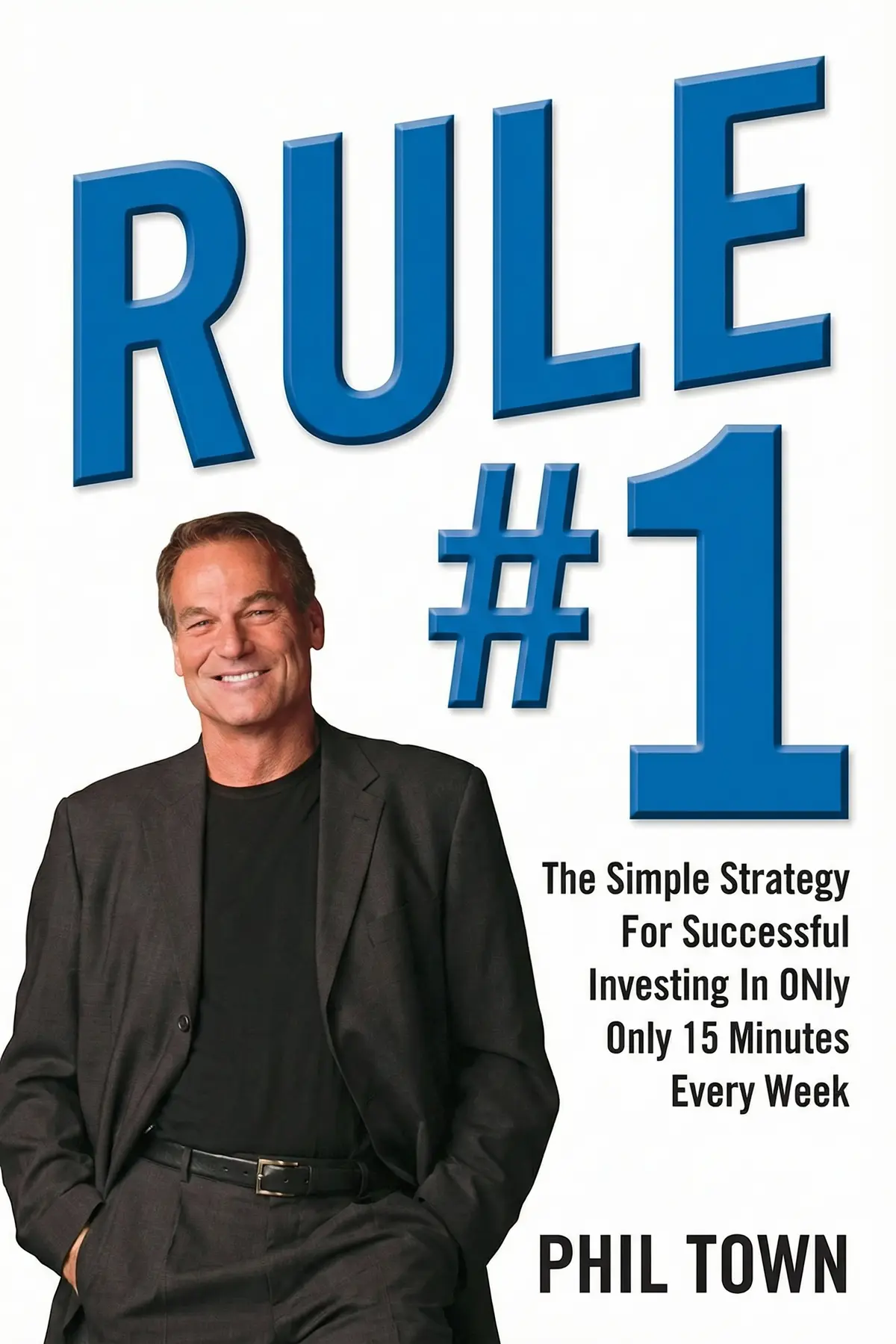
Table of Content
1. Introduction
1 min 01 sec
Most people treat the stock market as a place for experts only, too complex and too risky to enter alone. In Rule #1, investor and former river rafting guide Phil Town argues that an ordinary person with free online data and a few simple calculations can beat it. His method, borrowed from Warren Buffett, fits in one line: find a wonderful business, work out what it is worth, buy its stock at half that value, and keep repeating.
That line holds the whole argument. You win by owning a few businesses you understand, with lasting advantages and honest, driven leaders, bought only at a deep discount. Town shows how to tell such a company from an ordinary one using five numbers over ten years, a mental shortcut called the Rule of 72 and a hard look at the person in charge. What you gain is a checklist to run on any stock you are tempted to buy, and a price at which saying yes makes sense.
2. Beat the market with tools anyone can use
1 min 29 sec
Professionals like to say investing needs their training and their time. Town thinks a free website and one stubborn belief about prices put an ordinary person on equal footing, and a famous market crash is his evidence.
3. Own fewer stocks and see trouble coming
1 min 45 sec
Spreading money across the whole market is sold as the safe choice. Run it across a full century, though, and the record looks very different, and a single letter to a pharmacist shows what focus can buy you.
4. Judge every share as if you bought the company
1 min 26 sec
Because a share can be sold with one click, it invites careless buying. Town offers a simple mental switch that makes people far more careful, and it raises a question about what your money is supporting.
5. Spot the moat that keeps rivals out
1 min 29 sec
Profitable companies attract rivals, and most eventually lose their edge to them. A few hold on for decades. Town names five kinds of protection behind those survivors, from a drug patent to the hassle of changing software.
6. Prove a moat with ten years of numbers
1 min 32 sec
Any company can boast of an advantage in its marketing. Town trusts only what survives a decade of competition, and a small trade in postage stamps shows the measure he values above all the others.
7. Read any growth rate with the Rule of 72
1 min 49 sec
Growth rates sound like work for a spreadsheet and a finance degree. Three friends with a restaurant and one navigation company show how to estimate them in your head, in under a minute.
8. Back the CEO who thinks like an owner
1 min 36 sec
A company can pass every numerical test and still be run into the ground. Town looks for two traits in the person at the top, and one paper company’s long climb shows what they can build.
9. Pay half of value to protect your money
1 min 34 sec
A fair price sounds like a good deal. Town insists it is not nearly enough, and the story of one computer maker’s shares between 2000 and 2001 shows exactly when he would have bought.
10. Conclusion
1 min 09 sec
Underneath, Rule #1 is a map of the ways investors lose money, each paired with a check that closes it off. Not understanding the business, an advantage that exists only in the marketing, a CEO cashing out, a price that assumes everything goes right: Town has a test for each. That is why he believes an ordinary person with free data can do better than a diversified portfolio that went nowhere for 60 years of the last century.
The method also asks for a calmer habit. Town advises against checking prices many times a day. Look once the market has closed, at the same hour each evening, and the data you see will be consistent.
To begin, choose one company in a field you know from work or daily life. Name its moat, run its growth figures through the Rule of 72, notice how its CEO talks about bad years, and set the half-price figure you would accept. Then wait. An investor who bought Dell at $20 in 2001 needed no special insight, only a number fixed in advance and the patience to let the price come down to it.
About this book
What is this book about?
Most people stay out of the stock market or hand their savings to an adviser, convinced that investing needs expert knowledge and hours of work. Phil Town argues that free online data and a few simple calculations are enough for anyone to beat the market. His approach comes from Warren Buffett and fits in one line: find a wonderful business, work out its value, buy its stock at half that value, and repeat. Town takes apart the Efficient Market Theory and the standard advice to diversify and hold, which he says would have earned nothing in 60 of the 100 years from 1905 to 2005. He replaces both with a focused method. Invest in fields you understand, look for a moat that keeps competitors away, confirm it with five figures over ten years, check that the CEO is honest and driven, and insist on a 50 percent margin of safety. Readers get a repeatable checklist, a mental shortcut called the Rule of 72 for reading growth rates, and real cases from Garmin, Dell and Kimberly-Clark that show the method at work.
Book Information
Who it's for
Savers wary of stocks
Savers who have avoided stocks because investing seems built only for experts.
Industry professionals who invest
Professionals who want to put knowledge of their own industry to work in their portfolio.
Investors wanting clear rules
Investors unhappy with diversify-and-hold who want a clear test for what to buy and when.
About the Author
Phil Town
Phil Town, born in 1948, is an American who has worked as an investor and a hedge fund manager, and he also writes books and speaks in public. Before investing, he worked as a rafting guide on the Colorado River. After he helped save a group from a whitewater disaster, a client taught him the basics of investing on Warren Buffett's principles. Rule #1, his first book, appeared in 2006, reached the New York Times and Business Week bestseller lists, and was named by USA Today among the top business books.
Ratings & Reviews
Ratings at a glance

What people think
Listeners find this investment book practical and simple to grasp, offering thorough, sequential instructions and a direct methodology that leads them through manageable phases. Furthermore, the work acts as a premier starting point for those new to the market, providing significant assistance with their financial portfolios. They also value the book's cost-effectiveness, with one listener pointing out they made more money in less time.
Top reviews
Nina
Picked this up after getting burned on a couple of tech stocks, and I finally feel like I have a map for my money. Phil Town breaks down complex concepts like ROIC and growth rates into manageable baby steps that don't require a finance degree. While he repeats his 'river guide' persona often, the core advice about finding a 'moat' is incredibly solid for anyone tired of gambling. It’s the first time I’ve actually understood how to calculate a floor price for a stock instead of just guessing. I’ve already seen better returns because I’m actually waiting for the right price now. This book is worth every penny for the confidence it builds.
Show moreSiraporn
Finally, an investment guide that doesn't require a PhD in finance to understand the basic math. I’ve read 'One Up on Wall Street,' but Town takes it a step further by giving you a concrete formula to determine what a stock is actually worth. He calls it a blue-collar guide, and it really feels that way. The way he explains how to evaluate management is particularly helpful for someone like me who never knew what to look for in a CEO. It's a straightforward approach that takes you by the hand. My only gripe is the long-winded introduction, but once you get to the actual system, it’s pure gold.
Show morePick
Ever wonder why billionaire investors always seem to win while the rest of us lose our shirts? Rule #1 explains the 'Margin of Safety' in a way that clicked for me instantly. Phil Town isn't reinventing the wheel, but he is making the wheel much easier to steer for the average person. I appreciated the specific examples of companies and the detailed breakdown of how to use tools like MSN Money to find data. Even though some of those online tools have changed since publication, the principles remain timeless. This book helped me tremendously with my retirement planning and gave me the courage to pick individual stocks.
Show moreRosa
Look, if you're looking for a get-rich-quick scheme, this isn't it, despite what the promotional language might suggest. What this is, however, is a very practical, step-by-step roadmap for intelligent investing. The 'Three Tools' for timing the market were a bit surprising for a value investing book, but they provide a nice safety net for when the market turns volatile. I’ve started applying these rules to my own watchlist and the results have been eye-opening. It turns out I was overpaying for 'good' companies for years. No more. I feel much more like a business owner now and less like a gambler.
Show moreCholada
Is it really possible to beat the market with just fifteen minutes of work every week? Town makes a compelling case, though in my experience, the initial research takes much longer than he admits. The four Ms—Meaning, Moat, Management, and Margin of Safety—provide a fantastic framework for vetting companies. I appreciated the step-by-step guide to reading financial statements, which made the math feel less intimidating than 'The Intelligent Investor.' However, the heavy reliance on his specific website is a bit frustrating since many of those tools aren't free anymore. Still, the underlying philosophy of value investing is sound and very easy to follow for a beginner.
Show moreAisha
As someone who usually just dumps money into an S&P 500 index fund and hopes for the best, this was a wake-up call. The author argues that we can do better than the pros by staying small and focused on what we know. I love the idea of buying a business, not a ticker symbol. The math is simplified enough that I didn't get a headache, but it’s still rigorous enough to make me feel secure. I do think he oversimplifies how easy it is to find these 'Rule #1' companies in a crowded market. It takes real discipline to wait for that 50% margin of safety.
Show moreBrooklyn
The logic here is sound: treat a stock like you're buying the whole company, not just a digital asset on a screen. I found the sections on identifying a company’s 'moat'—whether it's a brand or a secret recipe—to be the most valuable part of the book. It changed how I look at my own portfolio. I’m giving it four stars because the '15 minutes a week' claim is definitely a bit of a stretch. You need to put in the hours upfront to do the research correctly. Once you do the legwork, though, managing the trades is a breeze. It's a great starting point for first-time investors.
Show moreYui
This book serves as a fantastic bridge between classic value investing and the modern day-trader mentality. It teaches you how to be conservative with your entries while still being aggressive with your goals. I liked the focus on 'Meaning'—investing in things you actually understand and care about. It makes the research process feel like less of a chore. My only concern is that the market is much more efficient now than when this was written, so those deep discounts are rarer. However, the discipline this book teaches will save you from making a lot of expensive mistakes.
Show moreWittaya
To be fair, there is a lot of good information here, but you have to wade through a ton of marketing fluff to get to it. The system is essentially a watered-down version of Warren Buffett’s strategy mixed with some basic technical indicators. It works if you have the patience, but the author makes it sound like anyone can become a millionaire overnight. The reality of finding a company with high ROIC that is also selling at a massive discount is much harder than the book suggests. It’s a decent introduction to fundamental analysis, but take the 'easy money' promises with a massive grain of salt.
Show moreIff
Frankly, the 'one of the guys' routine feels a bit forced considering the author's actual background in hedge funds. The book starts off promising with simple rules, but it quickly spirals into a sales pitch for his software and seminars. Much of the technical analysis he recommends, like using stochastics to time the market, feels outdated and contradicts the long-term value investing message he preaches earlier. Plus, a lot of the 'free' resources mentioned in the text are now behind paywalls. If you want real value investing, just read Ben Graham. This version is far too 'infomercial' for my taste and lacks the data-backed proof I was looking for.
Show moreQuestions about this book
What is the main idea of Rule #1 by Phil Town?
Town argues that anyone can beat the market by following a rule taken from Warren Buffett: find a wonderful business, work out its value, buy its stock at half that value, and repeat. He rejects the Efficient Market Theory, pointing to the nineties bubble, and says free online data and simple calculations now let ordinary people invest without an adviser.
What are the Big Five numbers in Rule #1?
Town checks five figures over at least ten years: return on investment capital, equity growth, earnings per share growth, sales growth and free cash flow growth. Each should reach 10 percent or more a year. Holding that level for a decade suggests the company has a moat that has kept competitors from eroding its profits.
How does the Rule of 72 work in Rule #1?
Count how many times a figure doubled over a period, work out the average years per doubling, then divide 72 by that number. Garmin’s sales rose from $100 million in 1995 to about $800 million in 2004, three doublings in nine years, or one every three years. Seventy-two divided by three gives a growth rate of about 24 percent.
What is a margin of safety according to Phil Town?
It is a company’s value minus its share price, and Town wants it to be half the value. In 2000, Dell was valued at $40 a share and priced at $40, so there was no cushion. A year later the price fell to $20 while value rose, which gave a 50 percent margin and made it the moment to buy.
Why does Rule #1 criticize diversify and hold?
Town calculates that a diversified, long-term portfolio would have earned nothing in 60 of the 100 years between 1905 and 2005. He adds that owning many stocks makes it hard to understand or monitor each one, so you react late to bad news. He prefers a few businesses in fields you know well.
Readers also enjoyed




AUDIO SUMMARY AVAILABLE
Listen to Rule #1 in 15 minutes
Get the key ideas from Rule #1 by Phil Town, plus 5,000+ more nonfiction titles.
- 5,000+ titles
- Listen as much as you want
- 7-day free trial
- Cancel anytime









