

14 min 40 sec
Available in: English
Raising a Secure Child: How Circle of Security Parenting Can Help You Nurture Your Child’s Attachment, Emotional Resilience, and Freedom to Explore
Shows parents how to tell when a child needs encouragement to explore and when they need comfort, how to repair everyday parenting mistakes, and how to spot the emotional blind spots inherited from their own upbringing.
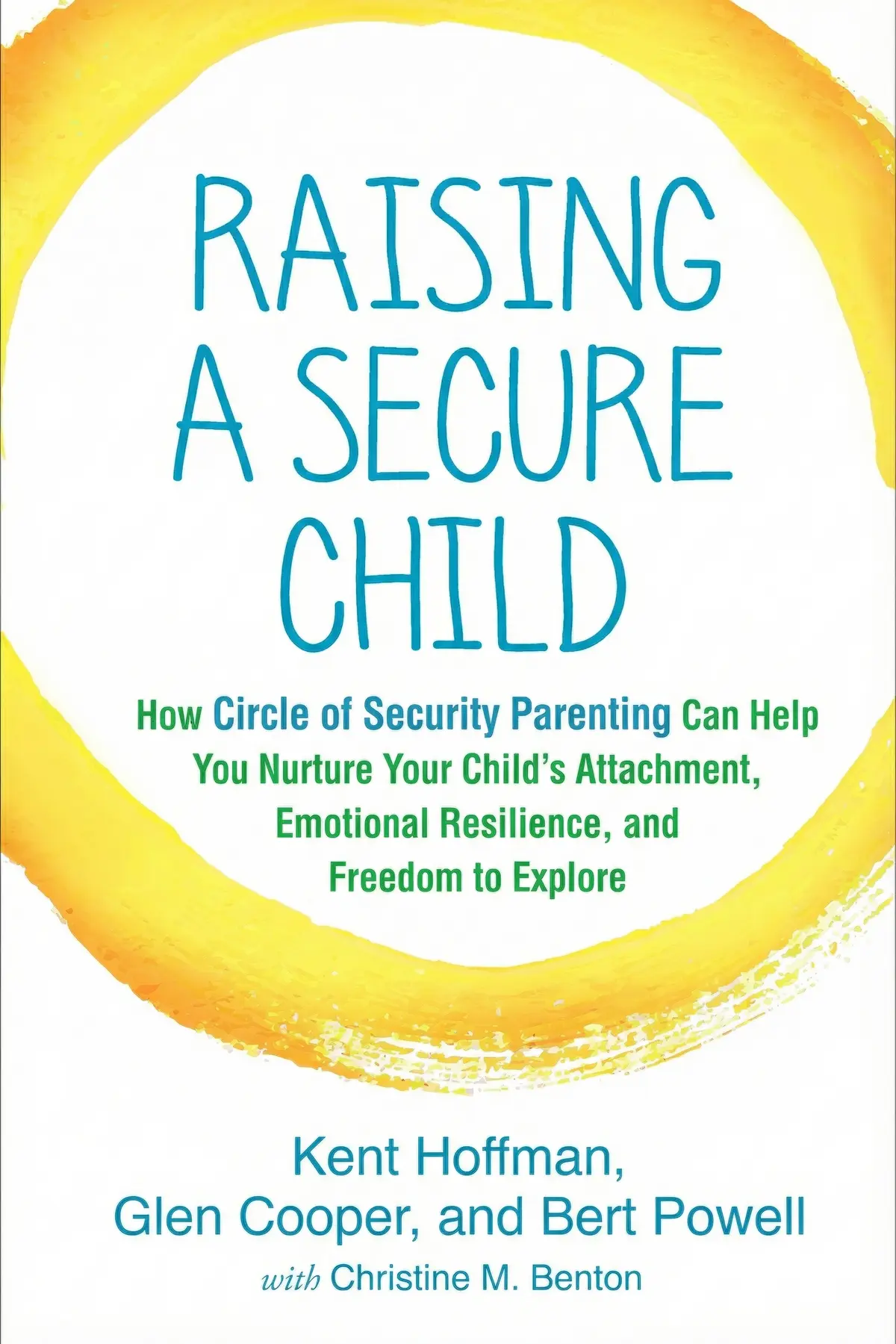
Table of Content
1. Introduction
1 min 01 sec
Most new parents measure themselves against one impossible standard: meeting every need, every time, with a smile. In Raising a Secure Child, clinicians Kent Hoffman, Glen Cooper and Bert Powell, writing with Christine M. Benton, argue that a parent who slips and then repairs the slip can do more good than one who never slips at all. Their work rests on attachment theory, the idea that a baby is built to bond with at least one reliable person, and that this bond shapes health and relationships for life.
The authors turn that theory into a picture called the Circle of Security. A secure child has a parent who supports both halves of a daily loop, heading out to explore and coming back for comfort, who mends the moments they miss, and who notices which half their own upbringing taught them to avoid. Once you can see the circle, a clinging, wandering or crying child becomes far easier to read.
2. Know what your baby needs beyond food and warmth
2 min 01 sec
Children in postwar orphanages had full stomachs, clean clothes and warm beds, yet they were miserable. Baby monkeys facing a hard choice pointed to what was missing, and the body keeps score when it goes unmet.
3. Read your child's needs on a simple clock
1 min 44 sec
A toddler tugging at your leg could want a cuddle or could want an audience, and guessing wrong frustrates you both. One glance from a sandbox, read correctly, tells you which it is.
4. Back your little explorer without taking over
1 min 37 sec
A daughter climbing a ladder at the park tests every parent’s instinct to reach out and steady her. Sometimes the hands should stay down, and the praise at the top matters less than you think.
5. Give comfort and words when they come back
1 min 39 sec
Picking up a nervous child after a first day sounds simple. Yet one well-meant phrase, the kind most parents say without thinking, can leave a small child alone with a feeling they cannot understand.
6. Turn a parenting mistake into a stronger bond
1 min 55 sec
Snapping at a child who came home hurt feels like failure. The authors see it differently, and they argue that a parent who never got anything wrong would leave a child badly prepared for life.
7. Find the half of the circle you avoid
1 min 44 sec
Some parents rush to soothe a child who is perfectly happy, while others start a game with a child who is crying. Both habits usually began long before the child was born.
8. Rebalance the circle in thirty-second moments
1 min 54 sec
Breaking a habit passed down from your own parents sounds like years of effort. The authors propose a daily exercise so short it fits between breakfast and the school run.
9. Conclusion
1 min 05 sec
The Circle of Security replaces the impossible ideal of the flawless parent with something a tired person can actually do. In the authors’ account, a secure child feels safe being honest about what they need. Parents make that possible by holding two abilities at once, encouraging self-reliance and offering tenderness when the child is hurting. When one of these feels hard, the cause usually lies in the parent’s own childhood, and the authors argue it can be overcome by seeing the pattern and choosing to act against the unhelpful instinct.
That changes what to watch for this week. When your child looks back at you from the sandbox or the classroom door, read the look as a question of direction: going out, or coming home. When you lose your temper, go back, apologize and spend a few calm minutes together. If closeness or distance makes you uneasy, start with a handful of half-minute moments of the one you avoid.
The boy at the preschool door does not need a perfect parent. He needs to look back and find someone there.
About this book
What is this book about?
Many new parents judge themselves harshly for every missed cue, convinced that a good parent meets each need instantly and cheerfully. Kent Hoffman, Glen Cooper and Bert Powell, clinicians who built their method on attachment theory, argue for a gentler and more useful standard. A child needs one reliable person to attach to. That bond affects stress, health and future relationships, and it grows from many small daily exchanges, not from perfection. The authors' central tool is the Circle of Security, a simple picture of a child's day. The child moves out from the parent to explore, then returns for protection and comfort, sometimes several times an hour. Each half of the circle carries its own needs, from being watched and delighted in to having confusing feelings named. The book also explains why parents struggle with one half or the other, usually because of how they themselves were raised, and how to repair ruptures when they happen. Readers get practical scenes from playgrounds and preschool doors, a clear method for apologizing to a child, and a small daily exercise for correcting the side of the circle that feels hardest.
Book Information
Who it's for
Worried new parents
New parents who worry that every missed cue or lost temper is doing lasting harm.
Parents unsure what's needed
Parents unsure whether a clinging or wandering child needs comfort or space.
Caregivers reflecting on upbringing
Caregivers who suspect their own upbringing shapes how they react to tears or independence.
About the Author
Kent Hoffman
Kent Hoffman, Glen Cooper and Bert Powell have shared a clinical practice in Spokane since 1985 and together created the Circle of Security, drawing on attachment theory, object relations and family systems theory. Each has received the Bowlby–Ainsworth Award and the Washington Governor's Award for Innovation in Prevention. Hoffman, a clinician and developmental researcher, has worked extensively with homeless adults and teen parents living on the street. Powell teaches at Gonzaga University's Graduate School of Counseling Psychology. They have taught their approach to thousands of families. Christine M. Benton contributed to the book.
Ratings & Reviews
Ratings at a glance
What people think
Listeners find this parenting guide to be essential for both families and experts, offering significant insights into the core principles of child-rearing and secure attachment. The material is accessible and well-regarded for its practical scenarios, with one listener highlighting its stunningly deep well of compassion and wisdom. Listeners appreciate its restorative qualities; one person notes it aids in repairing inner child wounds, while another values the emphasis on the bond shared by parent and child.
Top reviews
Thitima
This book felt like a warm hug for my frazzled parenting soul. It is deep. It is kind. It changes how you look at every tantrum. Instead of just focusing on the outward behavior of my toddler, I’m now looking at the 'circle' and wondering what need is being expressed underneath the screaming. The authors provide a stunningly deep well of compassion and wisdom that is often missing from more clinical parenting guides. I especially appreciated the focus on repair; knowing that I don't have to be perfect to raise a secure child is a huge weight off my shoulders. To be fair, some of the psychological concepts take a minute to sink in, but the emotional payoff is worth every page. It’s a must-read for anyone wanting to break old cycles.
Show moreSirinat
After hearing about the Circle of Security for months from my therapist, I finally dove into this book. It is a masterpiece of empathy and psychological insight. The authors don't just tell you to be a better parent; they show you how to heal your own inner child wounds so you can show up for your kids. Personally, seeing the diagram of the 'secure base' and 'safe haven' helped me realize where I was falling short in supporting exploration. The writing is accessible and filled with real-world examples that make the complex attachment theory feel tangible. It isn't just a parenting book; it’s a manual for human connection. I’ve already recommended it to several friends who aren’t even parents yet.
Show moreHarper
Finally got around to reading this, and it’s one of those rare parenting books that actually changes how you see yourself. It’s not just about the kids; it’s about healing the parts of us that weren't met with compassion when we were small. The authors have managed to take thirty years of research and turn it into something that feels deeply personal and practical. I found the examples of 'Shark Music' particularly hitting home for me. It helped me understand why I get so triggered by my daughter's crying. Since applying these concepts, our home feels much more peaceful. We are moving around the circle together. If you only read one book on child development, make it this one.
Show morePacharapol
Wow, I wish I had this years ago. This isn't just a book; it's a guide to being a better human being in a relationship with a small person. The wisdom here is stunning. It’s all about the 'hands' on the circle—knowing when to let go and when to pull them in. I’ve started noticing my own 'Shark Music' almost every day now, and just recognizing it helps me stay calm. It’s a must-read for both parents and professionals. No fluff, just deep, evidence-based insight into what makes a child feel truly safe and seen.
Show moreMuk
Ever wonder why you react so strongly when your child just wants to be held? The concept of 'shark music' was a total revelation for me. It perfectly describes that background noise of our own upbringing that colors how we respond to our kids today. The authors do a great job explaining the Circle of Security framework, emphasizing that we need to be 'bigger, stronger, wiser, and kind.' I found the practical advice on identifying miscues very helpful, though some sections felt slightly repetitive. Truth is, the book could have been about fifty pages shorter without losing much impact. However, the perspective shift it offers on childhood attachment is invaluable. It’s less about 'fixing' your kid and more about understanding the relationship dynamic.
Show moreSau
Gotta say, the pressure to be a 'perfect' parent can be suffocating, and this book is the perfect antidote to that anxiety. It emphasizes that secure attachment is built through the process of rupture and repair, not by being a robot who never makes mistakes. I loved the focus on 'organizing' a child's feelings. Sometimes they just need us to be the anchor in their emotional storm. My only minor gripe is that it assumes every parenting struggle stems from our own childhood attachment issues, which feels a bit reductive. Sometimes a toddler is just being a toddler! Still, the overall framework is incredibly grounding. It helped me move away from reactive discipline and toward a more relationship-focused approach.
Show morePongpan
The concept of being a 'secure base' changed everything about how I view my morning routine with my preschooler. This book offers a fundamental approach to parenting that moves away from tips and tricks and into the heart of the relationship. It’s about being present and paying attention to those subtle cues children give when they need to explore or come back for comfort. The authors' tone is incredibly gentle, which is a nice change from the 'drill sergeant' style of many parenting books. I did feel the section on boundaries was a little vague, but the emphasis on being 'kind' while also being 'bigger and stronger' is a helpful mantra. It’s a perspective-shifting read that requires some reflection.
Show morePranee
As a clinician, I find this framework incredibly useful for explaining complex attachment patterns to families. The Circle of Security is a brilliant tool for making abstract psychological needs visible. The book is easy to understand and the examples are relatable for parents from all walks of life. I appreciate that it doesn't push a specific 'parenting style' like co-sleeping or baby-wearing, but focuses on the emotional availability of the caregiver. My only criticism is that it lacks specific advice for children with significant neurodivergence, whose cues can be much harder to read. However, for the general population, this is a foundational text that provides a much-needed map for the emotional journey of raising a child.
Show moreMatteo
Look, the core message here is absolutely vital for any caregiver, but the delivery is a bit of a slog. I was really looking forward to learning about the evidence-based approach to childhood attachment, yet the writing style felt incredibly dense and circular at times. I found myself skimming through several chapters that seemed to repeat the same three points over and over again. While the last chapter provided some much-needed practical advice for different age groups, the rest of the book felt a bit light on 'how-to' and heavy on theory. That being said, the 'Circle' diagram is a brilliant way to visualize a child's needs. It’s a solid resource if you have the patience to dig through the repetitive prose to find the gems.
Show moreElan
Not what I expected given the high ratings and the academic backing. Frankly, I found this book incredibly frustrating to finish. While I agree with the premise that attachment is important, the writing was so dry and repetitive that I almost abandoned it twice. Also, the section on 'miscues' seemed to contradict their earlier point about parents being 'good enough' if they meet needs most of the time. It felt like if you misread a cue, you were potentially damaging your child's psyche forever. I was hoping for more practical, step-by-step strategies for daily life, but instead, it felt like a lot of abstract psychology. I really wish this information was available in a more concise, user-friendly format.
Show moreQuestions about this book
What is the Circle of Security in Raising a Secure Child?
It is a picture of a child’s daily needs, drawn like a clock face. At nine o’clock the parent acts as a secure base from which the child goes off to explore, needing to be watched, delighted in, enjoyed and helped. As the child returns, the parent becomes a safe haven offering protection, comfort, delight and help understanding feelings. The loop can repeat many times a day.
What is the main idea of Raising a Secure Child?
Hoffman, Cooper and Powell argue that a secure attachment to at least one reliable caregiver is a foundation for a child’s physical and emotional health. Security grows when a parent can support both exploration and return, repairs the moments they get wrong, and notices which needs their own upbringing made uncomfortable. Perfection is not the goal; repair is.
How do you repair a mistake with your child, according to the book?
The authors call a missed need a rupture. To repair it, acknowledge the need you missed, apologize, and then do something pleasant together. Their example is a parent who shouts at a boy who was teased at school, then goes to him, says sorry and reads a book with him until he calms down. He learns that relationships survive mistakes.
How can parents fix an imbalance in the Circle of Security?
First, honestly identify the side you avoid: closeness, when a child is upset, or distance, when a child wants to explore. Accept any panic you feel without judging yourself, and meet the need anyway. The authors then suggest adding about five extra moments a day, each 15 to 30 seconds long, of whichever closeness or distance you find hard.
Is constant praise good for a child's self-esteem?
The authors suggest it is not the best route. Praising everything a child does builds less healthy self-esteem than paying attention to what they actually do and delighting in what makes them unique. They also stress delighting in a child as a person, not only when they achieve something, such as reaching the top of a ladder.
Readers also enjoyed


AUDIO SUMMARY AVAILABLE
Listen to Raising a Secure Child in 15 minutes
Get the key ideas from Raising a Secure Child by Kent Hoffman, plus 5,000+ more nonfiction titles.
- 5,000+ titles
- Listen as much as you want
- 7-day free trial
- Cancel anytime









