
10 min 19 sec
Available in: English
Present Shock: When Everything Happens Now
Explains why constant digital updates leave us restless and directionless. It shows how living in an endless now has changed the way we tell stories, see ourselves and judge time.
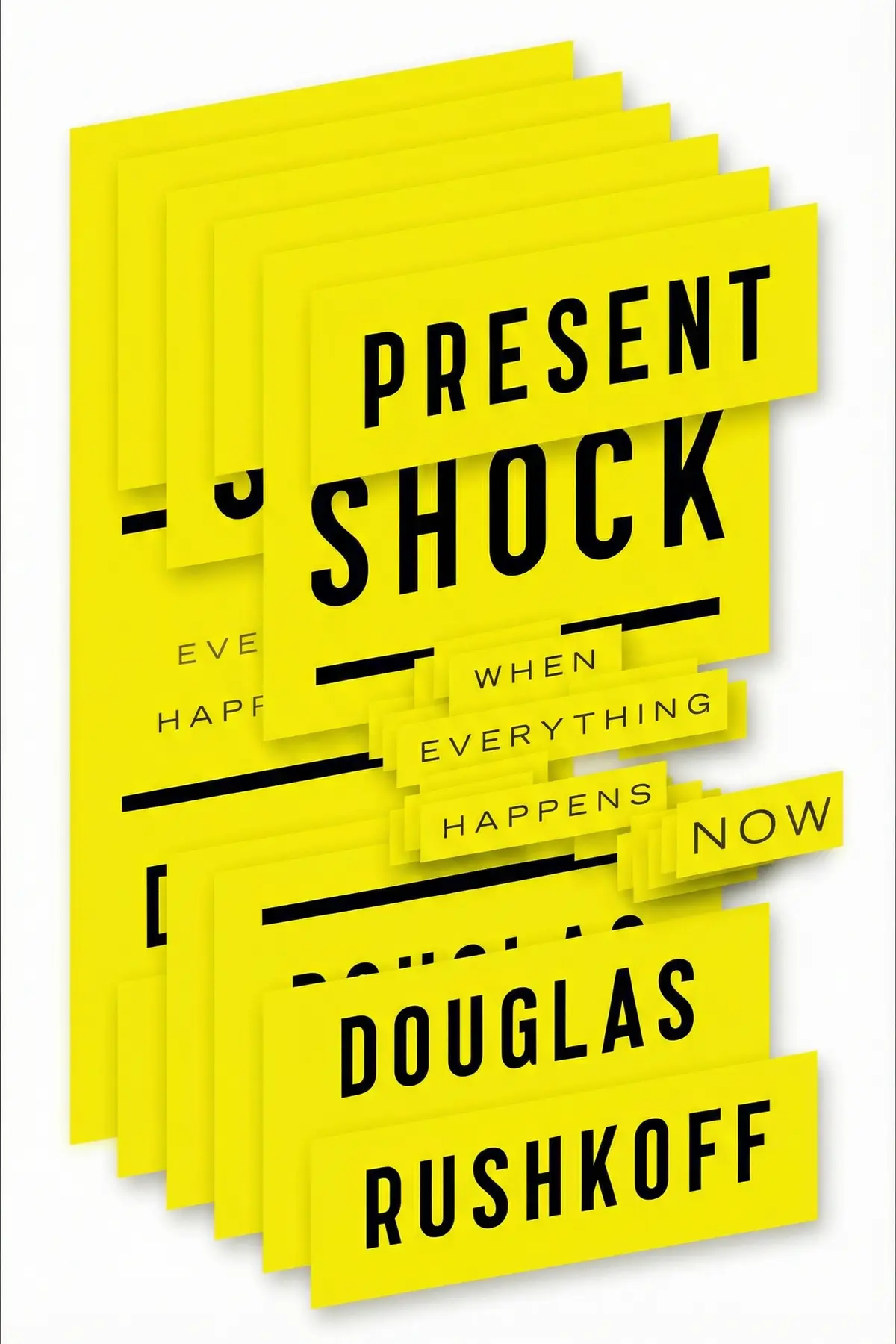
Table of Content
1. Introduction
58 sec
If you check your feeds all day and still feel you are missing something important, Douglas Rushkoff has a name for your condition. In Present Shock, the media theorist argues that the future shock predicted around 1970 has already arrived, and it looks different from what anyone expected. We have stopped planning for tomorrow and fixed our attention on an endless now.
Digital media now set the tempo of our days, Rushkoff says, yet we are still creatures tuned to natural rhythms. His central claim is that technology once pointed us toward the future and now traps us in the present. That trap has changed how we tell stories, who we think we are and how we sense time.
Follow his argument and that scattered feeling gets a vocabulary, plus a few plain tests: which updates actually matter, which story you are being sold, and which decisions deserve a longer clock than a news cycle.
2. See why constant change leaves you stuck now
1 min 59 sec
A futurist warned decades ago that progress would outrun our minds. He was right about the overload, but wrong about where it would leave us, and the first day of a famous stock offering shows the difference.
3. Understand how tidy hero stories lost our trust
2 min 03 sec
For centuries, stories marched from beginning to end, and audiences trusted them. Then people who used that shape to persuade wore out its welcome, and a small device in every living room finished the job.
4. Spot the scattered selves your phone creates
2 min 10 sec
Your phone lets you be in several places at once, which sounds like pure gain. The case of drone pilots, and the buzz of every notification, suggest the bill for that ability is higher than it looks.
5. Match each decision to its proper clock
2 min 02 sec
A glacier, an empire, a government and a fashion trend all change at once, but at wildly different speeds. Confusing those speeds, Rushkoff warns, is exactly what leaders and voters now do every week.
6. Conclusion
1 min 07 sec
Rushkoff’s picture is of a culture that got the speed it once dreamed of and lost its sense of direction along the way. The twentieth century imagined what technology would build for us tomorrow. Today the same tools hold us in a permanent now. They feed us updates that pull us out of the moment, stories as broken up as our days, and selves spread across screens. Even our feel for time has shifted, so a share price, a poll or a notification seems to outrank the slow work of a decade.
The book’s practical value lies in naming this. Once you can see present shock, you can resist it in small ways. Treat each buzz of your phone as news from the past and decide whether it earns your attention. When someone hands you a tidy hero story, ask who benefits from the plot. And before you judge any plan, place it on Brand’s rings and give it the clock it deserves.
We are not cyborgs, Rushkoff reminds us, but creatures bound to natural rhythms. The ball machine will keep firing. Which balls we swing at is still our choice.
About this book
What is this book about?
Many people check their feeds all day and still feel they are missing something important. Media theorist Douglas Rushkoff argues that this restless feeling has a cause. Around 1970, Alvin Toffler predicted future shock, a point where change would come faster than people could absorb it. Rushkoff says that point has arrived, but in a form nobody expected. We no longer look forward to a better tomorrow. Instead, we have become fixed on the present. Rushkoff follows this present shock into three areas of daily life. Classic hero stories have given way to fragments we flip through with a remote or a scroll. A single person now lives as several digital selves at once, a condition he calls digiphrenia. And by borrowing Stewart Brand's model of timescales running at different speeds, he shows how we end up judging slow processes, such as governing a country, by fast measures like polls that shift as quickly as fashions. Readers get a vocabulary for the scattered, always-on feeling of digital life, along with an account of how updates, fragmented stories and short-term thinking keep pulling us away from the moment.
Book Information
Who it's for
Professionals feeling scattered
Professionals who check feeds all day and still feel behind and scattered.
Managers and founders
Managers and founders tempted to judge long projects by this week's numbers.
Curious about digital media
Curious readers who want to understand how digital media reshape stories, identity and time.
About the Author
Douglas Rushkoff
Douglas Rushkoff is an American media theorist, writer, columnist, lecturer and documentarian. He is Professor of Media Theory and Digital Economics at Queens College, City University of New York. He is credited with coining the terms viral media, digital native and social currency, and he made the PBS Frontline documentaries The Persuaders, Generation Like and Merchants of Cool. His book Coercion won the Marshall McLuhan Award, and his podcast led to his book Team Human.
Ratings & Reviews
Ratings at a glance
What people think
Listeners find the book highly engaging and value its deep theoretical look at our current era. The research is also top-tier, leading one listener to label it a "grand vortex of information and technology." The commentary receives positive remarks for providing an objective cultural analysis, with listeners noting the abundance of intriguing concepts throughout. On the other hand, the writing style itself gets varied feedback, with some appreciating it and others considering it less effective.
Top reviews
Methinee
Picked this up because the premise of 'narrative collapse' felt so relevant to our current TikTok-brained culture. Rushkoff creates this incredible, grand vortex of information that perfectly captures why we all feel so overwhelmed and out of sync with our own lives. While some sections lean a bit heavily into speculative territory, the overall analysis of how we've traded meaning for immediacy is hauntingly accurate. I loved the way he dissected the collapse of the traditional story arc in favor of the 'now.' It’s a dense read, definitely not something you can just breeze through in a single afternoon, but the insights are lasting. If you've ever felt like you're drowning in notifications while life passes you by, this provides the vocabulary you need to understand that sensation.
Show moreOm
As someone who struggles to balance a digital identity with actual presence, I found Rushkoff’s concept of 'digiphrenia' incredibly validating. He captures that weird sensation of being 'here but never here' that defines so much of our social media interaction today. The book is a grand vortex of technology and culture, and while it's a bit rambling, I found the wandering style led to several genuine eureka moments. I especially loved the idea of 'Team Human' and the call to sustain the playability of the moment rather than just competing for dominance. It’s not a perfect book, and some of the examples are starting to feel a little dated, but the core message remains vital. It’s a must-read for anyone feeling overwhelmed by the digital 'now.'
Show moreJames
Finally got around to finishing this, and while it's a 'grand vortex' of tech-culture analysis, it definitely requires some patience. Rushkoff is an on-the-edge thinker who provides a really unbiased analysis of how our natural rhythms are being disrupted by real-time technology. I found his take on 'narrative collapse' particularly interesting, especially the idea that we’ve lost the ability to see things in a linear continuum. However, the writing quality is a bit hit-or-miss, with some chapters feeling much more polished and insightful than others. The section on 'fractalnoia' felt a bit like he was chasing his own tail, but the overall contemplation of the present is still very strong. It’s a thought-provoking piece that stays with you long after you close the cover.
Show moreCharles
Ever wonder why you feel constantly behind despite being perpetually connected? Rushkoff explains this through 'digiphrenia,' the mental strain of trying to exist in multiple digital spaces while our physical bodies remain stuck in one place. It’s a brilliant concept that gave me several 'eureka' moments, especially regarding how we treat time as just another commodity to be processed. To be fair, the book is a bit of a mess structurally; arguments don’t always build on each other in a linear way, which is ironic for a book lamenting the end of narrative. Still, the cultural commentary is unbiased and sharp, offering a much-needed update to Toffler's older theories. I’d recommend it for the ideas alone, even if the writing is occasionally frustrating.
Show moreAiden
After hearing so much about Future Shock, I found this to be a much-needed update for the digital era. The way Rushkoff distinguishes between 'chronos' and 'kairos' in the 'Overwinding' chapter was particularly eye-opening for me. We are living in a world where the ping of a notification carries more weight than the actual event it’s notifying us about. Personally, I found the research to be excellent, creating a grand vortex of information that forces you to rethink your relationship with your smartphone. Some of his points about the 'mythic present' are a bit vague, but the emotional core of the book—our loss of context—is undeniable. It’s an ambitious work that manages to capture the low-level unease of the 21st century.
Show moreCooper
The chapter on 'Overwinding' alone is worth the price of admission, even if some of the later sections get a bit bogged down in corporate-villainy tropes. Rushkoff’s description of the 'BlackBerry prayer' and the creeping start times of Black Friday shopping are perfect examples of our obsession with the immediate. I really appreciate how he doesn't just blame the tools but looks at the underlying shifts in how we perceive the passing of time. It's an incredibly fun read if you enjoy high-level media theory, though it does get a bit 'preachy' toward the end. Not every point lands, but the ones that do are incredibly sharp. It’s definitely made me more conscious of how I ‘spend’ my attention during the day.
Show moreJib
Truth is, I wanted to love this, yet the lack of a central thesis made the reading experience feel like wading through a stream of consciousness. There are some truly fascinating gems hidden in here, like the concept of 'Apocalypto' and our weird obsession with imminent doom. But the execution is just so disjointed that I finished the book without a clear takeaway or a sense of where we should go next. It’s more of a polemic than a study, and while the sentences sound persuasive, the logic often fails to stack up. If you're a good skimmer, you'll find plenty to like, but don't expect a rigorous or evidence-based scientific analysis. It’s more of a vibes-based critique of modern life.
Show morePim
Look, Rushkoff is clearly brilliant, but his ability to structure a coherent argument is severely lacking here. The book feels more like a collection of interesting provocations than a fully realized thesis on our contemporary condition. I found the sections on 'fractalnoia' and conspiracy theories particularly weak, as they seemed to rely on a false premise that everything is connected to everything else. However, his analysis of how corporations fail to communicate with real people on social media was spot on and very satisfying. It's a mixed bag of a book that requires a lot of skimming to find the truly insightful nuggets. If you’re looking for a prescriptive guide to digital wellness, you’re better off looking elsewhere, but for theoretical contemplation, it’s decent.
Show moreTitiluck
Why does every media theorist eventually resort to pseudoscientific blather to make a point? I started this with high hopes, but by the second chapter, the author completely lost my trust by citing a chiropractor's 'biochemical research' without a shred of irony. When you look into these sources, the air of respectability evaporates instantly, leaving you with a disjointed grabbag of speculative theories. It’s a shame because the core idea of 'present shock' is genuinely fascinating and worth exploring. Unfortunately, the execution is so lacking in rigor that it becomes impossible to take his broader arguments seriously. I eventually had to return this to the library unfinished because I couldn't stomach the rambling, incoherent structure anymore.
Show moreChanon
Not what I expected from such a well-regarded author, and frankly, I gave up midway through. The first hundred pages were okay, but it quickly devolved into a rambling, speculative mess that felt more like a series of disjointed blog posts than a book. I almost never quit books, yet the lack of precision and the constant 'moralizing' about how we use technology became too annoying to ignore. He spends so much time vilifying corporate narratives that he forgets to actually define what the 'present' is in any meaningful way. It felt like the author was just throwing neologisms at the wall to see what would stick. It’s a letdown because the 'Future Shock' comparison promised so much more than what was delivered here.
Show moreQuestions about this book
What is the main idea of Present Shock by Douglas Rushkoff?
Rushkoff argues that the future shock Alvin Toffler predicted around 1970 has turned into present shock. Instead of looking forward to what technology will bring, we are stuck in an endless now. We want instant results, we prefer fragmented stories to linear ones, we split into several digital selves, and we confuse fast changes with slow ones. Technology, in his view, has changed how we experience life at a basic level.
What is digiphrenia?
Digiphrenia is Rushkoff’s term for the way our identities split across digital spaces. One person might have a Facebook profile, gaming avatars and an anonymous handle for message boards, each serving a separate purpose. In its extreme form, he points to drone pilots who kill from an office chair and then go home to their families, and who face a greater risk of developing PTSD than those flying in Afghanistan.
What are Stewart Brand's timescales in Present Shock?
Rushkoff borrows Brand’s image of six rings turning inside one another at different speeds. The slowest outer ring holds geological change, then come culture, which may last about a thousand years, governance and fast-moving fashion and commerce. All run at once and influence each other. Present shock, Rushkoff argues, makes us judge slow processes by fast measures, as when politicians chase polls instead of governing.
How can I apply the ideas in Present Shock?
The book offers a diagnosis rather than a list of habits. It describes notifications as reports of past events, often from another place, that keep drawing you out of the moment, and it asks how often they really matter. Be wary of neat hero stories from politicians and advertisers, which Rushkoff says made many people distrust linear narratives. And before judging a plan or a change, ask which timescale it belongs on, so slow work is not measured by daily numbers.
Readers also enjoyed










AUDIO SUMMARY AVAILABLE
Listen to Present Shock in 15 minutes
Get the key ideas from Present Shock by Douglas Rushkoff, plus 5,000+ more nonfiction titles.
- 5,000+ titles
- Listen as much as you want
- 7-day free trial
- Cancel anytime









