

12 min 45 sec
Available in: English
One Simple Idea: Turn Your Dreams into a Licensing Goldmine While Letting Others Do the Work
By Stephen Key
Shows how to earn royalties from a product idea by renting it to companies that already make and sell similar goods. You test demand with a single page and protect the idea cheaply instead of building a business.
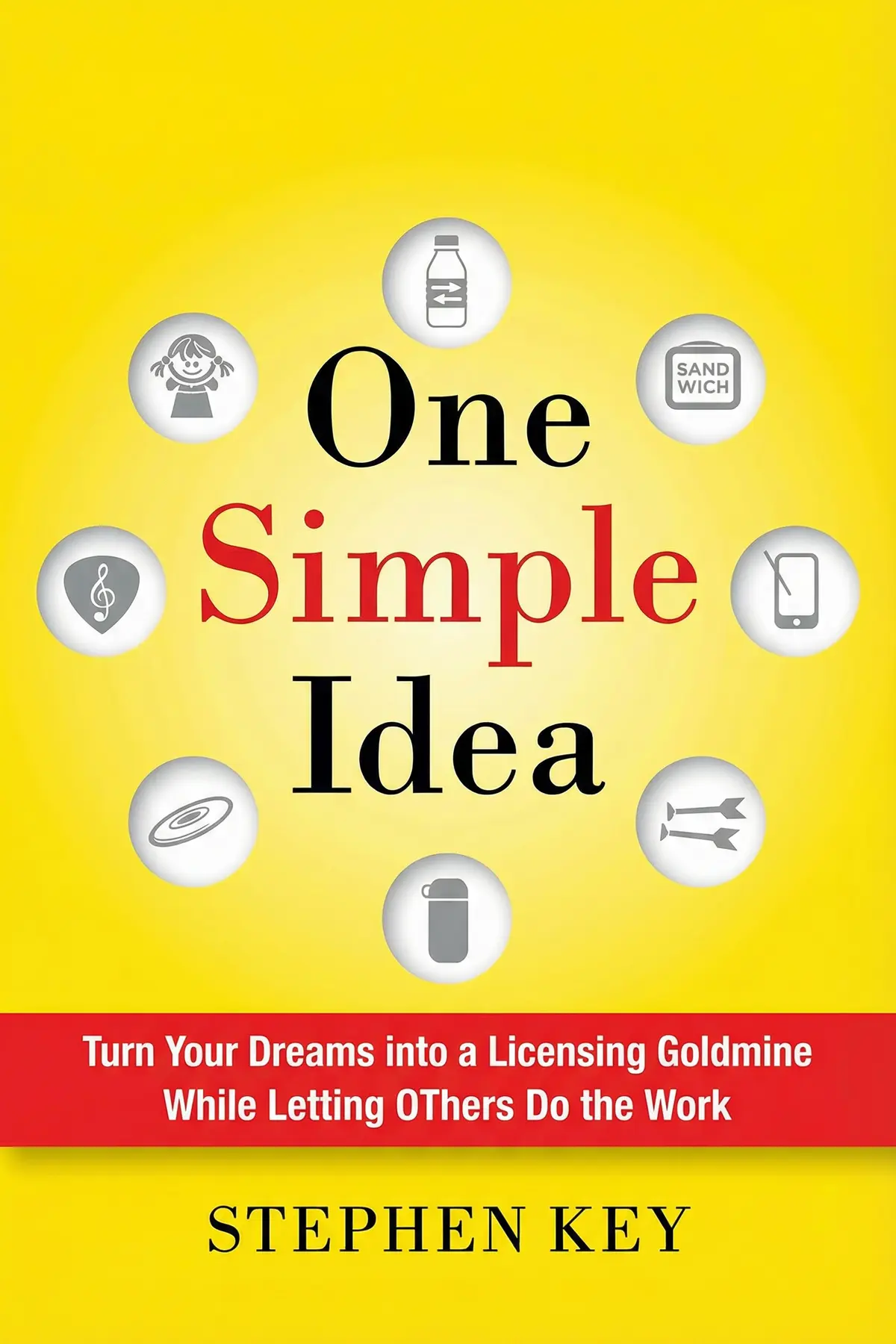
Table of Content
1. Introduction
1 min 04 sec
Most people with a good product idea assume the next step is a factory, a loan and years of risk, so the idea stays in a notebook. In One Simple Idea, independent inventor Stephen Key argues for a lighter route: rent the idea to a company that already makes and sells similar things, and collect a royalty on every unit sold. Key says he has licensed more than 20 product ideas this way, in toys, beverages, music, novelty items and pharmaceuticals, and that his creations have sold more than half a billion units.
His case is that the inventor’s real job is not building a business but finding a small, clear improvement, proving that companies want it and protecting it cheaply enough to try again and again. The path runs from a lesson at a toy startup to the contract clauses that make sure the money arrives. Along the way you get a working order of steps: where to look, what to spend, what to file, and how to keep going long enough to land a hit.
2. Let someone else's factory multiply your idea
2 min 14 sec
An inventor earned a fortune from a toy he never once handled on the production line. Watching him changed how a young designer thought about money, work and where wealth actually comes from.
3. Spot the old product waiting for one change
2 min 05 sec
Finding a patent that matches your idea sounds like the end of the road. Key reads it very differently, and his search habits turn a discouraging hour online into a ready-made list of buyers.
4. Test demand with a single page first
2 min 07 sec
Inventors often sink their savings into a model of a product nobody ends up wanting. Key landed a deal with a giant drinks company without building anything, using two cheap tools almost anyone can make.
5. Protect an idea without an expensive patent
1 min 59 sec
Friends, lawyers and TV shows all give inventors the same first piece of advice. Key thinks following it too early can sink you, and he offers a cheaper shield you can write at your kitchen table.
6. Turn early rejections into a deal that pays
1 min 59 sec
Key’s first license came after many rejections, then closed in days and sold for a decade. The book then turns to the contract: the right royalty rate, audit clauses, and making sure the licensee keeps performing.
7. Conclusion
1 min 17 sec
Key’s own career is the strongest case for his method. He says the process supported his family for 30 years, paying the bills and putting his children through college, all as an inventor. His products have sold in Walmart, 7-Eleven, Disney stores and theme parks, made and shipped by companies that did the work while he moved on to the next idea.
That freedom is what the book is finally about. Key presents licensing as a way to design your own life: companies handle production, and you are free to travel and spend your time on what you love. The talking bear showed him the shape of it decades ago. Forsse was paid for every bear without touching one.
What the method really does is shrink the risk of creativity to a size an ordinary person can carry. Pick one product you already use that feels old and tired, and find the single change it needs. Search to see whether it exists, noting every company that sells something similar. Put the improvement on one page, perhaps with a short video, protect it with a provisional application you write yourself, and show it to as many companies as you can.
Your hands never have to make the product. They only have to find the one change worth renting.
About this book
What is this book about?
Plenty of people have a product idea. Few act on it, because the usual path sounds like a factory, a loan and years of risk. Stephen Key, an independent inventor who says he has licensed more than 20 product ideas, offers another route: rent the idea to an established company and collect a royalty on every unit it sells. Key learned the model at a toy startup, where he watched the inventor of the first talking teddy bear earn huge royalties without touching a single bear. From that lesson he built a process he says supported his family for 30 years. It starts with searching the market for a gap, often an old product that needs one small change. Then he tests company interest with a one-page sell sheet and a short video rather than a costly prototype, protects the idea with a provisional patent application written by the inventor, and signs an agreement that makes sure the money keeps arriving. Readers get a practical order of operations, from first search to signed contract. Every step is built to keep spending low, so the inventor can try many ideas and stay in the game long enough to land one that sells.
Book Information
Who it's for
Product idea owners
People with product ideas who have no wish to run a factory or raise money.
Makers wanting royalties
Designers, tinkerers and side-project builders who want royalty income from their creativity.
Invention-curious professionals
Professionals considering inventing as a second career who need a low-cost, step-by-step process.
About the Author
Stephen Key
Stephen Key is an independent inventor who has built his career on licensing consumer product ideas. One of his packaging solutions is covered by more than 20 patents, and he fought a federal court case against one of the largest toy companies to protect his intellectual property. In 1999 he cofounded inventRight, a coaching program with students from more than 60 countries. He later cofounded Inventors Groups of America and inventYES, a free program for high school students.
Ratings & Reviews
Ratings at a glance
What people think
Listeners view this title as an essential resource for aspiring inventors, commending its thorough inclusion of vital details and sequential instructions for navigating the licensing world. The material is simple to grasp, and listeners feel it is a valuable investment for the price. They enjoy the inspiring tone, with one listener describing how it encourages everyday people to expand their vision, while others point out its actionable tips and useful strategies for brainstorming product concepts.
Top reviews
Talia
Stephen Key makes a compelling case for the 'renting' model of business, and frankly, it's a breath of fresh air for anyone tired of the typical startup grind. Instead of focusing on manufacturing or distribution, the author walks you through how to leverage existing companies to do the heavy lifting for you. I found the sections on sell sheets and 'doing your homework' on potential licensees particularly actionable. While the book can feel a bit repetitive at times, the core message—that your ideas have value without you needing to build a factory—is incredibly empowering for the average person. It’s a practical guide that demystifies the licensing world, even if some of the examples feel a bit specific to cheap consumer goods. Definitely a must-read if you want to understand the basics of intellectual property without a law degree.
Show morePruet
Finally got around to reading this, and it really flipped my perspective on what it means to be an 'inventor' in the modern world. Key strips away the mystery of patents and high-stakes manufacturing, replacing them with a streamlined system of 'renting' ideas to big brands. The focus on solving simple problems rather than trying to reinvent the wheel is a strategy that almost anyone can apply if they are observant enough. I loved the motivational tone because it makes the whole process feel attainable for someone without a massive bank account. Some people might find it a bit anecdotal, but the success stories provide the necessary context to see how these theories play out in reality. It’s more than just a business book; it’s a toolkit for changing how you view market needs.
Show moreGioia
I've been sitting on a product idea for three years because I was terrified of the legal costs and the complexity of starting a company. After reading this, I realized I was overcomplicating everything and that the path to market doesn't have to involve a million-dollar investment. Stephen Key’s strategy of using a $70 provisional patent to secure interest is a game-changer for the common person who wants to compete. The step-by-step guidance on how to reach out to potential buyers felt very practical and gave me the confidence to actually start making calls. While the book is definitely repetitive, I think that helps the core principles sink in so you don't forget the basics when things get tough. It’s an essential read for anyone who wants to turn their creativity into a paycheck.
Show moreNikolai
Ever wonder how those random kitchen gadgets or simple toys actually make it onto the shelves of big-box retailers? This book pulls back the curtain on that exact process, showing how a simple $70 provisional patent application can be the foundation of a real career. Stephen Key isn’t just some theorist; he’s clearly been in the trenches and knows exactly how to handle a cold call without losing your mind. The advice on creating a 'sell sheet' that catches a company's attention is worth the price of the book alone. My only gripe is that the author tends to plug his own coaching services quite a bit throughout the chapters. If you can look past the self-promotion, the actual strategy is solid for anyone looking to generate passive royalty income.
Show moreErn
As someone who always has 'million-dollar ideas' but zero manufacturing budget, this was exactly the roadmap I needed to see a different path forward. The book teaches you to prioritize your provisional patent over full utility patents, which is a huge cost-saver for anyone just starting out. I appreciated the blunt honesty about how many cold calls it actually takes to get a bite from a manufacturer. It isn't a 'get rich quick' scheme, despite what the catchy title might suggest to a casual reader browsing the shelves. Truth is, the success hinges entirely on your ability to execute the market research and identify the right licensees before you even pick up the phone. It’s a solid 4-star read that provides a usable framework, though it does lean heavily on the author's personal wins.
Show moreGin
Look, you aren't going to become a billionaire overnight by reading this, but the blueprint provided here for licensing is a legitimate way to enter the market. The author's 'One Simple Idea' approach is all about minimizing risk while maximizing the potential for passive income through royalties. I found the chapter on 'the life you can live' to be quite moving, as it encourages you to think bigger than just a 9-to-5 grind. However, the writing style is very casual and can sometimes feel like you're sitting through a sales pitch rather than a masterclass. The practical tips on using NDAs and protecting your work are great, even if the book ignores some of the more complex legal realities of modern business. It’s a great 'Phase 1' book for your invention journey.
Show moreBua
To be fair, the 'One Simple Idea' isn't exactly a secret, but Key explains the execution of licensing better than almost any other business author I've read. He makes you visualize the possibilities of a royalty-based lifestyle, which is great for staying motivated during the boring parts of market research. The focus on being first to market and creating a compelling visual through a sell sheet is advice that applies to more than just inventing. I did feel like some of the stories were a bit 'best-case scenario,' which might set unrealistic expectations for some readers who expect instant success. Still, the underlying tactics are sound and provide a clear path forward for anyone with a good idea and some grit. It’s not a perfect book, but it’s a very helpful one for the right audience.
Show morePla
The core concept here is gold, but the delivery is a bit repetitive and probably could have been summarized in a lengthy blog post. Key spends a lot of time dicing and slicing the same few ideas across multiple chapters, which makes the 250+ pages feel like a bit of a slog at times. However, I can't deny that the specific advice regarding the licensing process—especially the negotiation phase—is genuinely insightful for a beginner. If you are looking for high-tech research licensing, you might be disappointed as the focus is heavily on inexpensive consumer products. It’s an okay starting point for the uninitiated, but you’ll likely need to do significant outside research to actually pull this off. I liked the emphasis on being first to market, yet I wish there was more depth on the legal hurdles.
Show moreKamol
This book is basically an extended brochure for his coaching services, yet there are definitely some nuggets of wisdom buried in the self-promotion. I was particularly interested in the way he breaks down the difference between a product and an idea that solves a specific consumer desire. That distinction is vital. However, the book repeats its main points so frequently that I found myself skimming large sections by the time I hit chapter fifteen. It focuses very narrow-mindedly on simple, cheap products, so if your invention is a complex piece of machinery, look elsewhere for guidance. To be fair, for someone who has never heard of a sell sheet or a PPA, this is a decent introductory text. It just feels a bit bloated for the amount of unique information it actually conveys.
Show moreJai
Not what I expected based on the hype surrounding this title in the entrepreneurship community. While I appreciate the author's success, the book feels like one long advertisement for his consulting business and lacks the technical depth I was hoping for. Most of the advice is anecdotal, relying on the idea that because it worked for him twenty years ago, it will work for you exactly the same way today. The world of intellectual property and licensing has evolved, and some of the strategies here feel a bit dated or oversimplified for today's digital landscape. Honestly, the entire 200-page book could have been a 10-page PDF without losing any of the actual 'meat' or actionable steps. If you are brand new to the concept of royalties, you might get something out of it, but otherwise, a Google search will serve you better.
Show moreQuestions about this book
What is the main idea of One Simple Idea by Stephen Key?
Key argues that you can earn from a product idea without starting a company. You license, or rent, the idea to an established firm that already has manufacturing, marketing, distribution and shelf space, and it pays you a royalty on every unit sold. He learned the model at the toy startup Worlds of Wonder, where Teddy Ruxpin’s inventor earned about a million dollars a month in royalties.
Do I need a patent before licensing an idea?
Not necessarily, according to Key. He says not every idea needs a full patent. He recommends a well-written provisional patent application, which you can prepare yourself and which gives one year of patent-pending status while you show your idea to companies. If the idea proves itself, you can file a non-provisional application later, or ideally have the licensing company pay the patent costs.
Do I need a prototype to license a product idea?
Key says usually not. Prototypes can cost thousands and turn out too big, badly designed or unwanted. Instead he uses a one-page sell sheet with a drawing or 3D computer image and a clear benefit statement, often with a one-minute video showing the problem and solution. He describes a deal with one of the world’s largest beverage companies that needed no prototype at all.
How do I find a product idea worth licensing?
Key starts by searching Google images and Google shopping to see whether the product already exists, then looks for a point of difference. He favors what he calls a sleeping dinosaur, an old, tired product that a small change can revive. He also lists the companies selling similar products while he searches, since those are the firms he will later approach.
What should a licensing agreement include?
Key covers several essentials: a fair royalty rate, audit clauses that let you check the company’s sales figures, and terms making sure the licensee keeps performing and selling your product. His broader point is that inventors should treat the deal from a business perspective, because a signed contract is only valuable if the product keeps selling and you are paid what you are owed.
Readers also enjoyed


7 Powers: The Foundations of Business Strategy
Hamilton Helmer



Alibaba: The House That Jack Ma Built
Duncan Clark

Be A Free Range Human: Escape the 9 to 5, Create a Life You Love,
Marianne Cantwell
Be Obsessed or Be Average
Grant Cardone
Being Boss: Take Control of Your Work and Live Life on Your
Kathleen Shannon
AUDIO SUMMARY AVAILABLE
Listen to One Simple Idea in 15 minutes
Get the key ideas from One Simple Idea by Stephen Key, plus 5,000+ more nonfiction titles.
- 5,000+ titles
- Listen as much as you want
- 7-day free trial
- Cancel anytime









