

15 min 03 sec
Available in: English
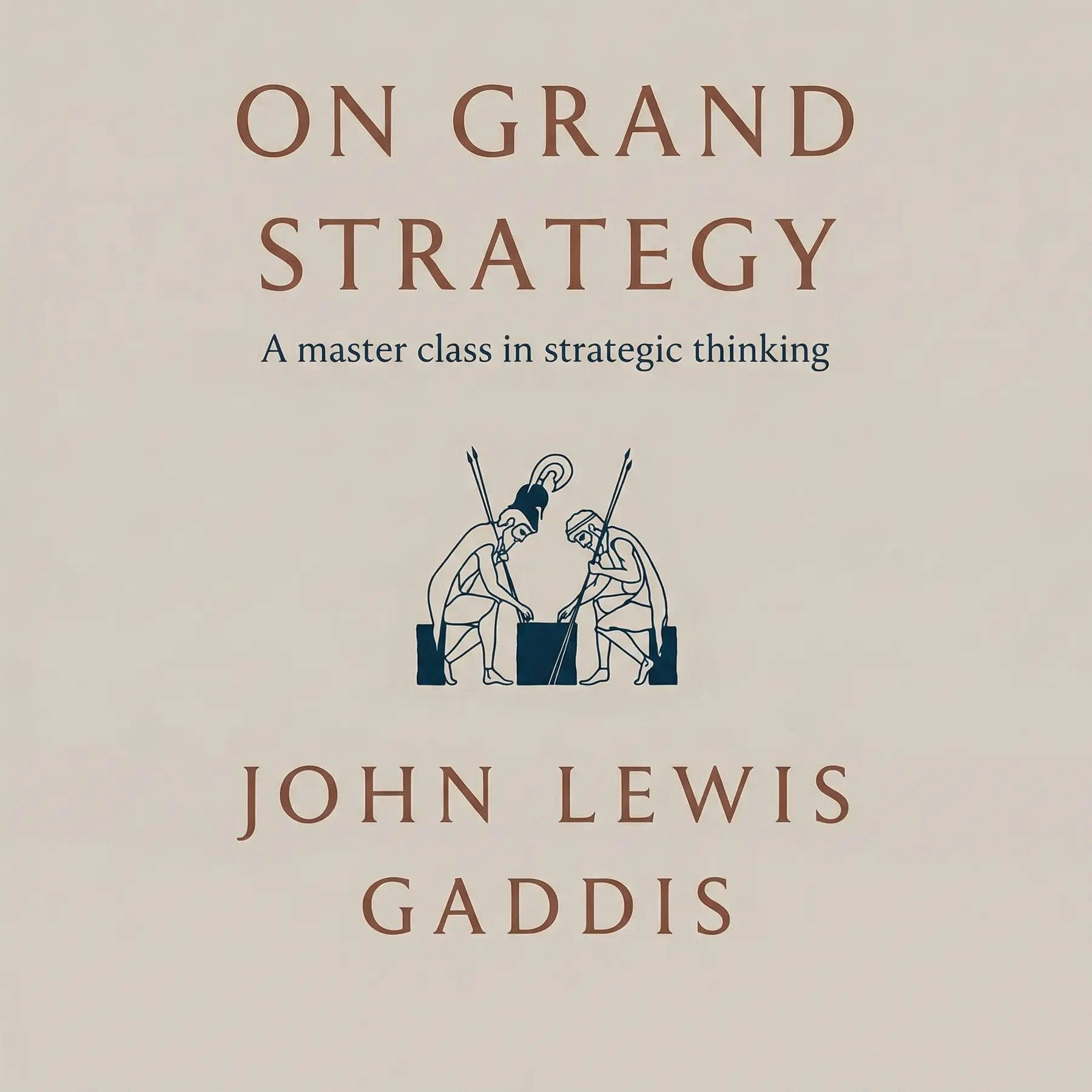
On Grand Strategy
Shows how leaders from Xerxes to Roosevelt succeeded or failed by balancing one big goal with careful attention to obstacles. It also explains how to use that balance in planning, forecasting and leading others.

Table of Content
1. Introduction
1 min 05 sec
Plenty of people with big goals stall. Some charge ahead without looking, and others see so many risks that they never move. In On Grand Strategy, Yale historian John Lewis Gaddis argues that the leaders who succeed hold both instincts at once. He borrows an image from the Oxford professor Isaiah Berlin and calls them part hedgehog, fixed on one large aim, and part fox, alert to every detail that could trip them up.
His argument runs across more than two thousand years of history. Lasting success comes from pairing a single clear goal with flexible, realistic means, and from never letting caution, a run of victories or a quick win blind you to what comes next. The cases range from a Persian king who marched his army into exhaustion to Franklin Roosevelt waiting for a pact between two dictators to collapse. Along the way you get a test for deciding whose predictions to trust, a way to plan with the resources you really have, and a warning about wins that build your next rival.
2. Hold one big goal while watching every obstacle
2 min 18 sec
A Persian king ignored his advisor’s warning and paid for it. Yet Gaddis refuses to say the advisor was the better leader, and the president he does admire used methods that might surprise you.
3. Trust the forecaster who admits doubt
2 min 20 sec
A study of more than twenty-seven thousand expert predictions found that politics, profession and optimism made no difference to accuracy. One trait did, and the experts who lacked it were the ones television loved most.
4. Build your plan from the strengths you have
1 min 58 sec
Caesar’s heir had little military experience and two rivals with far more of it. He accepted a smaller share of power than either of them, and that choice turned out to be the start of his rise.
5. Stop your victories from clouding your judgment
1 min 56 sec
Napoleon planned a quick lesson for the Russian czar and a triumphant return before winter. What he found at the end of his march explains why success can be more dangerous than failure.
6. A system that bends survives the shocks
2 min 11 sec
Two monarchs ran their American colonies in opposite ways. One looked stronger and more orderly. Centuries later, the difference helped explain why the United States prospered after independence while South America stayed fragmented.
7. Avoid quick wins that arm your future rival
2 min 07 sec
Food aid, factories and wartime pressure each looked sensible when America offered them. Gaddis shows how they added up to something no one intended, and how Roosevelt’s patience pointed the other way.
8. Conclusion
1 min 08 sec
Gaddis offers no formula, and he says so. What his history adds up to is a habit of mind. The leaders who last keep their eyes on one large goal and stay flexible about everything else: the route, the allies, the pace, even the smaller seat they accept along the way. Xerxes had the goal and ignored the ground. Artabanus saw the ground and would have stayed home. Lincoln, Octavian and Roosevelt held both.
You can practice this habit in an ordinary week. When a big decision comes, state the one aim you will not trade away, then let the most cautious person you know list what could go wrong. Give more weight to advisors who admit doubt than to those who explain everything with one idea. After a success, check whether your next move serves the goal or your pride. Before taking a quick gain, ask who it might strengthen later.
Napoleon got all the way to Moscow and found nothing there. Gaddis’s leaders knew their goal well enough to keep pursuing it when the road bent, and to stop when reaching a place no longer served it.
About this book
What is this book about?
Some leaders charge at a goal without seeing the ground in front of them. Others see every risk and never move. Yale historian John Lewis Gaddis argues that the leaders who last do both at once. He borrows Isaiah Berlin's image of the hedgehog, who knows one big thing, and the fox, who notices many small things. Gaddis tests that idea across more than two thousand years. Xerxes marches on Greece against his advisor's warnings. Octavian turns a weak hand into the title of Rome's first emperor, while Napoleon lets his victories lead him into the Russian winter. Elizabeth I and Philip II run their American colonies in opposite ways, and the United States helps build the rival it would later face in the Cold War. A large study of expert forecasts by Philip Tetlock adds evidence that foxes see the future more clearly than hedgehogs. Readers come out with a simple way of thinking about strategy: fix the aim, keep the methods flexible, distrust certainty, decentralize where you can, and check what a quick win might cost later.
Book Information
Who it's for
Managers and founders
Founders and managers whose big plans either stall in caution or run ahead of their resources.
Team leads
Team leads who want a way to judge expert advice and decide what to delegate.
History buffs
History readers curious how Xerxes, Augustus, Napoleon, Lincoln and Roosevelt won or lost.
About the Author
John Lewis Gaddis
John Lewis Gaddis is an American historian and political scientist, born in 1941 in Cotulla, Texas. He teaches at Yale University, where he holds the Robert A. Lovett chair in military and naval history. His work focuses on the Cold War and grand strategy, and his books include The Cold War: A New History. He is also the official biographer of the diplomat George F. Kennan. His biography of Kennan won the 2012 Pulitzer Prize for biography.
Ratings & Reviews
Ratings at a glance
What people think
Listeners find the work offers an educational perspective on high-level strategy, defining the core traits of successful and unsuccessful strategists. Furthermore, the prose is skillfully written, and listeners describe it as a gripping study filled with significant historical details. They also value the author's methodology, with one listener highlighting the way he links people throughout the text. Nevertheless, listeners express varied opinions regarding the overall storytelling and clarity.
Top reviews
Kae
Finally got around to reading Gaddis’s take on grand strategy, and it’s quite a journey through the ages. The way he links diverse historical figures like Sun Tzu, Elizabeth I, and FDR into a cohesive narrative is truly masterly. I particularly loved the recurring metaphor of the fox and the hedgehog—the idea that a great strategist must know many things while focusing on one big goal. It’s an erudite tour de force that feels less like a dry textbook and more like a personal conversation with a brilliant mentor. The writing is incredibly well-crafted, though it demands your full attention because the vocabulary is quite sophisticated. Some might find the jumps between centuries jarring. Personally, I found it refreshing. It’s a fascinating read for anyone interested in high-level thinking and the common sense that seems to disappear the higher one climbs in leadership.
Show moreArt
Wow. I was genuinely impressed by how Gaddis navigates the tension between aspirations and capabilities. This is an incredible book for anyone who enjoys seeing how different threads of history are woven together. He doesn't just talk about generals; he brings in Machiavelli, Tolstoy, and even Shakespeare to explain how leaders perceive the world. The distinction between the fox and the hedgehog is a simple but powerful tool for comparing different styles of leadership. I found the section on how Lincoln managed the Civil War to be particularly moving. Gaddis writes with a level of sophistication that is rare these days. The book is polysyllabic and dense, yes, but it rewards the patient reader. It’s a fascinating study of what it means to have a first-rate intelligence in an arena of constant conflict.
Show moreJob
Picked this up on a recommendation, and it’s one of those rare books that makes you rethink your entire approach to decision-making. Gaddis gives us a tour de force of historical wisdom. He shows that grand strategy is about the alignment of potentially infinite aspirations with necessarily finite capabilities. That’s a lesson for life, not just for war. The book is incredibly dense with historical content, but the author's voice is so engaging that it never feels like a chore. I loved the bits about how Lincoln and FDR navigated their respective crises with a mix of principled goals and pragmatic tactics. This is a well-crafted piece of scholarship that deserves to be read slowly. It’s informative, fascinating, and deeply human. If you appreciate seeing how the past informs the present, you need this on your shelf. It’s easily one of the best books on leadership I’ve read in years.
Show moreSook
This book is essentially a masterclass in how to bridge the gap between abstract theory and messy reality. Gaddis argues that grand strategy is the linkage of top-level political and military direction, which is often a very messy process. I loved the quote about how common sense is like oxygen: the higher you go, the thinner it becomes. That rings so true for modern politics! The author provides an informative look at the attributes of successful strategists, emphasizing the need to hold opposing ideas in the mind simultaneously. While the book can be dry in the middle sections, particularly when he moves away from the classics, the overall quality of the prose is top-tier. It isn't a traditional military history, so don't go in expecting tactical maps. It is a book about the psychology of power and the limits of human foresight.
Show moreWilliam
Ever wonder how the most powerful leaders in history actually think? Gaddis attempts to answer that by examining the attributes of good and bad strategists across millennia. The truth is, most strategy is about balancing what you want with what you can actually do. I appreciated how he linked the ancient Greeks with modern American presidents, showing that the problems of scale and time haven't really changed all that much. The writing is elegant, and the author's approach to comparing leaders across different eras is refreshing. It’s a very broad book, so if you want specific details on the Korean War or the Napoleonic Wars, you might want to look elsewhere. But if you want a sweeping overview of how 'big' thinking works, this is a solid choice. It’s a well-crafted, thoughtful meditation on the human condition and the art of the possible.
Show moreNoi
Frankly, I found the writing to be incredibly well-crafted even when the structure felt a bit loose. This isn't a book you read to learn how to win a specific battle. It’s a book you read to understand the mindset required to lead an empire. Gaddis focuses on the dimensions of time, space, and scale, which I found to be a useful framework for looking at history. The way he discusses Pericles and the walls of Athens was particularly insightful. It's a fascinating read because it links people throughout the text in ways you wouldn't expect. My only complaint is that it can be a bit repetitive with the fox/hedgehog metaphor. Still, it provides an informative look at high-level strategy that feels relevant even for non-military leaders today. It’s about the mental flexibility required to survive in a complex world.
Show moreTee
As someone who appreciates deep historical analysis, I found this collection of essays somewhat polarizing. To be fair, Gaddis is a giant in Cold War history, but this book feels like a transcript of his Yale seminar notes rather than a focused monograph. The early chapters on the ancient world are brilliant, specifically his analysis of Octavian and the Persians. However, things get murky when he starts making theological claims about St. Augustine. I felt his sarcastic jabs at Augustine’s spiritual beliefs were unnecessary and actually weakened his strategic arguments. The tone becomes surprisingly opinionated in ways that don't always serve the historical context. It’s still informative, but the structure is loose. You get plenty of vague musings where you might have expected a rigorous military framework. It’s worth a read, but keep your expectations for a concrete 'how-to' guide low.
Show morePornpimon
Look, Gaddis is clearly a titan in his field, but this particular work feels a bit like a collection of disjointed class notes. I was really excited about the premise of 'Grand Strategy,' yet the execution left me feeling a bit cold. The book is much drier and less focused than the intro makes it out to be. He spends a lot of time on Isaiah Berlin’s ideas, which is fine, but it feels like he’s just riffing on his favorite authors rather than building a new argument. Is it informative? Yes. Is it a well-crafted book? Mostly. But it lacks the clarity I wanted. He often pits two historical figures against each other as opposing archetypes, which feels a bit forced after a while. It's an okay read for a plane ride, but it didn't change how I think about strategy.
Show moreSarocha
The chapter on the Peloponnesian War was definitely the highlight for me, though the rest of the book felt a bit uneven. In my experience, Gaddis is at his best when he’s dealing with specific historical narratives. When he shifts into spiritual or theological commentary on Machiavelli and Augustine, he loses me. It felt like he was inserting his personal opinions on morality and God into a space where they didn't really fit. This made the actual ideas in the book feel a bit confused at times. To be fair, the prose is beautiful, and he has a knack for finding the perfect quote to illustrate a point. But as a cohesive guide to grand strategy, it falls short. It's more of a literary exercise than a strategic one. I’d recommend it for the history, but take the philosophical conclusions with a grain of salt.
Show moreKasemsan
Not what I expected given the title. If you are looking for a deep dive into military grand strategy or international relations, you will likely be disappointed by this one. It feels more like a self-help book for history nerds than a serious academic work. Gaddis relies far too heavily on the fox and hedgehog metaphor, shoe-horning every historical figure into these simplistic archetypes. The chapters are unstructured and often read like a collection of disjointed musings. A reader won't come away with a deeper understanding of actual statecraft. Instead, you get context-light anecdotes that feel like they were designed for undergraduates at Yale rather than seasoned students of history. Frankly, the whole thing is too vague to be useful. I don't understand the raving reviews for what amounts to a series of simplified historical sketches.
Show moreQuestions about this book
What is the main idea of On Grand Strategy by John Lewis Gaddis?
Gaddis argues that successful leaders combine the hedgehog’s single big goal with the fox’s attention to detail and obstacles. Leaders at either extreme fail: they ignore the risks, as Xerxes did in Greece, or they never act at all. Through cases from Persia to Roosevelt, he shows that lasting success means fixing the aim, keeping methods flexible, matching ambition to real resources and keeping the long term in view.
What is the fox and the hedgehog idea?
The idea comes from philosopher Isaiah Berlin, who sorted writers into hedgehogs, who see the world through one central idea, and foxes, who notice many complex and even contradictory details. Others later applied it to leaders. Gaddis uses it to argue that the best leaders mix both: a hedgehog’s firm goal with a fox’s varied tactics, as Lincoln showed in his push for the 13th Amendment.
Are foxes or hedgehogs better at predicting the future?
Foxes, according to Philip Tetlock’s study, which Gaddis describes. Tetlock analyzed 27,451 predictions from 284 experts between 1988 and 2003. Political views and profession did not predict accuracy, but self-described foxes did far better. They used varied sources and stayed humble. Hedgehogs did about as well as a chimpanzee throwing darts, yet they were the experts the media favored.
How can I apply On Grand Strategy at work?
Name the one goal you will not give up, then plan around the obstacles a cautious colleague would raise. Build your approach from the resources you actually control, as Octavian did. After a success, check whether a bold move serves your goal or your ego. Delegate decisions to the people closest to the problem, and before taking a quick win, ask who it might strengthen later.
Who should read On Grand Strategy?
It suits leaders, founders and managers who want a way of thinking about long-range planning, and readers who enjoy history told through decisions. Its cases include Xerxes, Augustus, Napoleon, Elizabeth I and Philip II, Lincoln and Franklin Roosevelt, plus a study of expert forecasting. Anyone who swings between reckless boldness and endless caution will find the fox and hedgehog balance useful.
Readers also enjoyed

A Long Way Gone: Memoirs of a Boy Soldier
Ishmael Beah

A Bigger Prize: How We Can Do Better Than the Competition
Margaret Heffernan







A Splendid Exchange: How Trade Shaped the World
William J. Bernstein
AUDIO SUMMARY AVAILABLE
Listen to On Grand Strategy in 15 minutes
Get the key ideas from On Grand Strategy by John Lewis Gaddis, plus 5,000+ more nonfiction titles.
- 5,000+ titles
- Listen as much as you want
- 7-day free trial
- Cancel anytime









