

13 min 50 sec
Available in: English
Nothing But Net: 10 Timeless Lessons for Picking Tech Stocks
By Mark Mahaney
Shows how to pick tech stocks by tracking sustained revenue growth and the four forces behind it, judging price with common sense, and ignoring the quarterly trades and meme-stock hype that tempt new investors.
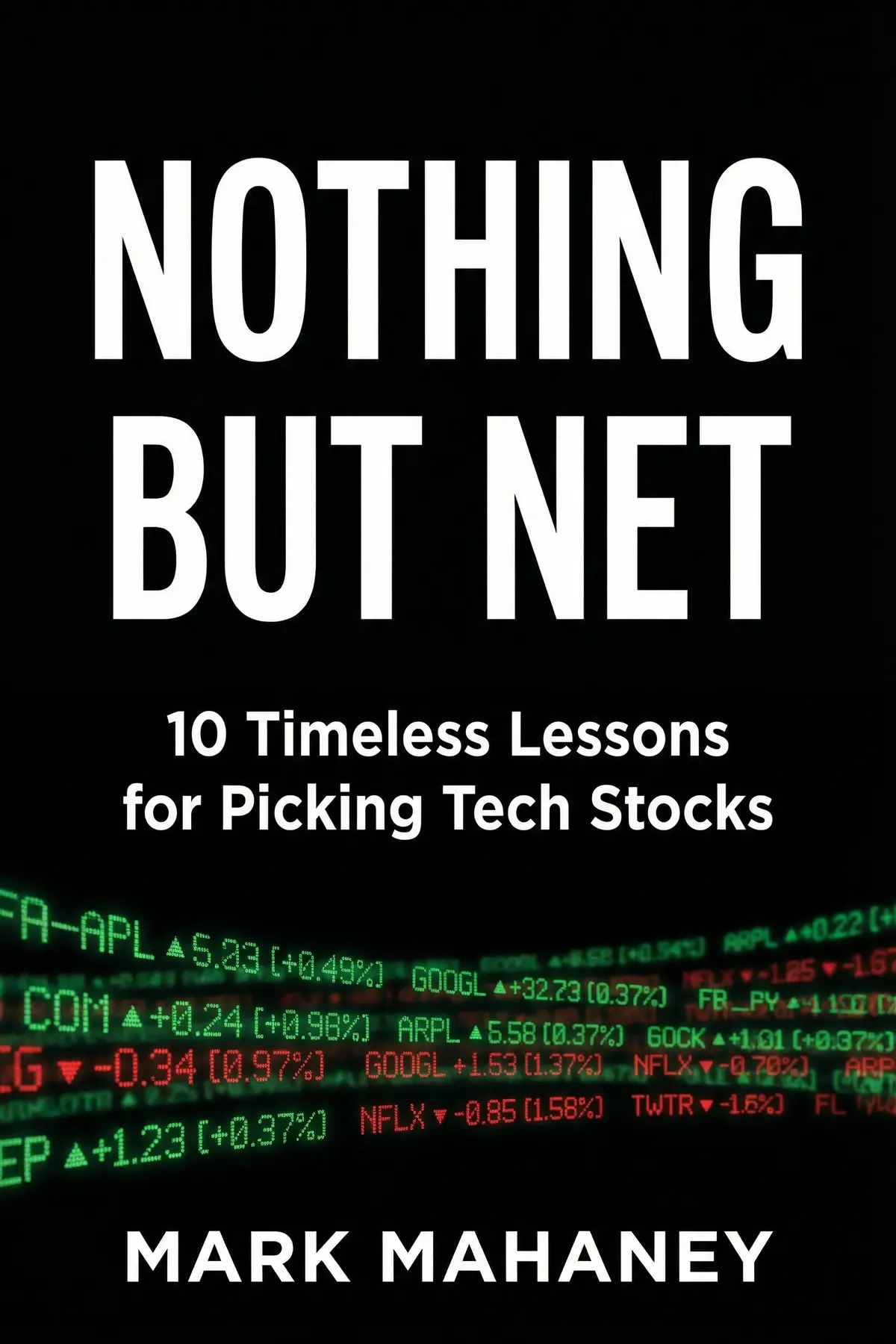
Table of Content
1. Introduction
1 min 01 sec
Most people who buy tech stocks pick names they like, check the price daily and sell when it hurts. In Nothing But Net, Mark Mahaney, a Wall Street analyst who has covered internet companies since 1998, argues that the better approach starts with one figure: revenue growth of at least 20 percent, kept up quarter after quarter. In his view, that steady climb in sales says more than profit, headlines or this week’s price.
His case draws on Amazon, Netflix, eBay and Uber, and on his own costly mistakes. The throughline is simple. Expect setbacks, ignore short-term noise and buy companies whose growth comes from innovation, a large market, customer focus and strong leaders, then judge their price with common sense rather than false precision.
What follows is a checklist you can run on any tech company you are tempted to buy, and a clear reason to stop trading on quarterly hunches.
2. Survive the losses even top picks bring
1 min 34 sec
Netflix, Amazon and a stock picked by a top analyst all suffered brutal drops, some through no fault of the company. Knowing why changes how you should prepare before you ever press buy.
3. Patient holders beat quarter traders over time
1 min 31 sec
Buying just before a company reports and selling right after looks like easy money, and demand for it is huge. One analyst hears that request constantly, and his answer never changes.
4. Spot winners by tracking 20 percent revenue growth
1 min 38 sec
One company stayed profitable for years while its share price went nowhere. Another often lost money and became a great stock. The difference comes down to a single number most investors underrate.
5. Find the engines that keep revenue climbing
1 min 40 sec
Some companies keep producing hit after hit while others peak with one. The difference often shows up in products you already use, and in how many more people could still buy them.
6. Back companies that serve customers before investors
1 min 48 sec
eBay once ruled online shopping, then lost its crown by doing what shareholders wanted. The winner’s choice looked risky at the time. Add one strange clue from a desert festival and a pattern appears.
7. Judge a valuation with plain logic, not math
1 min 50 sec
Careful financial models built in January 2020 were wrong within a month. Uber lost billions and its shares still soared. Precision on price is an illusion, but that does not leave you guessing blindly.
8. Skip the hype, do the homework, stay humble
1 min 41 sec
In January 2021, one stock soared 1,900 percent and then fell back by 90 percent the following month. Thrilling for traders, ruinous for many. The alternative is slower, less exciting and far more likely to last.
9. Conclusion
1 min 07 sec
The book fits in one picture: the patient owner of a growing company sitting calmly through drops that send traders running. Mahaney’s whole method serves that person. Revenue growth shows whether a company is gaining ground. Innovation, a large market, customer focus and strong leaders show whether the gains can continue. A rough, logical view of price keeps you from paying a fantasy figure, and the memory of Blue Apron keeps you modest.
What changes is the question you ask. Instead of guessing where a stock will be next quarter, you ask whether the business can keep growing sales by 20 percent or more for years. For your next idea, check at least five quarters of revenue growth, and name the product launch, new market or price move behind it. Look at who leads the company and whether they put customers ahead of short-term profit. Then ask whether the price seems roughly reasonable, without demanding a precise answer.
You will still be wrong at times, as the author was. Netflix lost 40 percent after one disappointing quarter in 2018, and it remains his clearest example of a stock worth owning.
About this book
What is this book about?
Plenty of people buy tech stocks on a hunch, a headline or a hot tip, then panic when the price drops. Mark Mahaney, a Wall Street analyst who has covered internet companies for nearly 25 years, offers a calmer and more disciplined way to choose. His method starts with revenue. He looks for companies growing sales by at least 20 percent for five or six quarters in a row. He then asks what drives that growth: product innovation, a large total addressable market, a customer-first culture and capable, often founder-led, management. He sets this against cases from his own career, including Netflix's sharp fall in 2018, Amazon's long rise past eBay, Uber's huge losses and his own costly call on Blue Apron. Readers get a practical checklist for assessing any tech company. They also learn why playing quarters and meme stocks resemble gambling, and how to judge a valuation with plain logic instead of precise forecasts that can collapse within a month.
Book Information
Who it's for
New to buying stocks
New investors who started buying stocks recently and feel pulled toward day trading or meme stocks.
Professionals owning tech shares
Professionals who own tech shares like Amazon or Netflix and want a clear test for what to buy and hold.
Curious about analyst ratings
Founders and operators curious how Wall Street analysts judge a tech company's growth and leadership.
About the Author
Mark Mahaney
Mark Mahaney has followed internet companies as a Wall Street analyst since 1998, with roles at Morgan Stanley, Citibank and RBC Capital Markets. At Evercore ISI he has served as Senior Managing Director and Head of Internet Research. Institutional Investor magazine has ranked him among the top internet analysts. Nothing But Net is his first book.
Ratings & Reviews
Ratings at a glance
What people think
Listeners consider this title exceptionally useful, and one listener suggests it is mandatory reading for both value and growth investors. The quality of the material is consistently praised, with listeners pointing out its great detail.
Top reviews
Rose
Finally, a guide that demystifies why some tech companies skyrocket while others fizzle out. Mahaney provides an incredible look inside the mind of a top-tier analyst, and I found the focus on 'revenue, revenue, and revenue' to be a massive wake-up call for my portfolio. Many value investors get stuck looking at P/E ratios and miss the boat on massive growth stories because they don't understand how a large Total Addressable Market functions. This book changes that perspective entirely. It is absolutely packed with case studies that show how product innovation acts as a 'repeatable offense.' Look, the writing is casual and easy to digest, making it mandatory reading for both retail and seasoned investors. I particularly appreciated the sections on staying humble and avoiding the trap of meme stocks. It’s rare to find an investment book that balances technical metrics with such practical, real-world wisdom. Five stars.
Show moreDaranee
Mahaney brings a level of humility that is rare in the high-stakes world of Wall Street analysts. He doesn't just talk about his wins with Amazon; he openly discusses the 'pains and gains' of his career, which makes the advice feel much more authentic. The chapter on how to identify 'dislocated' stocks during a selloff was worth the price of the book alone. Personally, I think this is mandatory reading for anyone trying to navigate the volatility of the tech sector. He breaks down complex ideas like network effects and economies of scale into plain English that any retail investor can understand. The focus on consistent, five-to-six quarter revenue growth is a practical metric I can actually use in my own research. It’s detailed, honest, and incredibly insightful. If you want to stop gambling on meme stocks and start actually investing, buy this book today.
Show moreJirapat
Ever wonder why a stock with zero profits keeps climbing? It’s about revenue. Pure, unadulterated, 20-percent-plus revenue growth sustained over five or six quarters. Mahaney explains that in the tech world, high growth rates can eventually transform an expensive stock into a reasonable one. In my experience, most books ignore this reality in favor of old-school metrics that just don't apply to the internet age. The detail provided on companies like Booking and Chewy is fascinating. You get to see the thought process of someone who has been doing this for 25 years. Not gonna lie, I’ve already changed how I screen for stocks after finishing this. It’s an easy read but it contains some very heavy truths about market dynamics and the power of a large TAM. Truly excellent work.
Show morePawinee
The chapter on Total Addressable Market (TAM) alone justifies the purchase price of this book. Mahaney explains how scale leads to competitive moats in a way that is both intuitive and analytically rigorous. I especially like the humble way the author explains everything—his mistakes are just as prominent as his wins. This makes the book feel like a real conversation with a mentor rather than a lecture from a titan. For anyone who felt confused by the wild price swings of tech stocks during COVID, this provides a much-needed anchor. It’s packed with practical examples and clear metrics. Whether you are a value purist or a growth seeker, there is wisdom to be found in these pages. It is a great resource that I will likely return to every few years to keep my head straight.
Show moreMai
As someone who has dabbled in tech stocks for years, I found Mahaney's focus on revenue over profitability refreshing yet slightly terrifying in the current market. He argues that 20% premium growth is the gold standard, and his comparison between eBay’s stagnation and Netflix’s rise is particularly enlightening. The information quality is high, providing great detail on 'Growth Curve Initiatives' that I hadn't considered before. However, to be fair, the book leans very heavily on the recent past. I would have liked more examples from his twenty-year career that didn't just involve the obvious FAANG winners. Still, it’s a decent start for anyone wanting to understand how Wall Street evaluates the internet sector. The advice to avoid day trading and focus on fundamentals is timeless, even if the specific stock picks might be sensitive to interest rate hikes. Definitely worth a spot on the shelf.
Show moreWachira
Picked this up on a whim and was pleasantly surprised by the 'Growth Curve Initiatives' framework. Mahaney explains that innovation isn't just about a new gadget; it’s about geographic expansion and price increases that drive the top line. The comparison between eBay and Netflix was a highlight for me. It perfectly illustrates why some companies fail to scale despite being profitable. My only real gripe is that the book feels a bit repetitive in the middle sections. He hammers home the '20% growth' rule so many times that it starts to feel like a mantra rather than an analysis. Regardless, the information is highly valuable for those of us trying to bridge the gap between value and growth investing. It’s a solid 4-star effort that provides a lot of clarity on how to value companies that don't yet have traditional earnings.
Show moreOmar
Is this the next Peter Lynch classic? Not quite. While the book is billed as a masterclass for tech investors, it feels a bit shallow in parts. Mahaney is clearly brilliant—the guy is a top-ranked analyst for a reason—but the writing style is a little grating at times. He uses the phrase 'Nothing But Net' a bit too much for my taste. The frameworks for identifying high-quality companies are solid, focusing on TAM and management, but they benefit greatly from looking backward. It’s easy to say Netflix was a great buy now, but the book doesn't give you enough tools to find the next one before it becomes a household name. In my experience, this is a good 'airport read' for a quick flight. It’s a 5-hour investment that will give you the basics, but don't expect it to turn you into a hedge fund manager overnight.
Show moreZoey
To be fair, the advice here is solid for beginners, but I found the case studies a bit too reliant on historical cherry-picking. The author's career trajectory is impressive, yet the book feels like it was written during a period of record-low interest rates. Now that the market has shifted, some of these 'high quality' companies have seen their valuations crater. Mahaney does touch on the risks of trading around earnings reports, which is a good lesson for the Robinhood crowd. But for more experienced investors, the book lacks the mathematical depth you might find in a textbook. It’s more of a memoir mixed with a basic primer. I’d recommend it to someone who is brand new to the internet sector, but if you’ve been through the Dot-com bubble or the 2008 crash, you might find it a bit elementary.
Show moreSuthida
This book felt more like a series of CNBC segments than a deep dive into serious investment philosophy. Frankly, I was expecting something with the weight of 'Lessons from the Titans,' but Mahaney delivers a much lighter touch that often feels like hindsight bias in action. He focuses heavily on the 20% revenue growth rule, using winners like Netflix to prove his point while glossing over the nuances of the losers. For a retail investor just starting out, there might be some value here, but for anyone with a professional background, it feels thin. The tone also tries too hard to be folksy, occasionally veering into being slightly unlikeable. Truth is, you’ll probably skim this in an hour and realize you already knew most of it. It is not a bad primer for a teenager, perhaps, but it certainly isn’t the definitive text on tech investing I wanted. Disappointing.
Show moreEvelyn
Not what I expected from an analyst of this caliber. The tone is often condescending to retail investors, even though he claims to be writing for them. I was looking for a deep dive into unit economics and competitive moats, but instead, I got a lot of anecdotes about Netflix. The problem is that his 'rules' are mostly just observations of what worked in the last bull market. Will 20% revenue growth save you when interest rates are 5%? The book barely scratches the surface of macro factors. Honestly, it felt more like a promotional tool for his firm than a teaching text. If you want to learn about investing, read Peter Lynch or Benjamin Graham instead. This one will likely be forgotten in a few years as the market cycle continues to turn. Not worth the time.
Show moreQuestions about this book
What is the main idea of Nothing But Net by Mark Mahaney?
Mahaney argues that the best tech stocks belong to companies that grow revenue fast and consistently, ideally at least 20 percent for five or six quarters in a row. He traces that growth to four drivers: product innovation, a large total addressable market, a customer-first culture and strong management. Investors should hold such companies for the long term, expect setbacks and judge valuations with common sense.
Why does Mahaney focus on revenue instead of profit?
He contrasts eBay and Netflix. eBay stayed profitable for a long period, yet its share price was unchanged over ten years because it could not keep growing at a premium rate. Netflix was not consistently profitable but sustained strong revenue and subscriber growth for years, which made it the better stock. For Mahaney, sustained revenue growth is the clearest sign of a high-quality tech company.
Does Nothing But Net recommend short-term trading?
No. Mahaney advises against playing quarters, meaning buying before quarterly results and selling right after. It requires guessing both a company’s real value and the market’s short-term expectations. Snapchat fell 10 percent in March 2019 despite promising revenue trends. Between 2015 and 2018 Amazon rose 386 percent, and an investor who held throughout earned far more than a quarter trader who also caught its four down quarters.
How does Mahaney suggest valuing a tech stock?
He prefers logic to precise math, since forecasts can collapse overnight, as many January 2020 models did once COVID-19 struck. Ask whether the price seems more or less reasonable. For high earners, ask whether growth can last. For low earners, look for signs of future improvement, such as heavy current investment. For unprofitable firms, check whether similar businesses make money. A high price-to-earnings multiple alone is no reason to avoid a stock.
What does the book say about meme stocks?
Mahaney warns new investors, especially those who started during the COVID-19 crisis, to avoid day trading and meme stocks, which move on hype rather than fundamentals. In January 2021, GameStop rose 1,900 percent and then fell 90 percent the next month. He compares such trading to gambling in Las Vegas and recommends researching high-quality companies and investing in them instead.
Readers also enjoyed







AUDIO SUMMARY AVAILABLE
Listen to Nothing But Net in 15 minutes
Get the key ideas from Nothing But Net by Mark Mahaney, plus 5,000+ more nonfiction titles.
- 5,000+ titles
- Listen as much as you want
- 7-day free trial
- Cancel anytime









