

12 min 42 sec
Available in: English
Next!: The Power of Reinvention in Life and Work
Lipman maps reinvention in work and life into four phases, search, struggle, stop and solution. She gives a practical tool for each, from a written record of your failures to a 90-minute rhythm of work and rest.
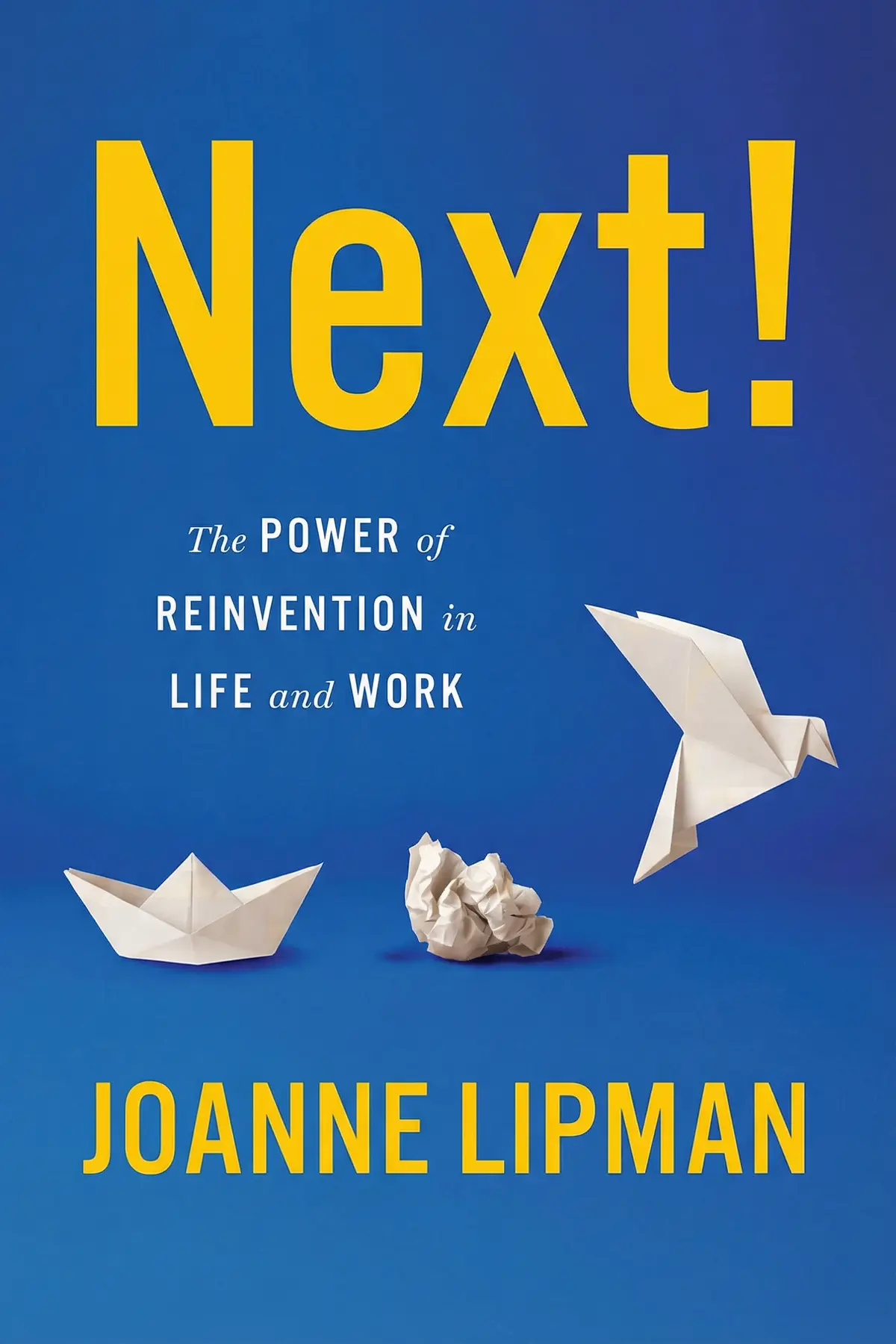
Table of Content
1. Introduction
1 min 06 sec
If your work has gone flat and you want a different life without knowing where to begin, there is an encouraging first finding in Next!: your change has probably started already, before any decision. Joanne Lipman, a former editor in chief of USA Today, argues that reinvention is rarely one dramatic leap. It moves through four phases she calls search, struggle, stop and solution, and each has its own work.
Her case is that reinvention is a process you can recognize and steer. It is built from experience you already have, setbacks you study instead of hide, and pauses that let new answers surface. She sets it against wide unhappiness at work, citing Gallup polls that put job dissatisfaction at a record high.
What follows will help you locate yourself among the four phases and pick up a tool for each. The proof comes from a fire commander, a home cook, two scientists and a basketball player who kept changing careers.
2. Read your gut as stored experience
1 min 31 sec
A fire commander pulled her crew out of a building seconds before the floor gave way, and it looked like pure instinct. A cognitive scientist explains what was really happening, and what it means for your own hunches.
3. Start small before you feel ready
1 min 42 sec
A pandemic hobby turned into an audience of millions within a year. The story looks like luck, but Lipman sees a pattern in it that reverses the usual order of deciding first and acting second.
4. Treat the stuck phase as part of progress
1 min 45 sec
Feeling stumped and ready to quit usually reads as proof you chose wrong. Lipman points to research, and to a biochemist whose career stalled for years, suggesting that this low point has a job to do.
5. Turn your failures into a career map
1 min 50 sec
One scientist found her next move by writing down everything that had gone wrong in her career. Her unusual document, and the right person beside you, can make a painful stretch far more useful.
6. Work ninety minutes, then step away
1 min 56 sec
A culture of long hours goes back centuries, and telling someone to stop working still sounds almost rude. Yet the evidence Lipman gathers suggests your best idea may arrive only once you leave the desk.
7. Keep reinventing long after the first change
1 min 42 sec
A former professional basketball player went on to four more careers, and none of the moves came easily. His path shows why reaching an answer is rarely the end of the story.
8. Conclusion
1 min 10 sec
Lipman’s four phases add up to a gentler picture of change than the dramatic leap most people imagine. A new direction tends to grow out of things already in motion: a hobby taken seriously, a hunch backed by experience, a run of failures read honestly, a walk that lets the mind connect what it already knows. And the cycle does not end with one answer, as Len Elmore found on his way from basketball to law, commentary and teaching.
The practical work is modest. Pick one small step toward whatever keeps pulling at you, and take it before you feel ready. Write your own CV of failures and look for the pattern in it. Find one person willing to stay with you through the hard middle. Protect your pauses, with ninety minutes of focus followed by twenty or thirty minutes away from the desk.
None of this requires knowing the answer in advance. The fire commander sensed something was wrong and ordered her crew out; her dread came from what years of experience had stored in her. Your next move may already be stored the same way, waiting for you to notice it.
About this book
What is this book about?
Many people feel stuck in work that no longer fits them. Joanne Lipman points to Gallup polls showing job dissatisfaction at a record high, and to studies finding millions who would like to change careers entirely. Her book is about how that change actually happens, and her answer is more hopeful than the image of one bold leap. Lipman describes reinvention as four phases. In search, you try things before you have decided anything, and your instincts are only as good as the experience behind them. In struggle, setbacks act as an incubation period that you can study and learn from. In stop, deliberate breaks make creative insight more likely. In solution, you carry what you know into new settings and stay open to the next change. The ideas come with real people and simple tools: a fire commander whose hunch saved her crew, a home cook who gained 2.5 million fans, a biochemist whose rejected research made the COVID-19 vaccine possible, a scientist's CV of failures and a basketball player with several later careers. Readers get a way to see which phase they are in and what to do there.
Book Information
Who it's for
Professionals feeling stuck
Professionals who feel stuck in work that no longer fits and want a way to begin changing.
Midway through changing careers
Career switchers in the uncomfortable middle of a transition, unsure whether to push on or pivot.
Working nonstop hours
Overworked people who suspect that nonstop hours are blocking their best ideas.
About the Author
Joanne Lipman
Joanne Lipman started as a reporter at The Wall Street Journal and became its first woman deputy managing editor. She was founding editor in chief of Conde Nast Portfolio, then chief content officer at Gannett and editor in chief of USA Today. She lectures at Yale University, contributes to CNBC and wrote the No. 1 bestseller That's What She Said. She has won the Matrix Award for women in communications.
Ratings & Reviews
Ratings at a glance
What people think
Listeners consider this manual on reinvention to be an uplifting and deeply researched look at making personal and career shifts. Although views differ regarding the relatability of the famous case studies—with one listener pointing out that the emphasis on "giant success stories" might seem unattainable for most people—many value the book’s straightforward "Search-Struggle-Stop-Solution" model for managing life shifts. Furthermore, listeners appreciate how the blend of interesting stories and psychological data works to clarify the mechanics of transformation. They also highlight that the guide is a relevant and accessible tool for anyone rethinking their professional path or experiencing dissatisfaction in their present job.
Top reviews
Leah
Finally, a roadmap that makes the chaos of career changing feel manageable and even purposeful. Like many others, the pandemic forced me into a period of intense re-evaluation regarding my career goals and personal fulfillment, and this book arrived at the perfect time. The framework Lipman introduces is a total godsend for anyone feeling restless or stuck in a professional rut. I particularly loved the 'Search-Struggle-Stop-Solution' model because it validates the messy, uncomfortable middle part of a transition that most people try to ignore. It’s optimistic, well-researched, and serves as a powerful reminder that failure is often just a springboard for something greater. I’ve already recommended this to three friends who are currently deliberating on their next big moves. It is an essential read for the modern workforce.
Show moreKrisada
After hearing so much buzz about Joanne Lipman's latest work, I decided to dive in during a particularly stagnant week at my corporate job. What I found was an incredibly motivating look at how we can deprioritize our current labors to make room for something legendary. The book emphasizes that luck and mentorship play huge roles, but it also highlights the grit required to move through the 'struggle' phase. I felt like the author was speaking directly to my restlessness, providing a framework to evaluate my next steps without the fear of catastrophic failure. Some might find the success stories intimidating, but I found them to be proof that big risks can lead to even bigger rewards. It's a timely and easy-to-read resource that I’ll definitely be referring back to as I plan my own pivot.
Show moreCholada
Wow, this was exactly what I needed to hear after questioning my career path for the last three years. The pandemic changed everything for me, and Lipman’s guide to navigating these pivots is both insightful and deeply encouraging. I loved the blend of storytelling and research, especially the parts about the 'Stop' phase where you just have to let things settle before the solution appears. It’s a beautifully written book that feels both timely and timeless in its advice about following your passions and taking calculated risks. Even the stories about famous people were fascinating because they showed that everyone, no matter how successful, goes through a period of struggle and doubt. If you are feeling restless and need a push to start your next chapter, buy this book immediately.
Show morePaiboon
As someone who has always been fascinated by the 'how' behind major life pivots, I found this to be a compelling and insightful read. Lipman successfully demystifies the process of reinvention by breaking it down into four distinct stages that feel grounded in actual psychology. The stories are engaging, and while some are about famous figures, the underlying lessons about patience and risk-taking remain universal. I did find myself wishing for a few more examples of 'normal' people who didn't end up as household names, but the high-profile case studies are still very entertaining. The writing style is brisk and professional, making it easy to fly through the chapters. It might not be a 'how-to' manual with checkboxes, but it offers a mental shift that is perhaps more valuable in the long run.
Show moreMarasri
The four-stage framework Lipman outlines—Search, Struggle, Stop, and Solution—is easily the most valuable part of this entire book. It provides a scientific lens to view the transitions we all go through, making the 'Stop' phase feel like a necessary part of growth rather than a sign of laziness. I appreciated how she balanced psychological studies with engaging anecdotes, even if some of the stories felt a little repetitive from other business books. Look, it’s not a magic wand that will instantly fix your career, but it is a fantastic tool for increasing your awareness of life’s cycles. My only real gripe is that there wasn't a dedicated section with a clear checklist of actionable steps to take immediately. Still, it’s a very solid 4-star read for anyone feeling the itch to try something new and daring.
Show moreDuangjai
Lipman's background as a journalist shines through in the way she meticulously weaves together these diverse narratives of transformation and growth. The book is incredibly easy to read and offers a lot of food for thought for anyone currently re-evaluating their professional life. I particularly liked the section on how we can test-run new careers in our 'spare time' before making a full commitment. This gradual approach feels much more realistic than the 'quit your job tomorrow' advice you see in other self-help books. While I agree with other reviewers that the examples are very high-profile, the underlying psychological insights are still applicable if you look past the big names. It’s an optimistic guide that encourages creativity and savvy, even if it lacks a rigid 'how-to' structure.
Show moreAim
While I appreciated Lipman's deep dive into the mechanics of change, the overall impact felt a bit diluted by stories I've heard many times before. The anecdote about the invention of Post-it notes is a classic, but do we really need to read it again in a book published in 2023? I found the first few chapters quite promising because they focused on how passions from your spare time can act as a bridge to a new vocation. However, the momentum slowed down as the book leaned heavily into high-profile success stories that feel out of reach. There are some good nuggets here for leaders, but the lack of actionable, step-by-step instructions for the everyday worker makes it a 'nice to read' rather than a 'must read.' It’s a decent compilation of stories, but ultimately just okay.
Show moreMai
Not gonna lie, I expected more actionable advice for the everyday person in this guide to personal metamorphosis. The book is definitely well-written and the research is top-notch, but the focus on legends like Marie Kondo makes the advice feel a bit lopsided. Truth is, most of us are looking for ways to pivot without risking our entire livelihood, and this book doesn't quite address that middle-class anxiety. Lipman does a great job identifying the 'catalyst' moments that spark change, which helped me be more aware of my own subtle shifts. However, the tips at the end felt a bit thin compared to the long-winded anecdotes. It’s an interesting read for inspiration, but if you’re looking for a practical workbook to change your life, you might find this one a bit too abstract.
Show morePracha
This book left me feeling more discouraged than inspired, which I assume was the opposite of Lipman’s intention. To be fair, the writing is polished and the research into psychological shifts is clearly thorough, yet the examples feel entirely disconnected from reality for most of us. When you’re reading about the pivots of multimillionaires like Jeffrey Katzenberg or global icons like Vera Wang, it’s hard to see how those lessons apply to a mid-level manager or a teacher. The average person doesn't have a massive financial safety net to catch them during the 'Struggle' phase she describes. Frankly, it felt like a highlight reel for the elite rather than a guide for the rest of us. If you enjoy reading about the success of famous people, you’ll like this, but don't expect a relatable handbook for your own modest career change.
Show moreCherry
Ever wonder what it’s like to have millions of dollars and decide to just try a new hobby that becomes a global empire? That seems to be the core requirement for the people featured in this book, and it makes the 'advice' feel totally alienating. Personally, I found it hard to relate to the reinvention of someone who already had the financial means to fail ten times over before succeeding. The average person is living paycheck to paycheck and can't afford a 'Search' phase that lasts for years. While the writing is fine and Lipman is clearly a talented journalist, the choice of case studies was a huge swing and a miss for me. It felt more like a collection of celebrity profiles than a helpful guide for the working class. This one just wasn't for me.
Show moreQuestions about this book
What is the main idea of Next! by Joanne Lipman?
Lipman argues that reinvention is a process with four recognizable phases: search, struggle, stop and solution. Change usually begins before any formal decision, through small experiments. Setbacks act as an incubation period, deliberate breaks make insight more likely, and any solution can lead to the next reinvention. She illustrates each phase with real people, from a fire commander to a former NBA player.
What is a CV of failures?
It is a document listing your professional setbacks instead of your achievements. Scientist Melanie Stefan created one, and reviewing her stumbles in one place helped her change her specialty and find a new path. Lipman suggests making your own to spot your strengths and weaknesses and decide whether to stay on course or change direction, while focusing on what you learn.
What is the 90-minute rule in Next!?
Lipman borrows it from psychologist K. Anders Ericsson. You work with full focus for 90 minutes, with no email, calls or interruptions, then stop for 20 to 30 minutes and do anything you like, such as a walk, a meal or some television. Then you repeat the cycle. It fits her argument that stepping away from work helps creative breakthroughs.
Should I trust my gut when changing careers?
Lipman’s answer depends on what the gut feeling rests on. Drawing on cognitive scientist Gary Klein, she explains that a fire commander’s life-saving hunch was really pattern recognition from years of experience. Instincts are most reliable when backed by expertise, so if you lack experience in a new field, start gathering it through small steps before making a big decision.
Who should read Next!?
It suits people who feel unhappy or stuck at work, whether they want a complete career change or a better version of their current role. It is especially useful for those in the middle of a hard transition, and for anyone who works long hours and wonders whether rest might help them think more clearly about what comes next.
Featured in
Readers also enjoyed

A Guide to the Good Life: The Ancient Art of Stoic Joy
William B. Irvine


A High-Performing Mind: Strengthen Your Mind and Live Your Best Life
Andrew D. Thompson


Abundance: The Inner Path to Wealth
Deepak Chopra


60 Seconds & You’re Hired!
Robin Ryan


AUDIO SUMMARY AVAILABLE
Listen to Next! in 15 minutes
Get the key ideas from Next! by Joanne Lipman, plus 5,000+ more nonfiction titles.
- 5,000+ titles
- Listen as much as you want
- 7-day free trial
- Cancel anytime









