
13 min 06 sec
Available in: English
 ไทย
EnglishไทยNever Split the Difference: Negotiating As If Your Life Depended On It
By Chris Voss, Tahl Raz
Shows how to handle salary talks and everyday disagreements by reading emotions instead of trading arguments. Mirror words, name feelings, invite a no, refuse easy compromise and listen for the surprise that changes the deal.
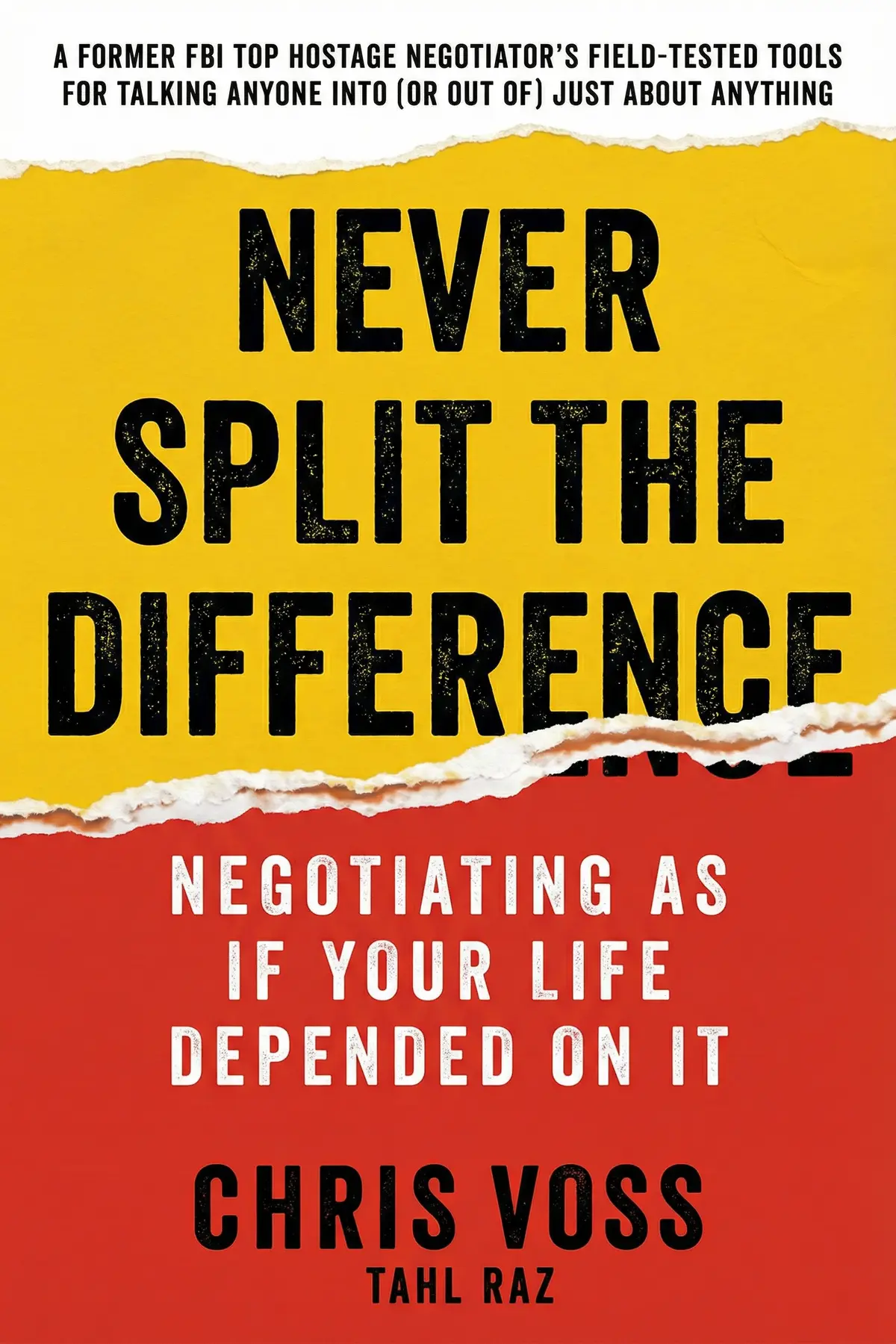
Table of Content
1. Introduction
56 sec
Most people walk into a tough conversation armed with facts, then walk out wondering why the facts lost. In Never Split the Difference, Chris Voss, who spent 24 years at the FBI and worked as a hostage negotiator, argues with journalist Tahl Raz that facts were never in charge. People decide with their emotions and explain the decision with logic afterward.
That is why Voss treats every negotiation as a conversation about feelings, and why his main tool is listening. The whole book makes one case: you get what you want by making the other side feel understood, then using what that trust reveals. On the way, Voss explains why a waiter’s habit builds trust, why a no can be worth more than a polite yes, and why meeting halfway often leaves both sides unhappy. The salary talk you keep putting off gets a set of sentences you can actually say.
2. Treat every disagreement as a negotiation
1 min 36 sec
You probably negotiate more often than you think, and you probably lose more often than you notice. The reason has little to do with how good your arguments are, and a lot to do with how people really decide.
3. Repeat their words to keep them talking
1 min 44 sec
A habit you have seen in every restaurant turns out to be one of the simplest ways to make a stranger trust you. Add the right tone of voice, and people start telling you more than they planned.
4. Calm a tense talk by naming the emotion
2 min 05 sec
A raise request built on hard work and long hours gets a pat on the back and nothing more. One different sentence changes the boss’s answer, and it says nothing at all about the employee’s achievements.
5. Get a no that moves the talk forward
1 min 42 sec
Most of us work hard to avoid hearing no, and we chase agreement instead. Voss suggests the opposite, and his reasoning explains why so many polite yeses never turn into anything real.
6. Skip the halfway deal and use time pressure
1 min 43 sec
Meeting in the middle feels like the mature way to settle a dispute. Voss thinks it often leaves both people worse off, and he offers two quieter sources of pressure that work better.
7. Find the hidden fact that tips the deal
2 min 12 sec
Any negotiation involves things you know, things you suspect, and things you cannot even imagine. The last group decides more outcomes than the first two, and there are ways to bring it into view.
8. Conclusion
1 min 08 sec
Voss’s book is finally an argument about where power in a conversation really sits. Facts and lists of achievements count for less than most of us believe. The person who listens best learns the most, and the person who learns the most decides where the deal goes. Every technique serves that idea, from the waiter’s repeated order to the black swan nobody saw coming. Even the word no, which feels like a wall, turns out to be a way of making the other side feel safe.
None of this needs a boardroom. In your next disagreement, repeat the other person’s last words and let them continue. When tension rises, name what they seem to feel, starting with it sounds like, and then stop talking. Ask a question they can honestly answer with no. And when someone offers to meet you halfway, first look for a fact you have not heard yet.
In Voss’s salary example, the opening came from one sentence that showed the boss someone understood the pressure they were under. That is where most good deals begin.
About this book
What is this book about?
Most people prepare for a hard conversation by collecting arguments, then watch those arguments fail. Chris Voss, a former FBI hostage negotiator writing with journalist Tahl Raz, explains why. People decide with emotion and justify with logic later, so whoever understands the feelings in the room shapes the outcome. Voss treats negotiation as part of daily life, from a child bargaining over bedtime to an employee asking for a raise. His method starts with listening and builds outward. Mirroring and a deliberate tone of voice create trust. Labeling, the habit of naming the other person's emotion out loud, calms tension and opens people up. A well-timed question that invites a no gives the other side a feeling of control and moves the talk forward. Deadlines and the word fair add pressure, and Voss argues against meeting halfway. The last piece is the black swan: the unexpected fact that can turn a negotiation around. Readers learn how to draw such facts out through questions and face-to-face contact, and how to use them as positive, negative or normative power. A single salary meeting comes back again and again as a worked example, showing labeling, saying no, time and fairness in action.
Book Information
Who it's for
Staff asking for raises
Employees preparing to ask for a raise who keep getting a polite pat on the back.
Dealmaking founders and managers
Managers and founders who bargain with clients, partners and teams every week.
Winning arguments too late
Anyone who wins the argument in their head an hour after the real conversation ends.
About the Author
Chris Voss
Chris Voss spent 24 years with the FBI, where he worked as a hostage negotiator. He founded The Black Swan Group, a consulting firm that trains and advises Fortune 500 companies on complex negotiations, and has taught negotiation at business schools including Georgetown University and the University of Southern California. Tahl Raz is a journalist and editor published in Inc. Magazine, GQ and Harvard Business Review. He co-wrote Never Eat Alone, which MBA programs around the world have used as a textbook.
Ratings & Reviews
Ratings at a glance

What people think
Listeners find this work very accessible and straightforward, packed with actionable lessons and meaningful observations about human psychology. The book is structured to assist people in refining their negotiation skills, as one listener pointed out how effectively the communication tactics are described. Additionally, listeners value the authentic and gripping anecdotes that keep them hooked, and they prize the way the content strengthens their communication and personal bonds.
Top reviews
Paiboon
Ever wonder why logic fails in a heated argument? This book tosses the traditional 'rational' negotiation playbook out the window and replaces it with raw human psychology. Voss argues that emotions aren't obstacles to be ignored, but tools to be leveraged through tactical empathy. I found the concepts of labeling and mirroring to be immediately applicable in my daily interactions at the office. The prose is punchy and moves fast, keeping you hooked with high-stakes FBI stories that illustrate each principle perfectly. While some might find the tactics a bit calculating, the truth is that they simply reflect how our brains actually process information. It’s not about being a jerk; it’s about understanding the person across from you. If you want to stop getting steamrolled and start finding better solutions, this is essential reading.
Show moreSienna
Forget the usual corporate fluff that tells you to meet in the middle. Voss makes a compelling case that 'splitting the difference' usually leads to a terrible deal for everyone involved. What I loved most about this book was how it reframes negotiation as an act of discovery rather than a battle of wills. By using calibrated 'How' and 'What' questions, you force the other party to help you solve your problem. It sounds manipulative on paper, but in practice, it actually makes the other person feel heard and respected. The writing is incredibly engaging, almost like a thriller novel, but with actionable takeaways at the end of every chapter. It’s rare to find a business book that is both a page-turner and a functional manual for life. My communication skills have improved 100%.
Show moreZoey
Not what I expected from a business book, but exactly what I needed. Voss breaks down complex psychological concepts into simple tools that anyone can use, regardless of their profession. I particularly enjoyed the section on the 'Accusation Audit.' It’s a brilliant way to disarm someone by calling out their negative perceptions of you before they even have a chance to voice them. In my experience, this alone has saved several failing projects at work. The book is highly readable and avoids the dry, academic tone you find in most negotiation texts. It’s grounded in the reality of how people actually think and feel, not how we wish they would behave. If you want to understand the hidden drivers behind human interaction, grab a copy. It’s an eye-opening look at the art of persuasion.
Show moreNarumon
After hearing everyone rave about this, I finally dove in and I’m glad I did. This isn't just for 'power hungry' business people; it's for anyone who has to deal with other humans. The insight that 'No' is the start of the negotiation, not the end, was a massive 'aha' moment for me. People feel safe when they say no, and Voss teaches you how to use that safety to uncover what they really want. The writing style is clear and accessible, making it easy to digest even for those of us who aren't in sales. I’ve already used the 'How am I supposed to do that?' question in a difficult client meeting and the results were almost spooky. It works. This book provides a realistic look at human behavior that most 'self-help' gurus completely miss.
Show moreTippawan
Chris Voss delivers a masterclass in communication that feels both dangerous and essential. He manages to bridge the gap between high-stakes crisis negotiation and everyday life with surprising ease. I was worried it would be too focused on 'winning' at all costs, but it’s actually more about deep listening and emotional intelligence. The book is structured beautifully, with each chapter building on the last to create a comprehensive system for influence. Not gonna lie, I was skeptical about the 'Late Night FM DJ Voice,' but it actually makes a huge difference in de-escalating tension. The stories are gripping and the lessons are immediately actionable. If you are looking for a way to improve your relationships and your bank account simultaneously, look no further. This is a five-star resource for understanding what makes people tick.
Show moreTaweesak
Picked this up after hearing it’s the 'anti-Getting to Yes,' and I wasn't disappointed by the shift in perspective. Instead of focusing on win-win scenarios that often feel unrealistic, Voss digs into the messy reality of irrational human behavior. The techniques, like the Accusation Audit, sounded bizarre at first but actually help clear the air in tense meetings. I do think some of the hostage negotiation anecdotes are a bit repetitive, yet they serve their purpose in hammering home the high stakes. Look, I’m not saying every car salesman is a terrorist, but the principles of calibrated questions definitely help in those scenarios. To be fair, some sections feel a bit like filler, especially if you’ve already studied basic behavioral psychology. Still, it’s a very practical guide that offers more than just theory. It significantly changed how I approach my 'No' responses.
Show moreNam
As someone who struggles with social anxiety, the idea of 'negotiating' always terrified me. This book helped me realize that it’s really just about listening and repeating what you hear. The technique of 'Mirroring'—simply repeating the last few words someone said—is a total game changer for keeping a conversation going without feeling awkward. I started using these tips with my landlord and managed to keep my rent from increasing this year. My only complaint is that Voss comes across as a bit of an egoist at times. He definitely thinks his way is the only way, and he doesn't have much patience for other styles. However, if you can get past the bravado, the psychological insights are gold. It's a very readable guide for anyone who wants to navigate human nature more effectively.
Show moreBrooklyn
The chapter on 'creating the illusion of control' is worth the price of the book alone. Most of us try to dominate conversations when we want something, but Voss shows that giving the other person the floor is actually more powerful. By asking calibrated questions, you guide them to the conclusion you want while they feel like they’re in charge. It’s brilliant. My only gripe is the heavy reliance on hostage stories; while exciting, they don't always translate perfectly to deciding where to go for dinner or asking for a small raise. Some of the advice feels a little 'one-size-fits-all,' ignoring personality differences like introversion. Still, the core lessons on empathy and active listening are universal. It’s a solid addition to any professional’s library, even if you have to filter out some of the FBI intensity.
Show moreUbolwan
To be honest, I have mixed feelings about this one. On one hand, the storytelling is top-notch and the concepts like 'System 1' vs 'System 2' thinking are fascinating. On the other hand, it feels like it could have been a long blog post instead of a full book. There is a lot of filler between the actual tips, and the author spends a lot of time patting himself on the back. I also found some of the tactics, like the 'Akselrod' haggling model, to be way too complicated for everyday use. Who has time to calculate diminishing percentages during a quick car deal? It's a decent read if you like true crime stories mixed with business advice, but don't expect it to magically solve every conflict in your life. It’s more of a toolbox than a bible.
Show moreGift
Frankly, I felt a bit greasy after finishing this. The author’s tone often leans into a specific type of aggressive masculinity that assumes everyone else is just a pawn to be 'mirrored' or 'labeled.' While the FBI stories are gripping, they often feel like a stage for Voss to show off how he outsmarted everyone around him. It ignores the reality that these high-pressure tactics don't land the same way when coming from a woman or someone without his inherent authority. Much of the advice feels like a manual for subtle manipulation rather than genuine communication or relationship building. I’m sure it’s a goldmine for the 'alpha' business crowd, but for anyone looking for ethical connection, it’s a bit much. I learned what to watch out for from people who use these tricks, which is the only real value I got.
Show moreQuestions about this book
What is the main idea of Never Split the Difference?
Chris Voss argues that people decide with emotion and explain their decisions with logic afterward, so negotiations are won by understanding feelings rather than by stronger arguments. His method starts with listening: mirroring words, using a calm or playful tone and naming emotions. Trust then reveals what the other side wants, which you can use to steer the deal instead of settling halfway.
What is labeling in Never Split the Difference?
Labeling means spotting the other person’s emotion and saying it out loud, starting with phrases like it sounds like or it looks like rather than putting yourself in the sentence. You state it, then stay quiet so they can respond. In Voss’s salary example, telling the boss that it sounds like management is pressuring them leads the boss to open up and offer an incentive.
Why does Chris Voss say you should get a no?
Voss sees no as a tool. Saying it clarifies what you want and buys time, while letting the other person say it gives them a sense of control that helps them relax. He suggests asking questions designed to get a no, such as asking a boss whether you have been underperforming, which keeps their autonomy but leaves little room to refuse your request.
How can I use Never Split the Difference in a salary negotiation?
Start by labeling your boss’s situation instead of listing your achievements, so they feel understood. Ask a question that invites a no, such as whether your work has fallen short. If they ask for time, set a private date after which you will look elsewhere. Use the word fair with care, either early on to show you are considering the other side, or as a pointed, defensive accusation.
What is a black swan in negotiation?
Voss uses black swan to mean an unexpected piece of information that can completely change a negotiation. You cannot predict these unknown unknowns, but you can surface them by asking many questions, watching nonverbal reactions, meeting in person instead of by email and staying alert in informal moments. Once found, they give you positive, negative or normative power in the deal.
Readers also enjoyed






AUDIO SUMMARY AVAILABLE
Listen to Never Split the Difference in 15 minutes
Get the key ideas from Never Split the Difference by Chris Voss, plus 5,000+ more nonfiction titles.
- 5,000+ titles
- Listen as much as you want
- 7-day free trial
- Cancel anytime









