
12 min 10 sec
Available in: English
Necessary Endings: The Employees, Businesses, and Relationships That All of Us Have to Give Up in Order to Move Forward
By Henry Cloud
Shows how to tell when a job, business, employee or relationship should end, how to build the urgency to act, and how to handle the hard conversation that follows.
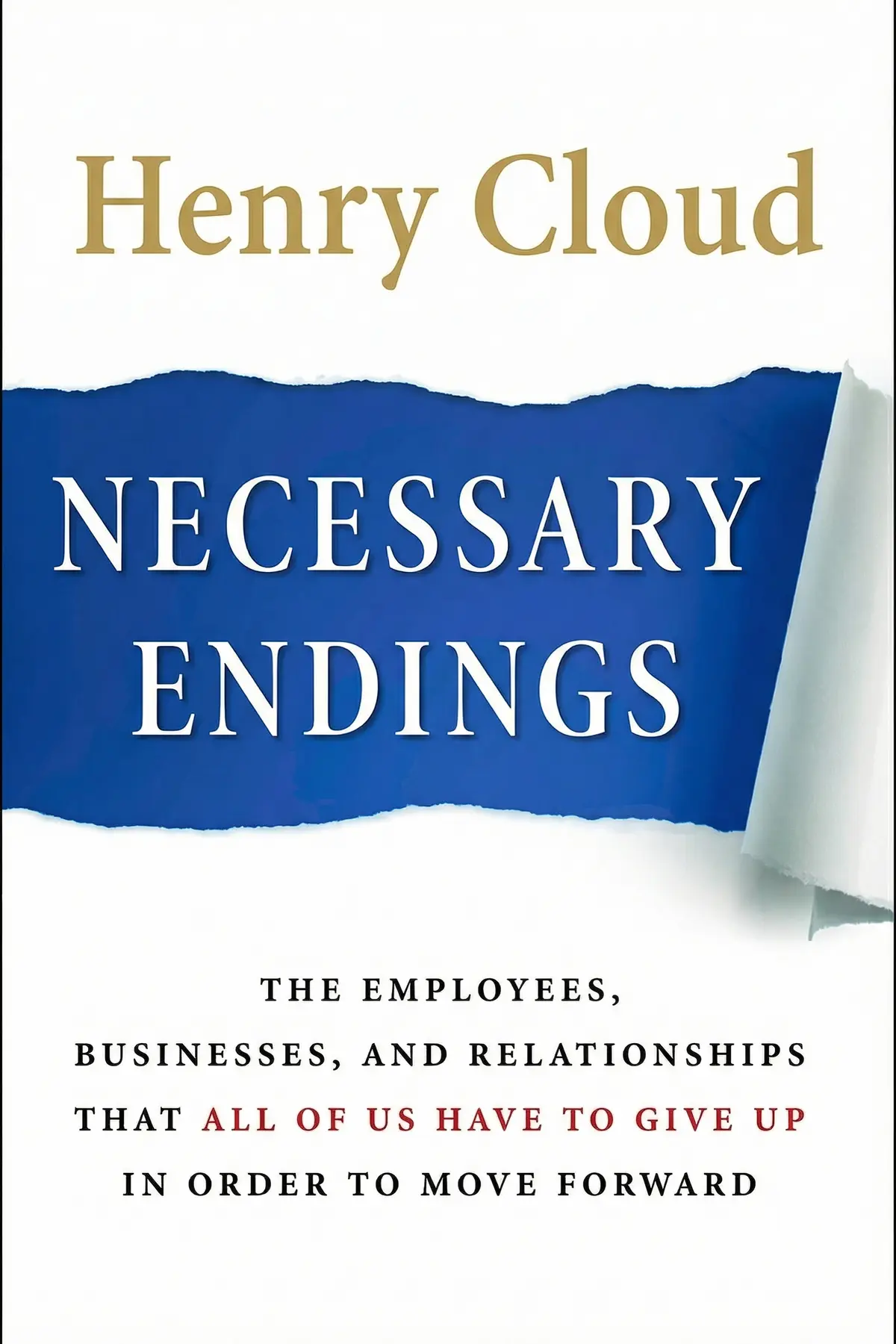
Table of Content
1. Introduction
1 min 00 sec
Many people stay for years in jobs, partnerships and business plans that drain them, and Henry Cloud argues that the real trouble is the holding on, more than the ending itself. In Necessary Endings, the clinical psychologist and executive coach treats letting go as a normal, healthy part of any life or company that is growing. A gardener cuts back a rosebush so the strong buds get the energy, and Cloud wants us to look at our work and relationships the same way.
His case is that once you know what you are growing toward, you can read the warning signs, find enough urgency to act, and end what holds you back with clarity instead of dread. Along the way a father is advised to ask for a future son-in-law’s tax returns and credit report, a chemical maker closes his firm and starts over, and an executive keeps delaying a talk she has already decided to have. What you get is a way to decide what stays, what goes, and how to say it.
2. Treat endings as a normal part of growth
1 min 55 sec
A design classic, a 1970s fashion and a determined small business owner all hit the same wall. The way one of them responded turned a painful loss into the start of a second career.
3. Prune toward a goal you can name
1 min 31 sec
A gardener never cuts a rosebush at random, and one famous chief executive never cut his company at random either. The difference between pruning and simple loss comes down to a single question asked before the first cut.
4. Predict the future from the past record
1 min 38 sec
A worried father wanted to know whether to bless his daughter’s engagement. The advice he got sounded strange at first, and it works just as well for hiring, partnerships and second chances.
5. Turn discomfort into the urgency to act
1 min 44 sec
A struggling chair business changed suppliers overnight, though nothing in its numbers had moved that day. A simple exercise in front of a mirror recreates the same jolt for any situation you keep tolerating.
6. Set the standard and let others choose
1 min 37 sec
Ending a relationship you still value can feel impossible. Cloud describes a way to reach a clear answer without forcing it, plus a dated promise to yourself for the choices nobody else can make.
7. Walk into the hard conversation already decided
1 min 38 sec
An advertising executive knew exactly what she wanted and still could not bring herself to say it. Her stalling points to the one piece of preparation that keeps difficult endings on course.
8. Conclusion
1 min 07 sec
Cloud’s book is, in the end, about permission. Many people see endings as negative events, so they tend to avoid them rather than face them. He recasts the ending as the gardener’s cut: a choice made for the sake of what comes next, and judged against a clear picture of what healthy looks like.
Once you see it that way, the question changes. It is no longer whether you are allowed to end something, but whether your goal and the evidence say you should. Blair did not lose his working life when he closed his chemical business. He found the next one.
If something in your life keeps draining you, begin by naming what you want it to become, then read the record honestly, the way that father read a credit report. Give the other person, or yourself, a clear standard and a date. And before the hard talk, decide exactly what you will say, with a few allies nearby who see what you see.
Holding on can feel like loyalty. Often it is only fear of one conversation, and the rosebush cannot bloom until someone picks up the shears.
About this book
What is this book about?
Most people stay too long in things that drain them: a business that no longer pays, an employee who keeps falling short, a relationship with no future. Henry Cloud, a clinical psychologist and executive coach, argues that the ending is rarely the real problem. The real problem is that we treat every ending as a failure, so we avoid it. Cloud borrows the gardener's view. A rosebush blooms because someone cuts away what drains it, and the cuts follow a clear picture of the healthy plant. From there he offers practical tests. Look at past behavior to predict the future, judge whether the person responsible can be trusted, and make the present feel real enough that change becomes urgent. The book then turns to execution. Readers learn to state their standards and let others choose whether to meet them, to set personal deadlines for decisions only they can make, and to prepare for the conversation that ends things, ideally with allies who see the need as clearly as they do.
Book Information
Who it's for
Keeping failing projects alive
Founders and managers keeping a failing product, project or hire alive out of hope.
Professionals stuck for years
Professionals stuck in a job or business that stopped working years ago.
In a draining relationship
Anyone in a relationship that drains them who keeps postponing the conversation.
About the Author
Henry Cloud
Henry Cloud, born in 1956, is a clinical psychologist who earned his Ph.D. at Biola University. In 1992 he co-wrote Boundaries, which sold two million copies and grew into a five-part series, and his books together have sold nearly 20 million copies. He works as a leadership consultant and executive coach for CEOs and leadership teams, founded a chain of treatment centers in more than 40 western US cities, and has led Cloud-Townsend Resources, which runs public seminars on relationships and personal growth.
Ratings & Reviews
Ratings at a glance

What people think
Listeners find this book beneficial for their careers and private lives, offering actionable guidance through numerous actual scenarios. The author's prose is top-notch, and listeners characterize it as a straightforward guide that functions like a sequential manual. They value the transformative insights, with one listener mentioning how it assists in clarifying muddled circumstances, while another points out its emphasis on concluding both work-related and personal associations.
Top reviews
Tanyaporn
Finally finished this masterpiece after it sat on my nightstand for three months. Cloud provides a surgical look at why we cling to dead weight in our professional and personal lives. The breakdown of people into three categories—the wise, the foolish, and the evil—was a total revelation for me. It transformed how I view feedback loops. Instead of banging my head against the wall with a "foolish" employee who refuses to own their mistakes, I now understand the necessity of the pruning process. To be fair, some of the corporate metaphors felt a bit sterile, but the core message is undeniable. If you are feeling stuck in a season that should have ended years ago, this is your roadmap. The writing is accessible, and the step-by-step playbook makes it easy to apply immediately to confusing situations. I wish I had read this a decade ago.
Show moreSelin
Wow, this was exactly what I needed to hear during a really difficult career transition. Dr. Cloud uses the metaphor of pruning a rose bush to explain that for new growth to happen, the healthy but non-productive parts must be cut away. It sounds harsh, but it’s actually a very graceful way to look at endings. Not gonna lie, I cried a little during the chapter on personal relationships because I realized I was holding onto "winter" when I should have been preparing for "spring." The book is structured like a practical guide, offering real-world examples that make the concepts feel grounded and achievable. Personally, I found the "Four Questions of Hope" to be the most impactful part of the entire text. It helps you stop living in a fantasy version of the future and start dealing with the reality of the present. This isn't just a business book; it’s a life manual.
Show moreDavid
After hearing about this from several mentors, I finally picked it up, and it lived up to the hype. Many leadership books focus on starting or scaling, but Cloud tackles the much harder skill of finishing. He makes a compelling case that growth requires pruning—not just of the bad things, but even of the good things that are in the way of the best things. I found the chapter on the three types of people to be a masterclass in discernment. It’s practical, easy to follow, and filled with real-life situations that felt like they were pulled directly from my own office. Truth is, we all have projects or relationships that are essentially on life support. This book gives you the permission—and the tools—to pull the plug with integrity. It’s a life-changing perspective for anyone who feels overwhelmed by too many commitments. Essential reading for every manager.
Show morePraepimon
What a powerful framework for decision-making! This book isn't just about firing people; it's about the stewardship of your time and energy. The way Cloud defines wise, foolish, and evil individuals is perhaps the most useful psychological tool I've encountered this year. It helps you stop trying to use "wise" methods (like logic and feedback) on "foolish" people who will only deflect and deny. I especially appreciated the focus on reality versus fantasy. Got to say, the Woody Allen quote about reality being the only place to get a good steak was a perfect touch to illustrate that truth is the only place to find satisfaction. The book provides a step-by-step playbook that helps navigate the most confusing and emotionally charged transitions. It’s a quick, easy read that stays with you long after you close the cover. If you feel like you're spinning your wheels, buy this book immediately and start your own pruning process.
Show moreAey
Before reading this, I felt paralyzed by guilt over the idea of walking away from certain commitments. Cloud completely reframed my perspective by showing that endings are not just necessary—they are healthy. The step-by-step approach to evaluating whether a situation has a future or is just a delayed ending was incredibly freeing. Personally, the real-life examples were the highlight for me because they showed how these principles work in both business and personal contexts. The distinction between helping someone and enabling them changed my entire approach to my team. It’s a very easy read, but the content is profound and life-changing. If you’re struggling to decide whether to quit a job or end a relationship, this provides the clarity you’ve been looking for. It is a brilliant guide for anyone ready to move forward into a new season. Truly an essential addition to any leadership library.
Show moreThongchai
As someone who struggles with confrontation, I found this to be a very helpful, if occasionally uncomfortable, read. Henry Cloud gets straight to the point about why we let toxic situations linger far longer than they should. The distinction between helping someone who is genuinely capable versus enabling someone who refuses to grow was a huge "aha" moment for me. Look, it’s a bit repetitive in the middle sections, and I think it could have been about fifty pages shorter without losing much impact. However, the strategies for having those difficult "ending" conversations are gold. It provides a clear playbook for navigating messy exits without feeling like a villain. I’ve already started applying the diagnostic questions to my current project list, and I’ve already dropped two pet projects that were just draining my energy. Solid 4-star read for anyone in a leadership role.
Show moreCherry
Ever wonder why you're still doing that one task you hate or staying in a job that drains your soul? This book dives deep into the psychology of why we refuse to quit. Cloud argues that endings are a natural and necessary part of any life cycle, yet we treat them like failures. I loved the section on "false hope" versus "objective evidence." In my experience, we often stay in bad situations because we hope things will change without any actual plan for that change to happen. The writing style is excellent and moves quickly, though some of the church-specific examples felt a little out of place for a general business audience. Still, the step-by-step approach for evaluating professional positions is incredibly valuable. It’s a great companion for anyone feeling stagnant. It really helps you distinguish between a temporary setback and a permanent dead end.
Show morePlernpiriya
Pick this up if you need a kick in the pants to finally make a change. Cloud is great at providing practical advice for knowing when to end things, whether it's a toxic friendship or a failing product line. I listened to the audio version and found it very easy to follow, though I think having a hard copy for the "Four Questions of Hope" would have been better for taking notes and reflecting. One minor criticism: the book gets a bit repetitive in the second half. He tends to hammer the same points home multiple times, which might be good for retention but felt a little tedious as a reader. To be fair, the core concepts are so important that they probably deserve the extra emphasis. It’s a solid resource for anyone navigating major life transitions. It really helps you realize that ending something isn't a failure—it's often a requirement for your next success.
Show moreAmara
Honestly, I have mixed feelings about this one. On one hand, the concept of pruning for growth is a brilliant metaphor that applies to almost every area of life. On the other hand, the application to church ministry felt a bit off-putting to me. As someone in the non-profit world, treating parishioners or volunteers like disposable corporate assets felt a bit cold and corporate. The writing is accessible, but the book could have easily been a long-form article. It’s quite repetitive, and I found myself skimming several chapters toward the end. Not gonna lie, the "wise, foolish, evil" labels feel a bit judgmental and oversimplified for real-world relationships. However, the practical steps for identifying when a season is over are genuinely useful. It’s a decent book with a few standout ideas, but it didn't quite live up to the five-star hype for me. Take what is helpful and leave the rest.
Show moreTen
The corporate-heavy tone was a bit of a turn-off for me, especially as I was looking for more personal relationship advice. Frankly, it feels like it was written primarily for tech-bro CEOs looking for an excuse to fire people without feeling guilty about the human cost. While the "wise, foolish, evil" framework is conceptually interesting, it feels far too reductive when applied to complex individuals who might just need better training or support. To be fair, Cloud supports personal development for the reader, but he doesn't seem to extend that same grace to employees who aren't "cutting the mustard." The pink slip is treated like a universal cure-all here, which feels more retributive than restorative in the long run. I struggled with the lack of empathy and the assumption that everyone who doesn't fit a specific mold is a fool. It’s a very easy read with a step-by-step playbook, but it left a bad taste in my mouth regarding how we should treat our fellow human beings during transitions.
Show moreQuestions about this book
What is the main idea of Necessary Endings by Henry Cloud?
Cloud argues that endings are a normal and healthy part of growth, in business and in personal life. Like a gardener pruning a rosebush, you cut away what drains energy so the healthy parts can thrive. He shows how to set a clear goal, judge situations by past behavior and trustworthiness, build urgency to change, and prepare for the conversation that ends things.
How do you know when something should end, according to Cloud?
Cloud offers two tests. First, past behavior predicts future behavior, which is why he advised a father to look at a suitor’s tax returns and credit report as signs of responsibility. Second, examine whether the person on whom success depends can be trusted with the task, as a comedy club owner would weigh a failed amateur against a proven professional.
What is self-selection in Necessary Endings?
Self-selection means stating your standards clearly and letting the other person decide whether they can meet them. In a relationship, you say what you need and ask whether your partner will commit to it. When a decision concerns only you, you set your own deadline in advance, such as moving home if no decent job appears by October.
How can I apply Necessary Endings at work?
Write down what a healthy team or business should look like, then check each project, product and role against it. Judge people by their record, not their promises. Make the cost of staying put feel real, as the chair seller did when he learned a rival was cheaper. Before a difficult exit conversation, decide exactly what you will say.
What is an ending alliance?
Cloud uses the term ending alliance for a set of people who, as you do, recognize that something has to come to an end. Because moods spread between people, spending time with them creates positive pressure that helps you follow through, which is especially helpful when you are struggling to leave an unhealthy relationship or situation.
Readers also enjoyed




A Guide to the Good Life: The Ancient Art of Stoic Joy
William B. Irvine




A High-Performing Mind: Strengthen Your Mind and Live Your Best Life
Andrew D. Thompson

A Year with Peter Drucker: 52 Weeks of Coaching for Leadership Effectiveness
Joseph A. Maciariello

AUDIO SUMMARY AVAILABLE
Listen to Necessary Endings in 15 minutes
Get the key ideas from Necessary Endings by Henry Cloud, plus 5,000+ more nonfiction titles.
- 5,000+ titles
- Listen as much as you want
- 7-day free trial
- Cancel anytime









