

16 min 36 sec
Available in: English
 ไทย
EnglishไทยNapoleon the Great
Follows Napoleon Bonaparte from mocked Corsican schoolboy to Emperor of France and exile. It shows how preparation, daring and concentrated force won him Europe, how overconfidence lost it, and which reforms outlasted him.
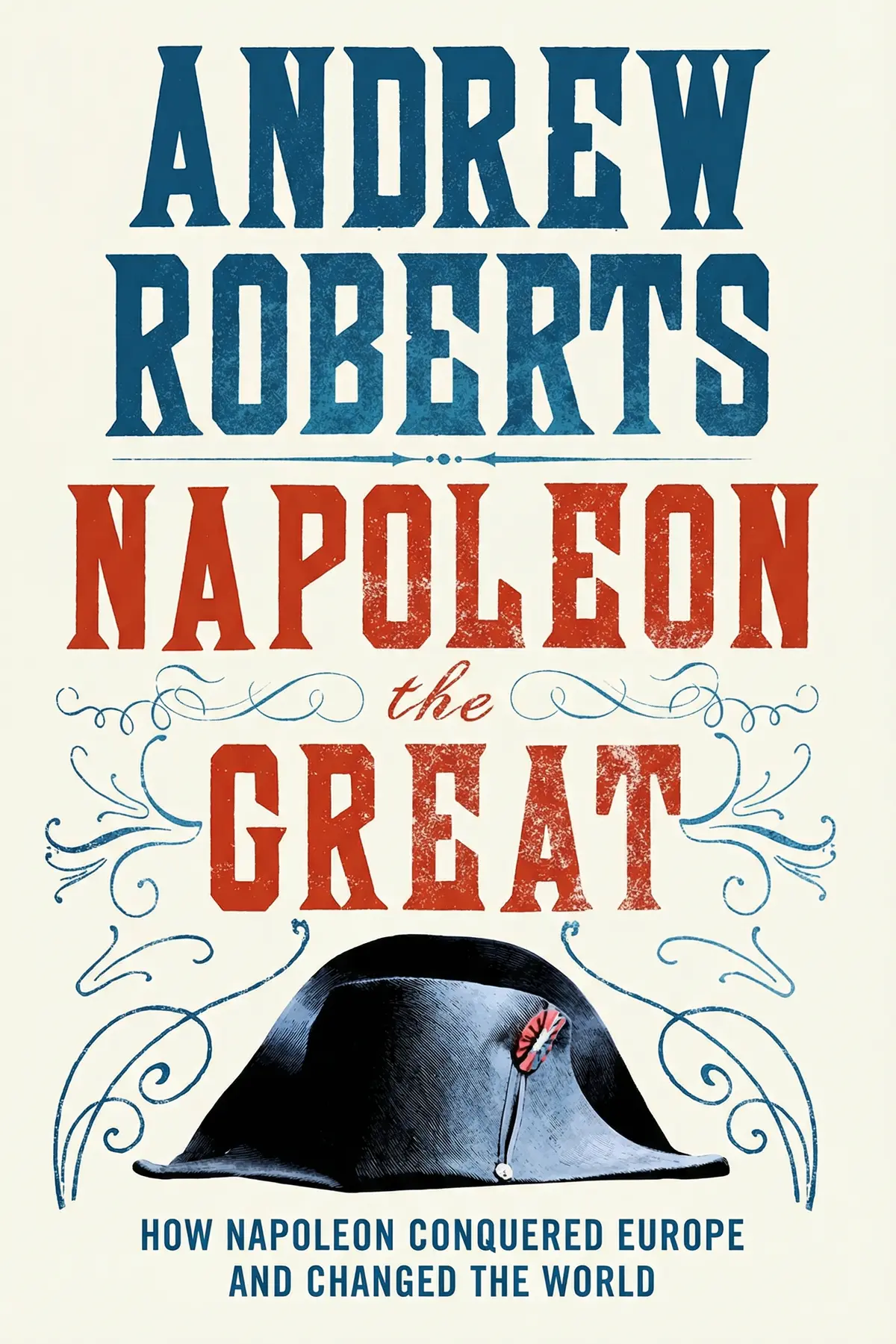
Table of Content
1. Introduction
1 min 02 sec
A mocked Corsican schoolboy who spoke French with an accent became Emperor of France. The habits that lifted him were the same ones whose neglect later brought him down. In Napoleon the Great, historian Andrew Roberts tells the life of Napoleon Bonaparte, one of the rare figures who seem to have driven events almost single-handed. Roberts shows a man who prepared for years, struck boldly and kept his army concentrated, and that formula carried him across Europe.
There were times when an easy win made him overconfident, or when he split his forces. Then the cost ran to hundreds of thousands of lives. Along the way he rebuilt French government, law and warfare, and some of that work still shapes Europe. Follow him from an island school to the throne and on to a rock in the South Atlantic. You will have a clear story to retell and a sharper eye for the moment a strength becomes a blind spot.
2. Turn being the outsider into fuel
1 min 58 sec
He was born on an island that had only just become French, and his classmates never let him forget it. What he did with their contempt set the pattern for everything that followed.
3. Win outnumbered by preparing years ahead
1 min 46 sec
Handed an army smaller than the enemy’s, a 26-year-old general moved at once and kept winning. The explanation lies in what he had been doing for three years before anyone gave him the job.
4. What an easy first win can blind you to
2 min 04 sec
The campaign opened with a city captured almost without effort. Months later the army had been blinded, poisoned and stopped cold, and the general who led it had also lost something far more personal.
5. See how a broken system hands power to the bold
1 min 58 sec
He walked into the nation’s legislature to win it over and was thrown out, called an outlaw and a dictator. Within hours he held the highest office in France, thanks to one piece of theater.
6. Concentrated force beats a bigger army spread thin
2 min 01 sec
In one battle he was outnumbered two to one by an army he never saw coming. Five years later he was the one exploiting that mistake, and the difference came down to a single rule.
7. A plan that needs everyone's restraint will leak
2 min 05 sec
He made peace across all of Europe, something no ruler had managed, and then watched it collapse within a year. His answer was a bold economic weapon, and it carried a flaw that led straight to catastrophe.
8. Spot the moment a winning habit starts to slip
2 min 28 sec
He lost an army of half a million, came back from exile with a few hundred men and retook France without a fight. Then, at Waterloo, he made a mistake he had learned to avoid years before.
9. Conclusion
1 min 14 sec
Napoleon’s life reads as one long test of what discipline and daring can do together. It also shows what happens when daring stops listening to discipline. The boy who studied eight hours a day at Brienne became the general who planned Italy for three years. Later he swung 170,000 men south in a single day. The same man marched into a Russian winter and split his army at Waterloo. Roberts counts him among history’s greatest leaders. The strongest case is what outlasted the battles: a rebuilt government, the Code Napoleon and a brief peace across Europe.
His story gives you a few things to watch for in your own work. Prepare long before the chance arrives, and keep your effort in one place instead of scattering it. An easy first win is a reason to look harder at the next step. When you make an agreement, settle the hard questions before you sign.
Paris gave him a proper funeral only on December 2, 1840, the anniversary of Austerlitz, and a million people came. The date fits the lesson: he is remembered best for the misty morning he did everything right.
About this book
What is this book about?
Few people in history seem to have steered events almost alone. Napoleon Bonaparte is one of them. Born on Corsica a year after the island became French, he was mocked at military school and still became a general at 24. He went on to rule France and much of Europe, and then lost almost everything. Historian Andrew Roberts tells that life as a story of habits. Napoleon prepared for years before his chances came, struck boldly and kept his army concentrated. That formula carried him from the bridge at Lodi to Austerlitz. When an easy win made him overconfident, as in Egypt, the price was steep, and when he split his forces he nearly lost at Marengo and was decisively beaten at Waterloo. Russia alone cost him around 524,000 men. Alongside the battles, Roberts follows the coup that made him First Consul, the Code Napoleon, the fragile peace treaties and the trade blockade aimed at Britain. Readers get the whole arc as one clear story they can retell. They also see what it shows about ambition, crisis and power, and about how a winning habit can slip.
Book Information
Who it's for
Professionals curious about Napoleon
Curious professionals who want the full arc of Napoleon's life told as one clear story.
European history students
Students of European history looking for the link between the French Revolution, the empire and modern France.
Leaders and career climbers
Leaders and ambitious climbers interested in how preparation wins and overconfidence loses.
About the Author
Andrew Roberts
Andrew Roberts is a historian who earned a first class degree in Modern History and later a doctorate at Gonville and Caius College, Cambridge. He is a fellow of the Royal Society of Literature and has been a visiting research fellow at the Hoover Institution at Stanford University. He was a trustee of the National Portrait Gallery in London from 2013 to 2021. His books include The Storm of War, which won a British Army book award, Salisbury: Victorian Titan and a biography of Winston Churchill.
Ratings & Reviews
Ratings at a glance
What people think
Listeners find this biography captivating and masterfully written, highlighting its thorough examination of Napoleon's life and the tactical history of his campaigns. Furthermore, the work is commended for its flow and engaging nature, with one listener mentioning that it offers profound perspective on the era. Listeners also respond well to Napoleon’s character, as one listener characterizes him as one of the greatest personalities in recent history.
Top reviews
Aey
This massive volume captures the dizzying rise and precipitous fall of history’s most enigmatic conqueror with remarkable clarity. Roberts writes with infectious enthusiasm. He makes even the dense administrative reforms of the Napoleonic Code feel like essential reading. While some might find his 'great man' approach a bit old-fashioned, it’s hard to argue with the sheer level of research on display here. The tactical breakdowns of his sixty battles are vivid, though I’ll admit the sheer volume of military maneuvering can occasionally feel overwhelming for the casual reader. Still, seeing Napoleon transition from a penniless political refugee to the master of Europe is a journey worth every one of these 800 pages. It is a definitive look at a man who essentially founded modern France through sheer force of will.
Show moreWillow
Picked this up specifically because of the buzz surrounding the 33,000 newly available letters Roberts used, and they really do provide a window into the 'inner man' that other biographies lack. You get a sense of his frantic energy and his surprisingly messy personal life, including his obsessive letters to Josephine. Truth is, the book makes a very strong case for the 'Great' epithet by highlighting his civil achievements like the Legion d’Honneur and his focus on meritocracy. My only real gripe is that Roberts occasionally borders on sycophancy, painting every tactical error as a result of a subordinate's failure rather than Napoleon's own growing hubris. Regardless, it is an incredibly entertaining and overstuffed account of a life that towered over the 19th century. A must-read.
Show moreErn
The chapter on the Levant was a fascinating look at how close Napoleon came to following in the footsteps of Alexander the Great. It highlights the sheer audacity of his ambition, even when it led him into morally murky territory. Roberts does a fantastic job of narrating these set pieces, making the historical facts read like a high-stakes novel. I loved the little footnotes where the author mentions visiting the actual battlefields today; it adds a wonderful 'travel guide' feel to the scholarship. While the book is undeniably a hagiography in places, the prose is clear and the pacing never flags. It makes you realize that even if he hadn't been a military genius, his impact on law, reservoirs, and education would still make him a giant of the modern era.
Show moreKoi
Finally got around to finishing this behemoth, and I feel like I've lived through the entire First Empire. Roberts has managed to condense an outsized life into 800 pages without losing the visceral feeling of the ranks. The research is just incredible. Pillaging 80 archives pays off in the richness of the detail. I especially liked the focus on the Napoleonic Code and how it still forms the basis of law in so many countries today. In my experience, the book is quite long and the cast of characters is so large that I frequently had to check the index to remember which Marshal was which. But if you are only going to read one book about the Little Corporal, this is undoubtedly the one to pick. Five stars.
Show morePlernpiriya
As someone who usually finds military history a bit dry, I was surprised by how much I enjoyed Roberts' narrative flow. The book moves at a brisk pace, focusing heavily on Napoleon's personality—his intellect, his quirks, and his staggering capacity for work. To be fair, the author is clearly an admirer of the Emperor. This leads to a somewhat lopsided perspective where Napoleon’s atrocities, like those in Jaffa, are acknowledged but quickly moved past in favor of more glorious moments. The maps are helpful, especially during the chaotic retreat from Moscow, which was truly heart-wrenching to read. I did wish there was a bit more time spent on the social impact of his wars on the common people. However, for a single-volume biography, the depth of research is unmatched.
Show moreRania
Ever wonder how one man could dominate an entire continent while also finding time to micromanage the lighting at the Paris Opera? Roberts illustrates Napoleon’s polymath genius with such relish that you can’t help but be swept up in the drama. The book strikes a fine balance between the 'sword' and the 'mind,' showing how his legal reforms outlasted his empire. Personally, I found the section on the Russian campaign to be the most compelling, even if the eventual defeat at Waterloo felt a bit rushed compared to earlier victories like Austerlitz. It’s a very tall task to humanize a legend, and while Roberts mostly succeeds, the 'Three-Minute Monsieur' anecdotes remind us he was human in the most awkward ways too. Definitely the most readable biography on the subject.
Show moreAir
Not what I expected from a doorstopper biography—I was prepared for a slog, but Roberts' writing is surprisingly effortless. He has a way of capturing the 'boyish zeal' of his subject that makes the rise from Corsican obscurity feel almost miraculous. The inclusion of small, humanizing details—like Josephine’s black teeth from sugar cane or Napoleon’s early attempts at writing novels—really helped ground the 'Great Man' narrative. Gotta say, the contrast between his brilliant military mind and his 'dimwitted miscalculations' during the later years is handled with great dramatic flair. My only complaint is that the epilogue felt a bit thin; I wanted more analysis on how his legacy shaped the 20th century. Still, it’s a spectacular tale of a man who truly believed he could bend history.
Show moreSiriporn
Roberts delivers a powerhouse biography that manages to be both a rigorous historical document and a gripping adventure story. He focuses heavily on how Napoleon consolidated the chaos of the French Revolution into a stable, meritocratic state. Frankly, it’s hard not to feel a bit humbled comparing your own life to a man who was reforming the French sewer system while fighting off three separate European coalitions. The author’s bias is visible, but he doesn't exactly hide the warts; he just chooses to focus on the 'glorious destinations.' The tactical focus might be a bit much for some, but I appreciated seeing how Napoleon used the lay of the land to his advantage. It is a comprehensive, refreshing view of a figure we often only see as a caricature.
Show moreTern
After years of seeing Napoleon as just a short-tempered warmonger, this book provided a much-needed, multi-faceted look at his actual intellect. Roberts portrays him as a man of unmatched ability who was ultimately undone by his own hubris and a series of 'unforced errors' in Russia and Spain. The prose isn't fancy. It’s exceptionally clear, though, making the complex political maneuvers of 19th-century Europe easy to follow. Not gonna lie, the section on his exile to St. Helena was quite moving. Seeing a man who once ruled Europe reduced to a lonely figure on a South Atlantic volcano is a hell of a way to end a story. While it could have used a bit more skepticism regarding Napoleon's motives, the sheer entertainment value makes it a solid read.
Show moreViolet
Wow, this was an absolute marathon of a book that left me both impressed and exhausted. Look, Andrew Roberts is an incredible historian, but his obsession with military minutiae meant that I spent way more time reading about the specific topography of Jena than I probably needed to. The maps are a godsend. However, even with them, the tactical maneuvering can get a bit tedious if you aren't a hardcore wargamer. I also felt the author was far too lenient on Napoleon’s more tyrannical tendencies and his racist views regarding the Haitian Revolution. It’s a well-written, 'old-fashioned' biography, but it lacks the critical distance I prefer in my history books. If you want every single detail of his sixty battles, this is for you. It is a heavy lift.
Show moreQuestions about this book
What is the main idea of Napoleon the Great by Andrew Roberts?
Roberts presents Napoleon Bonaparte as one of the rare people who drove events almost single-handed. He rose from a Corsican family of modest standing to Emperor of France through hard study, years of preparation, boldness and concentrated force. Roberts counts him among history’s greatest leaders. He transformed French government, law and military tactics, brought Europe a brief peace, and left reforms that still matter today.
Why did Napoleon lose at Waterloo?
At Waterloo on June 18, 1815, Napoleon broke the rule that had served him best. He split his army, dispatching a portion to chase the Prussians as they pulled back, and his assault began late. This delay allowed Wellington to arrange his troops and welcome reinforcements from the Prussians. The battle became disorganized, with thin infantry attacks and cavalry left without artillery support. France lost 25,000 to 31,000 men killed or wounded, along with 26 generals.
What was the Code Napoleon?
The Code Napoleon was a political project Napoleon pursued after becoming First Consul. It ended the privileges of royalty, separated church from state and standardized education. It came alongside other reforms that centralized government, gave citizens more rights and protections, revived business and cut taxes. The book’s verdict is that reforms like these continue to shape French and European society.
What happened to Napoleon's army in Russia?
Napoleon invaded Russia in June 1812 with about 600,000 men. Typhus and dysentery killed 140,000 soldiers, and by the Battle of Borodino only 103,000 were left. He reached Moscow to find it abandoned and burning, and the winter retreat was horrific. Russia cost him about 524,000 soldiers in total. Combat caused just 40 percent of that loss. The rest came from disease, starvation and suicide.
What can readers learn from Napoleon's life?
His career shows a few patterns worth remembering. Long preparation let a smaller army beat a larger one in Italy. An easy early win in Egypt led him into a disastrous advance. A crisis at home let him take power through a bold coup. The Treaty of Amiens collapsed because it left trade and territory unsettled. Dividing his army nearly cost him Marengo and helped bring about his defeat at Waterloo.
Readers also enjoyed

Age of Anger: A History of the Present
Pankaj Mishra

A Promised Land
Barack Obama


A River in Darkness: One Man’s Escape from North Korea
Masaji Ishikawa
1491: New Revelations of the Americas Before Columbus
Charles C. Mann

A Spy Among Friends: Philby and the Great Betrayal
Ben Macintyre
1929: Inside the Greatest Crash in Wall Street History--and How It
Andrew Ross Sorkin


A Biography of Loneliness: The History of an Emotion
Fay Bound Alberti
AUDIO SUMMARY AVAILABLE
Listen to Napoleon the Great in 15 minutes
Get the key ideas from Napoleon the Great by Andrew Roberts, plus 5,000+ more nonfiction titles.
- 5,000+ titles
- Listen as much as you want
- 7-day free trial
- Cancel anytime









