
15 min
Available in: English
Myth America: Historians Take on the Biggest Legends and Lies about Our Past
Shows how popular legends about American history leave out documented facts. Covers the vanishing Indian, the Lost Cause, immigrant invasions, empire, socialism and the family, and explains who gains from telling them.
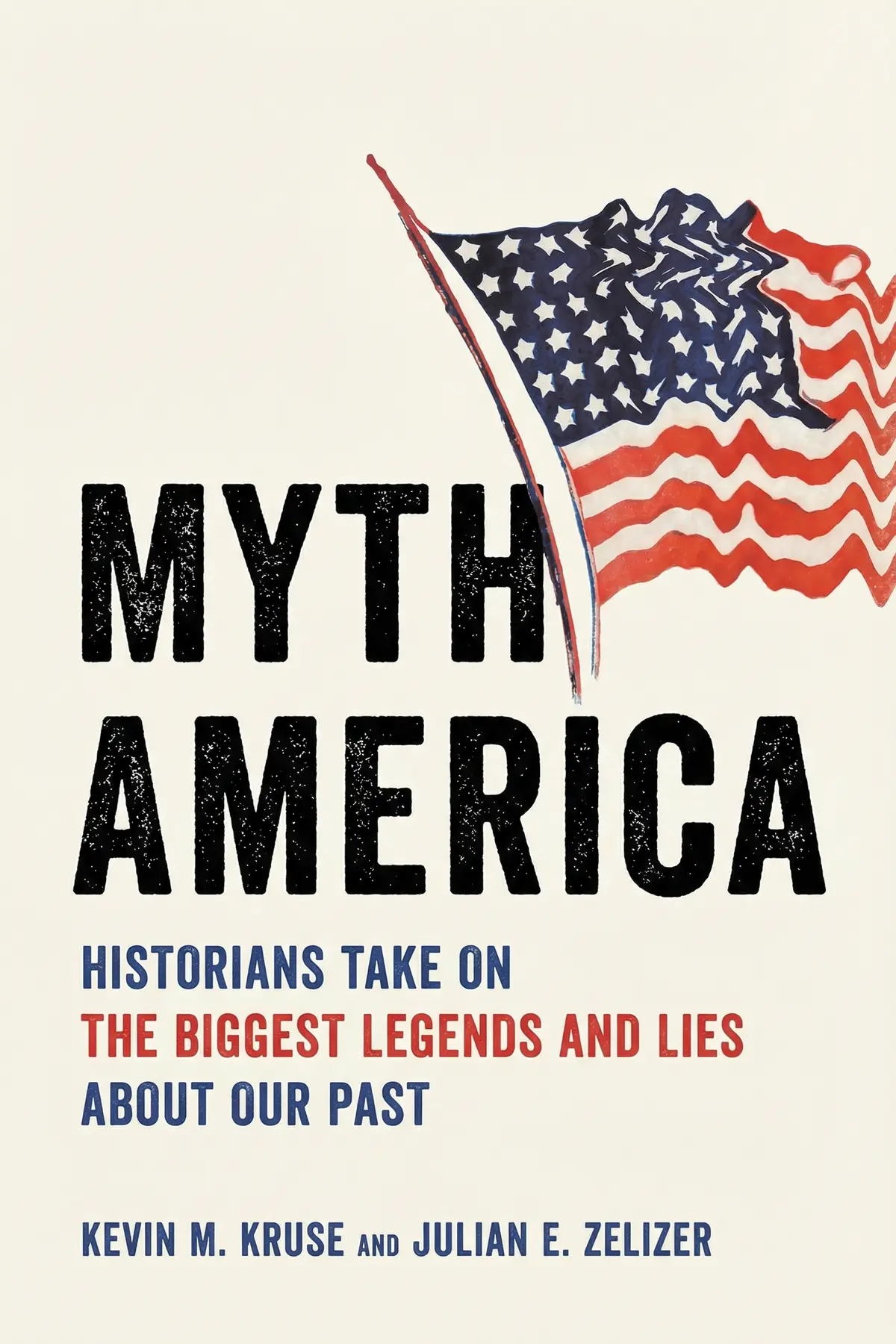
Table of Content
1. Introduction
1 min 05 sec
Across the last 75 years, American forces went without invading or fighting in some other country in just two of them: 1977 and 1979. That one fact sits awkwardly next to a favorite national belief, that America does not build empires.
In Myth America, historians Kevin Kruse and Julian E. Zelizer take on beliefs like this one, from the vanishing Indian to the claim that socialism is a foreign import. Their argument is that a myth survives because it is useful. Each of these stories drops facts that are on the record, and each serves someone who gains from it today. The authors write at a moment when anyone with a following can pose as an expert, and they treat separating fact from propaganda as urgent work.
Their cases cover immigration, empire, the Confederacy, socialism and the family. Together they teach a habit that works far beyond American history: when a story about the past feels too tidy, ask what it leaves out and who benefits from telling it.
2. Spot the origin story that erases people
1 min 55 sec
Every country tells a proud story about how it began. Some of those stories need a missing piece to work, and that missing piece has excused centuries of harm while still turning up in modern political speeches.
3. See what a Confederate statue was built to say
1 min 58 sec
Defenders of Confederate monuments say they are simply history. Look at when the statues went up, who paid for them and what speakers said at their unveiling, and a different purpose comes into view.
4. Hear the old panic inside immigration fears
2 min 11 sec
The warning that foreigners will overrun the country sounds like a reaction to today’s news. Benjamin Franklin was making a version of it about Germans, and the economics behind the fear have hardly changed.
5. Test the claim that America builds no empire
2 min 17 sec
Most Americans would deny that their country is an empire. A coup in Central America, a count of Cold War interventions and the conditions attached to European aid suggest a different answer.
6. Discover the deep American roots of socialism
2 min 09 sec
Socialism is often called a recent import that threatens American values. Two centuries ago, the man who gave it its name spoke to Congress, and many familiar American programs grew from the movement.
7. See how feminists strengthen American families
2 min 13 sec
Feminism’s critics have long accused it of attacking the family. One founder’s own family story, support from a Republican president and the households that never fit the ideal all complicate the charge.
8. Conclusion
1 min 12 sec
Myth America is a guide to stories that sound like history but work like campaign slogans. The empty continent, the noble Lost Cause, the endless invasion, the empire that is not an empire, socialism as a foreign threat and the feminist war on the family all follow the same pattern. Each starts from something people want to believe and drops the facts that would complicate it. Then it gives someone a reason to exclude, suppress or rule. The authors are writing for an age in which anybody can pose as an expert, and truth itself can seem optional.
You do not need to share their politics to use their method. When a claim about the past comes your way, ask what it leaves out, the way the discovery story leaves out people who had lived on the land for millennia. Ask who gains from telling it now. When a monument or a slogan is defended as simply heritage, find out when it was made, who made it and why. A statue unveiled to speeches by Confederate veterans tells you more about the people who built it than about the war.
A story that only holds up while the record stays hidden has not earned the name of history.
About this book
What is this book about?
Many people carry a version of American history they picked up from speeches, slogans and their social media feeds. Some of it is accurate. Some of it is a story built to win a present-day argument. In Myth America, historians Kevin Kruse and Julian E. Zelizer take several of the most common legends and test them against the historical record. Their cases cover a lot of ground. They look at the idea that Europeans found an empty continent, the Lost Cause story behind Confederate monuments, the centuries-old fear of immigrants who keep coming, and the belief that America builds no empire. They also examine the claim that socialism is a foreign import and the charge that feminists set out to destroy the family. In each case the authors show which facts the myth leaves out and who benefits from repeating it. Readers get specific counterevidence they can use, from 64 Cold War interventions to the growth of the United Daughters of the Confederacy. They also get a habit worth keeping: when a story about the past sounds too neat, ask what it leaves out and who gains from it.
Book Information
Who it's for
Hearing conflicting American histories
Readers who keep hearing competing versions of American history and want facts to check them against.
Needing cases for class
Students and teachers who need concrete cases on empire, immigration, race and political ideas.
Professionals wanting media literacy
Professionals who want a reliable habit for spotting propaganda in news and social media.
About the Author
Kevin Kruse
Julian E. Zelizer was born in 1969 in Union, New Jersey. At Princeton University he holds the Malcolm Stevenson Forbes, Class of 1941 chair in history and public affairs. His research focuses on American politics from the middle of the twentieth century to today, and he has written and edited several books on US political history. He is a political analyst for CNN, contributes to NPR and writes a column for Foreign Policy magazine. He wrote Myth America with his co-author Kevin Kruse.
Ratings & Reviews
Ratings at a glance

What people think
Listeners find the work deeply educational, highlighting how the thoroughly researched essays offer a superb look at historical occurrences. Many consider it essential for those captivated by American history, while one listener mentions that it is crafted for a broad audience. Additionally, listeners often call the book revelatory. However, perspectives on the prose are divided, with one listener describing the content as truly heartbreaking.
Top reviews
Narong
This collection provides an enlightening overview of how historical narratives are shaped and distorted over time. It’s written with a general audience in mind, which makes the deep scholarly research feel accessible rather than dry or overly academic. I especially appreciated the deep dive into the New Deal era; it’s a must-read for anyone trying to understand the roots of current American policy debates. While some might find the tone provocative, the sheer volume of factual evidence presented by these historians is hard to ignore. It is truly a revelatory experience to see the past through such a clear, evidence-based lens.
Show moreWillow
Picked this up on a whim and I'm glad I did because it is an absolutely vital piece of writing for our current moment. The authors do a fantastic job of taking complex historical events and making them digestible without stripping away the nuance. It is an eye-opening experience to see how much of what we take as 'common knowledge' is actually the result of deliberate propaganda. This should be required reading in colleges. It’s a must-read that clarifies the historical record on everything from voter fraud to the myth of American exceptionalism. Truly impressive work by all involved.
Show moreMia
The chapter on the rise of Confederate monuments was particularly enlightening, providing a clear-eyed look at how these statues were used to assert white supremacy during the Jim Crow era. Kruse and Zelizer have done a great service by compiling these diverse voices into one volume. It’s a deeply researched and eye-opening book that challenges many of the 'patriotic' myths we were taught as children. For anyone interested in the factual evolution of the Republican Party’s Southern Strategy, this is the gold standard. I found the writing to be sharp and the arguments incredibly persuasive throughout most of the text.
Show moreNutnicha
As someone who appreciates deep historical research, I found this collection of essays to be quite informative and timely. Kruse and Zelizer have assembled a formidable roster of scholars to tackle complex issues like the Southern Strategy and the reality of the Great Society. Personally, I think the writing style is a bit uneven—some essays flow beautifully while others read like dry academic journals—but the content is undeniably powerful. It’s an excellent overview for those who want to cut through modern soundbites and get to the actual data. Not everyone will love the partisan lean, but the facts are well-cited and hard to dismiss.
Show moreFord
Finally got around to finishing this anthology, and the essay by Carol Anderson on the history of voter fraud was a standout for me. The truth is, the quality across the twenty entries is somewhat varied; a few chapters feel a bit vague or skirt the most difficult questions. However, the overall project is incredibly important. These are academic specialists bringing their expertise to a general audience, which we need more of. I did find the focus on the Trump era a bit heavy-handed at times, but the historical parallels they draw are hard to argue with. A very informative and clearly researched volume.
Show moreWichai
Wow, some of these essays are genuinely heartbreaking to read when you realize how effectively certain historical lies have been used to justify modern inequalities. The prose can be a bit dense in places—I found the writing style to be a mixed bag depending on the contributor—but the emotional weight of the history is palpable. It’s an essential overview for anyone who wants to understand why our current political climate is so fractured. While it’s clearly written from a liberal perspective, the historians involved are all experts in their fields. It’s a necessary, if sometimes painful, look at our shared past.
Show moreGiulia
Frankly, I found the methodical way these essays mesh together to be the book’s greatest strength. It doesn't feel like a series of disjointed papers; instead, it builds a comprehensive case against many of the biggest lies currently circulating in our political discourse. I wanted to hear a bit more about myths that don't just involve the right, but the historical work here is still top-notch. It’s a thought-provoking collection that serves as a great introduction for undergraduates or casual history buffs. Definitely worth your time if you value evidence-based history over politically convenient soundbites. It is a very informative and necessary read.
Show moreFang
Not what I expected given the broad, sweeping title of the book. I assumed we would be looking at myths from all eras and political persuasions, but the scope is much narrower, focusing heavily on race relations and the modern GOP. In my experience, some of the material feels a bit recycled if you’ve already read books on these specific topics. That said, the individual essays are methodical and well-argued. It works better as a cohesive argument about the origins of modern political division than as a general history of American legends. It is a solid enough read, but lacks the balance I was hoping for.
Show moreRania
Look, if you’re already well-versed in 20th-century American history, you might find much of this book to be familiar ground. The essays are well-researched, but several of them feel like they could have been published as op-eds in the New Republic or Vox. It is a very informative collection, but the lack of balance is a legitimate concern if you’re looking for a strictly non-partisan text. It’s a solid enough overview for a casual reader, but the heavy liberal bent makes it feel more like an echo chamber than a revolutionary historical work. Good for a refresher, but not groundbreaking.
Show moreDream
Ever wonder why a book titled 'Myth America' feels so incredibly one-sided in its selection of legends to debunk? To be fair, the research presented by these historians is extensive, but the focus remains almost exclusively on dismantling conservative viewpoints while ignoring myths that might originate from the left. It feels less like a broad historical inquiry and more like a curated collection of liberal talking points. If you are looking for a truly balanced account of US history and its interactions with the rest of the world, you should probably look elsewhere. The title is a bit of a misnomer, frankly.
Show moreQuestions about this book
What is Myth America about?
Historians Kevin Kruse and Julian E. Zelizer test popular legends about American history against the historical record. They examine the idea that Europeans found an empty continent, the Lost Cause myth behind Confederate monuments, fears of immigrant invasion, the claim that America builds no empire, the idea that socialism is foreign and the charge that feminists attack the family. They argue that each myth drops documented facts and serves someone who benefits from it today.
Does Myth America argue that the United States is an empire?
Yes. The authors point to territories such as Puerto Rico and Guam, 750 military bases abroad, and only two years in the last 75, 1977 and 1979, without US forces invading or fighting somewhere. They count at least 64 Cold War attempts to remove foreign leaders or contest elections, including a coup in Guatemala. They also show that Marshall Plan aid came with expectations about trade and politics.
What is the Lost Cause myth in Myth America?
The Lost Cause was a story that defeated white southerners told after the Civil War. It described a noble South with a just cause, overrun by a bullying North over states’ rights, and it left slavery out. The authors show how Confederate monuments and their unveiling ceremonies spread the story. Between 1894 and 1914, membership in the group known as the United Daughters of the Confederacy swelled from just 30 women to 100,000, and this happened in the same years that Black southerners were being denied the right to vote.
How can I use the ideas in Myth America?
The book offers a simple test for any story about the past. Ask which documented facts the story leaves out, and ask who gains from telling it now. When a monument is defended as simply history, look at when it was built, who paid for it and what was said at its dedication. When an idea is called new and foreign, check its age and its record, as the authors do with socialism.
Who should read Myth America?
It suits readers who want evidence-based answers to common claims about American history, along with students and teachers who need concrete cases. People who follow politics and want to tell historical fact from propaganda will also find it useful. The authors argue that this skill matters most now, when anyone on social media can claim to be an expert and quickly build a large audience.
Readers also enjoyed

A Promised Land
Barack Obama


A River in Darkness: One Man’s Escape from North Korea
Masaji Ishikawa

A Splendid Exchange: How Trade Shaped the World
William J. Bernstein

A Theory of Justice
John Rawls

A Spy Among Friends: Philby and the Great Betrayal
Ben Macintyre




A Year in the Life of William Shakespeare: 1599
James Shapiro
AUDIO SUMMARY AVAILABLE
Listen to Myth America in 15 minutes
Get the key ideas from Myth America by Kevin Kruse, plus 5,000+ more nonfiction titles.
- 5,000+ titles
- Listen as much as you want
- 7-day free trial
- Cancel anytime









