

Acting with Power: Why We Are More Powerful Than We Believe
Deborah Gruenfeld
 English
Shows leaders how to carry a strategy through the long, discouraging stretch after launch, using concrete goals, outcome-based metrics, a team drawn for the goal, firm priorities and conversations that make the change everyone's own.
59 sec
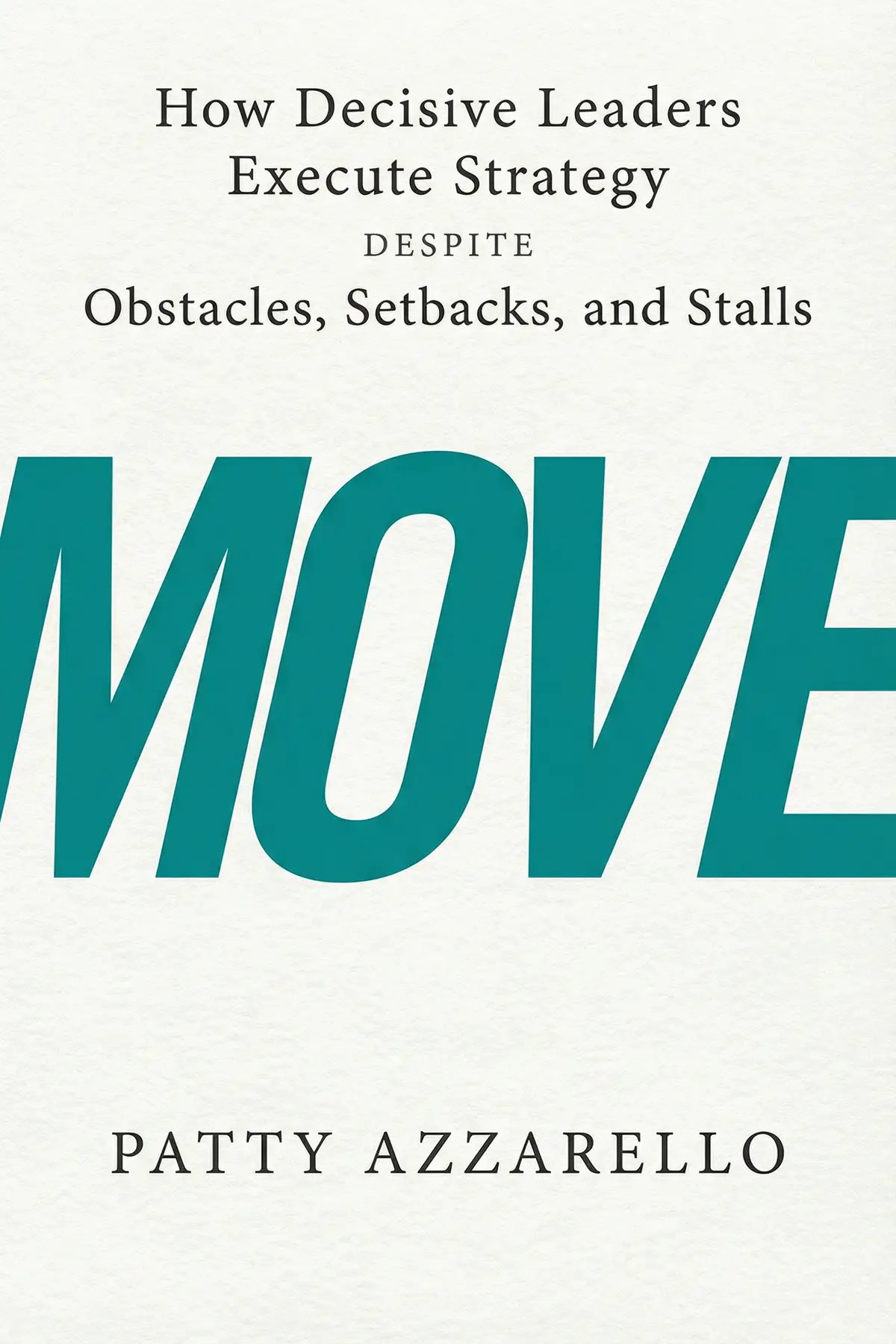
Most change efforts do not fail at the launch meeting. They fail months later, in the long gray stretch where the excitement is gone and the results have not yet arrived. In Move, Patty Azzarello, who became a general manager at Hewlett-Packard at 33, calls that stretch the Middle and builds her whole method around getting through it. Her model is named for four letters: Middle, Organization, Valor and Everyone. Each marks a place where good strategies stall, and each comes with a fix a leader can use next week.
The argument behind all of it is simple. A strategy survives the Middle when its goals are concrete and urgent, its team is designed for the outcome, its leader holds firm on a few priorities, and the people doing the work start to own it. The evidence includes sled dogs, a burned fleet, a resort’s group chat and a goat ceremony that outlived the charity behind it. The prize is a plan that is still moving in month nine.
1 min 48 sec
A company wanted better sales across a whole continent and had no idea where to begin. Two plain questions changed that, and a trick with deadlines kept the plan from drifting until December.
1 min 51 sec
Fast complaint handling looks like great service on a dashboard, yet it can hide unhappy customers. Learn which numbers deserve your attention, and a two-scenario sketch that makes budget conversations far more honest.
1 min 24 sec
A team of sled dogs straining at the line before the signal shows what real readiness looks like. Getting a messy company to that point started with nothing more than an empty sheet of paper.
1 min 57 sec
One simple question once made a grown man cry at work. It points to what drives effort far more reliably than pay, and to what leaders miss when they stop listening.
1 min 37 sec
Months into a change, tired teams start asking to return to the old ways. A sixteenth-century commander and a group of complaining engineers show what a leader owes them at that moment.
1 min 40 sec
Every company has more good ideas than it can pursue, and many drown in detail. A short list, a willingness to admit mistakes and a six-word rule keep growth on track.
2 min 04 sec
A resort’s group chat helped earn it top place on a travel site, and in one community a goat ceremony created by a charity has continued for 17 years with no involvement from that charity. Both show where lasting change really lives.
1 min 10 sec
The shower idea, in Azzarello’s telling, is the easy part. What her book supplies is a way through the dull, doubtful months that follow, when a strategy either becomes how people work or joins the pile of abandoned plans. Every tool she offers does a similar job: it makes the next few weeks of effort obvious, so the change no longer depends on anyone’s enthusiasm.
One tool from the book holds the rest together. Draw a timeline of the change, with major milestones below the line, such as a version release on a set date, and specific tasks above it, such as launching a new media strategy. Add a You are here marker, and never put it at the very start, because that discourages people. Bring the timeline into every strategy conversation and move the marker as the work advances. Before you draw it, ask your team the two questions that turn a vague goal into tasks, and ask one person what they really care about.
Over the months, the marker’s slow walk across the page becomes a reason to keep going. A team that can see how far it has come is much harder to stop.
Big ideas for changing a company tend to arrive in a flash and then hit reality: doubt, fatigue, thin budgets, confused plans and people who would rather go back to the old way. Patty Azzarello, who has spent more than 25 years leading organizational change, argues that strategies rarely die at the start. They stall in the Middle, the tedious stretch before results show. Her MOVE model gives a leader four places to act. Middle covers making vague goals concrete, adding near-term deadlines, choosing metrics that track outcomes and pricing the effort honestly. Organization means designing the team from a blank sheet around the result you want, then giving the work meaning. Valor is the nerve to face doubt, refuse retreat, prioritize ruthlessly and keep detail from clogging the top. Everyone turns command into conversation so the change becomes normal. Readers get practical tools drawn from the author's consulting and leadership work and from organizations such as a Honduran resort and the nonprofit Heifer International, along with a simple timeline that keeps a team's progress in view.
Managers and executives whose strategy launched with energy and has stalled months later.
Founders reorganizing a growing company who need the right roles and a short list of priorities.
Team leads who want their people to own a change instead of merely tolerating it.
Patty Azzarello has worked in organizational change for more than 25 years. At 33 she became Hewlett-Packard's youngest ever general manager, and she has since led business transformation projects at companies large and small. Today she helps organizations follow through on the priorities that matter most to them and develops their leaders, the same two problems Move sets out to solve.

Listeners find that this work offers actionable guidance and consider it essential reading for successful leaders, as one listener points out how easily the concepts translate to business projects. Its prose is clear-cut, and listeners describe the content as motivating; one listener even mentions that it acts as a fountain of individual assurance and optimism. They value how well it facilitates structural transformation, with one listener specifically praising the advice on explaining the reasons behind shifts, while another listener remarks on how the strategies work for every tier of a company.
Finally, a business book that doesn't just admire the problem but actually offers a shovel to dig your way out. Azzarello’s MOVE model—focusing on the Middle, Organization, Valor, and Everyone—is a breath of fresh air for anyone tired of high-level theory that fails in practice. I particularly appreciated the concept of 'Valor' because it addresses the emotional grit required to stop doing the low-value tasks that clutter our calendars. The writing is incredibly direct, making it easy to digest, though some might find the lack of fluff a bit jarring if they are used to more academic texts. Truth be told, it’s rare to find a guide that scales so well from mid-level managers to the C-suite. It gave me a renewed sense of confidence to tackle our upcoming structural shift with a concrete plan rather than just hope.
Show moreThe 'blank-sheet' org chart exercise is worth the price of admission alone because it forces you to think about outcomes rather than existing personalities. Azzarello doesn't pull any punches when discussing why change efforts fail, pointing directly at leaders who lack the valor to make the tough calls. I’ve read a lot of leadership fluff, but this felt like a practical manual for someone who actually has to get work done. The idea of 'control points' as metrics that are actually influenceable is something I’ve already started implementing with my direct reports. It creates a level of clarity that eliminates the usual churn and inconsistency seen in large-scale pivots. This is a must-read if you are serious about scaling your operations effectively and keeping your top talent engaged through the process.
Show moreYour strategy isn't what you say in a PowerPoint; it's where you actually put your resources, and this book hammered that point home. Patty’s approach to the MOVE model—Middle, Organization, Valor, and Everyone—is the most practical framework I have encountered for real-world application. I have recommended this book several times already because it answers the 'what now?' question that usually follows a big strategy announcement. The emphasis on having honest and often painful conversations about staffing and roles is exactly what is missing from most leadership training. It is an actionable guide that provides not only the strategy but also the relatable examples needed to make it stick. This is definitely a source of personal confidence for me moving forward into our new fiscal year. It makes sense.
Show moreI picked this up hoping for a quick guide but ended up with a profound shift in how I view leadership power. Azzarello argues that we are merely stewards of the power our roles provide, and that real loyalty comes from sharing that power and helping others thrive. This emotional core of the book, combined with the practical MOVE model, makes it an essential tool for any leader. The writing is clear and the targets she suggests are small and achievable, which prevents that feeling of being overwhelmed. Personally, I found the discussion on 'productive conflict' especially helpful for my current team dynamic where people are often too afraid to speak up. It is a brilliant follow-up to her first book and stands on its own as a masterclass in execution.
Show moreMost leadership books focus on the 'why' or the 'what,' but Move is obsessed with the 'how' and the 'who' in a way that is incredibly refreshing. Azzarello doesn't let you off the hook; she demands that you set concrete milestones and hold people accountable for them. I loved the idea of the '21 times' rule for communication because it is a reality check on how much effort it actually takes to align a large group. The book is dense with good ideas, yet it remains under 300 pages, which is a feat in itself. Not gonna lie, some of the sections on metrics were a bit technical, but they provide the necessary detail to move beyond vague goals. It is a must-read for anyone tired of seeing great strategies die in the middle.
Show moreAfter struggling with a messy restructuring at my firm, this was exactly the roadmap I needed to find my footing again. The book emphasizes that your strategy is defined by where you put your resources, not just the inspiring words you put on the company intranet. I found the section on the 'Middle' phase of change particularly illuminating since that’s usually where my team loses momentum and gets stuck in the weeds. While the advice is undeniably actionable, the formatting could be a bit more engaging as the text gets quite dense in the middle chapters. Still, the focus on concrete milestones over vague goals is a game-changer for project tracking. It is a solid resource for any executive looking to implement lasting cultural change without losing their mind or their staff.
Show moreEver wonder why your company’s big 'transformation' initiatives always seem to stall out halfway through? Patty Azzarello identifies that 'Middle' phase as the danger zone and provides a very clear structure to navigate it without losing your team’s trust. I appreciated her insistence on involving 'Everyone' in a way that creates an inextricable part of the culture rather than just another top-down mandate. The book is written in a very straightforward style, which makes the complex process of organizational change feel surprisingly manageable. My only minor gripe is that some of the remote work advice felt a bit like common sense, though it is still good to have it codified. Overall, it provides a sense of hope and a practical rationale for why we do what we do.
Show moreAzzarello writes with a no-nonsense style that cuts through the typical corporate jargon we’ve all grown to loathe over the years. Look, change is hard, but this book makes it feel like a series of logical steps rather than a chaotic mountain to climb. I specifically liked the focus on eliminating the people who have a negative influence on the team once you have given them a chance to adapt. It’s a tough message, but it is necessary for anyone trying to build a high-performing organization that can scale. The concept of 10x bottlenecks helped me realize where I was wasting my time on minor issues instead of structural problems. It is an inspiring read that provides a lot of personal confidence for those in leadership roles.
Show moreIt’s a dense read for being under 300 pages, and I’ll admit I had a hard time staying engaged through the entire thing. There is a lot of great, useful information here, but it didn't quite hit the mark for my specific industry at this moment in time. Azzarello is clearly an expert, and her MOVE model is logically sound, yet the prose felt a bit repetitive after the first hundred pages. Frankly, I was looking for more diverse case studies and fewer abstract frameworks to keep me hooked. I think it serves better as a reference guide you dip into when facing a specific bottleneck rather than a front-to-back read. It’s good, just not groundbreaking if you have already read a lot of her blog content or her previous book.
Show moreTo be fair, the advice here is solid, but the execution of the writing felt so dry and repetitive that I struggled to get past the 50% mark. I really wanted to like this because the MOVE model makes total sense on paper, but the presentation just didn't click for me. It felt like a very long blog post that had been stretched out to fill a book-length manuscript with too many redundant bullet points. If you are a fan of very structured, list-heavy business books, you might love this, but I found it lacked the narrative spark to keep me interested. I can see the value for an executive in the middle of a crisis, but for general professional development, it was a bit of a slog. I ended up skimming the rest.
Show moreThe letters of MOVE represent Middle, Organization, Valor and Everyone. Middle is the slow stretch after a change starts, handled with concrete goals, near-term deadlines and outcome metrics. Organization means designing the team around the result and giving work meaning. Valor is facing doubt, refusing to retreat and prioritizing ruthlessly. Everyone means replacing command with conversation so the change becomes familiar, safe and normal across the company.
She argues they stall in the Middle, the tedious period after the exciting start and before results show, much like a running habit that fades after a few weeks. Goals are often too vague and deadlines too far away. Her fix is to ask what success would produce and what it would look like, then set closer checkpoints, such as 50 target accounts by month six on the way to ten deals.
Azzarello advises measuring the desired outcome instead of a single activity in the process. Fast complaint resolution, for example, does not guarantee happy customers. Returning customers and referrals are better signals of satisfaction, and staff can gather the data by asking customers whether they would recommend the product. Once the right measure is set, she suggests sketching a low-cost and a high-cost funding scenario to see what each would achieve.
Start with a timeline: milestones below the line, specific tasks above it and a You are here marker placed past the very start, then use it whenever you discuss strategy. Write down your three non-negotiable priorities and protect them. Ask one team member what they really care about. And give people a space to talk about the change, as the Honduran resort Utopia Village did with a WhatsApp group.
Deborah Gruenfeld

Mike Michalowicz



Hamilton Helmer


Margaret Heffernan



AUDIO SUMMARY AVAILABLE
Get the key ideas from Move by Patty Azzarello, plus 5,000+ more nonfiction titles.









