


A Guide to the Good Life: The Ancient Art of Stoic Joy
William B. Irvine
 English
Shows how getting clear on who you want to be makes career moves, relationships and daily trade-offs easier to decide. It offers a thirty-second identity test, five portable skills and a scoring method for big choices.
1 min 02 sec
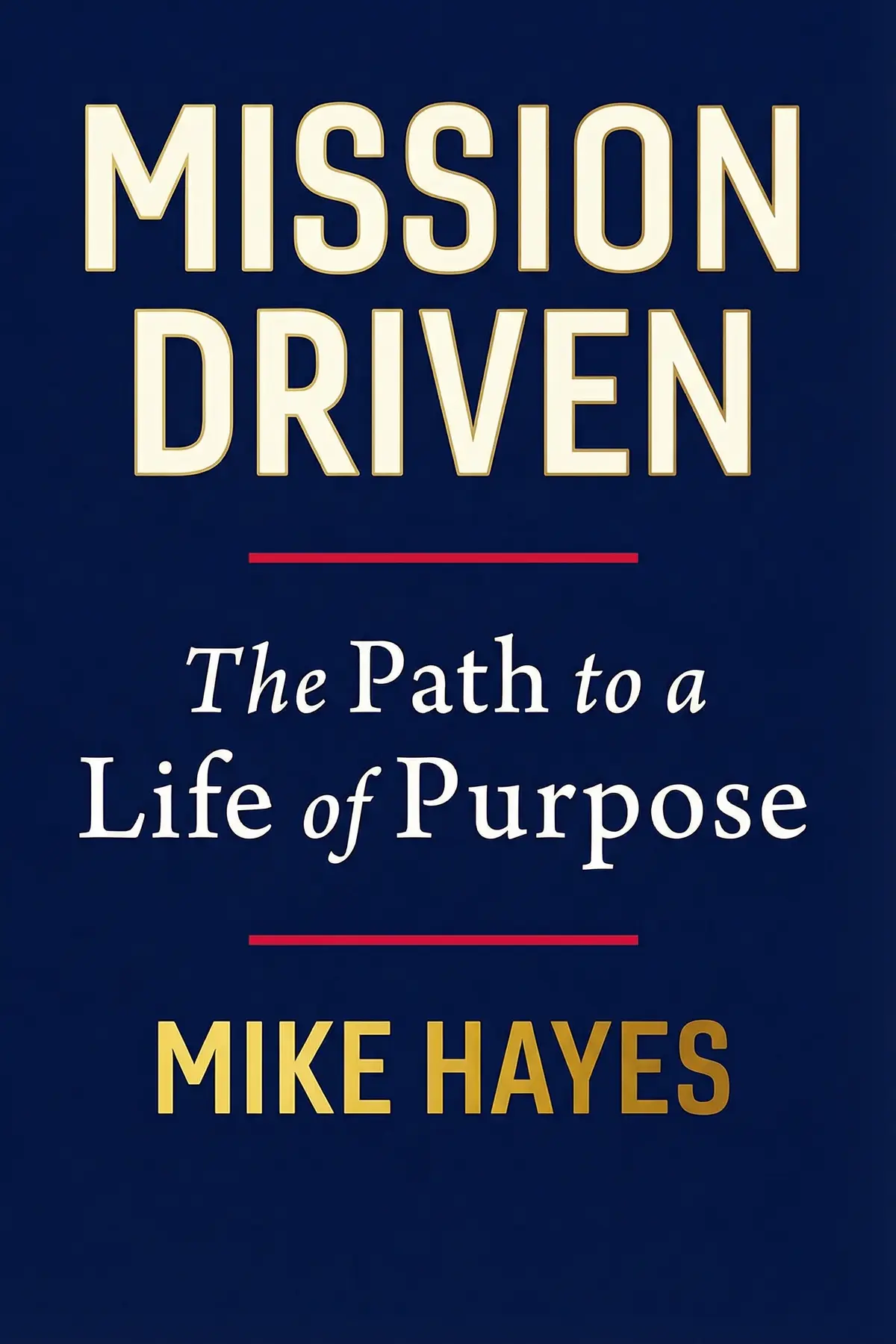
Plenty of people hold a good job and a respectable résumé and still feel they are running on autopilot, reacting to whatever comes next. In Mission Driven, former Navy SEAL commander Mike Hayes argues that the fix begins with a question most of us skip: before deciding what to do, decide who you want to be. Once that identity is clear, he says, hard choices about work, relationships and direction get easier, because there is finally an inner compass to check them against.
Hayes led a Special Operations task force of two thousand people in Afghanistan and later worked on defense policy at the White House. Even so, he insists that purpose is a learnable skill, open to anyone, starting where they are. The ideas ahead give you a thirty-second test of your identity, five skills that carry into any job, a scoring method for career moves and a monthly dinner that slowly gathers people worth knowing.
1 min 32 sec
Most people hope the right title will eventually tell them what their life is for. Hayes thinks they have the order reversed, and he offers a thirty-second test that most busy professionals find surprisingly hard to pass.
1 min 34 sec
A college coach was offered one of the most glamorous jobs in his sport, with money to match, and he hesitated. His reason exposes how often we judge our lives by someone else’s yardstick.
1 min 39 sec
Some colleagues land well wherever they go, and it is rarely because of their degree or technical expertise. Hayes names the qualities they share, and he suggests one of them may be the most crucial of all.
1 min 44 sec
Helping others sounds like a cost you pay for being decent. Hayes claims the helper gains the most, and he points to everyday talents most of us never think to offer.
1 min 43 sec
Job decisions tend to swing between endless agonizing and a hasty gut call. Hayes replaces both with six steps, and within one of them he warns not to skip the first level of conversation, which he calls the most important.
1 min 28 sec
Your circle of friends shapes who you become, yet most of us assemble it by accident. Hayes suggests a ranking that sounds almost clinical and a simple dinner invitation that keeps growing on its own.
1 min 28 sec
Every week forces trade-offs between what you want now and what you want later. Hayes pictures it as a backpack, and his examples of rearranging the weight are bolder than most people would consider.
1 min 03 sec
Mission Driven adds up to a reversal of the usual order of a career. Most people pick the job and hope an identity follows. Hayes starts with the identity and lets it judge everything else: the offer that looks too good to refuse, the hours you give away, the friends you keep, the weight you agree to carry. Dan Hurley’s hesitation over the Lakers job makes the case better than any principle. A prize means little if it does not fit the person you are trying to be.
The tools are small enough to start with today. Take the thirty-second elevator test and write down your answer, knowing it will change. Before your next career move, score what truly matters to you and seek out advice conversations before any interview. And look for one person to help who has not asked, perhaps over dinner with the person you admire most.
None of it requires a dramatic life or unusual resources. It asks for one honest answer about who you want to become, and then the steady habit of choosing in that direction.
Many capable people have the job, the salary and the résumé, yet feel they are drifting, reacting to whatever opportunity appears next. Mike Hayes, a former Navy SEAL commander who later worked in government and business, argues that they have the order wrong. They choose what to do before deciding who they want to be. In Mission Driven, Hayes treats purpose as a skill anyone can learn. He starts with identity and a personal definition of success, illustrated by a college basketball coach weighing one of the sport's most prestigious jobs. He then sets out five meta-skills that carry across any role, from creating value to helping people who have not asked. The second half turns to daily decisions. Readers get a six-step method for choosing a job, a way to rank what matters in relationships, a dinner chain for meeting remarkable people, a backpack image for managing time and an exercise for mapping where life has been and where it should go next.
Professionals with a solid job who feel they are drifting on autopilot.
Career switchers weighing offers and wanting a clear way to compare them.
Early-career climbers who want a definition of success that is their own, not borrowed from peers or parents.
Mike Hayes served twenty years as a Navy SEAL and commanded SEAL Team TWO, leading a Special Operations task force of two thousand people in southeastern Afghanistan. He was also a White House Fellow, and during two years at the National Security Council he directed defense policy and strategy and worked directly with Presidents George W. Bush and Barack Obama. He has since held senior roles at VMware, Cognizant Technologies and Bridgewater Associates and worked as a Managing Director at Insight Partners. He holds a master's degree in public policy from Harvard's Kennedy School.
Listeners find this to be a gripping work that delivers authentic lessons regarding purpose, featuring narratives that prompt the audience to stop and reflect. Furthermore, the content provides actionable advice and is highly accessible, with one listener describing it as essential for leaders operating under intense pressure. Listeners also appreciate the masterclass in leadership methodology, and one person notes that the book's proceeds are used to help Gold Star families.
It isn't every day you find a book that actually puts its money where its mouth is. Knowing the proceeds support Gold Star families makes every chapter feel more significant. Hayes isn't just preaching about service; he’s living it. The stories about SEAL Team Two and the White House are fascinating, but they serve as a backdrop for a much deeper message about character. I particularly connected with the idea that our 'inner compass' must be calibrated before we set any strategy. If you are feeling aimless or overwhelmed by external expectations, this provides a masterclass in reclaiming your purpose. It’s a compelling, deeply human read that forces you to stop and reflect on your own legacy.
Show moreFinally, a leadership book that doesn't just recycle the same three anecdotes about Steve Jobs. Hayes brings a totally different perspective to the table, drawing on his time in the West Wing and in combat to illustrate how to keep your cool. The five meta-skills—value, influence, learning, uncertainty, and attitude—are presented as daily habits rather than lofty ideals. I loved the section on Dan Hurley turning down the Lakers job. It was a perfect real-world example of staying true to one's mission over chasing a bigger paycheck or more fame. This is a must-read for anyone who feels like they are climbing a ladder leaned against the wrong wall.
Show moreAs someone who recently transitioned out of a high-pressure role, I found the 'short game' frameworks incredibly useful for navigating my next steps. We often focus on the prestige of a title rather than the alignment of the role with our core values. Hayes challenges that head-on. His method for scoring different dimensions of a job—like autonomy and culture—offered a level of clarity I haven't found in other career guides. The sentence structure is direct, reflecting his background, which makes the advice feel more like a briefing than a lecture. Truth is, the middle sections can get a little repetitive with the 'mission' terminology. Still, the practical exercises are worth the price of admission alone.
Show morePicked this up on a whim after seeing it on a leadership list, and I was pleasantly surprised by the 'who vs what' distinction. Most of us are taught to build our identity around our achievements. Hayes argues that this is a recipe for burnout. Instead, he pushes you to construct an identity based on principles that don't change when your job does. This resonated deeply with me as I balance family and a demanding career. The chapter on embracing uncertainty was particularly timely given how volatile everything feels right now. My only gripe is that it occasionally feels a bit too 'rarefied,' with examples that aren't always easy to translate to a 9-to-5 cubicle life.
Show moreMike Hayes writes with the precision you’d expect from a Navy SEAL, but there is a surprising amount of heart here. He avoids the typical 'grind harder' tropes of the genre and instead focuses on service as an engine for growth. The idea of the 'backpack' filled with weights is a brilliant way to visualize our responsibilities. Are you carrying weights that serve your mission, or are you just getting tired for no reason? It’s a quick read, but the questions it asks are heavy. It is a great gift for a new graduate or anyone at a crossroads. Definitely a standout in the crowded field of leadership literature.
Show moreEver wonder why you're exhausted despite hitting every milestone on your resume? Mission Driven answers that question by pointing out the gap between our actions and our identity. The book is structured around the 'Long Game' of who we are and the 'Short Game' of how we decide. This duality makes it both philosophical and actionable. I appreciated the emphasis on 'comfort with uncertainty.' In today’s world, waiting for perfect information is a death sentence for any project. Hayes provides the tools to move forward anyway. It’s a grounded, inspiring guide that helped me re-evaluate how I spend my time and who I allow into my inner circle.
Show moreNot what I expected from a military memoir, which is a good thing. Instead of just 'war stories,' Hayes uses his past to build a framework for anyone looking for more meaning. The tone is disciplined and demanding but also remarkably humble. I found his thoughts on 'service learning' to be a fresh take on personal development. Helping others isn't just a nice thing to do; it’s how we find ourselves. The writing style is lean, though occasionally I wanted him to go deeper into the 'cognitive underpinnings' he mentions. Overall, it’s a solid guide for anyone standing at a transition point who is tired of living on autopilot.
Show moreThe framework here is solid, particularly the emphasis on meta-skills like value creation and managing uncertainty. Hayes clearly understands how to navigate complex environments, but I found some of the corporate applications a bit thin. The writing is punchy, yet there were moments where I wanted more data to back up the assertions regarding cognitive underpinnings. It feels a bit like a refined version of Sinek’s 'Start with Why,' though focusing on identity (the 'who') is a smart pivot. I liked the focus on how helping others creates personal growth. It’s a good read for anyone stuck in a rut, though seasoned leaders might find some sections a bit elementary. The audiobook version narrated by Hayes adds a layer of authenticity that makes the stories land better.
Show moreTo be fair, the advice about 'leveling' your conversations is probably the highlight of the book for me. Seeking general advice before jumping into specific job interviews is a nuance most people miss. However, I felt the book struggled a bit with its pacing. Some anecdotes felt a bit stretched, while others, like the 'meta-skills' section, could have used more concrete examples of how they work in non-elite settings. Hayes has led an incredible life, and his earnestness is clear. It just felt like it could have been a very powerful long-form essay rather than a full-length book. Still, the focus on ethical influence and continuous learning is a helpful reminder.
Show moreWhile I respect the author's service, this felt like another 'special ops guy does business' book filled with name-dropping. There is a lot of talk about elite circles and high-level policy that felt a bit disconnected from everyday life for the average person. The advice isn't necessarily bad—who wouldn't want to be more resilient?—but it didn't feel particularly unique or groundbreaking. I found myself skimming the parts about the five meta-skills because they felt like standard HR training points reworded with military jargon. If you enjoy memoirs with a side of self-help, you might like it. For me, it lacked the depth and data-driven insights I was hoping for based on the description.
Show moreHayes argues that a purposeful life starts with your who, the principles and values you hold, before your what, the jobs and daily choices you make. When your identity is clear, decisions about careers, relationships and direction become easier because you have an inner compass. He presents this as a learnable skill, supported by five meta-skills and practical tools for scoring decisions.
Hayes names five qualities that carry across any job or industry: understanding and creating value, influencing others, never stopping learning, getting comfortable with uncertainty, and being intentional with your attitude. The last one breaks into agility, resilience, emotional intentionality, work ethic and attitude itself, which for Hayes centers on wanting to help others, even when nobody has asked.
Hayes offers six steps. List the job dimensions you care about, such as location, company size, industry, internal mobility and autonomy. Score each from zero to 100 by personal importance. Write a thirty-second pitch for the job you want. Hold conversations at three levels, starting with general advice. Thank people who help, ideally with a handwritten note. Then make the decision rather than waiting for a perfect option.
Hayes proposes phoning the person you admire most to invite them to dinner, with the request that they bring along whoever they most admire, and that this guest then pass on the same invitation. Held regularly, perhaps monthly, these dinners gradually gather a circle of remarkable people connected by mutual admiration and shared values, the kind of people whose idea of success is worth studying.
It suits people who have checked the conventional boxes but feel something is off, those facing a job change, and anyone who wants a clearer definition of success. Its tools are concrete, from a thirty-second elevator test of your identity to a scored list of job priorities and a backpack image for weighing what you can carry in a busy life.
William B. Irvine


Andrew D. Thompson


Deepak Chopra


Robin Ryan



Richard Wiseman
AUDIO SUMMARY AVAILABLE
Get the key ideas from Mission Driven by Mike Hayes, plus 5,000+ more nonfiction titles.









