

14 min 55 sec
Available in: English
Minimalist Parenting: Enjoy Modern Family Life More by Doing Less
A practical guide to getting off the treadmill of parenting pressure. It shows how to cut back on schedules, possessions, spending and school stress so family life fits your own values and feels lighter.
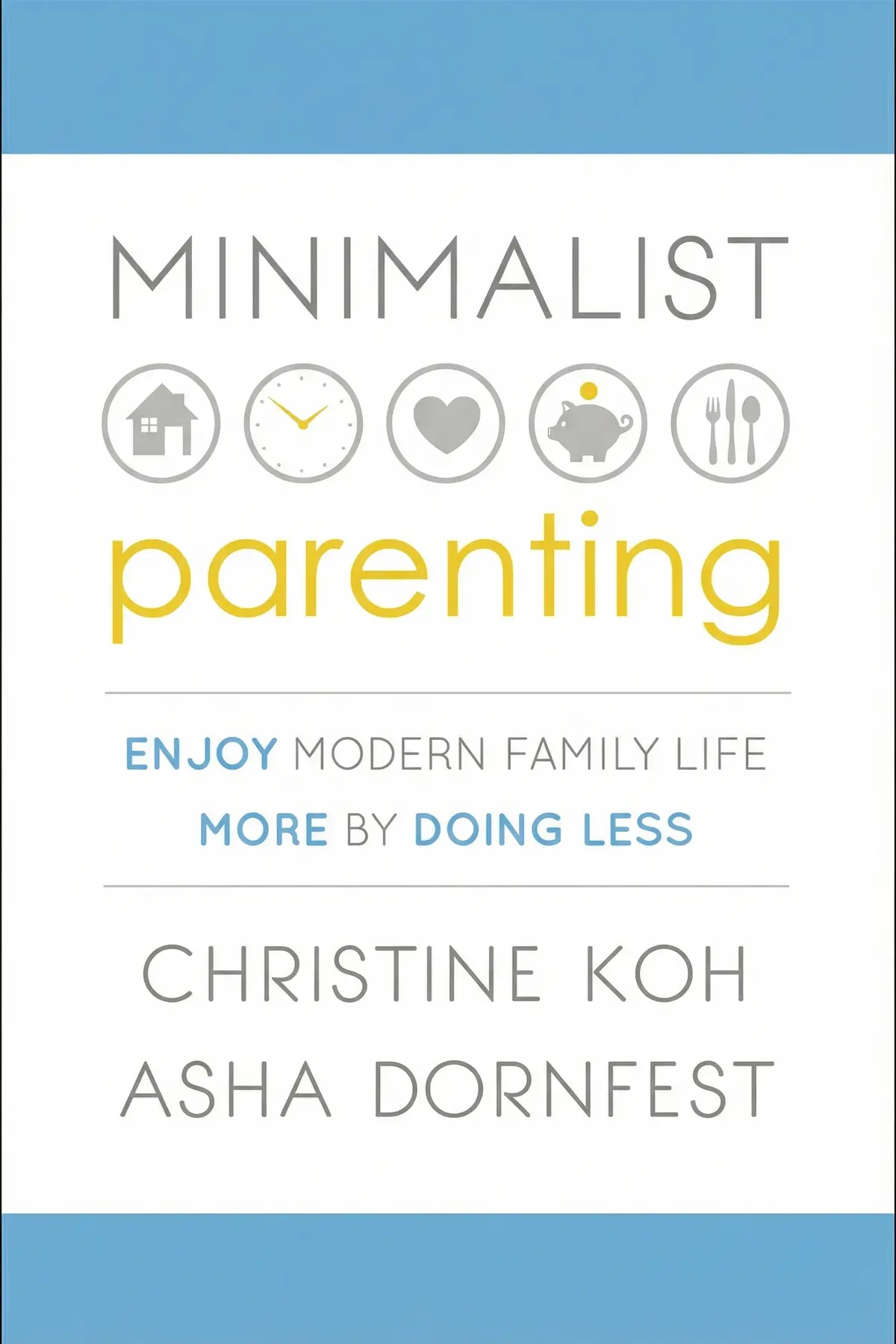
Table of Content
1. Introduction
1 min 00 sec
Most worn-out parents already have what a good family life needs: time, love and enough money for the basics. In Minimalist Parenting, Christine Koh and Asha Dornfest argue that the exhaustion comes from somewhere else. It comes from too many choices, too much stuff, too many obligations and a steady drip of guilt. Their answer is no strict system and no monk-like denial. It is permission to drop impossible standards and run your family by your own values.
That idea runs through every corner of home life the authors cover, from the calendar and the closet to school, play and dinner. Doing less, they argue, leaves parents happier and children stronger and more independent. Along the way come a quick test for any object in your house, a better question to ask about your week, a reason to stop hunting for the perfect school and a case for being a little selfish for your children’s sake.
2. Stop measuring your family against other parents
1 min 55 sec
The baby store, the forums and the family next door all send the same message: you should be doing more. The authors trace where that pressure really comes from, and why stepping away from it can help kids grow stronger.
3. Put yourself back on the family priority list
1 min 49 sec
Many parents assume that putting themselves first would shortchange their children. Koh and Dornfest argue the opposite, and their starting point is as ordinary as a child who will not sleep and a pair of old yoga pants.
4. Give your best hours to what matters most
1 min 47 sec
Every time-management trick promises to squeeze more into the day, and parents still end up running late. One changed question, and a great uncle’s birthday party, show a different way to treat the calendar.
5. A lighter home and money left for fun
1 min 58 sec
Clutter seems like a storage problem and money seems like a math problem. The authors connect the two, and they offer a single imaginary disaster that makes deciding what to keep surprisingly easy.
6. Ease school stress by making home the real classroom
1 min 52 sec
Early reading, music lessons, several languages, the best school in reach: the list of educational must-haves keeps growing. The authors explain why chasing it misses where children do much of their learning.
7. Let play happen without a master plan
1 min 54 sec
Parents are told which toys build brains and which activities build futures. The authors suggest a looser approach to play, screens and lessons, and one honest question about whose dream the violin really is.
8. Simple dinners that bring the family together
1 min 35 sec
Meals, birthdays and holidays can turn into productions that leave everyone tired. The authors show how plainer food and fewer plans can produce the closeness and memories those big efforts were meant to create.
9. Conclusion
1 min 05 sec
Minimalist parenting turns out to be about who gets to decide. Koh and Dornfest hand that decision back to parents. The advice books, the forums and the neighbors with busier calendars all have opinions, but none of them live in your house. A child who cries for weeks in a new bed tells you more than any expert’s timeline.
What the book adds up to is a family where the parents count too. Having children, the authors argue, does not have to push your own interests to the bottom of the list. Simplifying gives everyone room to grow, together and on their own.
Start wherever the pressure is worst. Hold one object and ask whether you would pay to replace it after a fire. Give your golden hours to what matters before the day uses them up. Skip the great uncle’s party without guilt. Open the door and let the children play outside while you garden or read.
Each of these takes something off the pile. What remains is what your family had all along: time, love and enough to get by.
About this book
What is this book about?
Modern parents face aisles of gear, endless advice online and a constant sense that their family should be doing more. Christine Koh and Asha Dornfest argue that most families already have what they need, which is time, love and enough money for the basics. The exhaustion comes from too many choices, too much stuff, too many obligations and too much guilt. Their answer is minimalist parenting. It has no harsh rules and asks for no deprivation. It gives parents permission to reject impossible standards and run their homes by their own values. The authors start with the parent, arguing that self-care is good for children. Then they work through the calendar, the closet, the budget, school, play, meals and travel. Readers get simple tools they can use straight away: a question that sorts priorities, a fire test for clutter, a reason to stop hunting for the perfect school, a balanced view of gadgets and a case for sending children outside. The promise is a calmer home and more independent kids, with parents who still have a life of their own.
Book Information
Who it's for
Parents wanting calmer homes
Parents worn down by gear, schedules and comparison who want a calmer home.
Working parents
Working mothers and fathers who feel their own needs have disappeared since having children.
Families hoping to simplify
Families stressed about school choice, activities and screens who want a simpler, values-first approach.
About the Author
Christine Koh
Christine Koh spent a decade as a music and brain scientist, with National Institutes of Health fellowships for her Ph.D. at Queen's University and a postdoctoral post at Massachusetts General Hospital, Harvard Medical School and MIT. She founded the family resource site BostonMamas.com. Asha Dornfest wrote Parent Hacks, which grew out of her award-winning blog. From 2015 to 2021 the two co-hosted the Edit Your Life podcast.
Ratings & Reviews
Ratings at a glance
What people think
Listeners find this to be an essential guide for modern-day parents, filled with useful advice and actionable ideas that are simple to apply. They value the fast-paced, enjoyable format, with one listener describing it as a true gift for overwhelmed families. The book earns praise for its logical structure; one listener characterized it as a comprehensive time-management resource, and listeners also appreciate its down-to-earth perspective on self-care.
Top reviews
Ning
This book arrived at exactly the right time for my family. The truth is, we were completely burnt out trying to maintain an 'organic' lifestyle while saying yes to every invitation. Koh and Dornfest give you the much-needed permission to do less and prioritize what actually matters to your specific family unit. I loved the emphasis on shared responsibilities and the realistic look at how cluttered houses contribute to mental fog. It’s a must-read for anyone feeling the pull of 'too much' in our modern world. We started implementing the 'saying no' strategy immediately, and the breathing room in our schedule is glorious. It’s not just about stuff; it’s about reclaiming your time and sanity. This is a gift for every harried family I know.
Show moreCholada
Why aren't we talking more about how liberating it is to say 'no'? This book is a breath of fresh air for parents who feel like they're failing the 'perfect parent' test. It’s a realistic approach to self-care that acknowledges how hard it is to raise kids in the 21st century. The authors encourage an organic schedule that fits your family's actual priorities, not what society expects. I found the tips on meal planning and reducing toy clutter to be incredibly practical and easy to implement right away. It’s a time-management book and a parenting manifesto all in one. If you’re feeling overwhelmed by the constant 'more, more, more' of modern parenting, please read this. It’s a total game-changer for your mental health.
Show moreRania
Finally got around to reading this and to be fair, it is a solid manual for the over-extended 21st-century parent. The authors provide a wealth of practical suggestions that are actually easy to implement if you are drowning in a sea of soccer practices and PTA meetings. While some of the advice on shared digital calendars and time-management feels like common sense, seeing it all laid out in such a quick-read format is genuinely helpful. I appreciated the realistic approach to self-care, though I could have done without the constant 'put your oxygen mask on first' metaphor. It’s a bit Type-A in its execution—using apps and spreadsheets to achieve 'minimalism'—but for a harried family looking to reclaim their weekends, this is a very useful guide.
Show moreAmara
Ever wonder why we feel the need to keep every single crayon scribble our kids make? This book tackles that guilt head-on. It’s a breezy, helpful manual for those of us struggling with cluttered houses and even more cluttered minds. While some reviewers call it 'privileged,' I think it’s just honest about the specific pressures facing modern families. The action items are clear: prep food ahead, prune the calendar, and stop caring about being hyper-involved in every single school activity. I actually liked the organizational tips; they provide a framework for people who genuinely don't know where to start. It’s a realistic approach to self-care that feels achievable, even if you aren't a 'Type-A' person by nature. Worth a read.
Show moreChanon
As a parent of a toddler, I found some value here, but much of it felt like a glimpse into a stressful future I’m not ready for yet. Personally, the talk about managing homework and intensive extracurriculars made me more anxious than calm! The book is definitely aimed at the elementary school crowd. While I appreciated the quick-read format and the focus on internal inspiration over external pressure, the constant tech suggestions were a bit much. Do I really need more apps and shared spreadsheets to be a minimalist? It feels counter-intuitive. That said, the sections on clearing physical clutter and simplifying meal times were decent. It’s a mixed bag of helpful reminders and 'Type-A' organizational overkill that might not suit every parenting style.
Show moreTod
Looking at the landscape of parenting books, this one sits firmly in the middle. The layout is great and the title is catchy, but the content is essentially 'Occam’s Razor' for moms. Do you really need a book to tell you to pack lunches the night before or to use a shared calendar? In my experience, these are things most people already know but just struggle to do. To be fair, the permission to sidestep the expectation of being a 'super-parent' who makes three-course meals is nice. However, the heavy use of the 'inner bus driver' phrase and the 'oxygen mask' metaphor felt dated and slightly grating. It’s a breezy read, but don’t expect any life-altering philosophy here. It's just basic organizational tips.
Show moreFelix
The layout of this book is visually appealing, which made for a fast read, but the substance was a bit thin for my taste. I appreciated the sentiment of 'minimalism' in terms of time, but the authors seem to quote so many other websites and blogs that I wondered why I wasn't just reading those instead. Truth is, if you have older kids in elementary school, you'll find some gems regarding schedule management. If you have a baby, it’s mostly irrelevant. The writing is casual and friendly, but it occasionally dips into that 'we're so good at this' tone that can be off-putting. It’s a fine book for a baby shower gift, but it's not the definitive guide to simplicity I was hoping for.
Show moreRatthapong
Is it just me, or does this book feel like a collection of #FirstWorldProblems? I tried to find the minimalism here, but it felt more like a guide for wealthy parents to feel better about hiring help or skipping a bake sale. Not gonna lie, the 'inner bus driver' concept was totally lost on me; it felt like a confusing way to say 'trust your gut.' Most of the tips, like setting up complex filing systems or color-coded folders, actually sound like more work than just living your life. If you have a baby, skip this entirely. It seems geared strictly toward families with elementary school kids who are already over-scheduled. The writing style is a bit disjointed, jumping between random quotes and blog tidbits that didn't always connect for me.
Show moreOtt
Frankly, a book about simplifying shouldn't be this exhausting to get through. I struggled with the writing style, which felt like a series of random tidbits followed by the authors praising their own methods. Gotta say, the advice to 'let your kids fail' by not doing homework in elementary school struck me as a bit ridiculous and out of touch. The authors seem to equate minimalism with being hyper-organized through filing systems and digital tools. To me, that’s just a different kind of clutter. It’s very millennial-focused—prioritizing your own feelings above almost everything else. I was hoping for deep insights into living with less, but instead, I got tips on how to manage a busy calendar. Disappointing.
Show moreWit
The title is incredibly misleading and I was deeply disappointed. Look, minimalism is about reducing possessions and living intentionally, but this book is just a time-management guide for the suburban elite. It’s filled with endless quotes from blogs and websites, making it feel like a recycled Pinterest board rather than a cohesive book. I found the tone incredibly smug, especially when the authors talk about how they 'rock' at certain parenting tasks. It felt like selfish fluff. If you want to actually simplify your life, look elsewhere. This is just a manual on how to be a more efficient perfectionist. I'm glad I got this from the library instead of buying it.
Show moreQuestions about this book
What is the main idea of Minimalist Parenting?
Christine Koh and Asha Dornfest argue that most families already have what they need: time, love and enough money for the basics. The stress comes from too many choices, possessions, obligations and guilt. Minimalist parenting means rejecting impossible standards, trusting your own values and deliberately doing less with your time, stuff, money, schooling and activities, so parents enjoy family life more and children grow stronger and more independent.
Is minimalist parenting about strict rules or living with very little?
No. The authors are clear that it is not about harsh rules, deprivation or living like a monk. You can still enjoy buying things. The aim is to keep only what you truly love, decline obligations nobody wants and make choices that fit your family’s values rather than other parents’ expectations.
Why do the authors say self-care is good for children?
They argue that the parent is the main priority, because treating yourself well spreads to your partner, children, friends and community. Self-care shows children that parenting does not mean losing yourself. It can start small, such as dressing in clothes that make you feel good or making time for purposeless fun with your partner.
How does the book suggest decluttering a family home?
Start small and judge each object by its worth. For every item, imagine losing it in a fire and ask whether you would pay to replace it. Shop more mindfully by asking if you really need something, and consider leaving empty spaces empty instead of filling them. The money saved can buy more family time or memorable experiences.
How can I apply Minimalist Parenting this week?
Pick one area. Cross one unwanted obligation off the calendar and protect your golden hours, when your energy peaks. Run the fire test on a cluttered shelf. Step back from your child’s homework. Send the kids outside while you read or garden nearby. Or plan one simple weekend meal where everyone has a role and the focus is conversation.
Readers also enjoyed

AUDIO SUMMARY AVAILABLE
Listen to Minimalist Parenting in 15 minutes
Get the key ideas from Minimalist Parenting by Christine Koh, plus 5,000+ more nonfiction titles.
- 5,000+ titles
- Listen as much as you want
- 7-day free trial
- Cancel anytime









