

Acting with Power: Why We Are More Powerful Than We Believe
Deborah Gruenfeld
 English
 ไทย
Shows how a short list of clear objectives, each paired with measurable key results, can focus a company or team, align everyone's work, track progress every month and make room for bold goals and better feedback.
1 min 04 sec
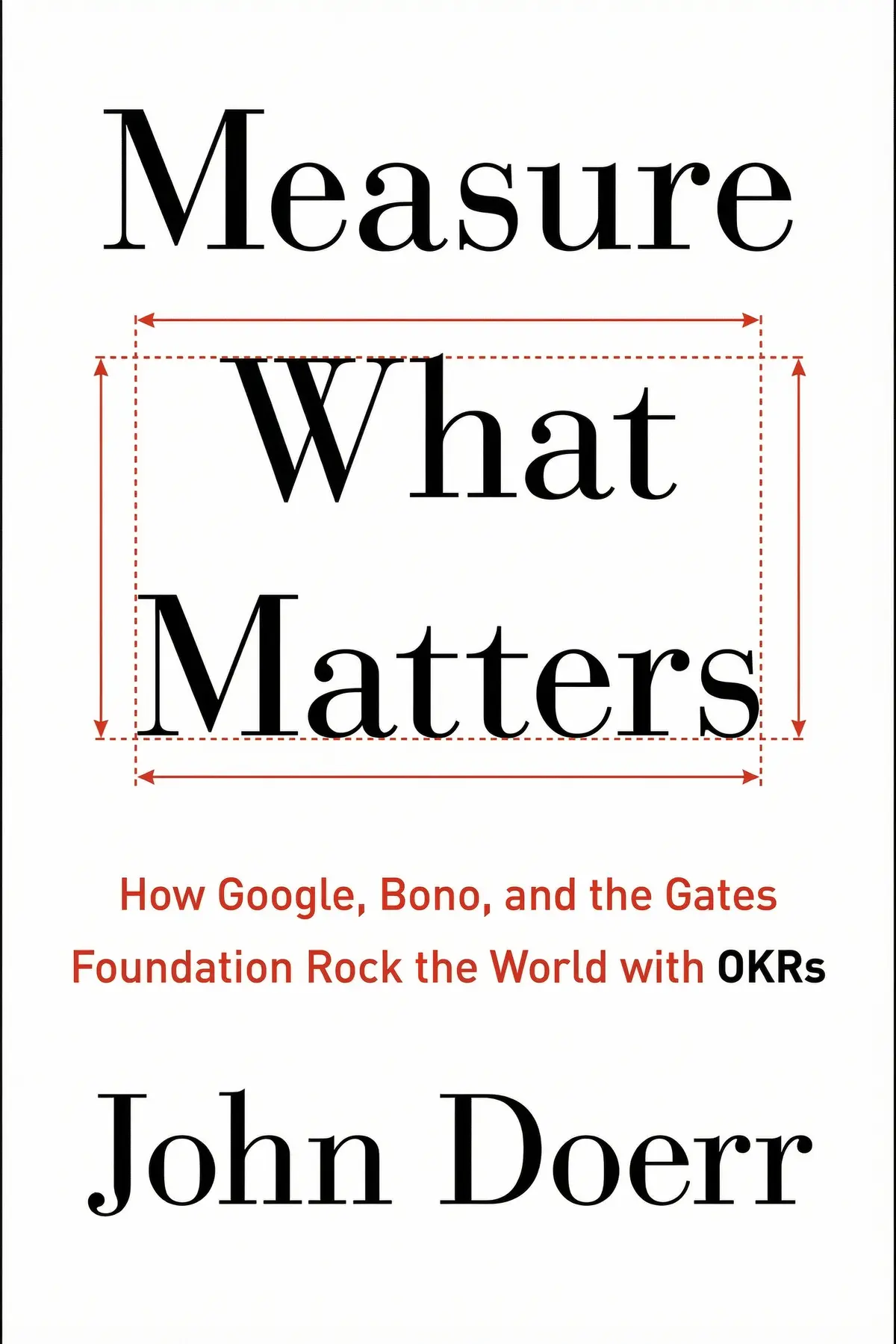
If your team chases a dozen priorities at once and still feels lost, the fix may be fewer goals, written so plainly that anyone can tell whether they were hit. In Measure What Matters, venture capitalist John Doerr, an early investor in Google, makes the case for objectives and key results, or OKRs: a short list of aims, each paired with a few measurable checks.
He learned the method from Andy Grove at Intel in the 1970s and has since carried it to start-ups and giants alike. His argument is that a handful of visible, regularly scored goals, backed by honest conversation, lets an organization move together and aim higher than it otherwise would. The stories run from a microchip launch to the birth of Gmail and Chrome’s climb to a billion mobile users.
What you get is a working method: how to write a goal, cut the list, share it, score it every few weeks and talk about it without a dreaded annual review.
1 min 46 sec
A summer romance led a young intern to a seminar that shaped his whole career. The idea he heard there sounds almost too simple, yet it helped one company grow fast for more than a decade.
1 min 48 sec
A tiny start-up was suddenly gaining hundreds of thousands of users a day, and teachers were begging for one feature. Turning it down looked like a mistake. The quarter that followed told a different story.
1 min 54 sec
A fitness app’s teams were working hard and still missing their targets, and nobody could see why at first. Meanwhile, a young engineer’s side project at Google grew into something used around the world.
2 min 05 sec
Halfway through a quarter, a founder looked at a project his team had committed to and made an uncomfortable call. Google and Intel had their own ways of deciding when a goal was really done.
1 min 53 sec
Google expects many of its boldest objectives to fail, and plans for it. One browser team missed its user targets more than once, and the numbers that followed explain why that did not worry anyone.
1 min 56 sec
Most managers dread annual reviews, and the cost in hours is startling. One software company noticed something odd each February, and the change it made afterward says a lot about what employees actually need.
1 min 07 sec
What holds the method together is honesty about limits. A short list admits that a team cannot do everything. A public score admits when a goal is slipping. A stretch goal admits it may fail, and a regular conversation admits that a plan set in January may be wrong by March. Doerr’s bet, drawn from Grove’s Intel and the companies he later advised, is that organizations which accept those limits openly end up achieving more.
That suggests a place to begin. Before the next quarter starts, cut your objectives to three to five, and give each a few key results anyone could score with a yes or no. As Larry Page put it, “Put more wood behind fewer arrows.” Review the scores each month and decide, without embarrassment, what to continue, change or stop. Then replace at least one formal review with a conversation about whether the goal is still the right one.
Intel never shipped all 500 samples. It shipped 470, scored itself 0.9, and knew exactly where it stood.
Many organizations chase so many goals at once that people end up pulled in every direction and sure of none. John Doerr, a venture capitalist who learned his method from Andy Grove at Intel in the 1970s, argues that the fix is objectives and key results, or OKRs: a few aims that say where you are going, each with a small set of results that prove whether you arrived. Doerr shows how OKRs work in practice through companies he backed or advised. An education start-up shelves a popular feature to stay on target. A fitness app discovers its teams are working against each other. Google scores its goals in red, yellow and green, and a side project becomes Gmail. Chrome misses its user targets year after year and still grows to more than a billion mobile users. Readers get a working system: how to write goals anyone can check, keep the list short, make it public, review it monthly, set stretch goals safely and replace the annual performance review with regular two-way conversations.
Founders and operators whose growing teams are pulled in too many directions at once.
Managers who want goals their people can see, score and question every month.
Employees tired of annual reviews who want clearer priorities and more regular feedback.
John Doerr, born in St. Louis in 1951, is an investor at the venture capital firm Kleiner Perkins in Menlo Park, California. He invested early in Google and served on its board, and in 2009 he joined the President's Economic Recovery Advisory Board, which advised the Obama administration during the downturn. He has mentored many CEOs and founders on OKRs, the method he first learned at Intel. In 2022 he and his wife Ann worked with Stanford University to launch the Stanford Doerr School of Sustainability.

Listeners find this work to be a significant and engaging guide that offers firm principles and actionable guidance on OKR implementation. It delves deeply into the subject, using specific illustrations and case studies from established organizations to serve as a valuable goal-setting resource. The book's capacity to inspire is highly regarded, with one listener noting how it fuels both individual and professional growth. Opinions on the pacing vary; while some listeners consider the content brief, others believe it could be more succinct.
Finally got around to reading John Doerr’s take on OKRs, and I can see why it’s a staple in Silicon Valley circles. The truth is, most business books are dry, but the historical narrative involving Intel and Andy Grove kept me hooked through the technical sections. Personally, I found the emphasis on transparency and public accountability to be the most transformative part of the whole philosophy. While some chapters felt a bit like a victory lap for Kleiner Perkins, the motivational value for a manager like myself is undeniable. It’s a dense read that demands you take notes, but it provides a clear roadmap for anyone trying to bridge the gap between abstract strategy and daily execution.
Show moreWow, I didn't expect a business book about metrics to be this engaging. Most authors make goal-setting sound like a chore, but Doerr frames it as a way to unleash human potential and drive 10x growth. Frankly, the chapter on 'Coach' Bill Campbell was worth the price of the book alone, offering a moving portrait of leadership that goes beyond just numbers. I loved how the book emphasizes that OKRs shouldn't be tied to compensation to avoid 'sandbagging.' It’s a refreshing take on corporate culture that prioritizes ambition over safety. Even if you aren't a CEO, the personal growth tips in here are incredibly applicable to your own life goals.
Show moreAfter hearing about OKRs for the tenth time at work, I decided to go straight to the source. This book is an absolute masterclass in organizational alignment. John Doerr doesn't just give you a template; he gives you the 'why' behind the system, illustrated through the lens of companies that changed the world. Some might find the case studies repetitive, but I found them to be essential proof that the system works across different sectors. The concept of 'aspirational' goals—the ones you expect to fail at 30% of the time—was a total paradigm shift for me. It’s a must-read for anyone serious about high-performance leadership.
Show moreThis book acts as both a history lesson and a tactical manual for anyone leading a team in the 21st century. I loved the stories about the early days of Google in Susan Wojcicki’s garage; it really humanizes the giants of the industry. The truth is, many companies fail because they try to do everything at once, and Doerr’s focus on 'less is more' is the perfect antidote to that. I appreciate that he included the Google OKR playbook in the appendix, providing the specific detail that some chapters lacked. It’s an entertaining read that provides a simple framework for achieving the impossible. If you want to build a culture of accountability, start here.
Show moreAs someone who has struggled with goal setting for years, this framework provided much-needed clarity on how to align daily tasks with long-term vision. The distinction between the 'What' (Objective) and the 'How' (Key Results) is simple yet profound when you actually apply it to a messy startup environment. I appreciated the specific examples from the Gates Foundation, even if they occasionally felt a little too glossy and polished for the average small business owner. My only real complaint is the pacing; it starts strong but gets a bit repetitive toward the middle as the case studies begin to blur together. Still, the tactical advice in the appendix is pure gold for anyone actually trying to implement this system from scratch.
Show moreLook, you can find the basics of OKRs on Wikipedia, but Doerr provides the soul behind the system. I’ve worked in tech for a decade and seen OKRs used poorly, so reading the original intent from the person who brought them to Google was eye-opening. The book goes into enormous detail about the four superpowers: focus, alignment, tracking, and stretching. I do think the case studies from large foundations felt a bit disconnected from the average worker's reality. Nevertheless, the specific examples of how Google used metrics to dominate the browser market are genuinely educational. It’s a solid resource for any leader who wants to stop guessing and start measuring.
Show moreEver wonder why some startups explode while others fizzle out despite having great ideas? Doerr argues that execution is everything, and his OKR system is the engine that drives it. I found the pacing to be a bit uneven, as it jumps from tactical advice to historical lore quite abruptly. That said, the practical advice on 'bottom-up' goal setting was a highlight for me. It’s important to give staff the chance to set their own targets rather than just cascading orders from the top. While the book could be more concise, the sheer volume of specific examples from established companies makes it a useful reference manual for my office shelf.
Show moreIs this book visionary or just a collection of anecdotes about wealthy tech founders? To be fair, the core logic of measuring what actually matters is sound, and Doerr is clearly an expert who has seen it all. However, I found the insistence that results must be binary—either you hit it or you didn’t—to be a bit too rigid for creative industries. The book is definitely padded with celebrity case studies that don't always translate to companies that aren't Google or Intel. It’s a decent introduction to the framework, but I spent more time reading about the history of Silicon Valley than learning how to fix my team's broken reporting system. It’s an okay read, I guess.
Show moreThe chapter on Intel’s history was fascinating, but the rest of this book felt like a bloated marketing pamphlet for Doerr's VC firm. Not gonna lie, I was expecting a rigorous tactical manual on how to actually write these metrics, but I got a collection of success stories instead. Why did I have to read about Bono's philanthropic efforts in a book that’s supposed to be about workflow efficiency? It feels like the entire concept could have been condensed into a three-page PDF or a decent blog post. If you’re already familiar with the difference between an objective and a key result, you’re just paying for fluff and anecdotes about Larry Page and Sergey Brin.
Show moreNot what I expected from a legendary VC, and frankly, I feel like my time was stolen. This is a meandering, self-indulgent paean to unfettered capital gains that ignores the human cost of 'stretch goals' that lead to burnout. The book is essentially a sequence of rich people congratulating each other on how rich they got by using three-letter acronyms. It provides a very vague explanation of how to actually track these results in a non-tech environment. If you want to feel bad for not being a billionaire while reading about Bono, this is for you. Otherwise, save your money and just look up the definition of an OKR online.
Show moreJohn Doerr argues that organizations do better with a few clear objectives, each tracked by three to five measurable key results. These OKRs are set every quarter, shared openly, aligned across teams and scored regularly. He learned the method from Andy Grove at Intel, who grew the company by 40 percent a year as CEO, and shows it at work in companies such as Google, Remind and MyFitnessPal.
An objective states where you want to go, such as Intel’s aim to lead the midrange computer component market. A key result tells you whether you got there, and Grove wanted it answerable with a yes or no. One Intel key result was winning ten designs for the 8085 microprocessor, counted each time another company built the chip into its products.
Google rates key results on a scale from 0 to 1.0 with colors. A score from 0 to 0.3 is red and means no progress. From 0.4 to 0.6 is yellow, meaning progress without completion. From 0.7 to 1.0 is green, meaning the key result was achieved. Employees usually review these scores monthly and can continue, update, start or stop OKRs.
CFRs are regular two-way conversations between leaders and contributors that include feedback and recognition. Doerr presents them as a replacement for annual performance reviews, which he says cost about 7.5 management hours per employee. CFRs ask whether a goal is realistic, right and motivating. Adobe saw voluntary attrition drop sharply after replacing reviews with regular check-ins.
Doerr’s advice is to begin small. Limit your objectives to three to five per quarter, give each a few key results anyone can check, and make all of them visible to the team. Meet monthly to score progress and decide what to keep, change or drop. Ask department heads to name the teams they depend on, as MyFitnessPal did, so support is agreed early.
Deborah Gruenfeld

Mike Michalowicz



Hamilton Helmer


Margaret Heffernan



AUDIO SUMMARY AVAILABLE
Get the key ideas from Measure What Matters by John Doerr, plus 5,000+ more nonfiction titles.









