

14 min 46 sec
Available in: English
Mastering Communication at Work: How to Lead, Manage, and Influence
Shows managers and team members how to adapt every message to the person hearing it, using thinking style, credibility, motivation, framing, vocal tone and validation so that updates, feedback and new ideas actually land.
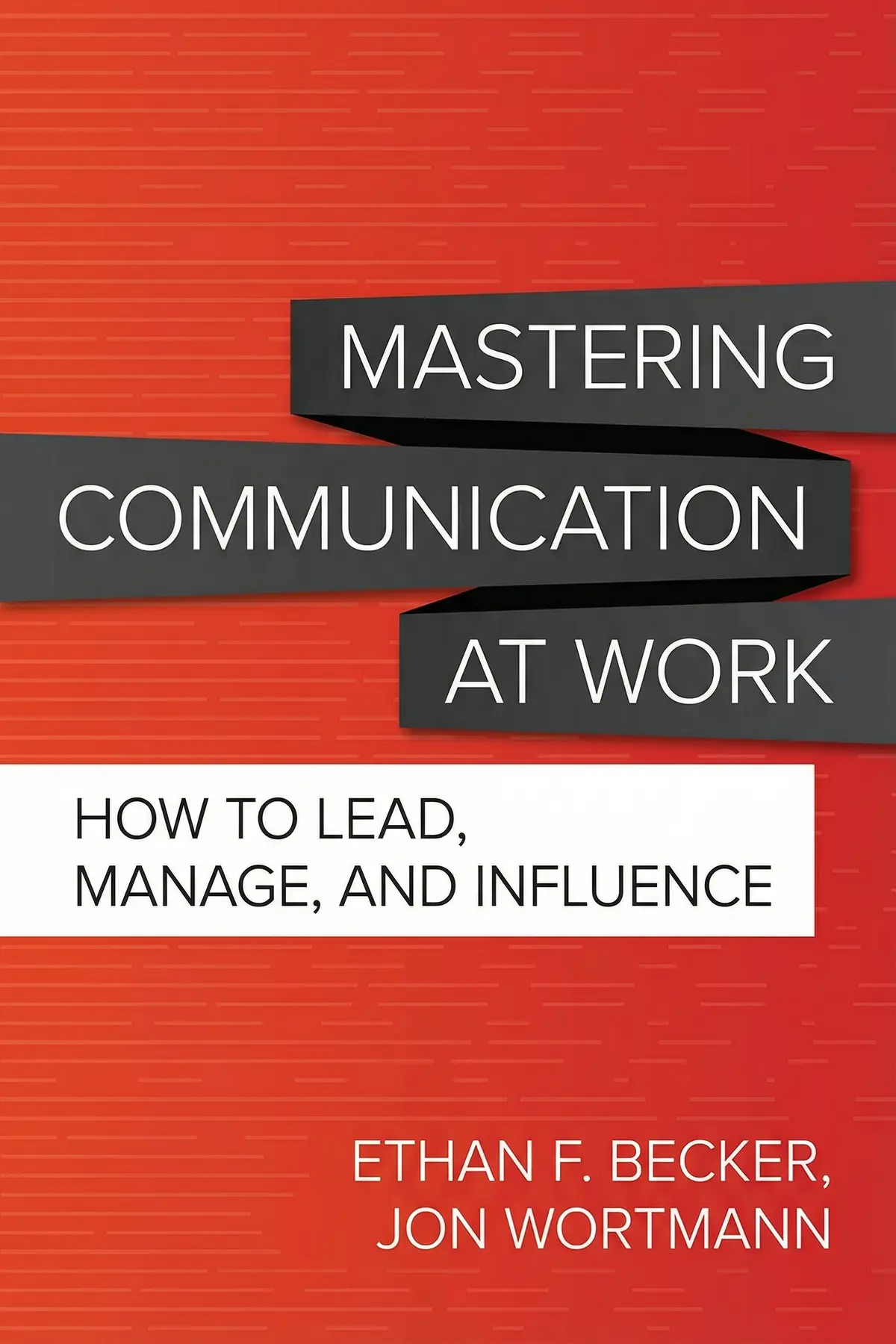
Table of Content
1. Introduction
58 sec
Most workplace messages that fail are not badly worded. They are aimed at the wrong kind of listener. In Mastering Communication at Work, executive coach Ethan F. Becker and mental coach Jon Wortmann show that some colleagues want the conclusion first, while others need the background before they can take it in. Ignoring that split causes much of the friction between managers, teams and bosses.
Their case is that strong communicators start with the person in front of them. They learn how each colleague thinks, what drives them and how they see the speaker, and only then choose their words, their tone and their praise. The authors build this from everyday scenes: a lawyer in sandals, a rafting guide in West Virginia, a company president with a long memory. Expect moves you can try in your next one-on-one, presentation or video call, plus a quick way to tell whether they are working.
2. Match your message to how people think
1 min 48 sec
A coworker tells you about dinner, a parking lot and new sneakers before asking a one-word question. Whether that story charms you or drives you mad reveals how you should be talking to your board.
3. Build the credibility that lets your ideas land
1 min 52 sec
The most creative lawyer at a firm dresses like a student and nobody minds. One bad case later, the same jeans tell a different story. Credibility moves, and it decides whether anyone listens.
4. Choose words that make a new idea welcome
1 min 50 sec
A rafting guide keeps beginners alive with one odd word for a helmet. The same skill decides whether a cautious senior colleague backs your digital plan or walks away from it.
5. Make your voice carry the meaning you intend
1 min 50 sec
Say one short word in your normal voice, then say it to someone about to step into traffic. That gap holds four levers most people never touch on purpose, even on a phone call.
6. Motivate each teammate with what actually drives them
1 min 49 sec
A reward meant to thrill a sales team in Las Vegas can insult half of it. Behind that misfire sits a simple grid that explains why one pep talk never works for everyone.
7. Make people feel valued without agreeing with them
1 min 54 sec
A company president spotted a face in a crowd of hundreds and said a few words from the stage. The manager never forgot it, and the same habit can calm an employee who has stopped listening.
8. Turn communication into a team habit, even remotely
1 min 38 sec
A famous business school dropped its communication course and ended up teaching the subject more than ever. That move, and how Google runs debate, show what hybrid teams lose without noticing.
9. Conclusion
1 min 07 sec
The thread running through Becker and Wortmann’s advice is attention. A deductive board, a wary senior colleague, a nervous candidate, a defensive employee: each needs the same message shaped a little differently, and the shaping starts with noticing who they are. Credibility, in their account, can drain away after one badly handled case, which is why this work never really ends.
Start with your next one-on-one. Decide whether this person wants the point or the story first, and what they work for: the result itself, the applause or the chance to lead. Pick a frame of a few clear words and phrases, and say them with varied pace and firm consonants. When they push back, ask what they need before you defend yourself.
Then listen to what comes back. The authors offer a simple test of whether your framing is working: people start using your vocabulary. When a colleague repeats your phrase in a sentence of their own, the message has arrived, the way a raft full of beginners remembers exactly what a brain bucket is for.
About this book
What is this book about?
Plenty of capable people prepare carefully for a presentation or a feedback talk and still watch the message fall flat. Ethan F. Becker and Jon Wortmann argue that the cause is usually a mismatch between the speaker's approach and the listener's needs. Good communication, in their view, is less about polishing your delivery alone and more about knowing exactly who is in front of you. The authors give readers a set of practical lenses. Some people think deductively and want the point first, while others think inductively and need the background. Everyone carries a level of credibility, or ethos, that rises and falls with results. People are moved by different things and work toward different rewards. From there the book turns to method: framing a message with the right words, coloring it with the right voice, and validating people, especially when they turn defensive. The examples come from a law firm, a West Virginia rafting river, Boston Scientific, Harvard Business School and Google. Readers finish with concrete moves for meetings, one-on-ones, delegation, hiring and hybrid teams, and a simple sign that their framing is working.
Book Information
Who it's for
Managers not getting through
New and experienced managers whose feedback, updates or pitches keep falling flat with their team or their bosses.
Presenting to senior leaders
Professionals preparing presentations for senior leaders or boards who want their key point to land the first time.
Leading distributed teams
Team leads running hybrid or remote teams who feel connection slipping between video calls.
About the Author
Ethan F. Becker
Ethan F. Becker is an executive and speech coach and president of The Speech Improvement Company, founded in 1964 by his parents, who both hold doctorates in communication. He has a doctorate in organizational psychology and has coached clients in countries including Japan, Australia, Germany and Malaysia, for organizations such as Harvard University, Boston Scientific and IBM. Jon Wortmann, a Harvard Divinity School graduate, has given more than 3500 live talks and over 10,000 one-on-one coaching sessions, and has trained public sector leaders in strategic communication and stress management.
Ratings & Reviews
Ratings at a glance

What people think
Listeners find the communication strategies in this guide helpful for improving their grasp of everyday interaction styles. The writing is also succinct and easy to understand, with one listener pointing out the authors’ effective breakdown of the root causes of communication conflicts.
Top reviews
Ava
Finally got around to reading this after a colleague recommended it, and I am genuinely impressed by the clarity of the writing. This book isn't just about talking; it's about the psychology of influence and how to ethically motivate people to take action. The chapter on active listening was a standout for me because it went beyond the usual 'nod and smile' advice and looked at how to structure messages for maximum impact. In my experience, most workplace friction comes from people not knowing how to match their listener’s motivation. Whether you are dealing with a boss who cares only about money or a peer driven by emotion, this book gives you the tools to bridge that gap. The real-world examples from successful business leaders add a layer of credibility that many other self-help books lack. It is concise, clear, and focused on professional success. I expect to go back to this handbook often whenever I am preparing for a high-stakes presentation.
Show moreAnthony
As a recent graduate entering the corporate world, this was exactly the kind of roadmap I needed. It is easy to feel like you are drowning in unwritten rules during your first few months. However, the authors break down complex interactions into manageable steps. I particularly enjoyed the section on 'managing your ethos,' which is basically building credibility when you have not been in the room long. Some advice regarding how to speak to colleagues felt a bit scripted—almost like a manual for robots—but the underlying theories are sound. Truth is, if you follow these tips to the letter, you might look like a total noob who just finished a seminar. But the breakdown of inductive versus deductive communication styles really helped me understand why my boss gets so frustrated when I don't get to the point quickly enough. It is a solid primer for anyone who feels clueless about workplace politics.
Show moreAnong
Ever wonder why your best ideas get ignored in meetings while others seem to coast on charisma? Becker and Wortmann argue that it is all about the 'frame' you put around your message, and I have to say, their logic is hard to argue with. I have started implementing the 'validation' technique during difficult conversations with my team, and the change in atmosphere is palpable. Instead of people talking at each other, we are actually communicating with a purpose. The authors do a great job of explaining the root causes of communication conflict, which helped me realize how my own nonverbal cues were undermining my authority. My only real complaint is that some of the sections on 'adding color' felt a bit like acting lessons. Not everyone is going to be comfortable varying their volume and stress in the middle of a budget report. Still, for a business book, it is remarkably readable and filled with actionable steps that actually work.
Show moreChloe
Learning how to 'frame' a message was a lightbulb moment for me. We all think we are being clear, but this book shows how easily our intent can get lost if we don't set the stage correctly for our audience. The authors focus on six key techniques, and while I don't think they are all equally important, the cumulative effect is a much more polished professional presence. The sections on nonverbal communication and tone of voice were particularly eye-opening. I never realized how much my speed and inflection were affecting how people perceived my confidence levels. Not gonna lie, some of the role-play scenarios in the book are a bit cringeworthy and would probably make you look silly if you tried them verbatim in the breakroom. But if you take the core principles and adapt them to your own personality, they are incredibly effective. It is a practical guide that emphasizes purposeful interactions over just talking for the sake of it.
Show moreYulia
Becker and Wortmann have put together a concise handbook that focuses on the psychology behind why people react the way they do in professional settings. As someone who has always struggled with 'people skills,' I appreciated the structured approach they took to explaining empathy and validation. The book doesn't just tell you to be a better communicator; it gives you the specific tools to build stronger relationships with your colleagues. I found the discussion on how to handle difficult conversations particularly helpful, especially the framework for staying calm and constructive when things get heated. Look, some of the writing is a bit dry, and the authors can be a bit repetitive with their 'match your listener' mantra. But the core message—that effective communication is the cornerstone of leadership—is something every professional needs to hear. It is a worthwhile addition to your library if you want to understand the 'why' behind successful workplace interactions.
Show moreLandon
This book functions more like a toolkit than a narrative, which is perfect for someone like me who prefers to dip in and out of chapters as needed. I have read a few books on communication at this point, but this one stands out for its focus on the 'ethos' of the speaker. It is not just what you say, but the credibility you bring to the table. The authors provide a wealth of real-world examples from various industries, which helps to ground the theories in reality. I did find the constant shifting between pronouns a bit distracting, and at times the advice felt like it was trying too hard to be 'business-casual.' Despite that, the chapter on speaking to motivate was fantastic and changed how I approach my weekly team meetings. If you can get past the occasional unsuitable metaphor, the strategies for enhancing influence are top-notch. It is a practical guide designed for anyone looking to step up their game.
Show moreSaengdao
To be fair, I did not agree with every single conclusion the authors made regarding 'adding color' to my speech, but the overall framework is incredibly helpful. The idea that you should adapt your style based on whether your listener is inductive or deductive has completely changed my approach to email. No more long-winded explanations for my boss who just wants the bottom line! The book is very readable and provides a lot of simple perspectives for those of us who were not born with natural charisma. While some might find the advice a bit basic, there is a lot of value in the way they explain how to prevent misunderstandings before they start. It is about building a culture of communication, not just winning an argument. Some parts are definitely better suited for a classroom setting than a real office, but I have already seen a positive reaction from my peers after trying out a few of the framing techniques.
Show moreWaree
The core concept of matching your listener’s style—either inductive or deductive—is definitely the book's strongest selling point. It makes so much sense when you see it on paper. Unfortunately, applying it in real-time during a high-stress meeting is a completely different animal. My main gripe with the text is the writing style; the authors constantly switch between 'he' and 'she' in their examples, sometimes even within the same paragraph. It is incredibly jarring and made several sections much more confusing than they needed to be. Additionally, a lot of the metaphors used to explain effective communication felt forced or just plain trite. While there are some really good tips here, the piece-meal approach to communication feels a bit disjointed. If you can ignore the clunky prose, there is value to be found in the chapters on framing and validation. It is a decent book for your arsenal, but certainly not the definitive guide.
Show moreOrathai
There is some solid gold buried in these chapters, though you have to wade through a fair amount of corporate fluff to find it. The book provides simple perspectives for the clueless, making it a decent choice for someone transitioning into their first management role. However, it is hard to ignore the tritely worded suggestions that pop up every few pages. Some of the advice is just not practical in a modern, fast-paced work environment where you don't always have time to 'add color' or 'manage your ethos' before every single interaction. I also found the 'Most Important Chapter' at the end to be the least impactful part of the entire book, which was a bit of a letdown. To be fair, the techniques for identifying whether someone is an inductive or deductive thinker are very useful. Use what works for you and discard the rest. It is a good book to have in the rotation, but it isn't quite the masterpiece the title suggests.
Show moreDream
Maybe I am just too far along in my career, but this felt incredibly vapid and elementary. I picked this up hoping for some advanced strategies on executive presence, but instead, I got advice that felt like it was plucked from a basic HR brochure. The tone of the book is also quite bizarre; there is a recurring pattern where negative examples seem to disproportionately use female pronouns while positive examples use male ones. It might be unintentional, but it certainly left a bad taste in my mouth. Frankly, the advice is so common-sense that I feel a bit ripped off even though I found a used copy. Most of these 'mastering' techniques are just basic social skills repackaged as revolutionary business secrets. If you have never had a job before, you might learn something. For anyone else, it is mostly just a collection of unsuitable metaphors and impractical suggestions that will not survive a real-world office environment.
Show moreQuestions about this book
What is the main idea of Mastering Communication at Work?
Ethan F. Becker and Jon Wortmann argue that effective workplace communication starts with the listener, not the speaker’s script. A good communicator learns whether a colleague thinks deductively or inductively, what motivates them and how they perceive the speaker’s credibility. They then frame the message with the right words, deliver it with a varied voice and validate the person, especially when that person turns defensive.
What is the difference between deductive and inductive thinkers?
Deductive thinkers want the main point first and the context afterward, if at all. Inductive thinkers need background before a question or conclusion makes sense to them. The authors stress that neither is better. Problems come from ignoring the difference, so they suggest learning each colleague’s tendency, and note that most board-level people lean deductive, which makes leading with the key decision a sensible default there.
How do you validate an employee without agreeing with them?
The authors separate acknowledging someone’s feelings and views from accepting them. You can say good job with a because and a specific reason, paraphrase what the person told you or use a smile or thumbs-up. When the answer is no, frame it so they still feel valued. With a defensive employee, ask what they need or ask them to help you understand their view.
How can I tell if my framing is working?
Listen to how people respond in your one-on-ones. If you have been framing a message with a consistent set of words and phrases, the authors say a clear sign of success is that colleagues start using that same vocabulary themselves. When your terms show up in their sentences, the frame has taken hold and the message is getting across.
Who should read Mastering Communication at Work?
It suits managers who give feedback, delegate and motivate teams, as well as anyone who presents to senior leaders or boards. Team leads in hybrid settings get specific ideas for virtual meetings, such as opening calls early for casual talk and using breakout rooms. Hiring managers also get a reminder to listen to a candidate’s tone and thinking style, not only their résumé.
Readers also enjoyed


A Year with Peter Drucker: 52 Weeks of Coaching for Leadership Effectiveness
Joseph A. Maciariello





Acting with Power: Why We Are More Powerful Than We Believe
Deborah Gruenfeld


All In: How Great Leaders Build Unstoppable Teams
Mike Michalowicz
AUDIO SUMMARY AVAILABLE
Listen to Mastering Communication at Work in 15 minutes
Get the key ideas from Mastering Communication at Work by Ethan F. Becker, plus 5,000+ more nonfiction titles.
- 5,000+ titles
- Listen as much as you want
- 7-day free trial
- Cancel anytime









