
12 Rules For Life: An Antidote to Chaos
Jordan B. Peterson
 English
Peterson argues that ancient myths share one plot about facing the unknown. He uses it to explain meaning, growing up, personal crisis, evil and ideology, and to show how you can chart your own path through uncertainty.
1 min 04 sec
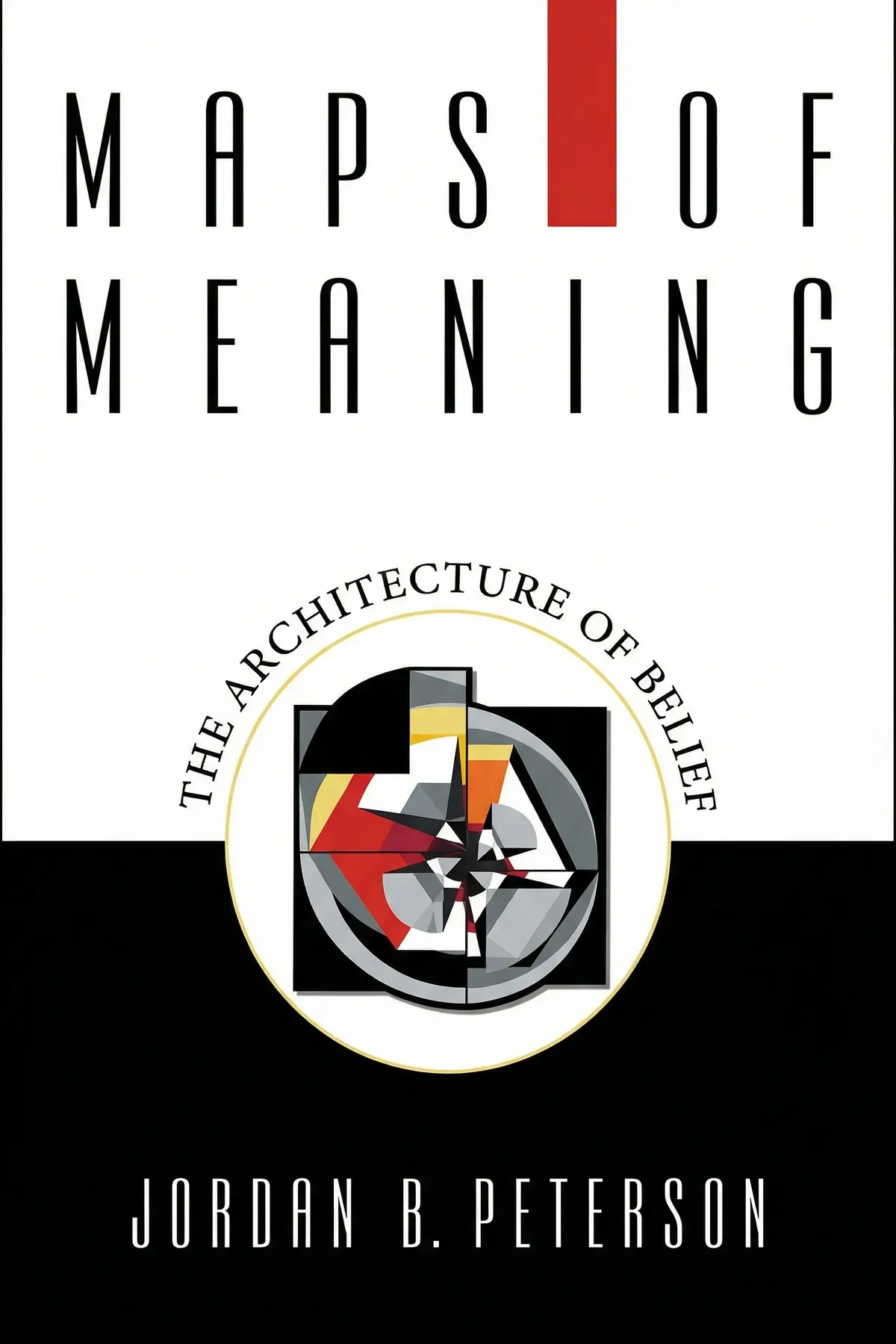
If change and uncertainty leave you anxious, Maps of Meaning offers a way to treat them as the raw material of a meaningful life. Clinical psychologist Jordan B. Peterson starts from a rat dropped into a strange cage: it freezes, then explores, and calms down as the unfamiliar becomes familiar. People do the same, he argues, and the world’s great myths are instructions for doing it well.
From Mesopotamian creation tales to Egyptian gods and the Garden of Eden, Peterson finds one plot. A brave hero ventures out of safe ground into the unknown and makes a triumphant return. His throughline is that meaning comes from willingly facing what you do not yet understand, and that refusing to face it, by hiding in tradition or in ideology, is the root of evil. The old stories become a working guide to setbacks, rebellion and rigid belief, along with a test for when your own worldview has stopped working.
1 min 48 sec
A rat in a new cage freezes before it does anything else. Peterson sees the same reflex in people facing an unopened letter or an unfamiliar situation, and finds in it the start of how we build our world.
1 min 53 sec
A slice of cheesecake is chemically identical whether your grandmother or a stranger offers it, yet it does not mean the same thing. That gap explains why ancient people told stories about dragons and storm demons.
2 min 04 sec
From Mesopotamia to Egypt, the oldest myths share a cast. Once you can name the three roles, a family quarrel over an Egyptian throne starts to look like advice for any organization weighing tradition against change.
2 min 04 sec
Teenagers rebel against their parents only to adopt rules that are just as arbitrary. Peterson argues that this is healthy up to a point, and that a second step is what keeps a person from becoming a tool of tyranny.
1 min 59 sec
A broken elevator and a sudden firing are both surprises, but only one forces you to rethink who you are. Peterson explains the difference and the warning sign that your view of the world has stopped working.
1 min 48 sec
Adam and Eve, living in the Garden of Eden, knew almost nothing and felt neither pain nor death. Peterson reads their exile as the moment that made meaning possible, and the reasoning applies to your worst weeks.
2 min 08 sec
Hannah Arendt saw that ordinary people can do terrible things. Peterson traces that evil to a single habit, one that myths personify in Satan and that modern ideologies practice every day.
1 min 05 sec
Peterson’s map has two territories and one task. A good life stands on the border between order and chaos, drawing on what culture has built while stepping into what it has not yet explained. Myths, from Marduk’s battle with Tiamat to Horus lending his eye to a blind king, are the oldest record of how people learned to do that. They still give direction where facts alone say nothing about what to do.
The practice can start small. Follow your own interests, which Peterson treats as your natural pull toward the unknown and the way individuality grows. When surprises keep piling up, read them as a sign that your model needs revising, as the fired worker did on discovering a wish to work with children. And when a ready-made worldview offers to explain everything, treat its comfort with suspicion, because what it asks of you is to stop exploring.
Like the rat in the new cage, you will freeze first. What you do after the freeze is where meaning begins.
Modern people tend to trust facts and dismiss myths as superstition. Jordan B. Peterson argues that this misses what stories are for. Facts describe what a thing is. Feelings, and the stories built around them, tell us what it means to us, and so how to act. Combining mythology, history and psychology, Peterson starts from a simple observation: rats and humans both freeze before the unknown, then explore it until it becomes familiar. The great myths dramatize that process with the same three figures, from the Mesopotamian battle of Marduk and Tiamat to the Egyptian tale of Horus and Osiris and the Garden of Eden. The unknown appears as a mother who creates and destroys, culture as a father who protects or oppresses, and the hero moves between them. From that structure Peterson draws lessons on growing up, on crises that wreck our plans, on why limits make meaning possible, and on evil, which he defines as refusing to face the unknown. Readers get a lens for setbacks and rigid beliefs, and a case for rejecting ready-made ideologies and charting their own path.
Readers drawn to mythology who want to know why the same hero story appears across so many cultures.
Professionals reeling from a setback, such as a lost job, who want a way to rebuild their sense of direction.
Students of psychology and politics who want to understand how belief turns rigid and dangerous.
Jordan B. Peterson grew up in Alberta, studied political science and psychology at the University of Alberta and earned a doctorate in clinical psychology at McGill University. He researched and taught at Harvard before becoming a psychology professor at the University of Toronto in 1998. Maps of Meaning, published in 1999, was his first book, followed by the bestseller 12 Rules for Life and by Beyond Order. Since 2022 he has been chancellor of Ralston College in Savannah, Georgia.
Jordan B. Peterson
Jordan B. Peterson
Listeners find the work intellectually stimulating, highlighting its broad investigation into mental models of meaning and its deep detailed analyses. Furthermore, they view it as a functional "self-help" guide that is life-changing and well worth the investment. However, the caliber of the writing gets varied reactions, with some praising the prose while others find it hard to understand. Similarly, the level of accessibility and density are also points of contention; while some find it absorbing, others suggest it is difficult to get through and super dense.
This is a monumental achievement that attempts to bridge the gap between ancient mythology and modern brain science. Peterson argues that we don't just see the world as a 'place of things,' but rather as a 'forum for action' where meaning is primary. It’s incredibly dense and requires your full attention to untangle the layers of Jungian archetypes and evolutionary psychology. Frankly, it’s life-changing if you can survive the first hundred pages of abstract terminology and repeated concepts. You start seeing the 'Hero' and the 'Great Mother' everywhere in your own life. It’s not just an academic text; it serves as a practical guide for taking responsibility in a chaotic world.
Show moreWow, what a ride. This book feels like it was written in a different century, blending science, religion, and alchemy into one massive theory of everything. Peterson takes the works of Jung and Campbell and updates them with a level of intensity that is frankly exhausting but exhilarating. The idea that our brains are hardwired to perceive 'Chaos' and 'Order' as fundamental categories of reality makes so much sense of history. It’s not a fast read, and I had to take breaks to let the concepts sink in before moving on. For those looking for a 'self-help' book, this is the ultimate version, though it requires much more intellectual labor than your average bestseller.
Show moreAfter hearing about the controversy surrounding the author, I decided to go back to his original work to see what the fuss was about. What I found was a brilliant, almost manic exploration of the human soul and its relationship to the collective unconscious. This isn't a political book; it's a profound psychological investigation into why people are capable of both extreme good and unspeakable evil. The way he ties the 'Great Father' archetype to the stability of culture and the 'Great Mother' to the devouring aspects of nature is masterful. It requires a lot of patience, but the payoff for your own mental health and understanding of society is immense.
Show morePicked this up because I was curious about how our mental models of the world actually function day-to-day. It’s a deep dive into how humans navigate the unknown and why we find comfort in familiar structures of order. While the prose is thick—expect to re-read sentences multiple times—the insights into why we tell certain stories are worth the effort. I appreciated the connections between the 'Hero' myth and our willingness to face things that terrify us. It’s a bit over-the-top at times with the italics and the constant references to the Nazis, but the core message is solid. This book forces you to look at your own biases and the 'maps' you use to walk through life.
Show moreAs a student of philosophy, I found the distinction between the empirical world and the phenomenological world to be the strongest part of this text. Peterson makes a compelling case that we prioritize 'what something means' over 'what something is' because our survival depends on it. He manages to explain how ancient myths are actually compressed maps for successful behavior in a dangerous environment. Some of the technical shorthand is a bit much, and the citations are sometimes outdated, but the overarching logic is powerful. It’s a rare book that tries to solve the 'is-ought' problem by looking at human evolution and storytelling. Not perfect, but certainly a major contribution to the field.
Show moreEver wonder why certain stories, like the battle between St. George and the dragon, never seem to get old? This book answers that by showing how these narratives are actually blueprints for how our brains handle unexpected information. I loved the way it explains that the 'unknown' isn't just a place, but a biological state of being that can be either terrifying or transformative. My only real complaint is the layout and the constant repetition of specific diagrams that look like they were drawn by a madman. However, once you get the hang of his vocabulary, the world starts to look different. It’s a demanding read that pays off if you're willing to do the work.
Show moreLook, this isn't light reading for a beach vacation. It's an 'everything bagel' of a text that throws neuroscience, mythology, and history into a blender to see what sticks. Personally, I found the focus on the individual as the 'knower' who mediates between order and chaos to be a very helpful way to frame personal growth. It’s a 'self-help' book in the sense that it tells you exactly how to stop being a coward and face the world. The writing is definitely clunky in spots, and Peterson's obsession with italics can be distracting. Still, the depth of the analysis is miles beyond anything else on the market today.
Show moreThe chapter on the neuropsychology of chaos was the highlight for me, even if some of the science feels a bit dated now. Peterson does an excellent job of explaining how the right hemisphere of the brain processes anomalies that the left hemisphere can't handle. This creates a bridge to understanding why we use mythological symbols like the dragon to represent things that threaten our current understanding of the world. Truth is, it’s a difficult book to summarize because it covers so much ground, from Egyptian myths to the horrors of the Soviet gulags. It’s a heavy investment of time, but you’ll come away with a much richer view of human history.
Show moreTo be fair, Peterson needs an editor who isn't afraid to cut three hundred pages of bloat. The book circles back to the same three points—Order, Chaos, and the Individual—for hundreds of pages without adding much new evidence. I found the sections on the neuropsychology of the limbic system fascinating, yet they were interrupted by long, rambling interpretations of the Bible. It’s a strange hybrid of a textbook and a sermon that doesn't always hit the mark. I can see why people find it life-changing, but I found myself skimming through the repetitive summaries. It’s worth reading for the core thesis, but don't feel guilty if you can't finish every single dense paragraph.
Show moreI really wanted to like this after the lectures, but the writing is often impenetrable and unnecessarily repetitive. Peterson has a habit of using fifty words when five would do, making basic psychological points feel like esoteric secrets. The most frustrating part was the blatant misinterpretation of Godel’s Incompleteness Theorem to support his views on moral systems. If he gets a fundamental mathematical concept that wrong, how can I trust his analysis of complex neuropsychology? There are flashes of brilliance, particularly when he discusses the origins of totalitarianism, but they are buried under mountains of obfuscation. It’s a slog that ultimately feels like sophistry designed to sound more profound than it actually is.
Show moreJordan B. Peterson argues that humans, like rats in a new cage, fear the unknown and then explore it to make it familiar. Myths across cultures dramatize this process in one shared plot, in which a hero faces chaos and returns with something that renews society. For Peterson, meaning comes from willingly exploring the unknown, and evil comes from refusing to, whether through blind tradition or ideology.
Peterson identifies three recurring figures. The Great and Terrible Mother stands for the unknown, both creative and destructive, as with the dragon Tiamat. The Great and Terrible Father stands for culture, protective or tyrannical, often shown as an old king. The hero ventures between them, defeats the bad side of each and unites the good, as Horus does when he rescues his father Osiris.
Peterson defines evil as the refusal to face the unknown. Drawing on Hannah Arendt’s idea that ordinary people can do terrible things, he reads Satan as the figure who denies the unknown and so blocks growth. That refusal leads either to blind obedience, as with Nazis who claimed to be following orders, or to decadence. Ideologies, as fixed pictures of the world, repeat the same refusal.
The book points to a few habits. Follow your personal interests, since Peterson sees them as your natural curiosity about the unknown. When surprises keep piling up, treat them as a sign that your picture of yourself or the world needs revising, as in his example of a fired employee who found a better calling. And be wary of any ideology that explains everything and lets you stop exploring.


John Rawls



Steven C. Hayes


Deborah Gruenfeld


Anthony Pratkanis

AUDIO SUMMARY AVAILABLE
Get the key ideas from Maps of Meaning by Jordan B. Peterson, plus 5,000+ more nonfiction titles.









