

59 Seconds: Change Your Life in Under a Minute
Richard Wiseman
 English
A practical guide to keeping four parts of life in balance: personal life, relationships, work and service. It offers simple habits for gratitude, worry, feedback, envy and purpose, all steered by a daily spiritual practice.
1 min 04 sec
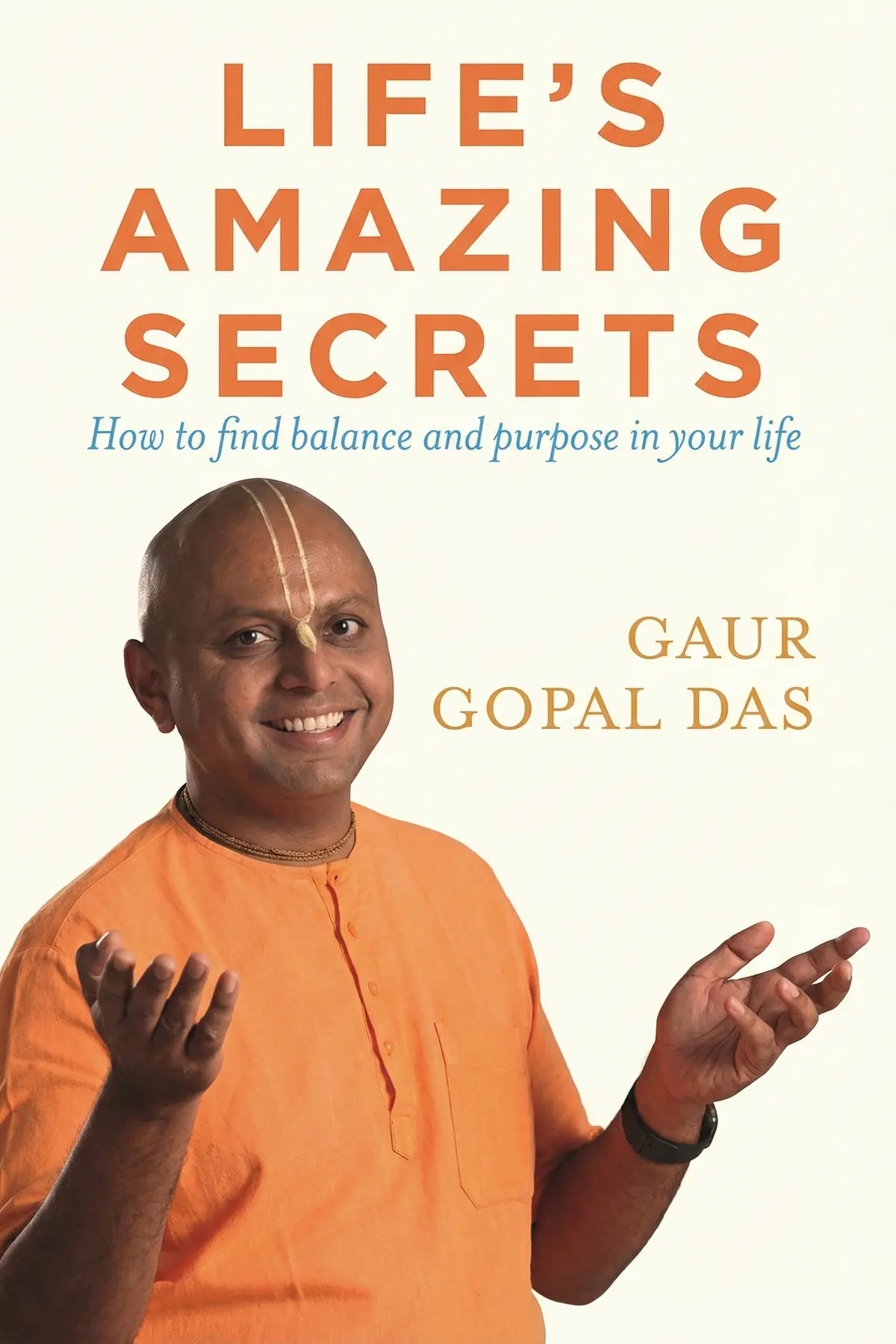
If your work is running fine while your home life, friendships or sense of purpose quietly sag, Gaur Gopal Das has an image for you. In Life’s Amazing Secrets, the engineer turned life coach pictures a life as a car on four tires: your personal life, your relationships, your work and your contribution to others. One soft tire makes the ride rough. Two or three flat ones and the car barely moves. Above them sits the steering wheel, which for Das is your spiritual life.
His argument is that a good life comes from keeping all four areas in balance, each with small practices you can repeat, while spirituality sets the direction. That gives you a kit for every tire: a ten-minute gratitude habit, a flowchart that ends worry, four checks before criticizing anyone, a way to compete without envy, a test for purpose, and one question about whether you live like an ice cream or a candle.
1 min 39 sec
A family facing a small child’s aggressive cancer had every reason to feel cursed. What they focused on instead shows why thankfulness is less a feeling than a skill, and how to train it.
1 min 44 sec
Two friends came home from a long trip abroad and found that no one would hire them. One reaction to that rejection was worth billions, and a simple diagram explains why it worked.
1 min 43 sec
A woman mocked her neighbors’ laundry for years, until one morning it suddenly looked spotless. The real explanation sits behind a five-part model of how we see other people.
1 min 49 sec
The childhood rhyme about sticks and stones gets one thing badly wrong. Four quick checks decide whether your feedback will help someone or leave a mark that lasts for years.
1 min 51 sec
A trusted magazine photographer found his work being secretly deleted, and the person meant to protect him joined in. His story, and an actor’s answer to a teenage question, show two very different ways to compete.
1 min 41 sec
A Japanese model asks four things of your work, and missing even one leaves a feeling you can name. For people too settled to start over, there are two smaller moves that still help.
1 min 50 sec
Ice cream and candles both melt, yet they follow opposite philosophies. Choosing between them shapes how you contribute to others, and Das adds a surprising rule about who should receive your care first.
1 min 14 sec
The car image works because it is ordinary. A car does not need one perfect tire. It needs four that hold air, and a hand on the wheel. That is why the practices Das offers are small: ten minutes of gratitude, two questions before worrying, a list of someone’s strengths before you scold them, a future self to race instead of a colleague.
The deeper point is that the areas leak into one another. Worry sours relationships, envy poisons work, and a life lived only for the ice cream’s pleasure leaves no light for anyone else. Spirituality, in his view, keeps the whole car pointed somewhere worth going, and his own preferred way of holding the wheel is mantra meditation.
So find the tire that feels softest right now. If it is your personal life, open a gratitude log tonight and write down one small kindness from today. If it is a relationship, frame the next argument as the problem, not his fault or yours. And look honestly at your free evenings, the 20 percent that belongs to you.
Every life melts eventually; the candle simply decides who gets the light.
Many people pour themselves into one part of life, usually work, and wonder why the rest feels shaky. Gaur Gopal Das, an engineer who left corporate life for a spiritual path and became a life coach, offers a simple picture for that problem. Life is a car resting on four tires: your personal life, your relationships, your work and your contribution to others. Spirituality is the steering wheel. Each tire gets its own practical tools. A ten-minute gratitude log and a two-question flowchart for worry strengthen the personal side. A five-type model of how people see each other, four questions to ask before criticizing anyone, and a way of thinking about conflict strengthen relationships. Self-competition and the Japanese model of ikigai help at work. A choice between living like an ice cream or a candle, plus the idea of seva, or service, guides social contribution. The stories are concrete: a family facing a child's cancer, Brian Acton shrugging off rejection before WhatsApp, a photographer sabotaged by envious colleagues, Matthew McConaughey chasing his future self. The result is a short kit of habits for keeping every area of life in balance.
Professionals whose work is thriving while their health, family or friendships are slipping.
Young people unsure what work will feel meaningful, and settled ones wanting more purpose.
Anyone prone to worry, envy or harsh criticism who wants simple, spiritually grounded daily habits.
Gaur Gopal Das was born in Pune, India, and trained as an electrical engineer. After a short spell at Hewlett Packard, he left in 1996 to join the International Society for Krishna Consciousness. He has since worked as a life coach and public speaker. Life’s Amazing Secrets, published in 2018, was his first book, and he has received an honorary doctorate from the Kalinga Institute of Industrial Technology.
Listeners find the book highly inspirational, with one listener noting that it helps them attain inner peace. Additionally, the caliber of advice is well-regarded, and listeners value the significant life lessons provided.
Wow. This book hits differently if you’re looking for a mental reset without the heavy religious baggage. Gaur Gopal Das manages to distill complex spiritual concepts into bite-sized, digestible pieces that actually feel applicable to a modern life. The way he frames the journey through a conversation in a car makes the heavy topics of purpose and inner peace feel like a casual chat with a friend. I particularly appreciated the focus on finding balance; it’s not just about being spiritual, but about excelling in your work and contributing to society too. While some might say the advice is common sense, the truth is that common sense is rarely common practice. Reading this felt like a gentle reminder to press pause and recalibrate my priorities before the tyres of my life go flat.
Show moreEver wonder why we make life so much more complicated than it needs to be? Gaur Gopal Das answers that by bringing us back to the basics of human decency and internal fulfillment. I’ve read my fair share of spiritual guides, but this one stands out because it doesn't feel preachy. The ice cream and candle analogy—living for yourself while also lighting the way for others—is something that will stay with me for a long time. The worksheet at the end is a fantastic touch for those who actually want to implement the lessons rather than just nodding along. It’s inspirational without being airy-fairy. I’ve already bought two more copies to gift to my siblings because the advice on handling unhealthy competition at work is something everyone needs to hear.
Show moreAfter hearing so many snippets of his YouTube videos, I finally bought the physical copy and I’m so glad I did. The book is an absolute gem for anyone struggling with their mental health or feeling lost in the rat race. What I loved most was the distinction between being successful and being happy. Das explains that while we chase the external symbols of success, we often ignore the alignment of our internal values. The anecdotes are funny and relatable, especially since the author isn't afraid to poke fun at himself. It provides a sense of inner peace that is hard to find in most modern self-help. It’s the kind of book you want to keep on your bedside table to flip through whenever you’re having a rough day.
Show moreNot what I expected from a monk, but in the best way possible. I was worried this would be a dry, religious text, but it’s actually a very modern guide to living well. Gaur Gopal Das uses his background as an engineer to bring a logical, almost clinical approach to spirituality, which I found refreshing. The way he discusses handling envy and choosing excellence over politics in the workplace is incredibly relevant for today's world. It’s an inspirational journey that focuses on the how of happiness rather than just the what. This book actually helped me achieve a sense of inner peace during a very turbulent month. I can see why his videos go viral; he has a way of making you feel understood.
Show morePicked this up during a long commute, which felt appropriate given the car metaphor used throughout the chapters. The book is structured around four pillars—personal life, relationships, work, and social contribution—likened to the four wheels of a car. It’s a very clever way to visualize balance. Frankly, the writing style is very conversational and easy to breeze through, which makes it perfect for beginners in the self-help space. My only slight gripe is that the secrets mentioned aren't exactly ground-breaking if you’ve spent any time reading philosophy or psychology. However, the anecdotes about his time as a monk and his interactions with his friend Harry add a layer of authenticity that keeps you engaged. It’s a solid, positive read that encourages a lot of self-reflection.
Show moreThe chapter on relationships really stuck with me, especially the part about being sensitive with words and setting boundaries. In a world where we are constantly told to just be positive, I appreciated that the author acknowledged compassion fatigue. It’s a very practical take on spirituality. The truth is, life is messy, and Das doesn't try to hide that with toxic positivity. Instead, he gives you a framework—the four tyres—to help navigate that messiness. My only minor critique is that the formatting in some sections felt a little repetitive, with summaries that echoed the main text too closely. Regardless, the core message about being selfishly selfless is a powerful one that everyone should consider.
Show moreAs someone who works a high-stress corporate job, I found the conversation between Gaur Gopal and his friend Harry incredibly relatable. We often get so caught up in uncontrolled ambition that we forget why we started working in the first place. The book does a great job of breaking down the work-life tyre and explaining how to compete with yourself rather than others. It’s written in a very accessible way, avoiding the jargon that usually clutters this genre. I finished it in two sittings because the pacing is quite fast. While it isn't an intellectual deep dive, it is a highly effective manual for daily living. Definitely worth the read if you feel like your life is slightly out of balance.
Show moreHonestly, I wasn't sure if I'd like this, but the simple philosophy shared here is surprisingly profound. It doesn't promise to solve all your problems overnight, but it does offer a different lens through which to view them. I particularly liked the section on social contribution—the idea that our service to others is the rent we pay for our space on Earth. It’s a humbling thought. The writing is punchy, the stories are engaging, and the advice is practicable. It might be a bit too light for some, but I think its simplicity is its greatest strength. If you need a book that feels like a warm hug and a firm nudge in the right direction, this is the one for you.
Show moreTo be fair, if you have already consumed a lot of content by Jay Shetty or Robin Sharma, you might find this a bit repetitive. The book covers the standard staple diet of modern spirituality: gratitude, mindfulness, and the importance of being kind. I liked the author’s sense of humor and his background as an engineer, which makes his logic very structured. Yet, there were moments where the stories felt a bit too simplistic for the complexities of adult life. It’s a light read, almost like a transcript of his YouTube videos, which is both a pro and a con. If you’re looking for deep, esoteric secrets, you might be disappointed. But if you want a quick, feel-good book that reminds you to be a better human being, this is perfectly fine.
Show moreLook, I know people love Gaur Gopal Das, but I struggled to find anything 'secret' in this book. It felt like a collection of generic inspirational quotes you’d see on a corporate hallway poster. Be grateful, forgive others, don't compare yourself—these are all fine things to do, but they aren't exactly amazing secrets. The narrative structure involving the car ride felt a bit forced and served as more of a vehicle for sermons than an actual story. For someone who has read deeper spiritual texts by Osho or Krishnamurti, this feels very Spiritualism 101. I gave it two stars because the writing is clear and the intent is pure, but it just didn't offer any new perspectives for me personally.
Show moreGaur Gopal Das compares life to a car on four tires: personal life, relationships, work and social contribution. If any one goes flat, the whole ride suffers, so all four need regular attention. Spirituality is the steering wheel that gives the car direction. For each area he offers simple practices, from a gratitude log and a flowchart against worry to self-competition at work and service to others.
It begins by asking whether you have a problem. When the answer is no, you have nothing to be concerned about. If so, it asks whether you can do anything about it. If you can, act rather than worry; if you cannot, worry changes nothing. Every path ends at the same place. Das illustrates it with Brian Acton, who stayed upbeat after Facebook and Twitter rejected him and later sold WhatsApp to Facebook.
He suggests four checks before correcting anyone. Make sure you are the right person, ideally someone close to them. Check that your motive is helping, not settling a grudge. Use a gentle face, voice and gestures, because how you say it matters most. And pick the right moment, for example not right after your partner has spent hours cooking dinner. He pairs this with forgiveness: treat conflicts as the problem, not as anyone’s fault.
Ikigai, a Japanese word roughly meaning a reason to live, asks whether your work covers what you love, what you are good at, what the world needs and what you can be paid for. Missing any of these leaves a gap, such as feeling useless or uncertain. If your career is already set, Das suggests loving the parts of your job you enjoy and using your free time for something meaningful.
It suits readers who feel one area of life is crowding out the others, often work. It also helps people who worry a lot, struggle with envy at work, criticize too harshly or want to give back but do not know where to start. The tools are short and concrete, and the spiritual side is broad rather than tied to one god.
Richard Wiseman

Pico Iyer


Alcoholics Anonymous World Services




William B. Irvine


Andrew D. Thompson
AUDIO SUMMARY AVAILABLE
Get the key ideas from Life’s Amazing Secrets by Gaur Gopal Das, plus 5,000+ more nonfiction titles.









