

13 min 50 sec
Available in: English
Leveraged Learning: How the Disruption of Education Helps Lifelong Learners, and Experts With Something to Teach
By Danny Iny
Shows learners and teachers how to design study that goes beyond memorizing facts. It covers building critical thinking, creativity and staying power, and choosing formats, deadlines and support that make finishing a course far more likely.
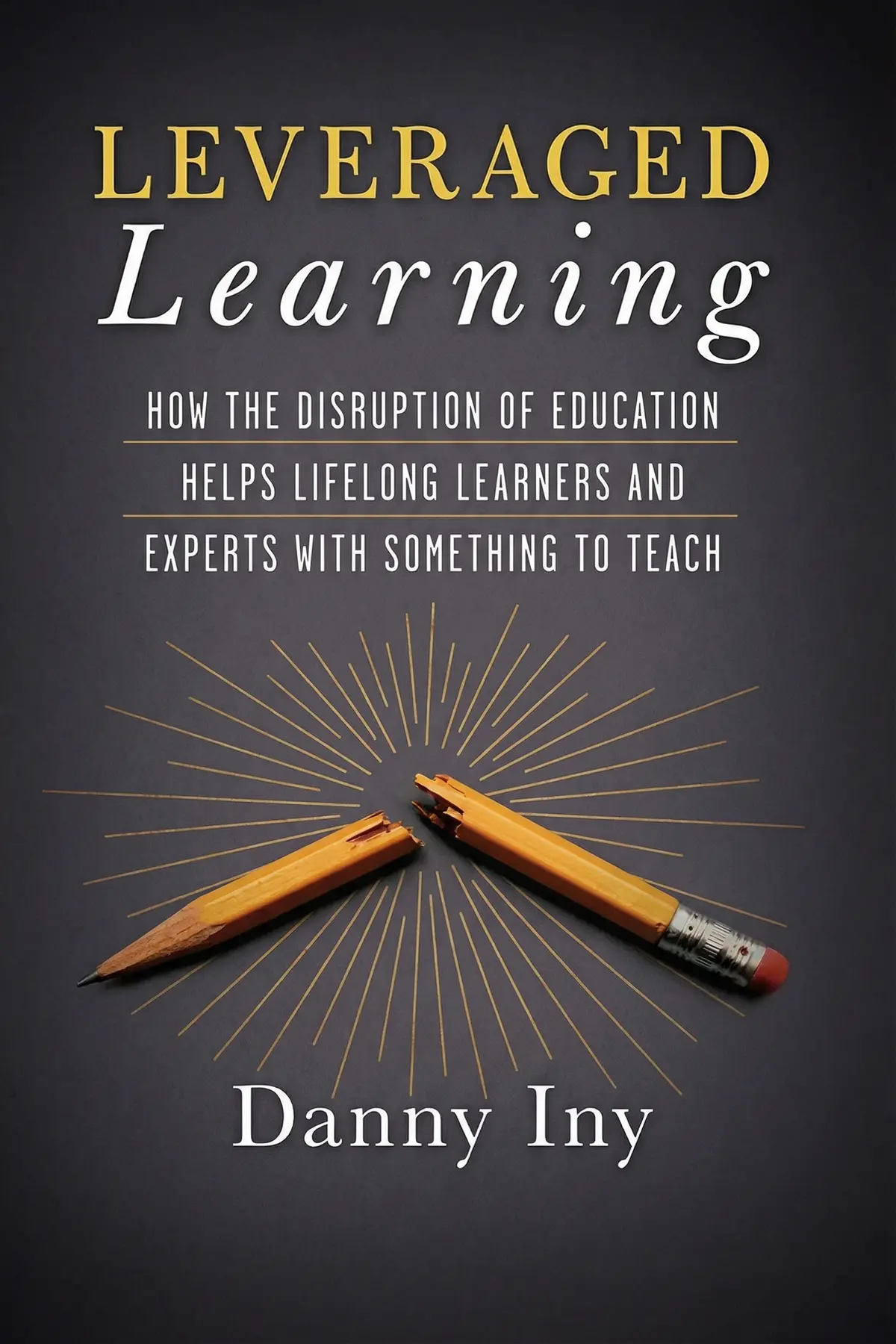
Table of Content
1. Introduction
1 min 04 sec
Many people finish a four-year degree, or a long streak on a language app, knowing plenty and still feeling unready for real work. In Leveraged Learning, entrepreneur Danny Iny argues that the reason is simple: knowledge has become the cheapest part of an education. What pays now is the ability to think, to create and to keep going. He divides any course of study into six layers, whether you are taking it or teaching it: content, success behaviors, delivery, user experience, accountability and support.
The throughline is this. Learn the minimum knowledge fast, then put your effort into insight and into the habits and structures that carry you to the finish. Iny’s evidence includes a rapper who turned a copyright worry into a hit, a study of undergraduates who barely improved, and the startling share of online students who quit. By the end, you can audit any course you are considering, or building, against those six layers and see where it is likely to break.
2. Make your skills hard for software to replace
2 min 01 sec
Accountants and lawyers have already watched software take over parts of their work. Iny’s warning reaches much further than those two professions, and it changes what any course of study should be measured against.
3. Train insight by practicing it with feedback
2 min 06 sec
A pop star spotted something among a crowd of gym T-shirts that most people would have treated as a problem. Most colleges, Iny argues, never deliberately teach the skill he used that day.
4. Learn only what you need, and learn it fast
1 min 47 sec
Most learners study far more material than their goal requires, and in the slowest possible way. An imaginary house and a much shorter pile of flashcards point toward a quicker route.
5. Talk yourself through the moment you want to quit
2 min 10 sec
Three small sentences people tell themselves after a setback make quitting feel perfectly reasonable. A psychologist gave them names, and Iny shows how to answer each one before it wins.
6. Pick the course format that fits your day
1 min 43 sec
Live lectures, recorded clips, apps and bootcamps all compete for your attention. Four simple pairs of choices reveal which format will survive contact with your actual week.
7. Finish what you start with deadlines and helpers
1 min 46 sec
Most online students never reach the end, and the cause is a bias about distant rewards that television takes advantage of every night. Iny’s final two layers are built to beat it.
8. Conclusion
1 min 13 sec
Underneath the six layers sits one change in what an education is for. Facts are no longer scarce, so the value of learning has moved to what you do with them: the judgment, the fresh connections and the stubbornness to finish. Iny’s layers are a way to check that a course, or your own plan, actually builds those things instead of piling up information and hoping the rest arrives by osmosis.
Any learner can act on that now. Before signing up for anything, name what you want to be able to do, and cut the content to what that requires. Spend most of your effort using the material on real problems, with someone knowledgeable telling you where your reasoning slips. When doubt says you will never get it, recognize one of Seligman’s three Ps and answer it with something truer. And surround the effort with a date, a stake and a person, because distant rewards lose to tonight’s distractions far more often than we admit.
Pitbull’s hit came from reading what a room full of Zumba T-shirts really meant. That kind of seeing is what Iny wants every hour of study to train.
About this book
What is this book about?
A four-year degree can leave you full of facts and still badly prepared for the real world. Danny Iny argues that this gap keeps growing. The internet stores information, and services like TurboTax and LegalZoom handle routine expert work. A 2013 Oxford study suggested that almost half of people face that kind of risk within 20 years. Iny's response is a framework of six layers that any learner or teacher can use to judge a program: content, success behaviors, delivery, user experience, accountability and support. Content starts with knowledge but aims at critical thinking, creativity and insight. Success behaviors cover study habits and the fortitude to push through doubt. The book is practical about method. It shows how to cut content to the essentials and learn it with memory palaces, spaced repetition and deliberate practice. It explains how to train judgment through practice and feedback and how to answer pessimistic self-talk. It also helps you pick a course format that fits daily life, and it shows how deadlines, stakes and layered feedback help you finish what you start.
Book Information
Who it's for
Professionals drifting from courses
Professionals who keep starting online courses and language apps, then drift away after a few weeks.
Career changers fearing automation
Career switchers worried that software will soon do what they know, looking for skills that last.
Course designers wanting follow-through
Trainers, teachers and experts designing a course who want people to actually finish it.
About the Author
Danny Iny
Danny Iny is an entrepreneur and author. In 2011 he started Firepole Marketing, the company that later became Mirasee, beginning with no audience and a quarter-million dollars of debt from an earlier startup that had failed. His other books include Teach and Grow Rich, The Audience Revolution and AI Curious, published in May 2026. He has given guest lectures at McGill and Yale.
Ratings & Reviews
Ratings at a glance

What people think
Listeners find the material deeply educational and perceptive, with one individual characterizing it as a thorough critique of current academic norms. The writing is expertly documented, and one listener highlights that it contains a wealth of historical context. Listeners view the book as mandatory study for both parents and those in the teaching profession.
Top reviews
Moo
Finally got around to Danny Iny’s latest, and it’s a total deep dive into why our current schooling is basically a relic of the Industrial Revolution. I was particularly impressed by the historical references he uses to ground his arguments. It isn’t just a rant; it’s a well-researched critique of how "academic inflation" is devaluing the very degrees we pay a fortune for. Truth is, the way he explains the shift toward skill-specific learning makes so much sense in our current economy. Every parent with kids approaching college age needs to sit down with this. It’s a sobering roadmap that highlights why soft skills and "robot-proof" education are the real currency now. My only minor gripe is that he plugs his own course-building philosophy a bit much toward the end, but the core insights are too good to ignore.
Show moreSawit
Wow. This is a comprehensive takedown of the educational status quo that left my head spinning. Danny Iny has clearly done his homework, blending historical data with a sharp vision of a "robot-proof" future. Why are we still using 19th-century methods to train 21st-century minds? It’s a question he answers with brutal honesty. I loved the emphasis on "learning to learn" and the focus on higher-order thinking skills that machines just can't replicate. The writing style is conversational yet authoritative, making complex pedagogical concepts accessible to anyone. Look, the world is changing faster than our curriculums, and if you aren't paying attention to the "leveraged learning" model, you're going to get left behind. This is mandatory reading for anyone who feels like the current path to success is a dead end.
Show moreSavannah
Ever wonder why a college degree doesn't guarantee a stable career anymore? Leveraged Learning tackles this head-on by exploring the "Age of Acceleration" and why our current credentials are often obsolete within five years. The research here is deep. I was fascinated by the historical deep-dive into how the Industrial Revolution shaped our current classrooms into "factory" models. Danny Iny’s argument for "skill-specific" training over broad, expensive degrees is hard to argue with when you look at the student debt crisis. His conversational tone makes the heavy statistics go down easy. Not gonna lie, I was skeptical about another "business guru" writing about education, but this is a serious, scholarly look at a systemic failure. It’s a roadmap for survival in an era where what you can do matters more than what you know.
Show moreJackson
This book is a blunt takedown of a system that is clearly failing the next generation. I was hooked from the first few pages where Iny describes the misalignment between what employers want—soft skills and initiative—and what universities actually provide. The historical references are packed in here, giving the whole argument a weight that many other "disruptive" business books lack. He makes a compelling case that we need a "robot-proof" education system that values creativity and innovation over rote memorization. It’s refreshing to read someone who acknowledges that "learning to learn" is the most important skill we can possess. Personally, I think every high school guidance counselor should have a copy of this on their desk. It provides a much-needed alternative to the debt-heavy path we’ve been told is the only option.
Show moreIvan
As a parent watching my kids navigate a broken system, this book felt like a much-needed wake-up call. Danny Iny doesn't hold back when he argues that the traditional university model is essentially dead for most practical purposes. The book is packed with fascinating historical context, showing how we got stuck in this "high school to college to job" loop that no longer functions. I found the section on Edgar Dale’s Cone of Learning particularly enlightening—it explains exactly why those long, dry lectures we all sat through are the least effective way to actually gain knowledge. Personally, I would have liked more concrete "how-to" steps for students who aren't looking to start their own businesses, but as a cultural analysis, it’s brilliant. It challenges you to rethink the value of a diploma versus actual, demonstrable competence.
Show moreFang
The chapter on "Designing Great Courses" was the highlight for me, as someone who actually works in the training space. Danny Iny understands that teaching is an art, not just a data dump. He correctly identifies that experts often fail as teachers because they forget the "curse of knowledge"—they don't remember what it was like to be a beginner. This book is a brilliant resource for anyone looking to create education that actually sticks. I appreciated the specific references to scaffolding and building "fortitude" in learners. Gotta say, the middle section on self-driving cars and tech shifts felt a little disconnected from the main point, but it eventually ties back into the need for rapid adaptation. It’s a solid four-star guide that bridges the gap between old-school theory and new-age application.
Show moreElan
After hearing Danny on a podcast, I had high hopes for this book, and it largely delivered. It’s a fascinating look at the "Story of Progress" and why we are currently at a breaking point with modern schooling. I found his take on "fortitude" and the need for emotional support in digital learning to be spot on. We can't just expect students to watch dry videos and magically become experts. The book does a great job of explaining that higher-order cognitive skills require interaction and discussion. To be fair, some of the acronyms and diagrams felt a bit like filler, but the overall message is powerful. It’s an essential read for educators who want to move beyond the "lecturing" model that Dale’s Cone shows is so ineffective. Solid 4 stars for a visionary take on our future.
Show moreKofi
In my experience as an educator, it is rare to find a book that so accurately captures the frustration of the modern classroom. Iny hits the nail on the head regarding "academic inflation" and the way degrees have become mere checkboxes rather than signs of true mastery. I especially liked the questions at the end of each chapter; they really help you integrate the concepts. The writing is authoritative, yet it feels like a conversation over coffee. While I don't agree that universities are completely "dead"—they still offer invaluable social growth—I do agree that the instructional model is broken. The book is a great reminder that we must commit to being lifelong learners if we want to stay relevant. It’s a provocative, insightful read that manages to be both historical and forward-looking at the same time.
Show moreBig
Not what I expected, though there are certainly nuggets of wisdom buried in here. To be fair, Iny makes a compelling case about the "87% dropout rate" of MOOCs and why simply dumping information online isn't enough. He argues that we need to teach "fortitude" and create engaging experiences rather than just checklists. However, I felt like a large portion of the book served as an elaborate funnel for his own business training programs. While the research into the evolution of education is top-notch, the tone occasionally slides into that "six-figure webinar" hype that I tend to avoid. If you can filter out the self-promotion, the discussion on cognitive objectives and the failure of the American student loan system is very much worth your time. It’s a decent read for educators, but take the "universities are dead" hyperbole with a grain of salt.
Show moreSofia
Frankly, I found this to be a bit of a retread of ideas that have been circulating in the "ed-tech" world for years. While Iny is a clear writer, he doesn't bring much new to the table if you’ve already been following the work of people like Ken Robinson or even using platforms like Khan Academy. He spends a lot of time attacking universities—which, let’s be honest, is an easy target—without acknowledging the social and networking value they provide. The "academic inflation" argument is valid, but the solution he offers feels suspiciously like it leads right to his own products. It’s a lot of hype about a revolution that is already well underway. If you are totally new to the concept of online learning, you might find it interesting, but for anyone already in the industry, it feels quite basic.
Show moreQuestions about this book
What is the main idea of Leveraged Learning by Danny Iny?
Iny argues that knowledge is now the cheapest part of an education, because the internet stores information and software performs many expert tasks. Learners should acquire only the knowledge their goal requires, as fast as possible, and then build critical thinking, creativity and insight through practice and feedback. Habits, the right course format, deadlines and personal support carry them to the finish.
What are the six layers of leveraged learning?
Iny describes six layers that a teacher, a course or a self-directed learner blends together. Content starts with knowledge but aims at critical thinking, creativity and insight. Success behaviors cover study habits and fortitude. Delivery is how material is packaged and practiced. User experience is the format, such as live or recorded, desktop or mobile. Accountability and support keep people going until they finish.
How does Danny Iny suggest learning faster?
First, trim the content to the minimum your goal needs, for example speaking practice over grammar rules for Spanish. Then use four techniques: scaffolding, such as a memory palace that links new words to rooms of an imagined house; spaced repetition in short bursts; deliberate practice focused on the items you get wrong; and practice in conditions that resemble real use, like talking with native speakers.
How can I stop quitting online courses?
Iny points out that as many as 87 percent of learners abandon the majority of courses taken online, partly because far-off rewards seem weaker than comfort right now, a bias called hyperbolic discounting. He suggests fixed start and end dates with deadlines, real stakes for skipping practice, and personal feedback from a tutor, mentor or peer group. He also recommends answering pessimistic self-talk and using mental contrasting to plan around obstacles.
Who should read Leveraged Learning?
It suits adults who want to learn new skills outside or after formal schooling, people worried that automation will copy what they know, and experts or trainers designing a course. Its framework works in both directions: learners can use it to choose a program that fits their lives, and teachers can use it to build one that people actually complete.
Readers also enjoyed


Alibaba: The House That Jack Ma Built
Duncan Clark




7 Powers: The Foundations of Business Strategy
Hamilton Helmer

AUDIO SUMMARY AVAILABLE
Listen to Leveraged Learning in 15 minutes
Get the key ideas from Leveraged Learning by Danny Iny, plus 5,000+ more nonfiction titles.
- 5,000+ titles
- Listen as much as you want
- 7-day free trial
- Cancel anytime









