
The Age of AI: And Our Human Future
Henry Kissinger
 English
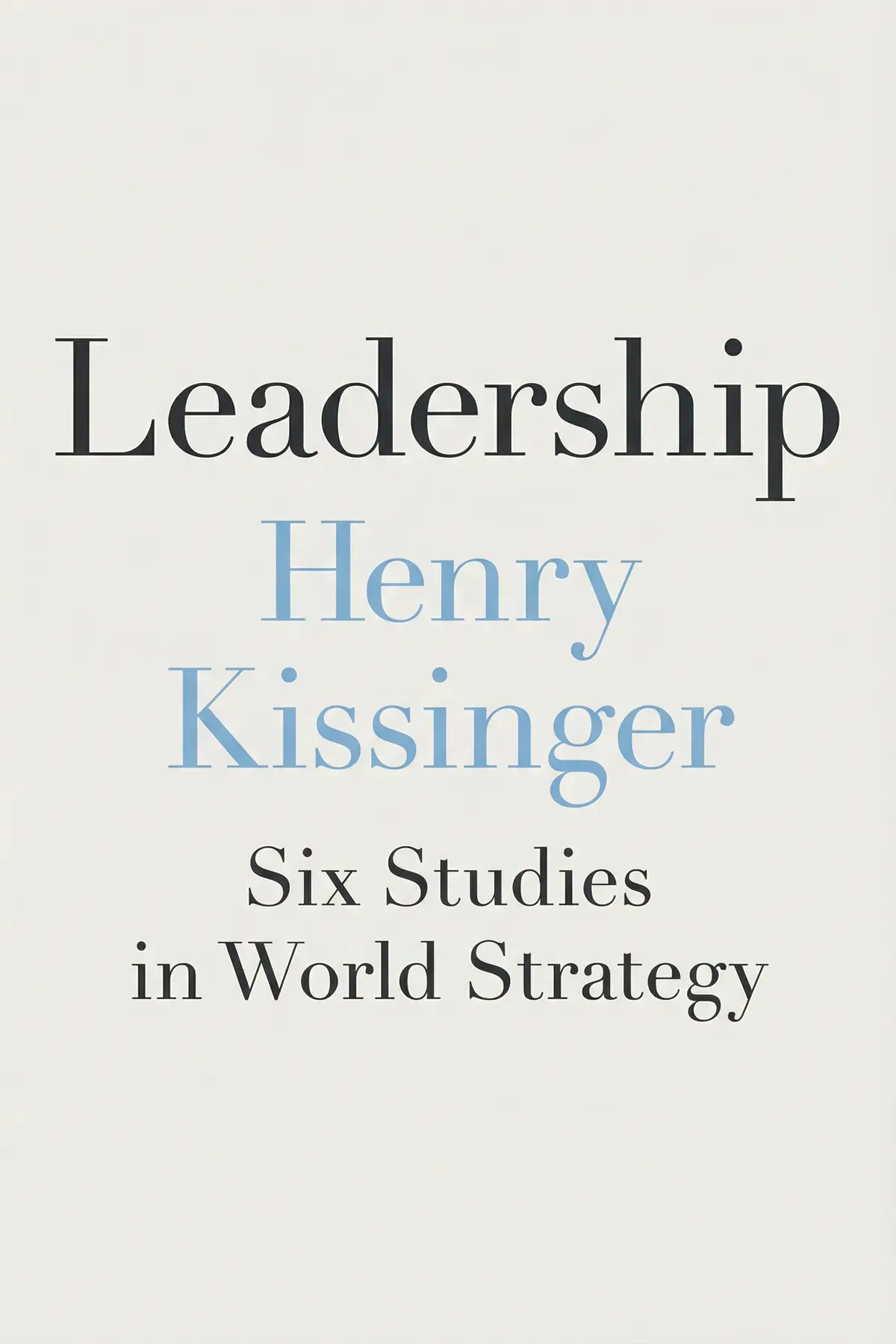
Henry Kissinger studies six postwar leaders who rescued or remade their nations, and shows how each matched one strategy, such as humility, will, balance or conviction, to the crisis in front of them.
1 min 16 sec
Most leaders spend their careers keeping things running, and in calm times that is enough. In Leadership: Six Studies in World Strategy, Henry Kissinger, the statesman who pioneered détente with the Soviet Union, argues that a crisis demands something else: a leader who acts instead of one who manages. To show what acting looks like, he studies six people who found their nations at a low point and turned them toward something new.
Temperament and politics set Margaret Thatcher, Konrad Adenauer, Anwar Sadat, Richard Nixon, Lee Kuan Yew and Charles de Gaulle far apart from one another. What joined them was one governing strategy, chosen to fit their moment: humility, will, equilibrium, transcendence, excellence or conviction. There is no universal leadership style, but there is a fit between a strategy and its circumstances, and these six found it.
Each portrait ends with a tool for anyone leading a team, a company or a project through a hard season. The tools range from owning a past failure in public to holding a course while the doubters grow loud.
1 min 49 sec
A defeated nation, starving and occupied, needed its dignity back. Its new leader chose a path that looked like weakness to many, and within a decade it had delivered something no show of strength could have won.
1 min 53 sec
France’s lowest-ranking general, newly arrived in London, asked his countrymen to defy their own government. Years later he gave speeches that left out who had actually freed his country, and it made him France’s leader.
2 min 03 sec
Egypt’s president took his people somewhere his admired predecessor would never have gone. He did it so gradually that few noticed the turn, and the destination won him a Nobel Prize and cost him his life.
2 min 06 sec
Secret messages passed through intermediaries, a hidden flight to Beijing and a summit that still shapes three governments. One American president bet that peace depends on balance, even if that means courting an ideological enemy.
2 min 03 sec
Conventional wisdom said elections were won in the middle. One British politician refused to chase it, pushed her country through a painful recession, and ended up redrawing where the middle actually sat.
1 min 59 sec
A tiny island was pushed out of a federation and left with no common language, no shared identity and no guarantee of survival. Its leader’s answer reached into where people lived and what their children learned.
1 min 11 sec
Six leaders, six strategies, and none of them would have worked in another’s place. Adenauer’s humility would have failed de Gaulle in 1940, when France needed someone to insist it had not lost. Thatcher’s open fight with the center would have sunk Sadat, whose people could not be allowed to notice how far he was taking them. Kissinger’s argument is that great leadership is a fit between a person, a strategy and a moment, and that in a crisis the leader who only manages lets the moment pass.
That gives you a question to ask before your next hard season at work: what does this situation actually need from me? Sometimes it needs an honest account of past mistakes and amends people can see. Sometimes it needs a confident story about who the group can become, or a slow change that respects what came before. Sometimes it needs a position held while the early numbers look bad, or standards built so deep into daily routines that they survive your departure.
Kissinger ends by asking readers to remember these six in a world that seems eager to forget them. The most useful way to remember them is to know which one your own moment is calling for.
Most leaders spend their time keeping things running. That works in calm years. In a crisis it fails, because someone has to change where the whole group is heading. Henry Kissinger, a statesman who helped shape American foreign policy for years, wrote Leadership to show what that kind of action looks like in practice. He profiles six people who took a country at a low point and set it on a new course: Konrad Adenauer in defeated Germany, Charles de Gaulle in occupied France, Richard Nixon facing a divided world, Anwar Sadat in Egypt, Lee Kuan Yew in a newly independent Singapore, and Margaret Thatcher in a struggling Britain. Each relied on a single governing strategy: humility, will, equilibrium, transcendence, excellence or conviction. Kissinger worked alongside Nixon and negotiated directly with Sadat, so he was in the room for some of the events he describes. Readers get six compact case studies of leadership under pressure. They also get a useful question for any hard season at work or in public life: which strategy does this moment actually require?
Team leads and managers facing a turnaround who need more than routine management.
Founders deciding whether to change course quickly, gradually or by holding firm.
Readers of history who want short, sharp portraits of postwar statesmen told by someone who knew several of them.
Henry Kissinger was born in Fürth, Germany, in 1923 and fled to America in 1938 as a Jewish refugee from the Nazis. He served in the US Army in the Second World War, then studied at Harvard and became a professor of government there. In government he promoted Realpolitik and pioneered détente with the Soviet Union. He was awarded the 1973 Nobel Peace Prize for his role in negotiating the Paris Peace Accords, a prize that drew controversy. He ran Kissinger Associates from 1982 until his death in 2023.
Henry Kissinger

Listeners find this work to be a perceptive treatise, valuing its sophisticated examination of six figures and its importance for future leaders. The writing is approachable and high-quality, as one listener observes it is written through the lenses of statesmanship. They characterize the material as engrossing and educational, with one review highlighting its masterful storytelling. Listeners also praise the book’s tempo, with one person noting its clear sense of purpose and direction.
Ever wonder why modern politicians seem so ephemeral compared to the giants of the mid-20th century? Kissinger argues that our shift from deep literacy to image-based social media is eroding the capacity for serious leadership. Frankly, his cultural analysis of the current educational system producing 'egotists' instead of citizens hit home for me. He uses figures like Lee Kuan Yew and Anwar Sadat to illustrate how vision must be paired with an almost stubborn courage. The book isn't just a history lesson; it is a warning about the decline of deep thinking in the digital age. This is easily the most thought-provoking thing I’ve read this year. It combines macro-level international relations with micro-details of personality in a way that feels both masterful and urgent.
Show morePicked this up on a whim after seeing a recommendation, and I was genuinely surprised by how engaging the storytelling is. Kissinger moves effortlessly from macro-level international relations to the micro-details of a leader's personality. Truth is, the chapter on Lee Kuan Yew was absolutely mind-blowing and prompted me to buy several more books on Singapore’s history. You can tell the author has a clear sense of purpose and direction with every anecdote he shares. It feels like you are sitting in a room with a master strategist who has seen everything. Even if you don't like the man’s politics, the information here is undeniably valuable for anyone in a leadership role. It is well-written, informative, and surprisingly easy to read despite the complex subject matter.
Show moreFinally got around to finishing this massive tome, and the closing chapter alone is worth the price of admission. Kissinger’s reflection on how solitude and deep thinking are becoming rare is a hauntingly accurate critique of our current society. He highlights how today's leaders are forced into immediate reactions by the internet, leaving no room for long-term strategy or moral reflection. The way he weaves together the lives of these six leaders to create a cohesive theory of statesmanship is brilliant. It is a masterful piece of writing that stays with you long after you close the cover. This is definitely a book that demands your full attention. It’s not just about the past; it’s a necessary look at the outlines of a worthy future during a period of transition.
Show moreKissinger’s prose flows with an old-world elegance that makes even complex diplomatic maneuvers feel like a gripping narrative. He isn't just recounting facts; he’s telling a story about the intersection of human character and historical necessity. I loved the way he describes the 'skein of intergenerational conversation' that history provides for those who are willing to study it. To be fair, it’s a very traditional view of 'great men,' but it is presented with such intelligence that it’s hard not to be impressed. The book is both a history and a guidebook for those who wish to understand the burdens of high-level decision-making. It is insightful as a treatise and reveals a masterful storytelling ability that keeps the reader engaged from start to finish.
Show moreWhat a fascinating look into the minds of six individuals who shaped our modern world through sheer force of will. From the very first chapter, you can see the depth of Kissinger's intellect as he balances macro-political shifts with micro-personal anecdotes. The book is essentially a treatise on how to handle periods of transition when institutions are losing their relevance. In my experience, we need this kind of abstract thought and erudition now more than ever. The storytelling is masterful, and even though it is a long book, it never feels like a slog. It provided me with a storehouse of knowledge regarding the Middle East and Southeast Asia that I’ll be reflecting on for quite some time. It is a brilliant chain of insights into the essence of power.
Show moreKissinger brings a weight of history to these pages that few other living writers could possibly match. He examines six leaders he knew personally, which adds a layer of intimacy that you won't find in a standard academic textbook. To be fair, he is clearly more forgiving of Nixon than many historians might like, yet his analysis of 'character' as a prerequisite for power is hard to argue with. The prose is elegant and the pacing remains steady throughout the lengthy profiles. I found the section on Margaret Thatcher particularly sharp in its assessment of how she navigated a declining Britain through sheer force of will. It is a dense read, but one that rewards those looking for a masterclass in global statesmanship and historical perspective. While his bias is visible, the intelligence behind the analysis is undeniable.
Show moreWhile I don't agree with every policy decision Kissinger ever made, his ability to dissect the 'vocation' of politics is masterly. He frames leadership as a struggle between the 'aristocratic' ideal of service and the 'meritocratic' drive for personal advancement. The analysis of Charles de Gaulle’s willpower was a highlight for me, showing how one man can essentially will a nation back into existence. My only gripe is that he occasionally gets bogged down in minutiae that might bore a casual reader. Still, the book offers a sense of proportion that is sorely lacking in today's political discourse. It is a dense, informative treatise that requires slow, careful reading. It really makes you question if our current educational system is capable of producing leaders of this caliber anymore.
Show moreAs someone who appreciates strategic thinking, I found the breakdown of Adenauer and Thatcher particularly illuminating. The book establishes a clear timeline of the twentieth century, using these figures as anchors to explain how the world shifted from the aftermath of WWII to the Cold War. Personally, I appreciated the focus on 'realist' principles, even if they are controversial in today's climate. The writing is incredibly polished and has a clear sense of direction that makes the 400-plus pages fly by. There are moments where the praise for Nixon feels excessive, but that was to be expected given their history. It is a fascinating, well-structured look at the mechanics of global power. Definitely a good addition to the library of any aspiring statesman or history buff.
Show moreThe geopolitical insights regarding the Middle East and Northern Ireland are undoubtedly the strongest parts of this collection. However, I found the title to be a bit misleading because this is less a book on 'leadership' and more a collection of personal memoirs and justifications. Kissinger’s admiration for his subjects often blinds him to their glaring flaws, resulting in a narrative that feels one-sided and overly protective of their legacies. Not gonna lie, the prose is beautiful, but I often wondered if I was getting the real history or just a polished version of it. It’s an okay read if you already have a solid background in 20th-century history to counter his biases. If you are looking for an objective analysis, you might want to look elsewhere, but for those interested in Kissinger’s personal lens, it has some value.
Show moreThis felt less like an objective study of power and more like a high-level exercise in reputation laundering. Look, Kissinger is a man of a specific era. His attempt to rehabilitate figures like Nixon by placing them next to the likes of Adenauer feels manipulative and frankly insulting to the reader's intelligence. Furthermore, his views on modern technology and AI come across as incredibly naive, bordering on cringeworthy at times. He is a senior gentleman who seems completely disconnected from the digital reality we live in now. While there are some interesting geopolitical crumbs regarding Northern Ireland, the heavy bias makes it difficult to trust the narrative as a whole. It is a rather uninspiring read that left me frustrated with its lack of critical self-reflection. I expected a treatise, but I got a self-serving memoir.
Show moreKissinger argues that in ordinary times leaders mostly manage, but in a crisis they must act. He studies six leaders who transformed their nations, Adenauer, de Gaulle, Nixon, Sadat, Lee Kuan Yew and Thatcher, and links each to one strategy: humility, will, equilibrium, transcendence, excellence and conviction. His point is that no single style works everywhere; great leaders find the strategy their moment requires.
Adenauer used humility, facing Germany’s Nazi past to win back equality. De Gaulle used will, describing a free and self-liberated France until it became one. Nixon pursued equilibrium, balancing the great powers by opening to China. Sadat practiced transcendence, moving beyond Nasser’s positions in stages toward peace with Israel. Lee Kuan Yew insisted on excellence in Singapore, and Thatcher governed by conviction, refusing to chase the political center.
Start by asking which strategy your situation needs. After a failure, Adenauer’s example suggests admitting what went wrong and making visible amends. If you inherit a respected predecessor’s team, Sadat’s approach suggests keeping what people value while changing the rest in steps. If a hard decision brings painful early results, Thatcher’s case shows the value of holding a clear position. Lee’s example says to build standards into everyday systems.
It suits managers, founders and team leads facing a crisis or turnaround who want concrete examples of leaders who changed direction under pressure. It also suits readers interested in postwar history and diplomacy, since Kissinger was personally involved in some of the events, including the secret opening to China and the peace talks with Egypt’s Anwar Sadat.
Kissinger presents Thatcher as the model of conviction. In a decade when politicians assumed only centrists could win, she argued for clear policies that let voters choose. She raised interest rates to 17 percent, accepted a recession and held firm against doubters in her party. By 1990 inflation had been halved and incomes had more than doubled, and she had pulled the views of the median British voter to the right.

Barack Obama


Masaji Ishikawa

William J. Bernstein

John Rawls

Ben Macintyre




James Shapiro
AUDIO SUMMARY AVAILABLE
Get the key ideas from Leadership by Henry Kissinger, plus 5,000+ more nonfiction titles.









