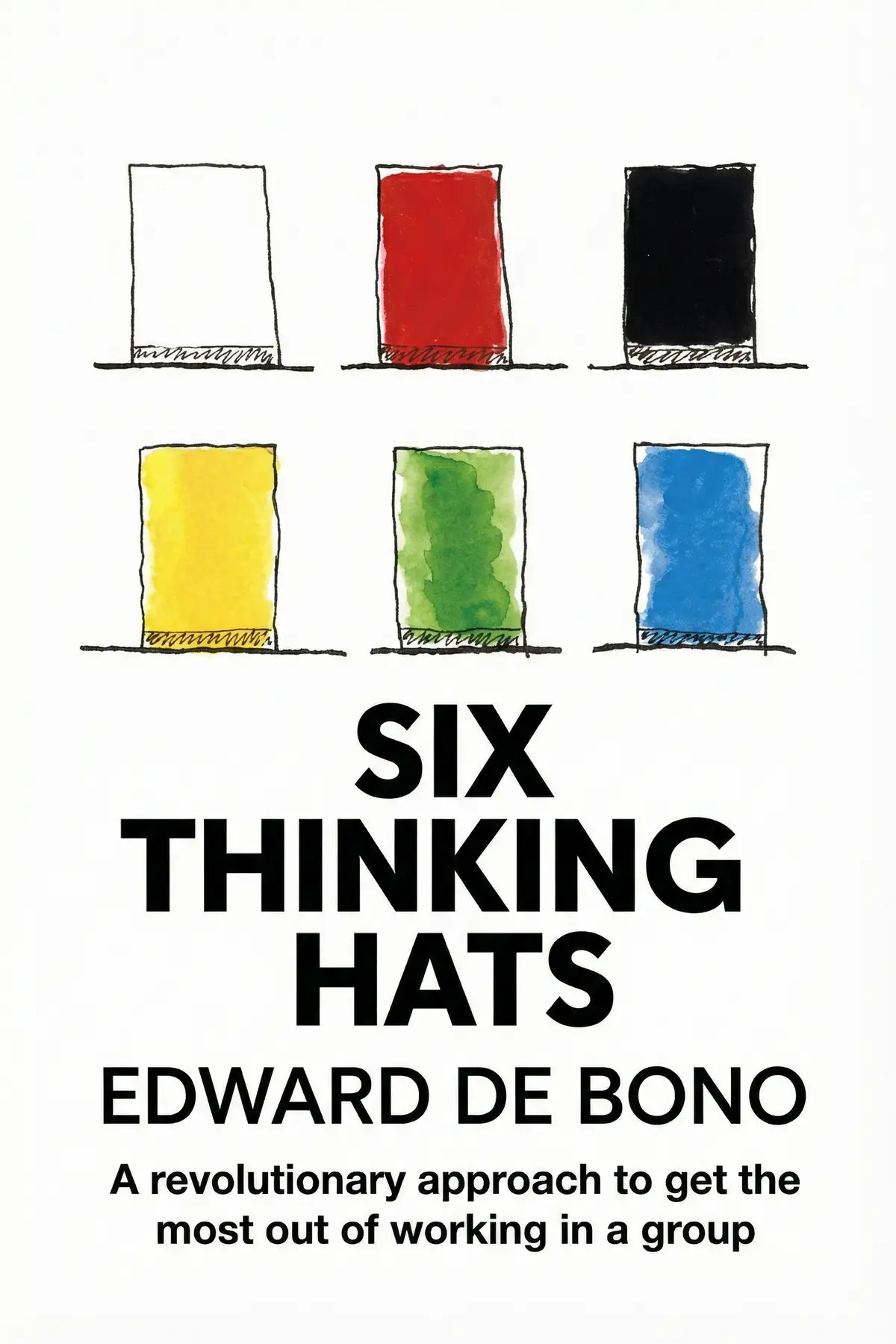
Six Thinking Hats
Edward de Bono
 English
Shows why a well-trained mind keeps producing the same ideas. It gives practical exercises for breaking that pattern: setting quotas of alternatives, holding back judgment, flipping problems, starting from the end and using random words.
1 min 02 sec
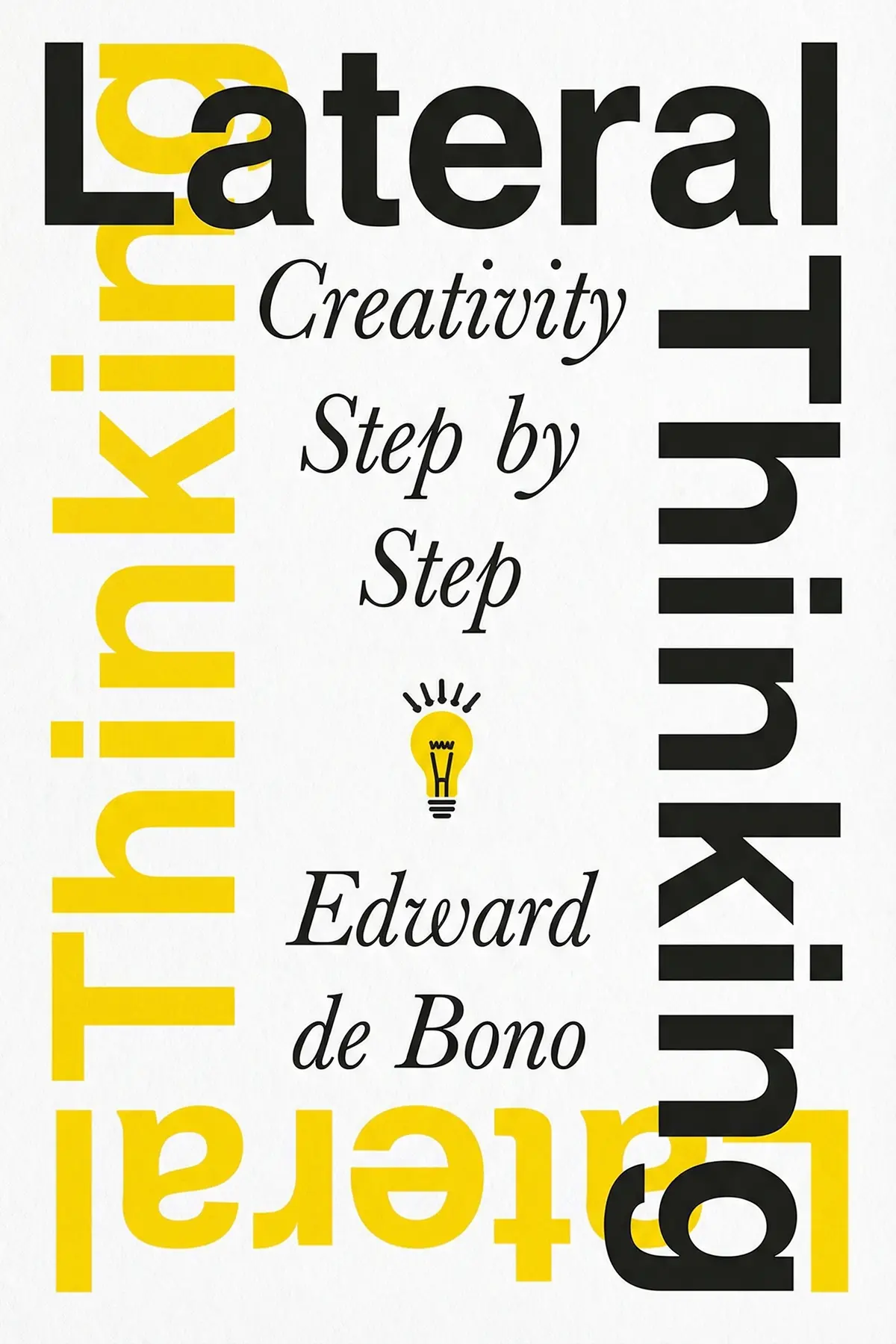
Most people who say they want new ideas end up polishing old ones, because the mind is built to repeat what has worked before. In Lateral Thinking, Edward de Bono, a physician, inventor and consultant, argues that creativity is a skill anyone can practice, step by step, rather than a rare gift. The brain, he explains, is an excellent pattern machine, and the very talent that makes it efficient also keeps it running in old grooves.
Lateral thinking is his name for knocking those grooves loose on purpose. It uses small techniques you can repeat: a quota of alternatives, a pause on judgment, a problem flipped backward, a start from the far end, a random word dropped into the mix. Each one moves you sideways, away from the obvious path. The tools come with de Bono’s own exercises, from a tangled fishing puzzle to a tennis tournament of 110 players, and you can try them on a real problem with your team tomorrow.
1 min 46 sec
The same mental skill that lets you read a half-hidden word also keeps you from having new ideas. De Bono explains why experience can make thinking narrower, and why the fix does not mean throwing logic away.
1 min 52 sec
Nearly everyone claims to welcome alternatives, and nearly every meeting still picks the first option that works. A simple rule and a stack of captionless photographs show how to close that gap.
1 min 41 sec
One of the great feats of early radio began with a belief that turned out to be false. De Bono uses it to argue for a strict rule in idea sessions, and he coined a word to enforce it.
1 min 41 sec
Ask a room to design a better apple-picking machine and everyone thinks they know the goal. Then ask them to name it. The answers split the problem open and reveal how many different machines were hiding inside.
1 min 48 sec
Imagine traffic directing a police officer, or a street that cleans its cleaner. Some of these flips are nonsense, and de Bono says that is fine. A comparison involving a snowball shows a second way to jolt the mind.
1 min 39 sec
A silent dog solved a Sherlock Holmes case, and a children’s puzzle about tangled fishing lines hides a shortcut most adults miss too. Both point to a habit of attention that makes hard problems suddenly simple.
1 min 36 sec
Open a dictionary at a random page, pick a word, and try to use it against shoplifting. It sounds like a party game, yet de Bono treats this kind of deliberate randomness as a serious tool for getting unstuck.
1 min 02 sec
What de Bono offers is a set of deliberate habits for interrupting a brain that is too good at repeating itself. Vertical thinking still does the building. Lateral thinking checks whether you are building in the right place. The pattern skill that lets you read a half-covered letter is the same one that hides the losers in a tennis draw and the silent dog at a crime scene.
None of these tools depends on talent. They depend on a willingness to hold off on no. In your next meeting, ask for a quota of alternatives before anyone chooses, and keep critique out until the ideas stop coming. When someone reaches for a reflexive objection, try de Bono’s word Po and let the strange suggestion stand a little longer. When a problem refuses to move, start from its end, say it backward, or open a dictionary at random and make the word earn its place.
Marconi crossed an ocean on an idea that turned out to be wrong. Give yours a little longer before you bury it.
Teams say they want new ideas, but they usually end up choosing the first workable option. Edward de Bono traces this to the way the mind works. It is an excellent system for spotting patterns and storing them, and that strength also locks it into familiar grooves. The more experience we gain, the less we question what we already believe. De Bono's answer is lateral thinking, a deliberate way of moving sideways from the obvious approach. He does not set it against ordinary logical thinking. It works alongside it, testing and updating the patterns that logic builds. He also treats creativity as a skill anyone can practice, not a rare talent. The book is a toolkit of exercises. You set quotas of alternatives, describe ambiguous photographs and redesign everyday objects. You flip problems backward, stretch analogies, start puzzles from the end and draw random words from a dictionary. Readers learn to run better idea sessions, spot the hidden assumption behind a problem and keep promising but strange suggestions alive long enough to pay off, helped by the word de Bono invented for that job.
Team leads and facilitators whose brainstorms keep producing the same safe ideas.
Designers, founders and product people stuck on a problem they think they already understand.
Teachers and trainers looking for ready-made exercises that build creative thinking in a group.
Edward de Bono was born in Floriana, Malta, in 1933 and died in 2021. He worked as a physician, an inventor and a consultant, and he introduced the term lateral thinking. He argued that schools should teach thinking on purpose, and he held faculty positions at Oxford, Harvard and Cambridge. He wrote more than 80 books, among them The Mechanism of the Mind and Six Thinking Hats.
Edward de Bono
Listeners find the material highly stimulating and quite straightforward to follow, with one person mentioning how approachable the author’s prose is. They value its usefulness in both professional environments and everyday life, and one listener describes how it aids in artistic pursuits. The visuals get conflicting reviews, as some find them useful while others view them as redundant.
This book is a masterclass in shifting your perspective. I’ve always considered myself a logical, vertical thinker, but this text opened my eyes to the limitations of that rigid approach. De Bono’s writing style is remarkably easy to read, which is rare for such a foundational text on psychology and education. The illustrations, while a bit simple, really helped visualize how the mind gets stuck in certain 'ruts' of thought. It’s been incredibly helpful for my own creative endeavors lately. I’ve started applying the 'suspension of judgment' technique in my meetings, and the results are already visible. Truly thought-provoking stuff that everyone should read at least once. It’s absolutely essential for any modern library.
Show moreFinally got around to reading this classic, and I honestly wish I’d picked it up years ago. The way De Bono explains the 'man in the elevator' riddle perfectly illustrates how our assumptions trap us in vertical thinking. It’s not just about being creative; it’s about learning how to dismantle the logical pathways that lead to dead ends. I found the tone to be quite encouraging, even if the structure is a little dry in the practice segments. The book serves as an excellent manual for anyone involved in invention or design. It provides a structured way to be unstructured, if that makes sense. Highly recommended for thinkers who want to expand their mental horizons.
Show moreAfter hearing so many people in my marketing firm mention 'lateral thinking,' I felt compelled to go back to the original source. Edward de Bono writes in a surprisingly accessible style that makes complex cognitive theories feel approachable for the average professional. The core distinction between vertical logic and lateral creativity is a total game-changer for brainstorming sessions. I found the practical applications for day-to-day problem solving to be the highlight of the text. However, the book does feel a bit dated in its presentation, and some of the examples are somewhat archaic. Despite those minor gripes, it’s a solid manual for anyone looking to break out of rigid thought patterns and find better solutions.
Show moreEver wonder why some people just seem naturally more 'inventive' than others? This book suggests it’s not magic, but a specific mental technique that can actually be practiced and refined. I loved how the author breaks down the mechanics of insight and humor as products of lateral thinking. The puzzles and exercises are fun, though some of the diagrams felt a bit repetitive after a while. It’s a very practical guide that avoids the usual fluff you find in modern self-help. Even though it was written decades ago, the advice on avoiding 'being right all the time' feels more relevant than ever. A very rewarding read that actually provides tools you can use immediately.
Show moreI’m not usually one for older 'how-to' books, but this one surprised me with its relevance to modern business. The truth is, most of our corporate training is purely vertical, focusing on being 'right' at every step of the process. This book provides a much-needed antidote to that rigidity. De Bono’s prose is clear and free of unnecessary jargon, making it a very quick read despite the depth of the subject matter. Some of the practice methods are a bit dated, but the underlying principles are rock solid. It’s helped me approach problem-solving with a lot more flexibility lately. Definitely worth the time for any professional who feels stuck in a mental rut.
Show moreLook, the concepts in this book are absolutely essential for anyone who wants to improve their cognitive flexibility. I particularly appreciated the distinction between 'insight' and 'logic,' and how the author uses humor as a prime example of lateral thinking in action. It’s a very accessible read, but you have to be willing to push through the parts that are clearly meant for a 1970s classroom. The advice on 'dominating ideas' helped me realize how often I get stuck in a single way of looking at a problem. It’s a very practical toolset for everyday life. While the smug tone mentioned by other reviewers is there, the actual insights are too good to ignore.
Show moreGotta say, I didn't expect a book written so long ago to be this easy to digest. De Bono has a way of explaining 'vertical thinking' that makes you realize just how much of our education system is designed to stifle genuine creativity. The book is more of a manual than a narrative, which makes it great for dipping in and out of when you need a spark. I found the sections on brainstorming and the 'reversal method' to be incredibly practical for my design work. My only complaint is that it can be a bit repetitive, but maybe that's necessary for the concepts to really sink in. It's a solid 4-star read.
Show moreAs someone who isn't a professional educator, I found parts of this book to be a bit of a mismatch for my needs. It is explicitly structured like a teacher's handbook, which means there's a heavy emphasis on classroom management and student exercises. While the theory behind lateral thinking is fascinating, the detailed practice sections felt a bit tedious and irrelevant to my life. The author makes some bold declarations about creativity that occasionally border on smugness. Still, the core message about how we impose our own limits is powerful and worth the price of admission. I’d recommend skimming the heavy academic sections to find the gems hidden within the text; they are definitely there.
Show moreThe chapter on the generation of alternatives was definitely the highlight of the book for me. However, I struggled with the overall pacing and the author's somewhat mechanical tone. At times, it feels like De Bono is trying to turn creativity into a cold, clinical formula, which is a bit of a contradiction. The illustrations were hit or miss; some were enlightening while others just felt like filler. I also found the repetitive nature of the theory sections to be a bit grating after the first hundred pages. It’s a useful reference book to keep on your shelf for specific exercises, but it’s not exactly a page-turner. Three stars for the quality of the ideas.
Show moreTo be fair, the central concept of the book is brilliant, but the execution left me feeling incredibly frustrated. De Bono spends way too much time congratulating himself on his own brilliance instead of getting to the actual techniques. I found the writing to be repetitive, often using different metaphors to explain the exact same point over and over again. It felt like a mechanical slog that could have been condensed into a long essay rather than a full-length book. I actually fell asleep twice trying to get through the middle chapters. If you’re looking for a snappy, engaging guide to creativity, this definitely isn't the one for you. It's a bit of a bore.
Show moreDe Bono argues that the mind is a powerful pattern-building system that gradually stops questioning its own patterns. Lateral thinking is a deliberate way of moving sideways from the obvious approach, testing and updating those patterns instead of digging deeper into them. It works alongside ordinary logical thinking, and he presents it as a skill anyone can learn through practice and exercises.
De Bono compares vertical thinking to digging one hole deeper: it takes an idea, firms it up and supports it with facts and data. Lateral thinking asks whether to dig somewhere else. He sees them as partners. Vertical thinking is right for labeling and categorizing, as in science and math, while lateral thinking challenges whether those categories still make sense.
Po is a word de Bono invented to suspend judgment. When someone in a brainstorm starts to say no to a suggestion, another person can say Po to remind the group that every idea is welcome at that stage. You can also open your own unusual proposal with Po to mark it as a provocation worth exploring. He argues it works better the more a group uses it.
De Bono suggests about twelve people for 30 minutes, with judgment held back until the ideas stop coming. Set a quota of three to five alternatives, identify the dominant idea behind the problem and break it into parts. Then try reversals, such as traffic directing police, analogies, starting from the end of the problem, or a random dictionary word as a trigger.
It suits anyone who runs or joins idea sessions and feels the group keeps landing on the same answers, including team leads, designers, founders and teachers. The book is built around exercises: describing captionless photographs, redesigning an umbrella or an apple-picking machine, solving puzzles from the end, and testing random words against problems such as shoplifting.
AUDIO SUMMARY AVAILABLE
Get the key ideas from Lateral Thinking by Edward de Bono, plus 5,000+ more nonfiction titles.