


14 min 51 sec
Available in: English
Languishing: How to Feel Alive Again in a World That Wears Us Down
By Corey Keyes
Explains the flat, empty state between depression and flourishing, why loneliness and exclusion feed it and even harm the body, and the five everyday practices that help people feel engaged with life again.
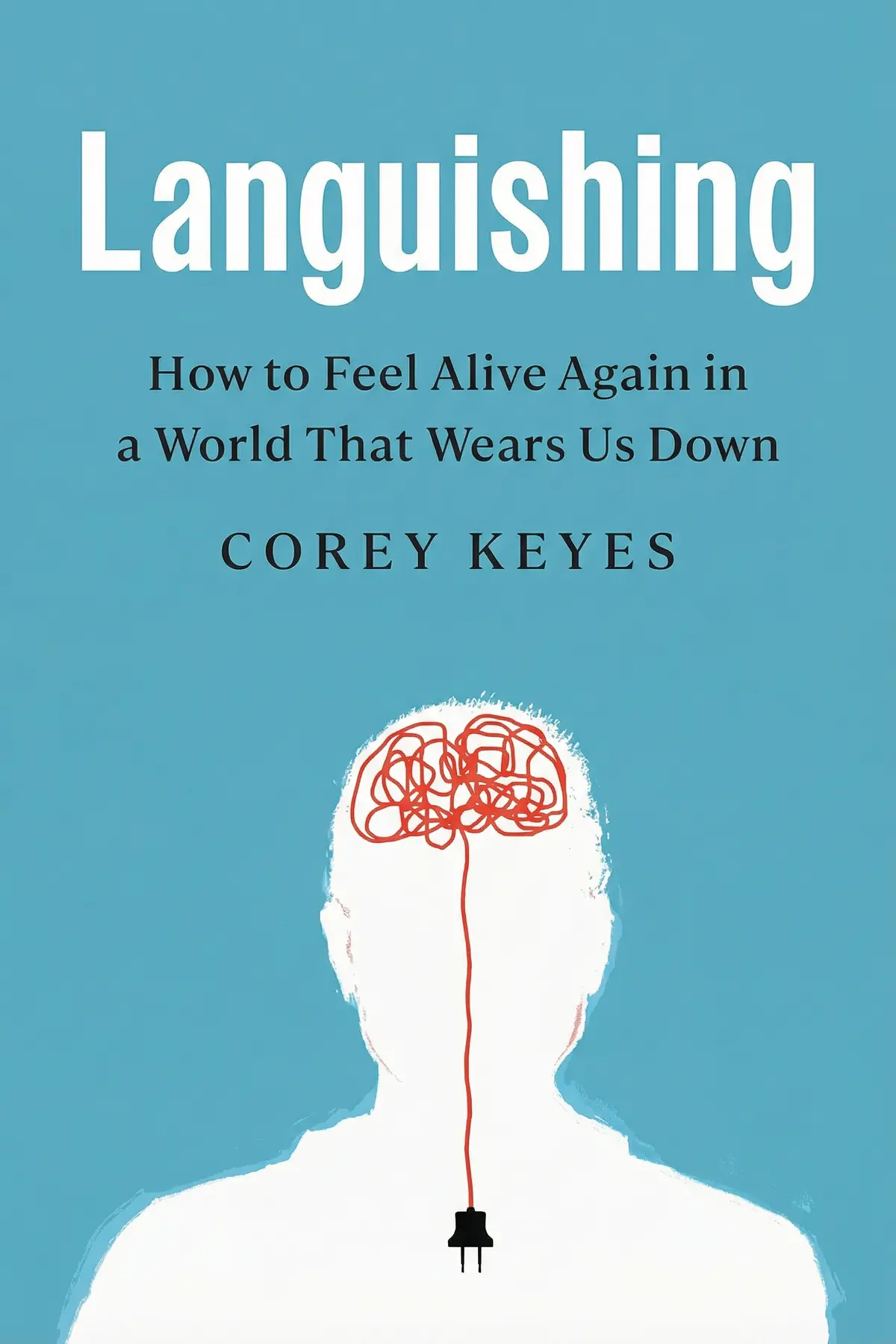
Table of Content
1. Introduction
59 sec
Plenty of people are not ill and not in crisis, yet they move through their days feeling flat and empty. Sociologist Corey Keyes names that state in Languishing, and his most striking claim is that it is not a mild depression: it sits on a separate scale, so treating illness alone does not lift it. He reports that between 50 and 60 percent of people languish at some point.
The book argues that this empty middle can be left behind, though chasing happiness will not do it. Flourishing has to be built, through five everyday activities Keyes compares to vitamins: learning, connecting, reaching toward something larger, living a purpose and playing. Along the way come a teenager’s alarming attempt to fill an inner void, a stress response written into our genes, a lonely city worker who found daylilies, and a living room turned into a dance floor. Each one points to something you can try in an ordinary week.
2. Put a name to the emptiness you feel
1 min 39 sec
A bored seventh-grader who had already been acting out in class did something that got him expelled. His story shows how a quiet, overlooked state of mind can hide behind what looks like ordinary misbehavior.
3. Understand how loneliness and exclusion harm your body
1 min 44 sec
Given the choice, many people preferred electric shocks to fifteen minutes alone with their thoughts. The forces behind that dread reach far beyond mood, all the way into how our genes respond to threat.
4. Treat flourishing as its own kind of health
1 min 38 sec
Clearing away symptoms seems like it should leave a person well. Keyes’s research says otherwise, and it changes what anyone who feels empty but technically fine should actually be working on.
5. Learn something just hard enough to change you
1 min 31 sec
A man stuck alone in a city apartment ended up growing over 35 daylily varieties and trying out new hybrids. Why that kind of accidental hobby helps, and why most of us resist it, comes down to stories.
6. Build friendships where support flows both ways
1 min 33 sec
A family moved to a small town for a fresh start and found neighbors crossing the street to avoid them. Their loneliness reveals a need far older than any town, and two ways to meet it.
7. Find a base camp for a calmer mind
1 min 31 sec
When a plan collapses or a relationship ends, some people recover and others stay stuck. Keyes points to a resource that needs no religion, and a single place in the mind to keep coming back to.
8. Look for purpose beyond your job title
1 min 35 sec
Only around 15 percent of adults see their jobs as a way to contribute to society. If a career cannot supply meaning, Keyes suggests a much smaller weekly habit that can, and explains why purpose fades at certain ages.
9. Bring active play back into adult life
1 min 27 sec
Two small children and a loud song turned an ordinary evening into something the adults will remember. Keyes explains why grown-ups abandon this kind of fun, and how to fit it back into dull chores.
10. Conclusion
1 min 14 sec
Keyes gives a name to a feeling many people carry without words, and removes the excuse that nothing can be done because nothing is clinically wrong. The empty middle is common, and the loneliness and discrimination behind it can keep the body inflamed over time. Yet because flourishing runs on its own scale, it can be raised directly, by adding to a life instead of waiting for the flatness to pass.
What gets added is ordinary. A man stuck in lockdown found daylilies in his mother’s garden. A room of mothers followed two small children onto a living-room dance floor. Neither needed a breakthrough, only an opening.
Begin with the vitamin your week lacks most. If it is people, have one conversation with someone unlike you and return the support you usually receive. If it is purpose, fit three good deeds in before the week ends. If it is play, turn a chore into a game. And find your base camp, the calm place you can come back to when the world wears you down.
Thoreau’s butterfly still holds: stop chasing the feeling, tend to the five, and let flourishing come to you.
About this book
What is this book about?
Many people are not depressed and not in crisis, yet they feel empty, unmotivated and disconnected, as if they are only going through the motions. Sociologist Corey Keyes calls this state languishing, and he reports that between 50 and 60 percent of people will experience it at some point in their lives. Keyes argues that languishing is its own condition. Mental health, in his model, runs along two separate scales: one for mental illness and one for flourishing or languishing. Reducing symptoms of illness does not automatically make someone flourish. He traces languishing to loneliness, discrimination and passive ways of living, and shows how loneliness and discrimination switch on a genetic stress response that keeps the body inflamed. The remedy is to build flourishing on purpose. Keyes describes five practices he compares to vitamins: learning something new, connecting with others, spirituality, purpose and play. Through stories such as a lockdown gardener, a lonely couple in a new town and a living room turned dance floor, readers get concrete ways to add each one to an ordinary week.
Book Information
Who it's for
High achievers feeling flat
People who are not depressed but feel flat, unmotivated and disconnected despite outward success.
Educators, parents and bosses
Parents, teachers and managers trying to understand withdrawal, absence or acting out in others.
Adults facing life transitions
Anyone facing a move, retirement or an empty nest who wants practical ways to feel engaged again.
About the Author
Corey Keyes
Corey Keyes is an American sociologist and professor emeritus at Emory University in Atlanta, where he held the Winship Distinguished Research Professorship. Known for his work in positive psychology, he developed the ideas of flourishing and languishing and the model that treats mental health and mental illness as two separate continua. He has advised the Centers for Disease Control and Prevention, the World Happiness Forum and government agencies in Canada, Northern Ireland and Australia, and served on the MacArthur Foundation Research Network on Successful Aging.
Ratings & Reviews
Ratings at a glance
What people think
Listeners view this title as an essential read, particularly for those enjoying their retirement. They value the high-quality insights provided, with one listener drawing attention to the comprehensive look at scientific research concerning both languishing and flourishing.
Top reviews
Mason
Finally, a book that addresses the unique emotional landscape of retirement! As someone who recently left the workforce, I struggled with a sense of aimlessness that didn't feel like depression but certainly wasn't joy. Keyes’ exploration of 'languishing' gave me the vocabulary I needed to understand this transition. The emphasis on 'vitamins' like learning and play resonated deeply with my current stage of life. It’s a must-read for seniors who might feel like they’ve lost their purpose after their career ends. The information quality is top-notch, offering a detailed look at research while remaining conversational enough to enjoy over coffee. Truly, this book shifted my perspective on what it means to flourish in my later years.
Show moreJoshua
This isn't just a self-help book; it's a deeply personal look at the human spirit. I was blown away by the author’s vulnerability regarding his own traumatic childhood and his past struggles with mental health. It made his arguments for 'flourishing' feel earned rather than just academic. The way he breaks down the need for curiosity and trusting relationships hit home for me. I’ve read so many books on happiness, but this is the first one that focused on 'purpose' in a way that felt authentic. The idea that we can be 'not depressed' yet still 'not well' is a revelation. I’ve already started incorporating more 'play' into my weekends, and it really does make a difference. This is a profound, life-affirming read.
Show moreRatthapong
Absolutely essential reading for anyone feeling like they are just going through the motions. The section on 'Vitamin 4: Help' really changed my perspective on what it means to live with purpose. It's not about being a hero; it's about finding small ways to contribute to something bigger than yourself. Keyes writes with a lot of heart and clearly knows his stuff. Some might find the research heavy, but I thought it added a lot of credibility to his claims. If you're tired of the same old 'just think positive' advice, give this a try. It’s a grounded, realistic approach to building a life that actually feels worth living. Five stars for the clarity it brought to my own 'blah' feelings.
Show moreLena
Ever wonder why you feel 'fine' but also completely empty? That’s the core of languishing, and Keyes does a brilliant job defining that middle ground between clinical depression and true happiness. I found the section on the five 'vitamins'—especially the focus on connection and play—to be a refreshing departure from typical toxic positivity. While some of the advice on finding a 'calling' feels a bit out of reach for those of us working 9-to-5 grinds, the research behind the dual-continuum model is solid. It helped me realize that just because I’m not 'sad' doesn't mean I’m actually thriving. To be fair, the book leans heavily into sociology, which makes it feel more grounded than your average airport self-help read. It’s a thoughtful guide for anyone trying to reclaim their spark in a world that feels increasingly disconnected and gray.
Show moreAria
The chapter on 'Play' was exactly what I needed to hear. We spend so much time documenting our lives for social media that we’ve forgotten how to actually live in the moment. Keyes makes a compelling case for why we need to reclaim our sense of wonder and fun, even as adults. I found myself nodding along to his critique of 'hustle culture' and how it keeps us in a state of constant languishing. While I didn't agree with every single point—especially the bits about medication—the overall message of seeking purpose over simple pleasure is a powerful one. It’s an encouraging book that makes you stop and evaluate your daily habits. If you’ve been feeling worn down and disconnected, this might be the spark you need.
Show moreDivya
Keyes provides a necessary vocabulary for a state of being that many of us can't quite name. We often think of mental health as a binary—you're either depressed or you're fine—but this book proves there is a massive gray area in between. I loved the data-driven approach in the first section. As a sociologist, Keyes brings a different perspective than your typical therapist, which I appreciated. However, I have to agree with other reviewers that he glosses over the privilege required to follow some of his advice. Not everyone has the time or resources to 'transcend' or find a cause. Still, the core message about the 'presence of well-being' being different from the 'absence of disease' is something everyone should hear.
Show moreMai
Corey Keyes offers a solid sociological framework, though the practical advice feels a bit recycled. The first half of the book is excellent, providing a deep dive into the data on why we feel so stuck. I appreciated the distinction he makes against authors like Gretchen Rubin; he argues that happiness shouldn't be the goal, but rather 'flourishing.' However, when we get to the 'action plans,' things get a bit wonky. Suggesting a new mother make friends with an old man on a park bench to find a 'village' is just not practical advice for 2024. Also, the author's dismissal of the medical model of depression felt a bit out of touch. It’s a decent read for the theory, but don't expect a life-changing roadmap to happiness.
Show moreAudrey
As someone who has struggled with that 'stuck' feeling since 2020, I found the first half far more compelling than the second. Keyes identifies the 'languishing' problem with surgical precision, using his background in sociology to explain the epidemic of loneliness we are all facing. But the transition to 'vitamins' felt like a letdown. The advice is stuff we’ve heard a million times: get a hobby, volunteer, talk to people. Some of the anecdotes were a bit bizarre, too, like the park bench suggestion for new moms. It’s a bit of a mixed bag; the academic side is 5 stars, but the self-help side is a 2. I’m giving it a 3 because the vocabulary of languishing is genuinely helpful for self-reflection.
Show moreNatchaya
To be fair, the concept of the 'dual continuum' is fascinating, but the execution of this book is lacking. The author uses these hyper-achieving examples that feel totally unrelatable to the average person. Not everyone can just drop their life to pursue a religious calling abroad, yet Keyes presents these stories as if they are accessible blueprints for everyone. I also found the 'annoying cheerleader' tone of the second half to be a bit much. It felt like he was trying too hard to be inspiring without acknowledging the systemic issues, like income inequality, that make 'flourishing' a luxury for many. There are some good quotes and interesting statistics scattered throughout, but overall, it didn't offer anything new for me. It’s a bit of a memoir-self-help hybrid that never quite gels.
Show moreMikael
Look, I wanted to like this, but the author's stance on psychiatric medication is frankly dangerous. Keyes is a sociologist, not a medical doctor, yet he spends a significant amount of time dismissing the 'chemical imbalance' theory of mental illness. Telling readers they might be better off without their meds is irresponsible. Beyond that, the memoir elements felt a bit jarring; the sudden mention of a suicide attempt came out of nowhere and wasn't handled with much sensitivity. While the concept of languishing is a useful term for the post-pandemic 'blah' feeling, the actual solutions provided are mostly recycled tropes about meditating and finding hobbies. If you’re looking for a scientific look at mental health, you might want to look elsewhere, as this often feels more like a personal manifesto than a rigorous study.
Show moreQuestions about this book
What is languishing according to Corey Keyes?
Keyes describes languishing as a state of emptiness, low motivation and disconnection from life, a feeling that something is missing even when things look fine. It is distinct from depression and sits between depression and flourishing. He reports that between 50 and 60 percent of people experience it at some point, and that it shows up differently with age, from acting out in children to isolation in older adults.
Is languishing the same as depression?
No. Keyes argues that mental health runs along two separate continua: one for mental illness and one for flourishing or languishing. Studies he describes find that reducing symptoms of illness often fails to raise positive well-being. A person can have few symptoms and still languish, or live with an illness and still flourish, so both scales need attention.
What causes languishing?
Keyes points mainly to loneliness and discrimination, along with passive lifestyles lacking purposeful activity. A 2021 study found 61 percent of people aged 18 to 25 had felt deep loneliness in the past month. Loneliness and discrimination can trigger a genetic stress response called CTRA, which keeps the body inflamed and raises the risk of cancer, heart disease and mental health problems.
How do you stop languishing and start flourishing?
Keyes recommends five practices he calls vitamins: learning something new at a manageable level of difficulty, building reciprocal relationships, connecting with something greater than yourself, finding purpose, often through volunteering, and making time for active play. Practical starting points include talking with someone from a different background, doing three good deeds a week, finding a calm base camp such as yoga and turning chores into games.
Who should read Languishing by Corey Keyes?
It suits people who feel empty or stuck without being clinically ill, and anyone who has been told they are fine but does not feel it. Parents and educators will find help reading withdrawal or misbehavior in young people, and adults facing transitions such as a move, a career change or retirement will find concrete ways to rebuild meaning and connection.
Featured in
Readers also enjoyed





Alcoholics Anonymous
Alcoholics Anonymous World Services

A Liberated Mind: How to Pivot Toward What Matters
Steven C. Hayes


AUDIO SUMMARY AVAILABLE
Listen to Languishing in 15 minutes
Get the key ideas from Languishing by Corey Keyes, plus 5,000+ more nonfiction titles.
- 5,000+ titles
- Listen as much as you want
- 7-day free trial
- Cancel anytime









