

15 min 02 sec
Available in: English
Karma: A Yogi's Guide to Crafting Your Own Destiny
By Sadhguru
Sadhguru recasts karma as patterns of intention and memory that you write and keep running yourself. He shows how to stop adding to that load, tell pain apart from suffering and act with full awareness.
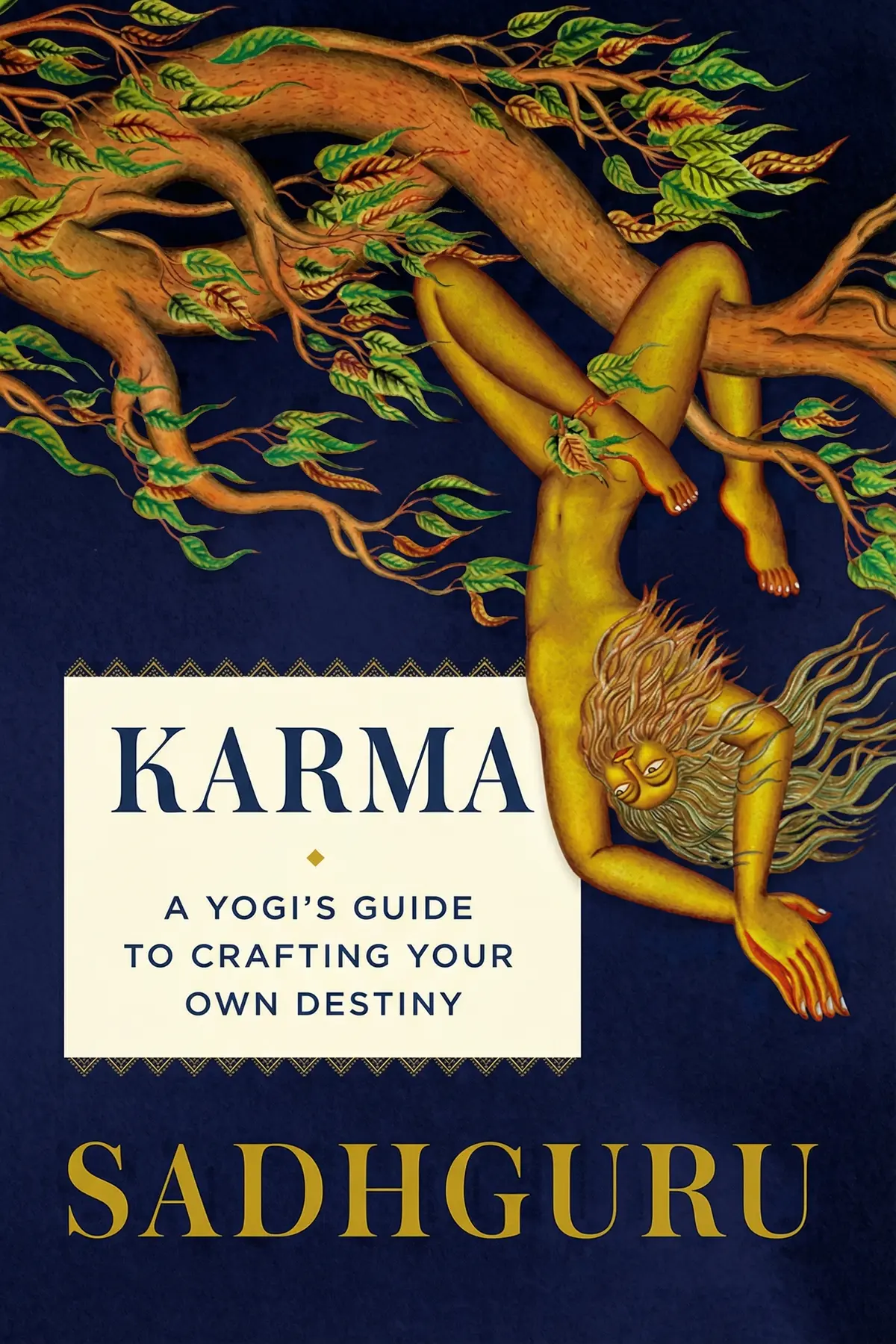
Table of Content
1. Introduction
54 sec
People who lose a job and call it bad karma, or credit a lucky break to a kind deed, are treating their lives as something done to them. In Karma, the yogi and mystic Sadhguru turns that around. Karma, he argues, is no cosmic judge keeping accounts. It is a set of patterns each of us writes and keeps running inside ourselves.
Whatever we wrote, we can rewrite. That idea runs through everything ahead. Karma is memory and intention hardened into habit, and someone who acts with full awareness, involved in life without being entangled in it, can stop adding to the load and start shedding it. Sadhguru offers a way to tell pain apart from suffering and to trace oversized reactions back to their roots. He also gives a short nightly practice for loosening what you cling to.
2. Stop blaming bad luck for your life
1 min 35 sec
A firing after a padded résumé feels like cosmic payback, and a dinner invitation after a kind gesture feels like a reward. Sadhguru thinks both stories get the cause wrong, and that the real source is far closer to home.
3. Your private intentions shape your karma most
1 min 37 sec
Three versions of the same kitchen quarrel end very differently, and the one with no violence at all turns out to be the heaviest. The ranking says a lot about the grudges people carry without ever acting on them.
4. Trace your reactions to memories you never chose
1 min 43 sec
Mice that were never harmed still panicked at the smell of cherry blossoms, because their grandparents had been. Sadhguru uses that finding to explain why some of your strongest reactions may not start with you.
5. Stay involved in life without getting entangled
1 min 37 sec
Clearing your karma sounds like a recipe for a cold, withdrawn existence. Sadhguru calls that version joyless and draws a careful line between caring deeply about people and being tied up by them.
6. Turn everyday tasks into an offering
1 min 45 sec
A would-be yogi watched a lion feed a crippled fox and took it as a sign to sit and wait. A passing guru saw the same scene and drew a lesson the yogi missed entirely.
7. Loosen old patterns through body and mind
1 min 38 sec
A handshake, a meal in a stranger’s home and a story about your father may all leave more of a mark than you think. Sadhguru offers ways to clear that residue, starting with the body.
8. Do the inner work while you still can
1 min 41 sec
Sitting on a stone bench in an ancient rock monastery, Sadhguru says he could sense a monk who had died nearly two thousand years before. The story leads to his starkest warning about waiting too long.
9. Ask one question less to loosen karma
1 min 27 sec
Courtesans in ancient India wore jewelry that defeated every suitor who tried to remove it, yet the trick was tiny. Sadhguru says freedom from karma depends on a pin just as small.
10. Conclusion
1 min 05 sec
Sadhguru takes an idea most people use to explain their luck and turns it into a mirror. In his account, the setbacks, partners and moods that seem to follow you are programs you wrote and keep running. Intent and memory older than you hold them in place. That is also why they can change: what you wrote, you can stop writing.
His own practice fits into the last minutes of the day. Each night, sit cross-legged on the bed with your eyes closed and imagine you are on your deathbed. Go through what makes you who you are: loves, hatreds, relationships, attachments and the body too. Remind yourself that you gathered each one along the way, and set them down gently, one at a time. Then lie back and sleep without opening your eyes.
During the day, separate the pain you cannot avoid from the suffering you add to it, and give one ordinary task your full attention. Given the same sign as the starving yogi, Sadhguru would have you follow the lion.
About this book
What is this book about?
Most people use karma to explain their luck: a lost job is payback for some old misdeed, and a good day is a reward for a kind act. In Karma, the yogi and mystic Sadhguru rejects that idea of a cosmic judge. In his account, karma is a cycle each of us creates. Reactions harden into patterns, patterns become personality, and personality decides what we attract and how we see the world. Drawing on yogic teaching about memory, the five bodies and the energy that outlasts us, Sadhguru explains why intention weighs more than action and why a private grudge can weigh more than a blow. He argues that the aim is to empty the karmic load you carry in this life. That means staying fully involved with people and the world while refusing to get entangled. Along the way he offers practical ground rules. Act with total absorption and without the need to be seen as good. Separate unavoidable pain from the suffering you add. Use physical effort and attention to the present, and let go of the question "What about me?" The book closes with a simple nightly exercise for setting down what you cling to.
Book Information
Who it's for
Facing the same setbacks
People who keep facing the same setbacks and want to see their own part in them.
On a spiritual path
Spiritual seekers curious about yoga, karma and rebirth who want a clear account from a living teacher.
Holding grudges or fatalism
Anyone carrying old grudges or a sense of fate who wants practical ways to set them down.
About the Author
Sadhguru
Sadhguru, born Jagadish Vasudev in 1957, is an Indian yogi, mystic and speaker who has taught yoga since 1982. In 1992 he founded the Isha Foundation, which runs an ashram and yoga center near Coimbatore, India. His books include Karma and Inner Engineering, both New York Times bestsellers, and Death. He has spoken at the United Nations and the World Economic Forum and has led environmental campaigns such as Rally for Rivers and Cauvery Calling. In 2017 the Government of India awarded him the Padma Vibhushan.
Ratings & Reviews
Ratings at a glance
What people think
Listeners find this work enlightening, noting that its deep insights and teachings significantly alter their worldview. They further appreciate the clear, actionable advice on understanding karma, viewing it as a vital resource worth returning to often. The book's thoroughness is also highlighted; one listener observes how it simplifies complicated notions, and listeners find the material easy to grasp. Finally, listeners value the deliberate pacing, with one mentioning that the material naturally prompts them to stop and think.
Top reviews
June
Wow. This isn't just another spiritual self-help book that recycled old clichés about 'what goes around comes around.' Sadhguru actually redefines the word 'Karma' as action and responsibility, which feels incredibly empowering rather than scary. I particularly appreciated the distinction between conceptual and perceptual knowledge—it’s the difference between reading a menu and actually eating the food. The writing style is punchy and direct, though some might find his 'energy mechanic' persona a bit much if they prefer traditional academic rigor. Personally, the idea that we are the sole architects of our destiny shifted my entire perspective on daily stress. I’ve started implementing the Sadhanas at the end of the chapters, and there's a noticeable difference in how I react to external triggers. It’s a deep dive that requires you to pause and reflect every few pages, making it a slow but rewarding read. If you’re tired of being a passenger in your own life, this is the manual you need.
Show morePornpimon
This book is a masterclass in shifting your internal chemistry. As someone who has always felt like a victim of circumstance, hearing that 'suffering has to be baked fresh every day' was a total wake-up call. Sadhguru explains how our five senses bombard us with data that eventually hardens into personality traits, or what he calls our karmic software. It's fascinating and, frankly, a bit convicting. The way he discusses inner well-being in the face of modern technology is so relevant for our current age where we are all 'time-poor' but 'stimuli-rich.' The chapters are well-paced, allowing the complex ideas about cellular memory and energy bodies to sink in before moving forward. It’s the kind of teaching that makes you want to turn inward 100% and stop looking for external solutions to internal problems. Truly a transformative guide for anyone seeking a more conscious existence.
Show moreOat
The chapter on how intentions shape our karmic accumulation was worth the price of the book alone. Most of us go through life thinking our actions are the only things that count, but Sadhguru argues that our internal state and 'vasanas' (fragrances) are what truly matter. Not gonna lie, the idea that we can rewrite our own 'software' is incredibly liberating. It takes the power away from fate or 'heaven' and puts the steering wheel firmly back in our hands. The writing is simple enough for a beginner but contains enough depth that I know I’ll be rereading this in a year. It’s rare to find a book that manages to be both a philosophical exploration and a manual for daily living. This isn't just theory; it’s a challenge to live more intelligently and joyfully. Highly recommended for anyone feeling stuck in recurring life patterns.
Show moreSirirat
In my experience, most spiritual books are either too dry or too 'woo-woo,' but this one hits a sweet spot. Sadhguru's take on karma as 'action' rather than 'fate' is the best explanation I've encountered yet. He uses great examples to show how we become puppets of our past and why 'suffering is baked fresh' by our own choices. I loved the section about the different levels of action—body, mind, and energy—and how they all imprint on us. It’s an empowering read that demands you stop asking 'why me?' and start asking 'what now?' The pacing is excellent; I found myself stopping after every chapter just to sit with the ideas. It’s an enlightening guide that actually offers a key to happiness by returning us to the driver's seat of our own lives. A must-read for seekers.
Show moreAey
As someone who loves a mystical view of the world, this was right up my alley. Sadhguru explains that we are living repositories of memory on levels we aren't even aware of, and that this 'software' runs us until we consciously intervene. The concept that our five senses are constantly bombarding us with data that shapes our very nature was a 'wow' moment for me. I’ve read a lot of self-help, but nothing that explained the mechanics of the energy body quite like this. It’s not just about thinking positive; it’s about a deeper alignment. The book is written with a certain grace and simplicity that makes the pages fly by, yet the content is incredibly dense with insight. If you’re ready to stop leaving footprints and start flying, this is the book to show you how to drop the weight of your past.
Show moreEleni
Finally got around to reading this after seeing it everywhere, and I have to say, the hype is mostly justified. To be fair, some sections feel a bit repetitive, and the 'scientific' explanations can occasionally veer into hand-waving territory that might annoy the skeptics. However, the core message about breaking the cycle of unconscious patterns is brilliant. The Q&A section at the back was actually my favorite part because it addresses the very questions I was scribbling in the margins. It clarifies that karma isn't a cosmic accounting system of reward and punishment but a software we’ve written for ourselves. While the tone is definitely authoritative—almost like being in a lecture hall—the practical advice on living joyfully in a chaotic world is hard to argue with. It's an enlightening read, though you might need to take some of the more mystical claims with a grain of salt.
Show moreSarawut
Picked this up during a particularly rough month, and it really helped reorganize my priorities. Truth is, I didn't understand every single mystical concept—the stuff about solar cycles and etheric bodies was a bit out there for me—but the practical applications are solid. The 'Sadhanas' or kriyas provided at the end of chapters offer a way to actually do something with the information rather than just letting it sit in your head. I like how he dispels the myth that karma is about 'good' or 'bad' deeds. Instead, he frames it as a way to wear your past more loosely so you can actually fly. My only gripe is that the tone can feel a bit condescending at times, as if the author is amused by how little the rest of us know. Still, the message of radical self-responsibility is one that everyone needs to hear.
Show moreLayla
After hearing so much about Jaggi Vasudev's previous book on Death, I was curious to see how he'd handle Karma. He manages to break down very complex Vedic ideas into a language that feels accessible to a modern audience. Personally, I think the most poignant point he makes is how we've prioritized external science while letting our inner state decay. It’s a sobering thought. While some of the humor in the book felt a bit forced and certain anecdotes were a tad repetitive, the overall impact is profound. It makes you realize that your personality is just a cluster of tendencies you've accumulated in unawareness. Breaking those cycles isn't easy, but this book provides a very clear roadmap for how to start. It’s a 4-star read for me simply because some of the 'energy' talk felt a bit vague, but the core psychology is brilliant.
Show moreNutnicha
Frankly, I went into this expecting a lot of hand-waving, but I came away with a lot to think about. The book is divided into three parts, and I found the first part—the thorough explanation of what karma actually is—the most helpful. It cleared up so many misconceptions I had about reward and punishment. The second part gets a bit more into the 'yogic' weeds, which might not be for everyone, but the final Q&A section brings it all back to earth. My main issue is that the author presents his views with such authoritarianism that it leaves little room for doubt or debate. But if you can get past the persona, the wisdom about letting go of the ego and the 'what about me?' mindset is life-changing. It's a solid 4 stars for its clarity and the practical way it addresses our internal entanglements.
Show morePranee
Ever wonder why certain 'gurus' never use their legal names on their covers? This book is a classic example of marketing over substance, essentially packaging the old 'thoughts become actions' lesson in a bag of elaborate jargon. Look, I’m open to spiritual concepts, but Sadhguru spends 300 pages lecturing the reader with superficial examples and twisted logic that lacks any real analytical rigor. It feels like fluff designed for a very specific market of stressed-out techies looking for a quick fix. There is no unique insight here that hasn't been handled better by Krishnamurti or Ramana Maharshi. Instead of deep realization, we get hand-waving and a brand-building exercise under the guise of an 'energy mechanic.' If you want timeless wisdom, go back to the Gita; if you want a glossy manual of 'thoughts-become-things' with extra steps, this is for you. Otherwise, skip it and save your money.
Show moreQuestions about this book
What is the main idea of Karma by Sadhguru?
Sadhguru argues that karma is not a cosmic judge handing out rewards and punishments. It is a cycle we create ourselves. Mental reactions trigger chemical and physical ones, these harden into patterns, and the patterns become personality. Because we write this software ourselves, we can rewrite it. The aim is to stop adding to our karmic load by acting with awareness, and to shed what we already carry.
Does Sadhguru say actions or intentions matter more for karma?
Intentions. In his example of a quarrel in a kitchen, a sudden stabbing creates heavy karma and a planned attack creates more. But the most negative karma comes from smiling at a partner while secretly wishing him dead, with no violence at all. Volition, the will behind an act, counts more than the act. That is also why charity done to look generous dissolves nothing.
What is the difference between pain and suffering in Karma?
Sadhguru uses the example of someone with a painful disease who calls it fate. The pain itself may be unavoidable. The suffering laid on top of it, he argues, is made by the mind and serves almost no purpose. Many people suffer only because they never realized they could choose not to. Separating the two is one of the most practical uses of the book.
Does Sadhguru want people to become detached from life?
No. He calls detachment a joyless philosophy without life in it. He wants people fully involved with others and the world, but not entangled. Memories of a good holiday or the stories of your clan have value. Trouble begins only when memories become boundaries. Tasks done with full absorption, joy and love become an offering and stop adding to the karmic load.
How can I apply the teachings of Karma in daily life?
Sadhguru suggests a nightly exercise. Sit cross-legged on your bed with your eyes closed and imagine you are on your deathbed. Name every attachment, including your body, and gently set each one aside before lying back to sleep. During the day, give ordinary tasks your whole attention, use physical effort such as yoga, stay with the present moment and let go of the question “What about me?”
Readers also enjoyed

A Force for Good: The Dalai Lama's Vision for Our World
Daniel Goleman


A New Earth: Awakening to Your Life’s Purpose
Eckhart Tolle
A Return to Love: Reflections on the Principles of a Course in Miracles
Marianne Williamson

Abundance: The Inner Path to Wealth
Deepak Chopra

Aflame: Learning from Silence
Pico Iyer

Alcoholics Anonymous
Alcoholics Anonymous World Services

All My Knotted-Up Life: A Memoir
Beth Moore
Autobiography of a Yogi
Paramahansa Yogananda
AUDIO SUMMARY AVAILABLE
Listen to Karma in 15 minutes
Get the key ideas from Karma by Sadhguru, plus 5,000+ more nonfiction titles.
- 5,000+ titles
- Listen as much as you want
- 7-day free trial
- Cancel anytime









