

13 min 47 sec
Available in: English
Kaizen: The Japanese Secret to Lasting Change―Small Steps to Big Goals
By Sarah Harvey
A practical guide to changing habits through kaizen, the Japanese approach of continuous improvement: take stock of your life, start with a tiny step, set time frames, track progress and adjust your pace without guilt.
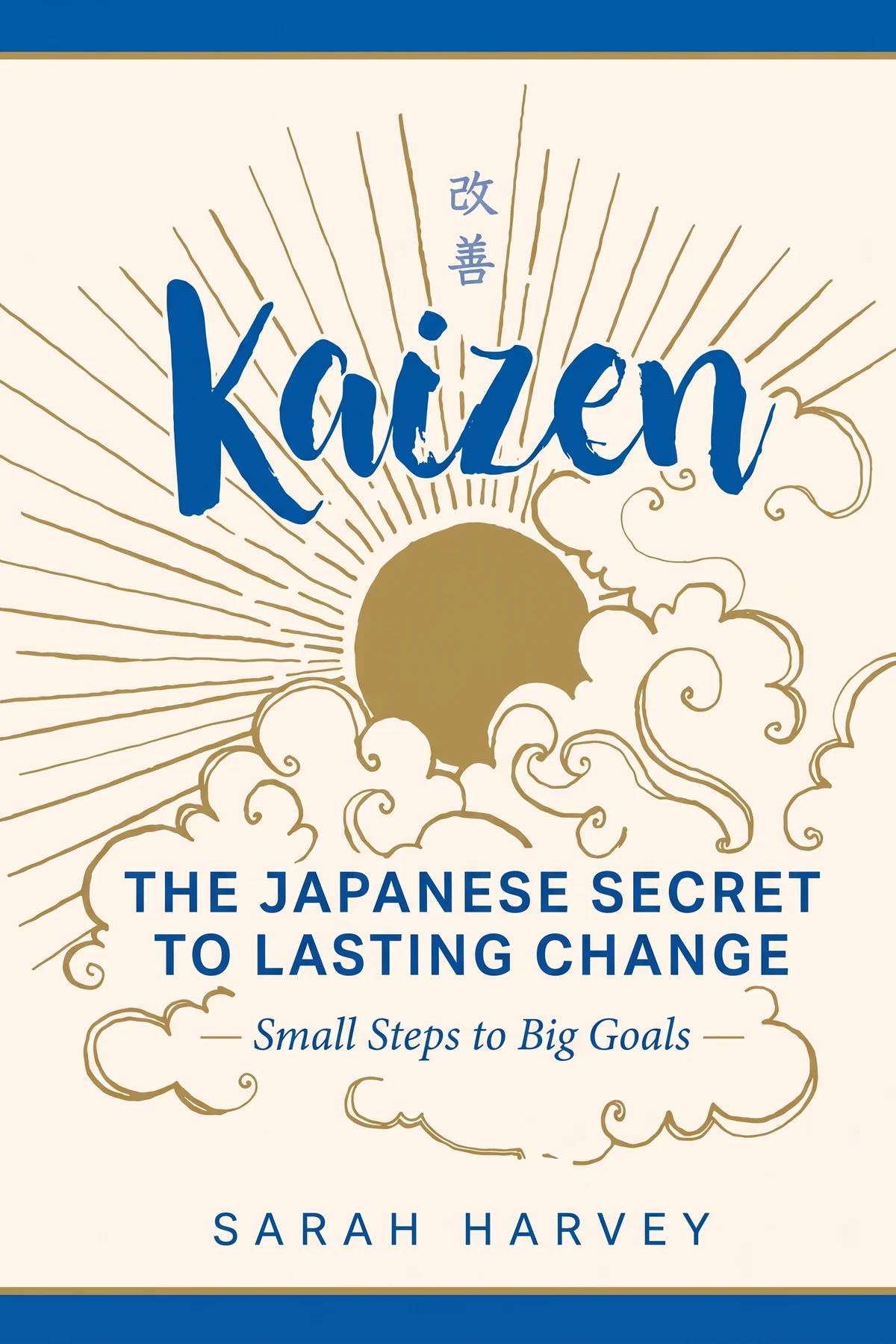
Table of Content
1. Introduction
1 min 02 sec
A resolution made on the first of January is often dead by the middle of the month, and the usual reason is its size. In Kaizen, Sarah Harvey argues that the cure is to stop leaping and start stepping: pick one action so small it barely disturbs your day, repeat it, and let the next step grow out of it. Kaizen is a Japanese word for change. As a method it began in management, where it helped make Toyota a model of steady improvement.
Harvey first met the idea while working in Tokyo. She shows how the same thinking works on a sugar habit, a career, a savings plan or a guitar piece. Her case is simple: lasting change comes from small, measured steps taken at your own pace, reviewed often and made smaller whenever life pushes back. What follows is a working method you can start tonight: an inventory of your life, a first step, a time frame, a simple tracker and a way back after you slip.
2. Swap the quick fix for small repeated steps
2 min 12 sec
An expensive promise to end sugar cravings in five sessions works for exactly one week. The method that replaces it has an unexpected history involving postwar Japan, an American government and a famous carmaker.
3. See your habits clearly before you change them
1 min 57 sec
Your brain has good reasons for running your day on autopilot, and those same reasons make bad habits stubborn. A single sheet of paper can show you which routines deserve to stay.
4. Start with a step too small to notice
1 min 56 sec
A struggling cycling team stopped chasing perfection and started chasing something almost invisible. Within a few years it was winning Olympic gold, and the same logic fits a diet, a run or a new routine.
5. Turn a distant goal into a weekly plan
1 min 46 sec
Some goals have a finish line and some never end. Both need a time frame, and the most useful time frame is one that is allowed to get smaller when you are tired.
6. Keep a record that shows your progress
1 min 46 sec
In 1904, Japan’s first woman journalist invented a way of handling money that people still use today. Its real lesson concerns every habit you want to change, and it needs only a pen.
7. Recover from a setback by stepping smaller
1 min 51 sec
A sudden house move can wipe out weeks of good progress. Research on how long habits take to form suggests why the usual reaction to that kind of setback is the wrong one.
8. Conclusion
1 min 17 sec
Harvey makes change much smaller than most people expect, and the small size is the point. A cycling team found gold medals in 1 percent gains. A carmaker cut waste one detail at a time. A journalist in 1904 taught women to manage their money with a pen and a monthly check-in. None of them bet everything on one dramatic effort. Each kept the stakes low enough that the next step was always possible.
That changes what a bad week means. A missed goal becomes a signal to resize the step and begin again, with no reason for guilt.
You can test the whole method on something modest. Harvey’s own suggestion is clutter: a drawer full of files or a messy desk that feels too much to face. Give it five minutes once a week, one drawer or even one file at a time, and watch the mess shrink. Alongside that, write a one-page inventory of your life, choose a single goal from it, and color in a square each day you take its first small step. When the month ends, read the page before you decide what comes next.
Progress built this way rarely looks impressive on any single day. It simply keeps going, and that is why it lasts.
About this book
What is this book about?
Most resolutions collapse within weeks. They ask for too much too fast, and when the first burst of resolve fades, the old routine returns. Sarah Harvey argues that the fix is to stop leaping and start stepping. Kaizen, a Japanese word for change, began as a management method credited with Toyota's long run of improvement. Harvey applies it to everyday goals: eating less sugar, saving money, rethinking a career, learning an instrument. Her method runs in stages. First, make an honest inventory of your life and choose a goal. Then pick a first step so small you barely notice it, and break the larger goal into short, medium and long-term stages with a time frame. Track progress in a journal or an app and review it every month. When life gets in the way, go back to the smallest action you can manage. Along the way she draws on the British cycling team's 1 percent gains under David Brailsford, the psychologist Ben Gardner's account of how habits lock in, and kakeibo, the money journal Hani Motoko invented in 1904. Readers finish with a calm, repeatable system for change that survives bad weeks.
Book Information
Who it's for
After short-lived resolutions
People whose New Year's resolutions are gone by mid-January and who want a gentler system.
Professionals weighing big changes
Professionals rethinking a job, their savings or their health who need a clear first step.
Restarting a habit
Anyone restarting a habit after a move, a job loss or a hard month.
About the Author
Sarah Harvey
Sarah Harvey was a publishing consultant in Tokyo, where she first came across kaizen, the philosophy of continuous improvement, and saw its effects at first hand. She later settled in London, where she works for a literary agency. Kaizen is her first book.
Ratings & Reviews
Ratings at a glance

What people think
Listeners find that perspectives vary on whether this work provides enough fresh material for those already knowledgeable about habit-forming books, yet many value the author’s kind and compassionate style of self-improvement. They also appreciate the useful advice for implementing gradual changes across several life areas, including wellness, money, and home management. Additionally, listeners enjoy the historical background shared regarding the Kaizen philosophy and its Japanese cultural origins. They also highlight the book’s supportive voice, with one listener noting that the tiny, "miniscule steps" help the journey feel especially achievable and relaxed.
Top reviews
Luke
Ever wonder why big changes never seem to stick? Harvey's take on the Japanese philosophy of continuous improvement is exactly the antidote I needed for my burnout. Instead of demanding massive overhauls, the book advocates for tiny, almost invisible 1% shifts that build momentum over time. I particularly loved the sections on 'sunshine files' and the gentle way she suggests managing social media habits. The history of how Toyota utilized these principles was fascinating, giving the advice some serious weight beyond just another 'self-care' guide. While some might find the tips simple, the empathy in her writing makes it feel achievable rather than a chore. It’s a gorgeous, soothing read that now lives on my nightstand for whenever I feel overwhelmed by life's demands. It really helped me reframe my morning routine without the typical guilt.
Show moreSelin
The chapter on work-life balance for freelancers was worth the price of the book alone. Sarah Harvey captures the essence of Kaizen beautifully, translating a corporate concept into a deeply personal and spiritual practice. I loved the emphasis on 'forest bathing' and connecting with nature as part of the improvement process. The photography and layout are stunning, making it a very tactile and calming experience to flip through. Unlike other productivity gurus who focus on 'crushing it,' Harvey focuses on 'sustaining it.' It’s the first time I’ve felt like I could actually stick to a system because it allows for human error and slow progress. Truly a gem for anyone seeking a more mindful way to exist in our fast-paced world. Small plates and mindful eating have already changed my relationship with lunch breaks!
Show moreSiriphen
This book is like a warm hug for your productivity. After reading James Clear’s Atomic Habits, I wanted something with a bit more of a cultural and aesthetic focus, and this delivered. Harvey’s tone is gentle, empathetic, and entirely devoid of the 'drill sergeant' vibe found in most business books. I’ve implemented the '24-hour rule' for shopping and the morning routine tips, and the difference in my stress levels is night and day. The way she links the history of Japanese reconstruction to personal growth is both clever and inspiring. It’s a beautiful reminder that we are all works in progress. I’ve already bought two more copies to give as gifts to friends who are feeling burnt out. The focus on fulfilling relationships as the foundation for success really hit home for me.
Show moreMikael
Finally, a productivity book that doesn't make me feel like a failure for not waking up at 5 AM every day. Harvey’s approach is refreshing because it’s rooted in kindness and the reality of a messy life. The concept of 'brain dumping' to clear mental clutter has already helped my work-from-home anxiety significantly. I also enjoyed the 'non-essential' shopping checklist—waiting 24 hours before a purchase is a simple trick, but it works. My only gripe is that some chapters feel a bit more developed than others; the section on health felt a little biased by the author's own negative experiences with sport. Still, for anyone who finds typical 'hustle culture' books aggressive, this gentle guide to incremental growth is a breath of fresh air. It’s practical, pretty, and very easy to digest over a weekend.
Show moreHenry
As someone who struggles with 'all or nothing' thinking, this book provided a much-needed perspective shift. The idea that you can improve your life through 'miniscule steps' that don't cause stress is revolutionary if you’re used to failing at New Year's resolutions. I’ve already started applying the 1% rule to my kitchen organization and it’s surprisingly effective. The author's personal journey living in Japan adds a nice layer of authenticity to the text. I did notice the slight edge whenever she discussed gym culture, which felt a bit unnecessary, but I ignored it for the sake of the better tips. It’s a very practical manual for anyone looking to declutter their mind and their home without the pressure of a total lifestyle overhaul. The tips on digital detoxing using the Forest app were particularly helpful.
Show moreSamira
Starting a new habit is usually terrifying for me, but this book made the process feel entirely manageable. Harvey explains how to break down massive goals into tiny, digestible tasks that bypass our brain's natural fear of change. I particularly liked the section on 'intentional eating' and the advice to focus on the first three mouthfuls of a meal. It’s these little nuggets of wisdom that make the book stand out from the crowded shelf of habit literature. While some of the advice is definitely repetitive if you’ve been in the self-improvement space for a while, the Japanese cultural context kept me engaged. The section on managing money through small, mindful tweaks was also surprisingly grounded and useful. A very solid, comforting read that encourages you to be your own best friend rather than your own boss.
Show moreLandon
After hearing so much buzz about this 'magic' Japanese method, I finally got around to reading Harvey’s interpretation. To be fair, the book is beautifully presented and the writing is incredibly accessible, almost like a cozy chat with a friend. I appreciated the breakdown of the history and the way she explains the word’s etymology. However, I struggled with how much of it felt like 'common sense' repackaged with a fancy name. Do I really need a book to tell me that cleaning my room or eating mindfully will make me feel better? The sections on money management and relationships were sweet but lacked the rigor I was hoping for. It’s a lovely gift book for someone starting their wellness journey, but seasoned self-help readers might find it a bit too elementary. It's more of a gentle reminder than a roadmap.
Show moreHazel
Picked this up on a whim because the cover was so inviting and I've always been a bit of a Japanophile. The truth is, the book is a bit of a mixed bag. On one hand, the historical background of Kaizen transitioning from US-led industrial training to a cornerstone of Japanese culture was genuinely enlightening. On the other hand, the practical advice often veers into the overly simplistic, like the suggestion to drink water every time you use the bathroom. I enjoyed the colloquial tone for the most part, but it did feel a bit 'lifestyle blog' at times. It’s a quick, breezy read that serves as a nice reminder to slow down, though it probably won’t change your life if you’re already disciplined. It’s nice to have on the shelf, but don't expect a masterclass in behavioral psychology.
Show moreLaor
Look, I really wanted to love this, especially since my office uses Kaizen for lean management, but it felt remarkably thin. The author spends a lot of time on personal anecdotes that felt slightly misplaced; there’s a recurring tone of resentment regarding fitness and personal trainers that I found distracting. If you’ve read James Clear or any major habit-building literature, you’ve heard 90% of this before. Drink more water, go for a walk, sleep more—these aren't exactly revolutionary insights for a grown adult. While the cultural context regarding Japan was interesting, it didn't save the book from feeling like a collection of blog posts. It’s probably fine for a complete beginner to self-help, but for anyone looking for deep psychological or organizational systems, this isn't it. I felt the colloquial tone undermined the actual philosophy.
Show moreKob
Frankly, I found this entire book to be an exercise in stating the obvious. The author’s writing style is quite colloquial, but it often tips over into sounding unprofessional and strangely bitter about her past. The frequent jabs at gyms and physical activity were particularly off-putting for me. I was expecting a deep dive into the methodology used by giants like Toyota, but instead, I got a series of basic life tips like 'wear comfortable shoes' and 'tidy your desk.' It felt like a collection of Instagram captions expanded into a book. If you want to learn about the actual philosophy and mechanics of Kaizen, look elsewhere. This is self-help for people who don't actually want to do the hard work of change. I was disappointed by the lack of original research or novel applications.
Show moreQuestions about this book
What is the main idea of Kaizen by Sarah Harvey?
Harvey argues that lasting change comes from small, repeated steps, and dramatic overnight fixes do not provide it. Kaizen, a Japanese word for change, began as a management method linked to Toyota’s success. Harvey applies it to personal life: take stock of your habits, start with a tiny step, set short, medium and long-term goals, track your progress and adjust your pace when life gets difficult.
How do you start using kaizen in everyday life?
Begin with an inventory. Divide a page into areas like home, health, career and relationships, and ask whether each is working for you, breaking vague areas into smaller parts. Add new challenges you would like to try. Then choose one goal and find the smallest, easiest step toward it, such as one extra vegetarian night a week or simply planning a running route.
How long does it take to form a habit according to Kaizen?
Harvey cites studies showing a behavior can take anywhere from 18 to 254 days to become automatic. She draws one conclusion from such a wide range: the time varies hugely between people and between habits. That is why she treats kaizen as personal and urges patience, with no self-criticism when progress is slower than you hoped.
What is kakeibo and how does it relate to kaizen?
Kakeibo is a money journal invented in 1904 by Hani Motoko, known as Japan’s first woman journalist. You record all income and spending by hand and review the ledger monthly to set next month’s goals. Harvey uses it as a model for tracking any habit and recommends a bullet journal, or a phone app, with a monthly review.
What should you do when you fall behind on a kaizen goal?
Harvey advises going back to the smallest possible action. If a planned 5 kilometer run feels impossible, take a short walk. If 200 words of writing a day is too much, drop to 100, which still adds up to 700 a week. Wait until you are ready, take the tiniest step and build back up gradually.
Readers also enjoyed

A High-Performing Mind: Strengthen Your Mind and Live Your Best Life
Andrew D. Thompson


Abundance: The Inner Path to Wealth
Deepak Chopra

59 Seconds: Change Your Life in Under a Minute
Richard Wiseman




AUDIO SUMMARY AVAILABLE
Listen to Kaizen in 15 minutes
Get the key ideas from Kaizen by Sarah Harvey, plus 5,000+ more nonfiction titles.
- 5,000+ titles
- Listen as much as you want
- 7-day free trial
- Cancel anytime









