



14 min 36 sec
Available in: English
Job Moves: 9 Steps for Making Progress in Your Career
Shows how to plan a job change around the progress you actually want: read your past moves, map your energy and skills, test possible futures through real conversations, and tell a story that shapes your next role.
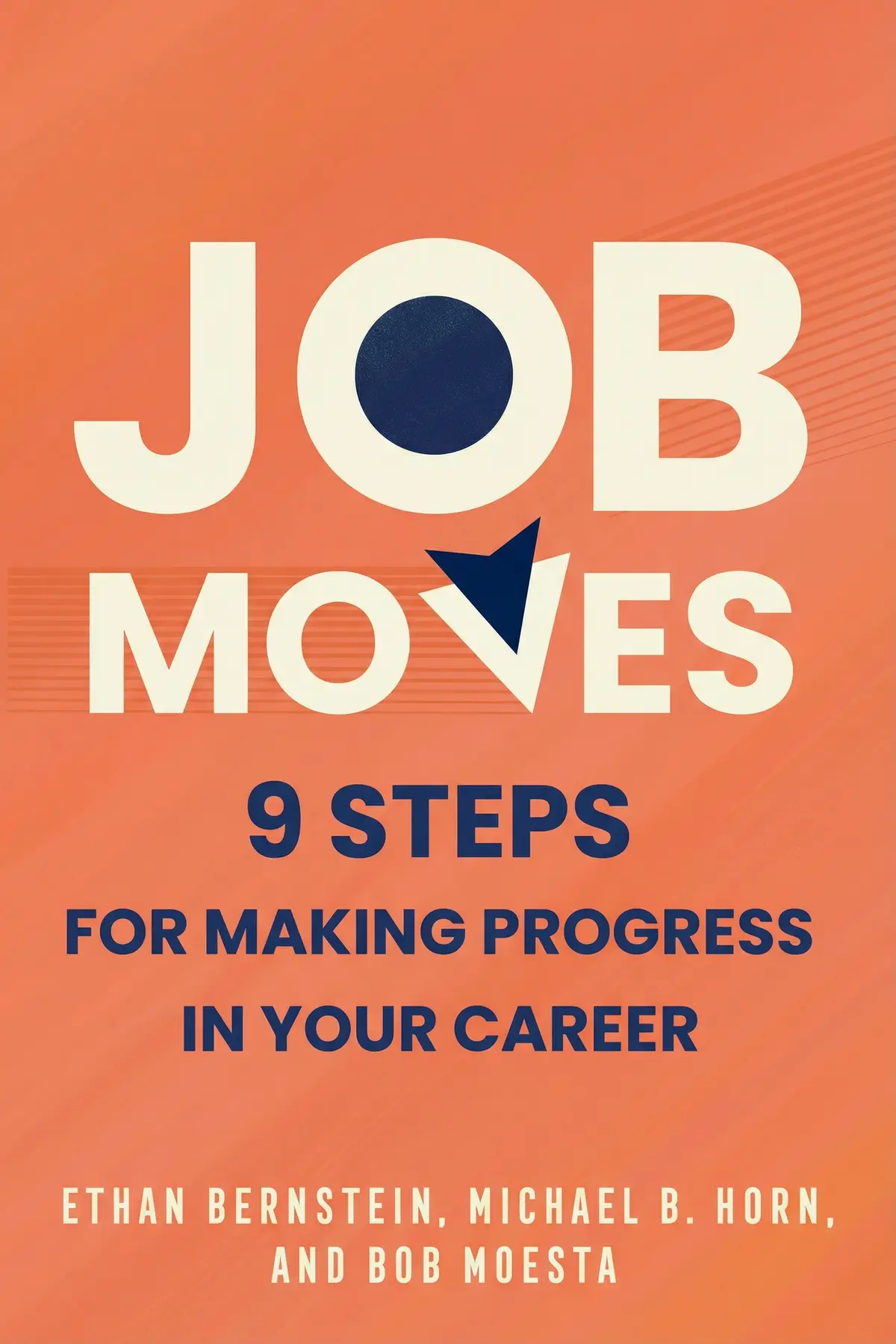
Table of Content
1. Introduction
1 min 02 sec
Every year roughly a billion people change jobs, and most of them come to regret something about the move. In Job Moves, Harvard Business School’s Ethan Bernstein, education writer Michael B. Horn and product developer Bob Moesta blame the usual advice. Climbing the ladder and chasing a bigger title or salary says little about whether a new role will make your working life better.
The authors studied thousands of job switches and found that people are really after progress, and that the kinds of progress they want fall into clear patterns. Their nine steps turn those patterns into a method. Once you know what you want work to do for you, test that against real jobs and can explain it clearly, you stop accepting whatever is offered and start choosing.
Two people carry the story: a manager who could not relocate and a therapy assistant with an unused science degree. The questions they asked themselves are ready for you to borrow before your own next move.
2. Stop feeling trapped by remembering you hire employers
1 min 30 sec
A manager learns his department is leaving town and his family cannot follow. He feels powerless at first, until one change in how he sees the employment deal hands him back a surprising amount of choice.
3. Read your last job switch for clues
1 min 41 sec
Most people can list where they worked but struggle to say why they really left. The answer tends to follow a pattern, and it reveals more about your next move than any job board will.
4. Map the work that gives you energy
1 min 32 sec
A job can look right on paper and still drain you by midweek. One lab manager found that studying her best and worst days pointed to careers she had never thought to consider.
5. Know which of your skills are gaining value
1 min 28 sec
Some of what you know grows more valuable each year, while some of it is losing worth faster than you think. A coder turned product manager shows how to tell the difference before the market does.
6. Name the kind of progress you need now
1 min 26 sec
Two people can both want a new job and need completely opposite changes. Two simple questions sort you onto one of four paths, and choosing the wrong one means solving a problem you never had.
7. Test imagined futures before you apply anywhere
1 min 43 sec
A dream role at a famous organization seemed to combine science, travel and researchers. A few honest conversations revealed what the job mostly involved, and the discovery reshaped what she was looking for.
8. Filter your options and choose your trade-offs
1 min 32 sec
An outdoor dream job fails a simple test, and a manager discovers which sacrifices he can live with. Knowing why you accept a compromise turns out to change how that compromise feels.
9. Tell a career story that shapes your role
1 min 33 sec
A project manager whose department was relocating shared a well-told account of himself in talks with managers at his company. His manager went on to create a new role for him.
10. Conclusion
1 min 09 sec
The deeper lesson of Job Moves is that a good career change is designed long before it is announced. Alex began feeling that his company had decided his future. He ended with a role built around him, because he knew what he was hiring his job to do and could say it plainly. Clara began chasing a bigger title and ended with a sharper question: where would science be the work itself?
Neither found a perfect job, and the authors are clear that none exists. What the method gives you is compromise chosen with open eyes, and that feels nothing like compromise forced on you.
The first moves are small. Talk through your last job switch with someone you trust until you can name what pushed you out and what pulled you in. Before applying for anything that excites you, ask someone who does that work how their week really divides. Then write your own cheat sheet, so that when an offer comes you can bargain for the job you actually want.
A billion people will change jobs this year. The nine steps exist so that your next move is one you chose.
About this book
What is this book about?
About a billion people change jobs every year, and most come to regret some part of the move. The trio of authors, Bernstein, Horn and Moesta, fault advice that frames a career as a ladder of bigger titles and higher salaries. That advice says little about whether a new role will make working life better. The authors studied thousands of job switches and found that people are really looking for progress, in a few recurring forms: escaping a bad situation, gaining control over their time, getting their skills valued properly, or finding a new challenge. Their nine steps help you work out which one you need. You look back at why you left past jobs, map what gives you energy, and draw up a balance sheet of your skills. Then you sketch possible futures and test them by talking to people who do that work. The final steps cover the move itself: filtering options and choosing trade-offs, checking job postings against reality, and telling a career story that can persuade a manager to shape a role around you. Two people carry the book, Alex and Clara, and their moves show each step at work.
Book Information
Who it's for
Restless in their role
Professionals who feel restless in their role but cannot say what should change.
Career switchers weighing options
Career switchers weighing very different futures who want to test them before applying.
Facing a forced change
Employees facing a forced change, like a relocation or reorganization, who want to shape what comes next.
About the Author
Ethan Bernstein
Ethan Bernstein is an associate professor in the Organizational Behavior unit at Harvard Business School, where he teaches leadership and human capital, after years at The Boston Consulting Group and as Chief Strategy Officer at the Consumer Financial Protection Bureau. Michael B. Horn co-founded the Clayton Christensen Institute for Disruptive Innovation and writes widely on education. Bob Moesta is an engineer and product developer who co-created the Jobs to Be Done theory of how people make choices. He has helped launch more than 3,500 products, services and businesses.
Ratings & Reviews
Ratings at a glance
What people think
Listeners find this book to be a vital resource that delivers practical methods for professional advancement. They appreciate the highly applicable content, where one listener notes it's packed with activities and tools, and another draws attention to its step-by-step guidance. Moreover, the work is lauded for its depth, with one listener highlighting its research-backed approach and real-life examples.
Top reviews
Por
Ever wonder why you feel so drained at the end of the day despite having a 'good' title and salary? This book suggests it is likely an alignment issue, and their 'energy mapping' exercise really opened my eyes to the specific tasks that were bleeding me dry. I have always chased the next big title, but Bernstein and his co-authors argue that we should be looking for 'Regain Control' or 'Regain Alignment' moves instead. The focus on trade-offs is a refreshing dose of reality in a genre that usually promises you can 'have it all.' It is a research-backed manual that treats career changes with the scientific rigor they deserve, rather than just fluffy motivational quotes. Definitely a must-read for the modern professional.
Show moreSawit
Few career books actually provide a research-backed roadmap that feels actionable, but 'Job Moves' manages to bridge that gap beautifully. I was skeptical of the 'nine-step process' at first, fearing it would be another generic self-help guide full of platitudes. Instead, I found a rigorous manual that helped me evaluate my skills through the lens of market demand. The case studies, like Clara’s transition into science writing, were relatable and highlighted the importance of testing your assumptions before quitting. I used the 'narrative' approach during my last interview, and it helped me negotiate a role that actually fits my life. This isn't just about getting hired; it's about designing a life where work actually supports your long-term goals.
Show moreSayan
Picking up this book felt like hiring a team of career coaches to help me audit my entire professional history. The authors take the 'Jobs to be Done' theory and apply it to our own lives, asking what 'job' we are hiring our next employer to do. It is a brilliant flip of the traditional script. I found the 'Regain Control' section particularly poignant, as it addressed the burnout I have been feeling lately. The book provides a practical, content-heavy approach that relies on real-life examples rather than just theory. It is a heavy read at times, but the step-by-step guidance is essential for anyone serious about their next big move. Highly recommended for mid-career professionals.
Show moreTak
After hearing Ethan Bernstein on Lenny’s Podcast, I was immediately intrigued by the idea that we 'hire' our employers just as much as they hire us. This book takes that philosophy and builds a disciplined, structured framework around it. I specifically appreciated the 'Take the Next Step' quest, which helped me realize I wasn't just looking for more money, but for a diagonal move that actually utilized my dormant skills. While some of the later chapters felt like they were retreading ground covered in the first half, the job prototype templates are genuinely useful. You will definitely want to visit the website to download the worksheets, as the Kindle formatting makes the diagrams a bit hard to parse. It is a solid choice for anyone feeling stuck.
Show moreNarongrit
The energy map exercise alone was worth the price of admission for me. By identifying which tasks gave me life and which ones left me feeling hollow, I realized I was on the 'Regain Alignment' quest without even knowing it. The authors do a great job of explaining that your skills are assets on a 'career balance sheet' that can grow or shrink depending on the market. I have read a lot of career books, but this one felt more tactical because it encourages you to prototype your future through informational interviews. It is not just about finding a job; it is about making an intentional choice about how to spend your time and what you will accept in return.
Show moreFang
Finally got around to reading this after struggling with a toxic boss for six months. I was firmly in the 'Get Out' category, and the authors' advice on how to stop making emotional, reactive moves was exactly what I needed. They provide a structured way to look at your past career moves to find the 'pushes' and 'pulls' that actually drive your behavior. The writing is clear and professional, though it can feel a bit dry at times when they dive into the statistics of job switchers. Still, the step-by-step guidance for crafting a narrative for your next role is invaluable. It is a crucial read for anyone feeling stuck in a role that does not respect their true value.
Show moreTanawan
One of the most sobering realizations I had while reading was that no job will ever tick every single box. Bernstein, Horn, and Moesta emphasize making smart trade-offs rather than searching for a mythical 'dream job.' I really appreciated the 'career balance sheet' concept because it forced me to see my background as a collection of evolving assets. The book is packed with activities, and while it can feel like a lot of homework, the insights you gain are profound. Just be aware that some of the online resources require you to sign up for their newsletter. Overall, it is a disciplined look at career growth that avoids the typical clichés found in the business section.
Show moreGame
Look, the core concepts here are revolutionary, but the execution feels like a long-form article stretched into a full-length book. I loved the initial podcast interview with the authors, which laid out the four 'quests' perfectly. However, the book gets bogged down in repetitive case studies that do not always add much new value to the core thesis. If you are in a toxic situation and need to 'Get Out,' the advice is solid, but if you are just looking for a standard promotion, it might feel like overkill. I would recommend skimming the second half once you have nailed down your energy map and your 'career balance sheet' priorities. It is useful, but perhaps a bit too dense for the material.
Show moreSupranee
As someone who prefers internal growth over switching companies, this book felt slightly misaligned with my specific needs. The framework is heavily skewed toward people looking to change industries or jump to competitors, which the authors call the 'four quests.' If you are looking for a promotion within your current department, the '9-step process' might feel like an unnecessary detour. That said, the chapter on 'job prototyping' is actually quite clever even for internal moves, as it helps you test-drive new responsibilities before fully committing. It is a solid 3-star read—useful for external transitions, but perhaps a bit too broad for someone happy with their current employer but bored with their current role.
Show moreMint
To be fair, I expected something more revolutionary from Harvard and Christensen Institute authors, but I found the '9-step process' incredibly mechanical. It felt less like a career guide and more like a corporate textbook, complete with endless appendices that made tracking my reading progress on my E-reader a total nightmare. While the idea of 'hiring a company' is a nice sentiment, the actual steps involved in building a 'personal cheat sheet' felt like busywork. If you thrive on rigid structure and academic frameworks, you might enjoy this, but for me, it lacked the human touch needed for such a personal transition. It is okay, just not the life-changer I was hoping for after the hype.
Show moreQuestions about this book
What is the main idea of Job Moves?
Bernstein, Horn and Moesta contend that career advice fixates on titles and salary, which is why most people regret something about their job changes. Drawing on research into thousands of job switches, they say people are really seeking progress. Their nine steps help you identify the progress you want, test possible futures against real jobs and tell a story that lets employers shape a role around you.
What are the four types of progress in Job Moves?
The authors lay out four paths, depending on whether you wish to keep or change your motivations and the skills you apply. Get Out means changing both. Regain Control keeps your skills but changes how you spend your time. Regain Alignment keeps your motivations but uses your skills differently. Take the Next Step builds on everything that already works. Clara, a therapy assistant with an unused science degree, landed in Regain Alignment.
How do you prototype a career according to Job Moves?
You sketch several possible futures, even unlikely ones, then test each through conversations with people doing that work. Clara imagined being a science writer, a physician assistant or a climbing instructor. Talking to people in a National Geographic style coordinator role showed her that scientific discussion filled barely 10 percent of the job, which told her she wanted a role where science was the main work.
How can I apply Job Moves to my own job search?
Start by walking through your last job switch with someone you trust and name what pushed you out and pulled you in. Map which activities energize and drain you, and list which skills are growing or fading in value. Before applying, ask people in target roles how their time divides. Then write a personal cheat sheet about how you work best and use it to shape the role you accept.
Featured in
Readers also enjoyed

60 Seconds & You’re Hired!
Robin Ryan






Be A Free Range Human: Escape the 9 to 5, Create a Life You Love,
Marianne Cantwell
Be the Unicorn: 12 Data-Driven Habits That Separate the Best Leaders from the
William Vanderbloemen
AUDIO SUMMARY AVAILABLE
Listen to Job Moves in 15 minutes
Get the key ideas from Job Moves by Ethan Bernstein, plus 5,000+ more nonfiction titles.
- 5,000+ titles
- Listen as much as you want
- 7-day free trial
- Cancel anytime









