
11 min 31 sec
Available in: English
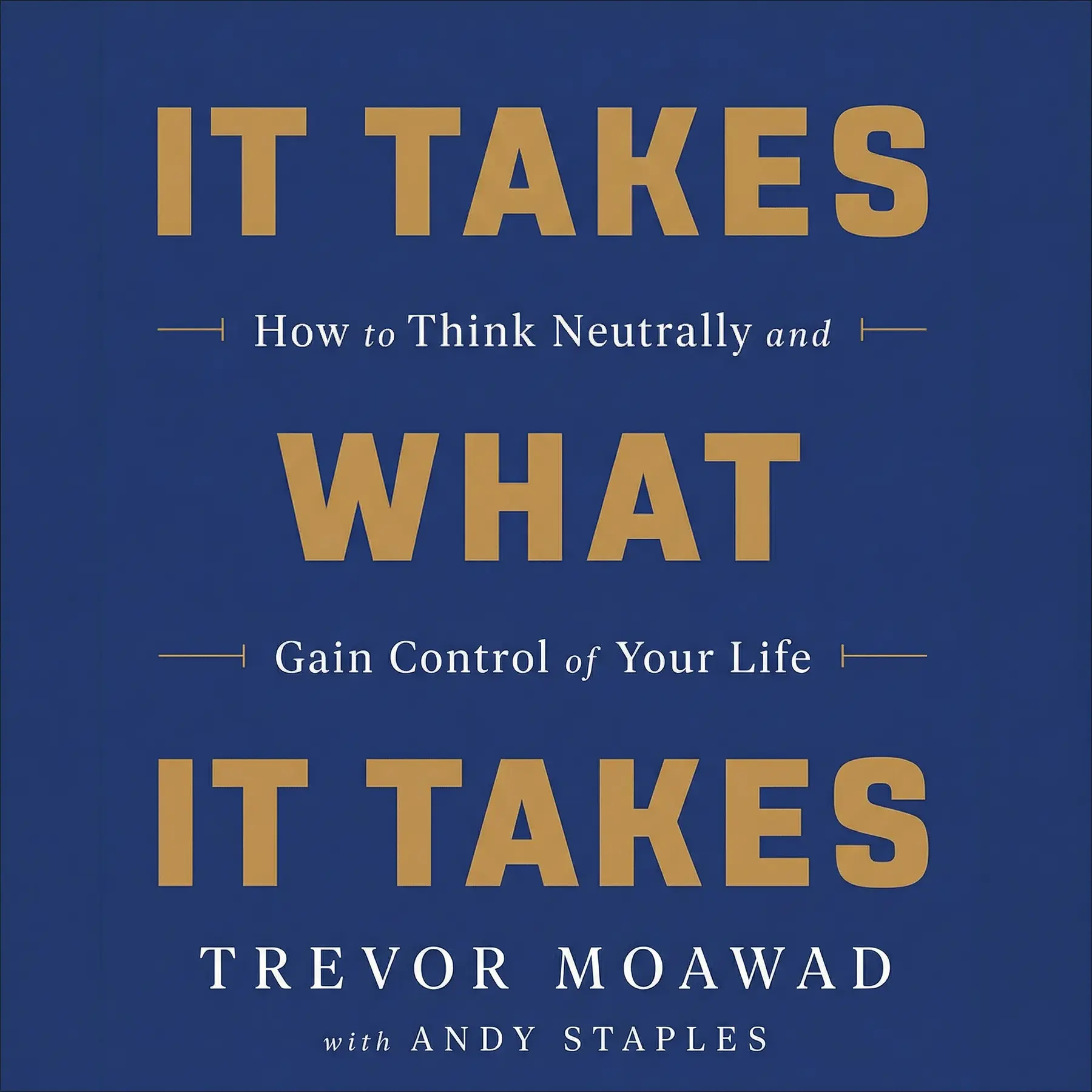
It Takes What It Takes: How to Think Neutrally and Gain Control of Your Life
Shows how to stay clear-headed when things go wrong by admitting what happened without judgment and focusing on the next move. It then covers detailed plans, a negativity diet and well-chosen role models.
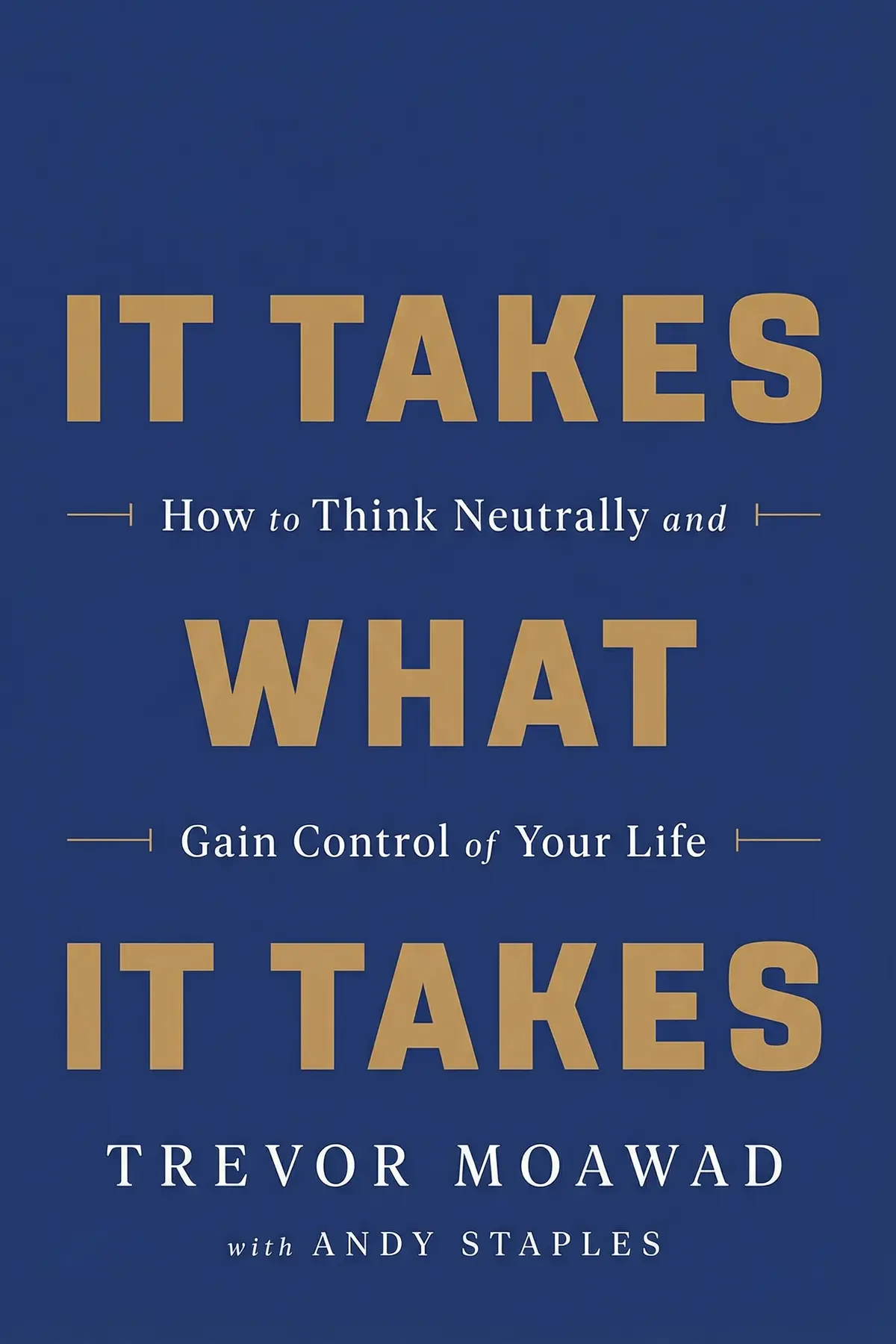
Table of Content
1. Introduction
1 min 03 sec
When something goes wrong in front of other people, most of us either panic or try to cheer ourselves up. Neither one helps us decide what to do next. In It Takes What It Takes, mental conditioning coach Trevor Moawad, writing with sportswriter Andy Staples, offers a third option he calls neutral thinking. You admit what just happened, you notice the feelings it stirs, and then you choose your next move without letting those feelings decide for you.
Moawad coached Russell Wilson, the Seattle Seahawks quarterback, and his examples run from football fields to a damaged spacecraft. His case is that this calm, honest stance is a skill. It can be built on purpose: through specific plans, through careful choices about what you let into your head, and through the people you learn from. What the book offers is a way to stay clear during the worst five minutes of a bad day, plus a handful of habits that keep that clarity going on ordinary days.
2. Reset after a mistake without pretending it away
1 min 50 sec
Cutting out negative self-talk is only part of it, Moawad argues; the rest is noticing your emotions without letting them steer. A quarterback’s worst playoff moments point to a third response that keeps your attention where it can still do some good.
3. Solve a crisis one problem at a time
1 min 51 sec
A failed oxygen tank left the crew stranded in space with their lives at risk. The way they and their ground team responded offers two small tools you can use the next time your own day starts falling apart.
4. Turn big goals into three daily behaviors
1 min 53 sec
Two NFL players set big targets and refused to rely on hope or willpower to reach them. An Olympic sprinter’s unusual footwear shows the other half of their method, and it starts long before race day.
5. Put your mind on a two-week negativity diet
1 min 57 sec
Your mood is shaped all day by inputs you never consciously chose. Moawad describes a short experiment that cuts them back, and one worn-out professional’s results suggest the change can show up within weeks.
6. Your small habits teach whoever is watching
1 min 50 sec
A Super Bowl quarterback, a stubborn believer in attitude and a student in Los Angeles all show how influence really travels. The most surprising lesson comes from a letter about something the author barely noticed doing.
7. Conclusion
1 min 07 sec
Moawad’s book makes the case for a steadier kind of toughness. His athletes and astronauts are not fearless, and they are not relentlessly upbeat. They see the bad news clearly, feel what they feel and still choose the next move with a level head. In Moawad’s account, that stance is not a gift some people are born with. It is built from ordinary pieces: a plan made of daily behaviors, a careful diet of what you read and hear, and the people whose example you follow and set.
The book points to a few concrete places to begin. The next time something goes wrong, breathe deeply three times and ask what you control in the next five minutes. Write your biggest goal as three present-tense behaviors, and picture the steps before your next hard task. Spend two weeks cutting back on bad-news inputs and watch what happens to your focus. And remember the student in Los Angeles who wrote a letter of thanks for nothing more than a daily hello.
The past is fixed. The next pass is still yours to throw.
About this book
What is this book about?
When something goes badly, most people react in one of two ways. Some spiral into blame and fear. Others force a cheerful face. Mental conditioning coach Trevor Moawad, writing with sportswriter Andy Staples, argues that neither one helps you decide what to do next. He offers a third stance, neutral thinking: see the situation as it is, recognize the emotion it stirs, and choose the next action without letting that emotion steer. Moawad draws his examples from elite performers. Russell Wilson resets after costly mistakes. The Apollo 13 crew and ground control solved one problem at a time after an oxygen tank failed in space. The Olympic sprinter Michael Johnson rehearsed success in his mind. The book then shows how to build the stance into ordinary life. You turn big goals into present-tense daily behaviors, you cut back on negative inputs, and you pay attention to the role models you follow and the example you set. Readers get simple tools they can use the same day: three deep breaths before reacting, a focus on the next five minutes, and a two-week diet of fewer bad-news inputs.
Book Information
Who it's for
Professionals replaying mistakes
Professionals who replay mistakes for hours and want a calmer way to recover from them.
Students and early-career workers
Students and young employees who face high-pressure moments like exams, presentations and interviews.
Hoping to model steadiness
Managers, coaches and parents who want to set a steadier example for the people watching them.
About the Author
Trevor Moawad
Trevor Moawad (1973 to 2021) was an author and consultant who worked as a mental conditioning coach for elite performers. His best-known client was Russell Wilson, quarterback of the Seattle Seahawks. He also wrote Getting to Neutral. His co-author, Andy Staples, is a sportswriter who began writing for Sports Illustrated and SI.com in 2009, after covering college sports for newspapers in Tennessee and Florida. Staples studied journalism at the University of Florida, where he was a walk-on football player during the 1996 national title season.
Ratings & Reviews
Ratings at a glance
What people think
Listeners describe this book as articulate and practical, featuring lucid examples that provide deeper understanding of neutral thinking. They value the encouraging themes, with one listener highlighting its utility in governing one's attitude without emotional charges. The work garners praise for its storytelling, impact, and prose quality, while one listener notes its specific use in sports performance. Even though many consider it a simple read, perspectives on its accessibility are somewhat divided.
Top reviews
Sirinat
Wow. This book fundamentally changed how I view my bad days and professional setbacks. Moawad’s core concept of neutral thinking is a total game-changer because it allows you to strip away the emotional baggage of a crisis. Instead of forcing a fake smile through toxic positivity, you learn to look at the facts and decide what the next right step is. The anecdotes about Russell Wilson and other elite athletes aren't just fluff; they provide a clear roadmap for mental conditioning in high-stakes environments. I especially appreciated the 'negativity diet' advice, which forced me to audit who and what I let into my headspace daily. If you're tired of typical self-help platitudes and want a strategy that actually feels grounded in reality, this is it. It’s articulate, practical, and highly motivating without being cheesy.
Show moreAnucha
Ever wonder how elite performers keep their cool when everything is falling apart? This book provides the answer through the lens of neutral thinking. It’s not about lying to yourself with sunshine and rainbows; it’s about acknowledging the situation without judgment. Moawad is an expert at mental conditioning, and his ability to break down complex psychological states into actionable behaviors is impressive. I loved the emphasis on 'drawing a line in the dirt' and moving forward regardless of what just happened. The stories from the NFL and Special Operations communities add a layer of intensity that kept me hooked from start to finish. It’s a direct, punchy, and incredibly articulate guide to gaining control of your life. Honestly, it’s one of the few self-help books that I’ve actually revisited to highlight specific strategies for my own career.
Show moreBenjamin
After hearing Trevor Moawad speak on a few podcasts, I knew I had to grab his book before he passed. He had such a unique way of articulating how the brain processes failure and success. This isn't your typical 'believe in yourself' fluff; it’s a rigorous system for managing your internal monologue. The way he describes emotions as signals rather than directives changed my entire approach to stress management. By staying neutral, you give yourself the clarity to execute your plan without the fog of anxiety. The book is well-written, fast-paced, and filled with insights that apply just as much to a corporate office as they do to an NFL stadium. It’s a bittersweet read knowing he’s gone, but his legacy of mental excellence lives on in these pages. Highly recommend for anyone looking to level up their mental game.
Show moreTak
Direct and articulate, Moawad delivers a masterclass in mental toughness that is surprisingly easy to digest. He cuts through the bull and explains that champions don't have a choice; they simply do what the situation requires. This 'illusion of choice' concept really resonated with me because it simplifies decision-making during high-pressure moments. You don't need to be an elite athlete to appreciate the value of a 'negativity diet' or the power of visualization. The book manages to be both motivational and deeply practical, offering a clear framework for anyone wanting to improve their performance. I found the sections on how to lead yourself before leading others particularly insightful for my own management style. It’s a quick read but the impact of the message lingers long after you close the cover. This is essential reading for anyone serious about personal growth.
Show moreKavya
Picked this up after seeing several teammates mention it, and I’ve got to say, the logic holds up. Moawad argues that your past doesn’t have to dictate your future unless you choose to stay there, which is a powerful reminder for anyone struggling with a recent failure. The writing style is very conversational—definitely a 'bro' book in some ways—but the advice on mental toughness is top-tier. I found the sections on detailed planning and visualization more useful than the standard motivational speeches you usually get in this genre. My only real gripe is that it feels a bit repetitive toward the end, as if the main points were stretched to fill the page count. Still, the concept of staying neutral when things go sideways is a tool I’ll be using for a long time. It’s a fast, engaging read that delivers on its promise.
Show moreAom
The chapter on the law of substitution alone was worth the price of the book for me. It explains how focusing on a specific behavior can effectively crowd out negative thoughts, which is much more practical than just trying to 'stop' being sad. Truth is, I found the first half of the book much stronger than the second. Once you understand the pivot from negative to neutral, the later chapters start to feel like they’re retreading the same ground. However, the storytelling remains high-quality throughout, and the collaboration with Andy Staples ensures the prose flows smoothly. It’s a great introduction to mindset training for anyone who feels stuck in a cycle of overthinking. While it might feel a bit like a sports-centric 'bro' manual at times, the underlying message is universal. It takes discipline to stay neutral, but this book makes a compelling case for why it’s necessary.
Show moreValentina
To be fair, I went into this expecting a typical ghostwritten sports book, but I was pleasantly surprised by the depth of the philosophy. Moawad’s focus on the present moment and the refusal to let the past taint current actions is incredibly liberating. He explains that while the past is irrevocable, our response to it is entirely within our control. The writing is punchy and moves at a brisk pace, which helps when the concepts get a bit repetitive. I do think the name-dropping of Russell Wilson was a bit excessive, but I suppose that’s the nature of the industry he worked in. Regardless, the core message about neutral thinking is a vital tool for navigating the ups and downs of life. It’s a solid 4-star read that offers real value if you’re willing to actually implement the 'negativity diet' he suggests.
Show moreKamol
Frankly, this book is a bit of a mixed bag for me. On one hand, the premise of neutral thinking is excellent and provides a much-needed alternative to the 'positive vibes only' culture that has become so prevalent. On the other hand, the execution feels a bit like a highlight reel of the author’s famous clients. I was hoping for more concrete exercises or a step-by-step workbook style, but instead, it’s mostly anecdotal. The 'negativity diet' is a solid takeaway, yet I felt like I got the gist of the book within the first fifty pages. If you’re a big sports fan, you’ll probably love the behind-the-scenes looks at various programs and players. If you’re looking for a rigorous psychological deep dive, you might find it a bit superficial. It’s a decent read, just don’t expect it to reinvent the wheel.
Show moreEarn
Not what I expected based on the glowing reviews, though it’s certainly not a bad book. It reads more like a memoir of a high-level consultant than a practical 'how-to' guide for the average person. I found the tone a bit too 'macho' at times, and the lack of structured exercises made it hard to figure out how to actually practice neutral thinking in a systematic way. That said, the central idea is quite good. The analogy of shifting from reverse to neutral before going forward is a perfect way to visualize the process. I think this would have been much better as a long-form article or a series of videos. As a full book, it feels like a lot of fluff surrounding a very solid ten-page thesis. It’s an okay read if you have a few hours to kill, but don't expect a life-altering plan.
Show moreViolet
I really wanted to like this book, but it felt like a hodgepodge of name-dropping and hollow cliches. While I respect Trevor Moawad’s career, the constant reminders that he’s BFFs with Russell Wilson and other celebrities became incredibly distracting after the third chapter. There is a serious lack of research or scientific studies to back up his claims, making the 'neutral thinking' concept feel more like a personal mantra than a proven methodology. To be fair, the idea of a 'negativity diet' is a decent tip, but you can find that same advice in a five-minute blog post. The writing is filled with an unnecessary amount of profanity that felt forced rather than authentic. If you want a deep dive with actionable exercises, you’re going to be disappointed by this diluted version of his coaching. It’s basically a long-winded pitch for his services.
Show moreQuestions about this book
What is neutral thinking in It Takes What It Takes?
Neutral thinking, as Trevor Moawad describes it, is a stance free of bias and judgment. You admit what happened, you recognize the emotion it causes, and you do not let that emotion choose your next action. It goes further than avoiding pessimism, because it accepts reality as it is while keeping emotions out of the driver’s seat. It treats the past as fixed and puts your attention on the next decision you control.
How can I practice neutral thinking day to day?
Moawad suggests two simple tools. Before reacting to a stressful moment, stop and take three deep breaths so you move from an emotional state to a neutral one. Then remember that you cannot change the last five minutes but fully control the next five. He applies this to big moments like presentations and to small ones like deciding what to eat.
What is the negativity diet?
The negativity diet is a period, two weeks in the book’s example, when you cut back on pessimistic news and on time with people who drain you, and replace them with neutral or positive inputs. In the example, Sarah limits news to essentials, changes her music and sees supportive friends more. She ends up more focused, less anxious and more productive.
Who should read It Takes What It Takes?
It suits people who freeze, spiral or overthink after setbacks: professionals who replay mistakes, students facing high-stakes tests and anyone heading into big presentations. It also speaks to leaders and parents. Moawad’s stories of role models, including a student moved by his daily greetings, show how much others learn from small, everyday behavior.
How does the book suggest turning goals into action?
Moawad recommends choosing three behaviors that move you toward a big goal and stating them in the present tense, such as running every morning or reading for 30 minutes before bed. Plans should stay flexible, the way a coach adjusts to an unexpected defense. He adds structured visualization, picturing the steps to success, as Michael Johnson did before the 1996 Olympics.
Readers also enjoyed

59 Seconds: Change Your Life in Under a Minute
Richard Wiseman





A Guide to the Good Life: The Ancient Art of Stoic Joy
William B. Irvine


A High-Performing Mind: Strengthen Your Mind and Live Your Best Life
Andrew D. Thompson

Ali: A Life
Jonathan Eig

AUDIO SUMMARY AVAILABLE
Listen to It Takes What It Takes in 15 minutes
Get the key ideas from It Takes What It Takes by Trevor Moawad, plus 5,000+ more nonfiction titles.
- 5,000+ titles
- Listen as much as you want
- 7-day free trial
- Cancel anytime









