
14 min 47 sec
Available in: English
 ไทย
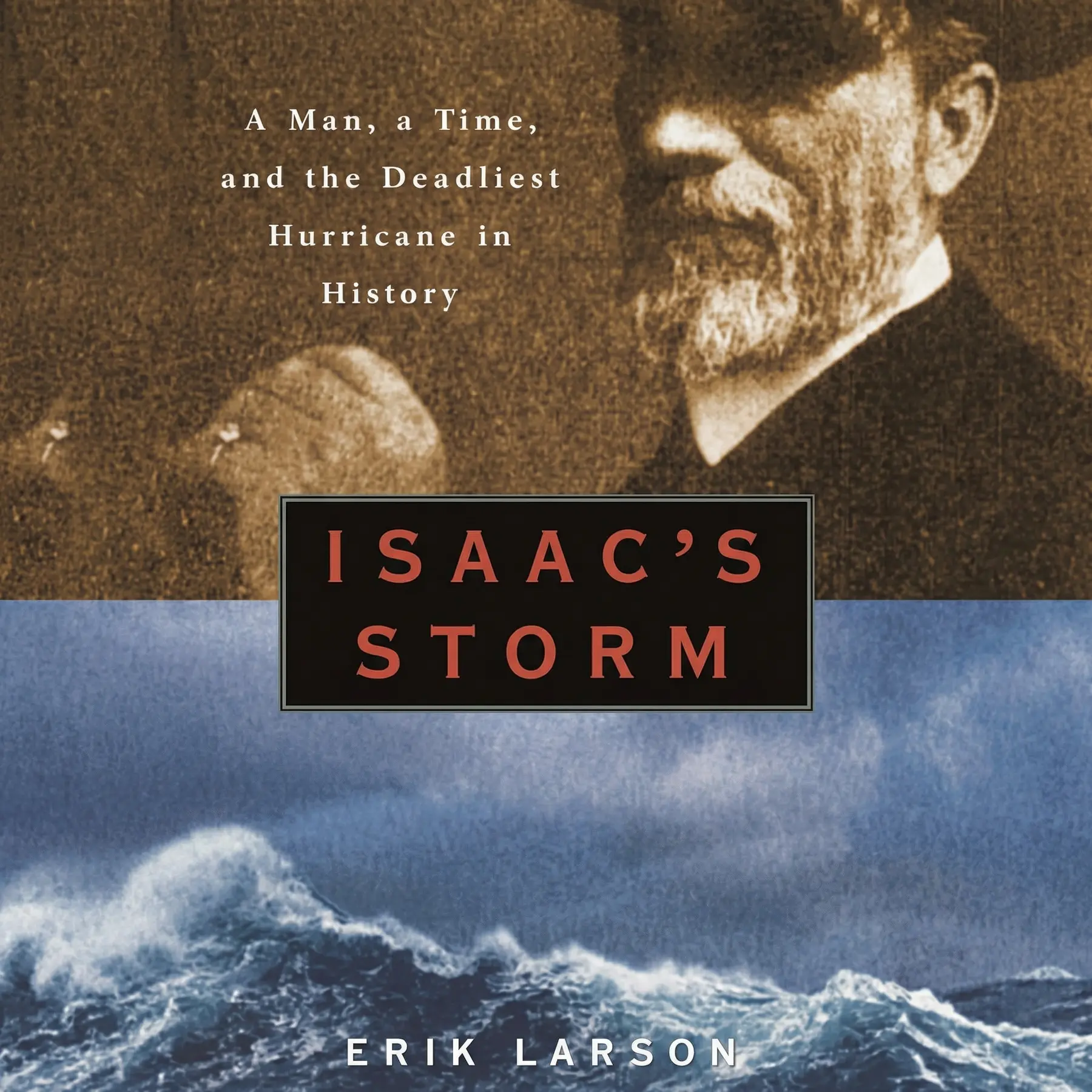
EnglishไทยIsaac’s Storm: A Man, a Time, and the Deadliest Hurricane in History
By Erik Larson
How the 1900 Galveston hurricane struck almost without warning, and what it shows about expert overconfidence, silenced warnings and the choices ordinary people face when official reassurance turns out to be wrong.
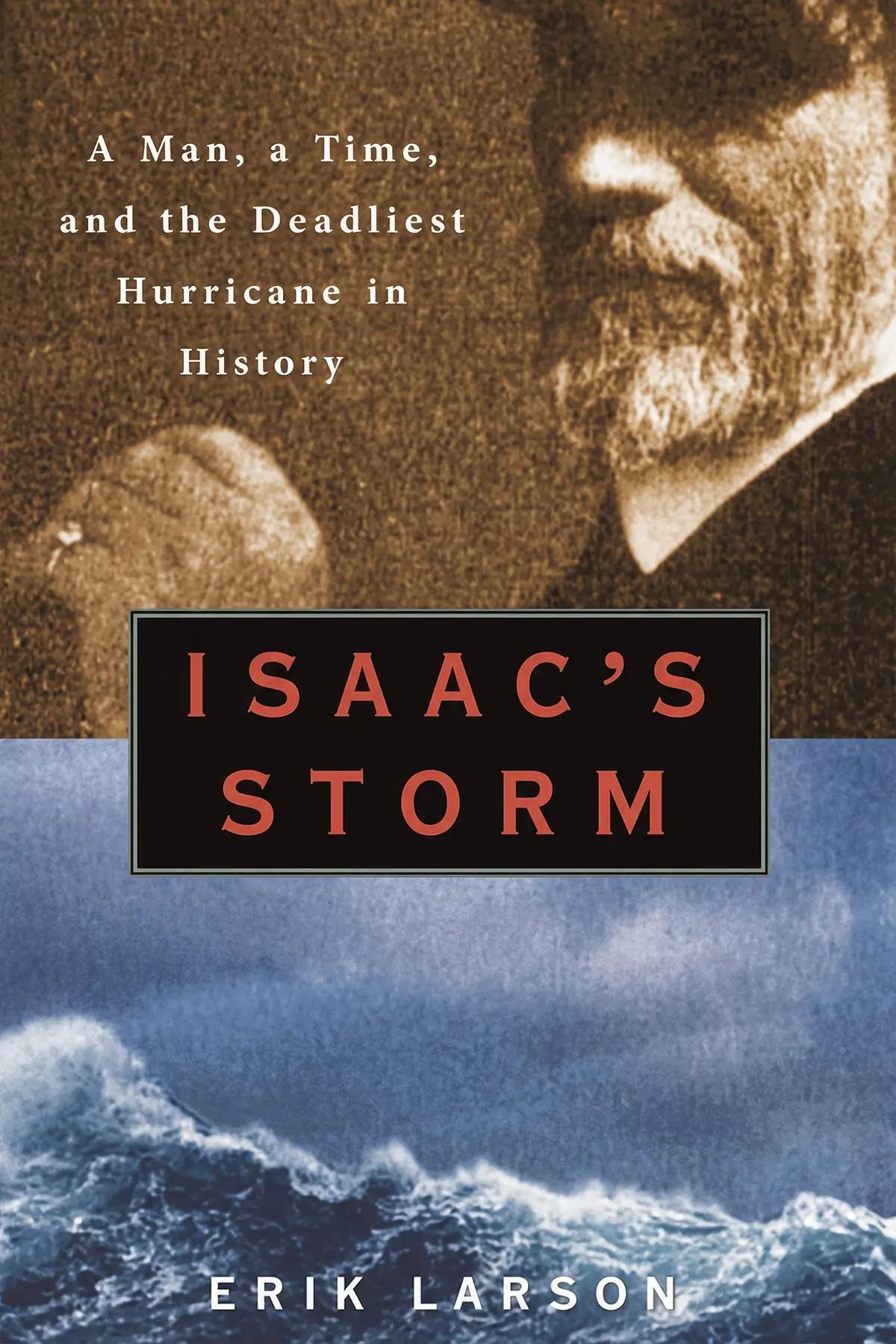
Table of Content
1. Introduction
1 min 00 sec
When experts are sure of something, the evidence against them can sit in plain view and still go unread. On September 8, 1900, that blindness helped a hurricane strike Galveston, Texas, with almost no warning, and by the next dawn thousands were dead. In Isaac’s Storm, journalist Erik Larson tells the story through Isaac Cline, the admired head of the city’s weather station, who had once assured readers that no serious hurricane would ever reach his island.
Larson’s case is that this storm was more than a force of nature. Scientific overconfidence, and a weather service anxious to protect its name, let the danger pass unnoticed until water filled the streets. Following Cline, his brother Joseph and the families around them, the story shows how a capable institution talks itself out of fear, what people faced once the warnings failed, and why some questions about the storm remain open.
2. See how a battered institution chooses its hero
1 min 48 sec
A weather service ruined by theft, fake forecasts and drunken staff needed someone spotless to restore its name. The man it found was brilliant and tireless, and those very qualities carried a hidden risk.
3. Spot how confident experts explain away their own evidence
1 min 49 sec
In a newspaper article, Galveston’s weather expert declared the island safe from hurricanes. The strange part is that the same article contained the facts that should have changed his mind.
4. Spot the cost of muting voices you distrust
1 min 36 sec
A bureau chief haunted by one deadly blown forecast decided to control every report his service issued. His solution removed the people best placed to see the next disaster coming.
5. Catch the small signals an official forecast misses
1 min 50 sec
A Cuban forecaster and a local newspaper saw the danger a week ahead, while the official reports sent the storm somewhere else. On the morning it arrived, children cheered the waves.
6. What the families' shelter choices teach about risk
1 min 51 sec
As the water rose, families had to decide whether to stay or run for a stronger building. One man waded through a yard full of floating toads to ask the expert what to do.
7. Understand what decided who lived through the night
1 min 58 sec
At nightfall the water rose four feet in seconds and the sturdiest houses began to move. In two crowded homes, survival depended on a window, a raft of shutters and flashes of lightning.
8. See how an impossible storm rewrote a city's future
1 min 47 sec
A barometer reading the bureau considered impossible appeared in Galveston that afternoon. Larson weighs how much blame belongs to human pride and how much to a storm that broke every rule.
9. Conclusion
1 min 08 sec
Larson’s story holds two truths at once. The 1900 hurricane was a freak, a storm that broke the instruments’ assumptions and grew faster than science could explain. And it struck a city whose best expert had already decided it could not happen, under a bureau that had muted the people who knew better. The water did the killing, but certainty decided who would be warned.
That pairing is what makes the book worth carrying beyond weather. When a rule you trust keeps needing exceptions, the way Indianola was struck twice, treat the exceptions as the news. When an instrument shows a number you were trained to call impossible, as Blagden’s 28.48 was, question the training before you dismiss the reading. And when an organization protects its reputation by shutting out an awkward source, ask what that source can see that you cannot.
Isaac Cline survived, and he wore his wife’s ring on his own hand. It is a small object, and it carries the whole cost of being sure.
About this book
What is this book about?
On September 8, 1900, a hurricane struck Galveston, Texas, a thriving port with big ambitions. By the next morning thousands were dead and the city's future had been broken. Erik Larson tells the story through Isaac Cline, the respected head of Galveston's weather station, who had once assured the public that the island was safe from serious hurricanes. Larson's angle is that the disaster was partly man-made. Cline dismissed the evidence of two nearby hurricanes as anomalies, and the bureau chief, Willis Moore, blocked weather cables from Cuba, whose forecasters saw the storm's danger early. The book follows the Cline brothers, the Palmers, the Credos and other families through a day of mounting fear and a night of collapsing houses, then through the grim count of the dead. Readers get a gripping account of the storm and a lasting lesson about certainty: how capable institutions talk themselves out of fear, why awkward evidence gets labeled an exception, and why some questions about the storm's sudden strength remain open today.
Book Information
Who it's for
History buffs
History readers who want a gripping true disaster story told through real families.
Managers and analysts
Managers and analysts who rely on expert forecasts and want to see how confident institutions miss warnings.
Curious about weather science
Anyone curious about weather science and the 1900 Galveston hurricane.
About the Author
Erik Larson
Erik Larson studied Russian history, language and culture at the University of Pennsylvania and earned a master's degree in journalism from Columbia University. He was a staff writer at The Wall Street Journal and a contributing writer for Time. Isaac's Storm was his first narrative nonfiction book. He went on to write The Devil in the White City, which won an Edgar Award, and The Splendid and the Vile. Six of his books have been New York Times bestsellers, published in nearly forty countries.
Ratings & Reviews
Ratings at a glance
What people think
Listeners find this book captivating and immersive from start to finish, praising the superb prose and meticulous research. They appreciate the historical narrative, especially the intriguing chronicle of Galveston, and value the meteorology details, including the evolution of forecasting. The pacing gets varying feedback, with several listeners noting that it begins slowly.
Top reviews
Moo
Erik Larson has this incredible knack for taking a historical footnote and turning it into a pulse-pounding thriller. I was fascinated by the early days of the U.S. Weather Bureau and how their arrogance led to such a catastrophe. The way he describes the 'explosive deepening' of the hurricane makes you feel like the pressure is dropping in your own living room. While some might find the biographical bits about Isaac Cline a little dense, they are essential for understanding the sheer hubris of the era. This wasn't just a natural disaster; it was a failure of imagination and scientific ego. By the time the sea starts reclaiming Galveston, you’re already holding your breath for the inevitable. It’s a chilling, masterfully researched account that stays with you long after the final page.
Show moreCholada
How can a city just vanish into the sea in a single night? This book explores that terrifying question with such precision and atmosphere that I felt like I was standing on the beach in 1900. Larson masterfully builds the tension by jumping between the oblivious residents of Galveston and the monster churning in the Gulf. The theme of human hubris is woven into every chapter, showing how our misplaced faith in technology can lead to total ruin. I was particularly struck by the accounts of the survivors, especially the heartbreaking story of the nuns and the orphans. It’s a brutal reminder that nature doesn't care about our scientific models or our civic pride. If you enjoy history that reads like a disaster movie, this is the gold standard.
Show moreAom
I'm still thinking about that image of the children tied together at the orphanage to keep from being swept away. This book is absolutely haunting in its depiction of the 1900 hurricane and the sheer scale of the loss in Texas. Larson doesn't just give you the statistics; he gives you the human faces behind the 6,000 deaths. The contrast between the sun-drenched, optimistic city of the Gilded Age and the post-apocalyptic ruins of the next morning is staggering. I loved the scientific explanations of how hurricanes form and the terrifying reality of a storm surge. It’s rare to find a book that is both intellectually stimulating and emotionally devastating at the same time. This is easily one of the best pieces of non-fiction I have ever picked up.
Show moreGai
This book serves as a grim reminder of what happens when we think we’ve conquered the natural world. Larson paints a vivid picture of Galveston as a thriving metropolis on the verge of greatness, only to show how quickly it could be dismantled. The biography of Isaac Cline is fascinating, portraying him not as a villain, but as a man trapped by the limitations of his era’s knowledge. I was particularly impressed by the way the author handled the aftermath, describing the grim task of dealing with the thousands of bodies left in the wake. The prose is elegant and descriptive without being overly flowery, which suits the subject matter perfectly. It’s a powerful exploration of tragedy, science, and the enduring resilience of the human spirit in the face of total disaster.
Show moreSaengdao
Finally got around to this classic, and while it didn't quite hit the heights of his later work for me, it's still top-tier narrative nonfiction. The first half is admittedly a bit of a slow burn as it sets up the various bureaucratic squabbles between the Americans and the Cuban meteorologists. Truth is, you have to be interested in the history of weather science to really enjoy the buildup. However, once the storm actually makes landfall in Galveston, the pacing shifts into high gear and becomes genuinely terrifying. The descriptions of the 'cock's tails' clouds and the rising water are visceral and haunting. Larson’s research is clearly exhaustive, but he never lets the facts get in the way of a compelling story. It’s a solid four-star read for anyone who likes their history with a side of impending doom.
Show moreErn
The politics of weather sounds like a dry topic, doesn't it? Surprisingly, Larson manages to make the internal power struggles of the fledgling Weather Bureau feel like a high-stakes political thriller. I had no idea that xenophobia and petty jealousy played such a large role in why Galveston was so tragically unprepared. The way the U.S. officials ignored the more experienced Cuban forecasters was infuriating to read about, especially knowing the death toll that followed. The writing is crisp and journalistic, though it occasionally gets bogged down in minutiae that might not interest a casual reader. Still, the level of detail regarding the storm's physics and the city's destruction is truly impressive. It makes you realize how much we take for granted with our modern satellite tracking and 24-hour news cycles.
Show moreCarter
As someone who grew up on the Gulf Coast, this was a terrifying look back at a time before we had any real warning systems. The hubris displayed by the meteorologists of the time is just mind-blowing when you consider how vulnerable Galveston was to the sea. Larson does a great job of explaining the 'Age of Certainty' and why people were so convinced they had conquered nature. My only minor complaint is that the character development for some of the secondary figures felt a little thin. You see a lot of names flash by, and it's hard to keep track of everyone before they are inevitably swept away. Regardless, the book is a fast-paced and informative read that provides a fascinating glimpse into a forgotten chapter of American history.
Show moreSirinat
Not what I expected after loving Devil in the White City, as this one felt significantly more disjointed and academic. Larson clearly knows his stuff, but there were stretches where I found myself skimming the technical details of 19th-century barometers. I wanted more about the actual disaster and perhaps a bit less about the interpersonal drama at the Weather Bureau. Isaac Cline is an interesting figure, yet he remains somewhat distant and hard to sympathize with despite the personal tragedies he endured. The book only really comes alive in the final third when the hurricane hits, and those chapters are undeniably gripping. To be fair, the research is impeccable, but the middle sections felt like they were treading water. It’s worth a read for the history, but be prepared for some dry spells along the way.
Show moreSoontorn
Look, I appreciate the research that went into this, but the narrative felt a bit padded at times. There is a lot of speculation about what Isaac Cline was thinking or feeling, which is understandable given the lack of records, but it sometimes pulled me out of the story. The first hundred pages move at a glacial pace, focusing heavily on the history of meteorology rather than the people of Galveston. I found the sections on the storm itself to be the only truly engaging parts of the book. While the ending is poignant and effectively highlights the tragedy, getting there felt like a bit of a chore. It’s a decent historical account, but it doesn't quite have the narrative flow I’ve come to expect from Larson’s newer books.
Show moreViroj
Maybe I just wasn't in the right mood for 19th-century atmospheric science when I started this one. The truth is that the "Storm" part of Isaac's Storm takes a long time to arrive, and the buildup is very heavy on data. I found the descriptions of the Weather Bureau's internal scandals to be a bit repetitive after a while. Larson is a gifted writer, but the pacing here feels uneven compared to his other works like Dead Wake. I did enjoy the final chapters and the look at how Galveston changed afterward, but it was a bit of a slog to get through the middle. If you're a die-die-hard history buff or a weather nerd, you'll love it, but casual readers might find it a bit too technical.
Show moreQuestions about this book
What is Isaac's Storm by Erik Larson about?
It tells the story of the hurricane that destroyed Galveston, Texas, on September 8, 1900, through Isaac Cline, head of the city’s weather station. Larson shows how Cline’s confidence that hurricanes would never reach Galveston, and the weather bureau’s decision to block cables from Cuba, left most residents unwarned. He follows families through the storm’s night and the grim aftermath, when somewhere between 4,263 and perhaps 10,000 people were counted dead.
Why didn't Galveston get a warning about the 1900 hurricane?
Larson points to two failures. Isaac Cline had argued in 1891 that cyclones always turn north before reaching the Gulf of Mexico, dismissing two deadly hurricanes at nearby Indianola as anomalies. And bureau chief Willis Moore, distrusting Cuban forecasters, had outgoing weather cables from Cuba blocked, even after Cuban meteorologist Julio Jover warned of a likely cyclone. Official reports expected the storm to turn north along Florida.
Did Isaac Cline really warn people before the storm?
Cline later said that by the afternoon of September 8 he understood the danger and warned people along the beach, saving hundreds or even thousands of lives. Larson finds little evidence that this happened. What is documented is that Cline admitted to Anthony Credo around 2:30 p.m. that he had underestimated the storm, and that he advised Judson Palmer to stay in his house, which was later destroyed.
What made the 1900 Galveston hurricane so unusual?
The weather bureau treated any barometer reading under 29 inches as an error, yet agent John Blagden recorded 28.48 in Galveston that afternoon. The storm grew far stronger between September 3 and 8 than anyone thought possible, a process later named explosive deepening. One leading theory is that it passed over the Loop Current, a warm branch of the Gulf Stream, which may have fed it enormous heat.
What lesson does Isaac's Storm teach?
The story shows how expertise can turn into blindness. Cline treated the facts that contradicted his theory as exceptions, and his bureau silenced the forecasters most likely to disagree. The practical lesson is to take exceptions to a trusted rule seriously, to question readings you were taught to call impossible, and to keep listening to awkward sources instead of shutting them out to protect a reputation.
Readers also enjoyed

Alexander Hamilton
Ron Chernow

Alexander the Great
Philip Freeman


A History of Iran: Empire of the Mind
Michael Axworthy

A History of the World in 6 Glasses
Tom Standage

A Long Way Gone: Memoirs of a Boy Soldier
Ishmael Beah


AUDIO SUMMARY AVAILABLE
Listen to Isaac’s Storm in 15 minutes
Get the key ideas from Isaac’s Storm by Erik Larson, plus 5,000+ more nonfiction titles.
- 5,000+ titles
- Listen as much as you want
- 7-day free trial
- Cancel anytime









