

13 min 29 sec
Available in: English
IRREPLACEABLE: The Art of Standing Out in the Age of Artificial Intelligence
Shows how to stay valuable as AI takes over routine work: build creativity, critical thinking and authenticity, learn just enough AI to partner with it, and apply the same approach to raising children and running a company.
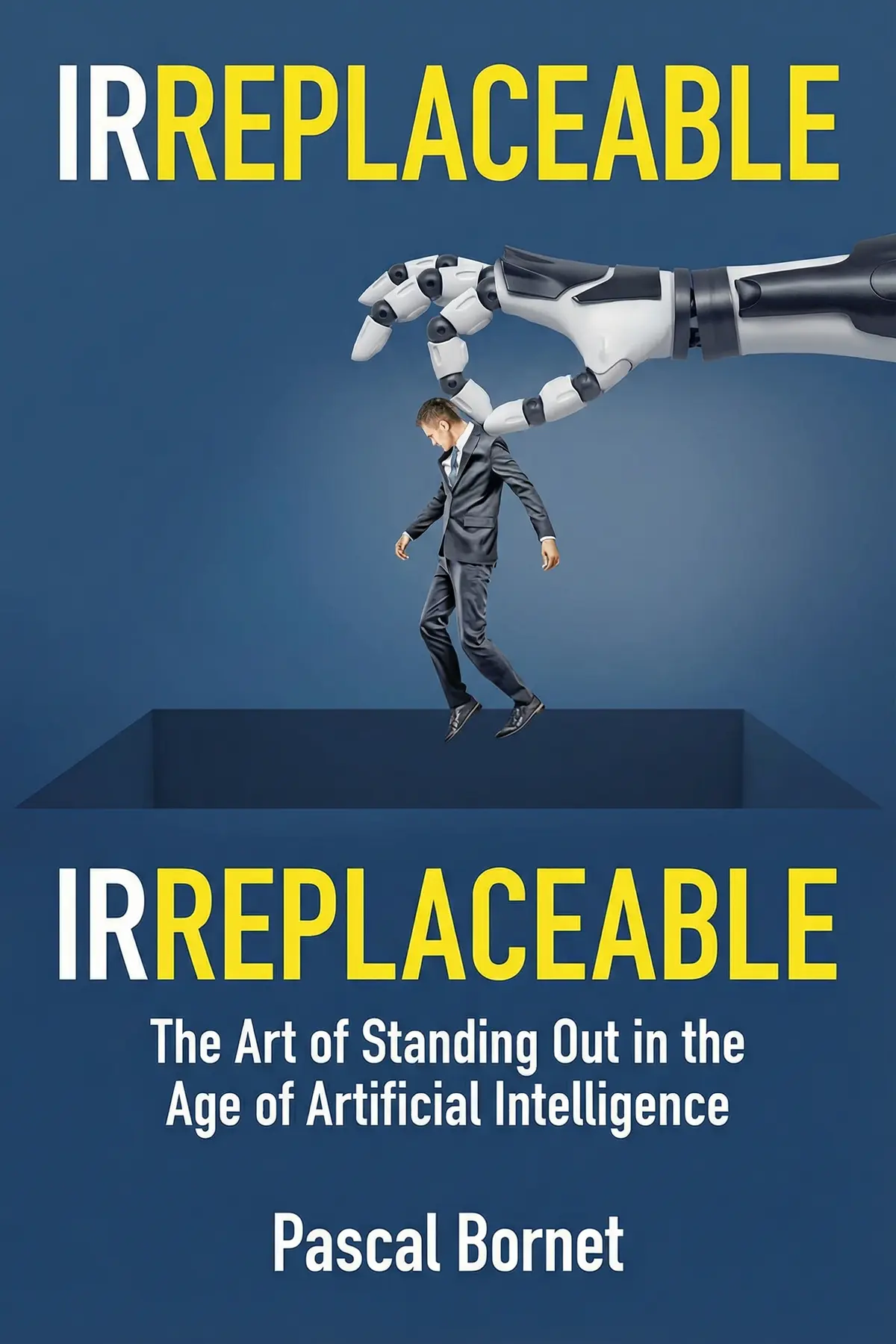
Table of Content
1. Introduction
58 sec
If AI can now do in minutes much of what fills your working day, a worry follows naturally: what is left for you? In IRREPLACEABLE, Pascal Bornet, who built and led the intelligent automation practices at McKinsey and EY, answers that your safest ground is wherever human judgment beats the rule. He calls these abilities Humics, and he names three: genuine creativity, critical thinking and social authenticity.
His throughline is direct. Grow those human skills first, then hand AI the data and the routine work, and the pairing makes you harder to replace than you or the machine alone. Bornet carries that idea from the single worker to parents raising children and to leaders redesigning a company, and he finishes with a plan measured in weeks and months. The payoff is a clear sense of which parts of your work to protect, which to automate, and how to start sorting them this week.
2. Step in when the automated system gets it wrong
1 min 29 sec
A family misses a flight they could have boarded without causing any problems, and the person who could have fixed it chose not to. That small airport scene holds the first test of whether your job can be automated.
3. Train the three human skills machines lack
1 min 56 sec
A capable software developer looked at her strongest skills and saw a chance to grow beyond them. What she chose to work on next helped her become a better project leader and design friendlier software.
4. Treat AI as your sidekick, never your rival
1 min 21 sec
In a 2005 chess tournament, top grandmasters and supercomputers both lost. The winners were a group nobody would have bet on, and their victory reframes the fear of being beaten by AI.
5. Learn just enough AI to put it to work
1 min 42 sec
Many people hold back from AI because they think they must master it first. Bornet sets a far lower bar, and he borrows a lesson from flowers about how to use a partner without depending on it.
6. Raise children who question their AI tools
1 min 39 sec
In 1998, a group of math teachers tried to get calculators banned from schools, and they lost. Bornet draws a lesson from that fight for any parent tempted to ban AI at home.
7. Build a company that adapts instead of disappearing
1 min 46 sec
One video rental giant became a relic while the company that replaced it became a household name. Bornet uses their split fate to show leaders what an AI-era business must protect, and what it must be willing to change.
8. A three-month plan to make yourself irreplaceable
1 min 18 sec
Good intentions about the future of work tend to stay intentions. Bornet breaks the change into stages small enough to begin this week, with clear activities to take on at each step.
9. Conclusion
1 min 20 sec
Bornet’s book keeps returning, in spirit, to the crew manager at the gate. He had the authority, the information and the obvious right answer, and he still let the system decide. The whole argument is a case against becoming him. Machines will keep getting faster at the routine parts of work, so value moves to the moments that need a person: an exception, a hard question, an honest conversation, a new idea.
That holds at every scale. A developer like Maya, a child checking what a chatbot says, a company choosing to change the way Netflix did: each stays relevant by pairing human strengths with tools that carry the load.
The first moves are small. Spend an evening listing your strengths, then hand one routine task to an AI tool and put the saved hour into something only you could do. Keep some independence from your tools, the way a flower still accepts pollen from the wind. And when a rule produces a plainly wrong result, be the person who notices and acts.
The algorithm can close the gate. Deciding when to open it is still your job.
About this book
What is this book about?
Imagine watching AI finish in minutes most of the tasks that fill your day, and wondering how your own value can stay indispensable. Pascal Bornet, who built intelligent automation practices at two of the world's best-known consulting firms, argues that the answer is neither to ignore the technology nor to compete with it. His case rests on what he calls Humics: genuine creativity, critical thinking and social authenticity. These are the abilities software cannot replicate, such as the judgment to make a sensible exception when a rule produces a wrong result. Bornet explains how to strengthen each one on your own, then how to pair them with AI as a sidekick that takes over data and repetitive tasks. The book extends the idea beyond the individual. Parents and teachers get ways to raise children who question their AI tools instead of trusting them blindly. Leaders get principles for an adaptable, ethical business that keeps the human touch. A staged plan covering the first week, month and three months turns the ideas into a starting routine.
Book Information
Who it's for
Office workers facing AI
Office workers who see AI taking over their routine tasks and want to know what to build next.
Parents and teachers
Parents and teachers deciding how children should use tools like ChatGPT.
Redesigning companies around AI
Founders and leaders redesigning their company around AI without losing customer trust.
About the Author
Pascal Bornet
Pascal Bornet spent more than two decades in senior executive roles at McKinsey and EY, where he created and led their Intelligent Automation practices. He has put AI initiatives into practice for hundreds of organizations around the world. His research focuses on where AI and people meet, and he argues for human-centric AI. LinkedIn named him a Global Top Voice in Tech in 2019. His work has appeared in Forbes, Bloomberg, McKinsey Quarterly and The Times, and he lectures at several universities.
Ratings & Reviews
Ratings at a glance
What people think
Listeners find the work insightful, and one individual highlights how it offers an incredible structure for grasping AI. The title earns praise for being easy to follow, while one listener considers it essential for AI fans. Regarding the tempo, listeners have expressed varying opinions.
Top reviews
Pichaya
Finally got around to reading Bornet’s latest and it’s a total game-changer for how we view our place alongside machines. The framework he provides for "Humics" is truly insightful, especially the emphasis on social authenticity and critical thinking. Instead of the usual doom and gloom, this book empowers you to leverage AI as an augmentation tool. I loved the practical roadmap for reinvention, though it does get a bit repetitive with the word IRREPLACEABLE popping up in all caps on every other page. Despite that, the message is clear: our uniquely human traits are our greatest assets. It’s an essential guide for anyone looking to future-proof their career in an age of unprecedented change. Highly recommended for leaders and professionals alike.
Show moreMo
This book provides a masterclass on staying relevant in a world dominated by algorithms and silicon. I was particularly impressed by the way Bornet connects our biological evolution—our phylogeny—to the current technological revolution. He argues that we are stepping into a new era where our ability to experience love and empathy makes us distinct from any CPU. The book is highly readable and serves as an empowering treasure for those feeling overwhelmed by the pace of change. I've already started applying the adaptability roadmap to my own business strategy. It’s not just about surviving; it’s about thriving. Truly a must-read for any AI enthusiast or leader who wants to maintain a human edge.
Show moreSiriporn
As someone who works in tech, I found this to be a pretty balanced take on the whole GenAI explosion. Bornet isn't a "doomer" by any stretch; he’s actually quite optimistic about how we can thrive if we focus on what makes us human. Truth is, the pacing felt a bit slow in the middle, and I think the content could have been condensed into a much shorter volume without losing much impact. However, the focus on individual agency and adaptability is exactly what's needed right now. If you can get past the constant use of the word "unprecedented," there are some real gems here about building a personal competitive advantage that AI simply cannot replicate. It's a very practical manual for a complicated time.
Show moreBook
The chapter on social authenticity really hit home for me because it highlights something a chatbot just can't replicate. Bornet manages to take complex technological shifts and distill them into a readable guide for the average professional. Frankly, I appreciated the individualistic approach, though it ignores the need for broader societal regulation or government guardrails. It's very much a "help yourself" manual for the AI age. The structure is logical, moving from the current state of robotics to a future where human-machine collaboration is the norm. It’s a solid 4-star read that offers a refreshing perspective compared to more academic texts. It makes you feel like you have a fighting chance against the algorithms.
Show moreEarn
Pascal Bornet offers a refreshing take on the synergy between human and machine that avoids the typical binary of "replace or be replaced." He focuses heavily on how we can use GenAI to our advantage, provided we cultivate our "Humics." I found the framework easy to follow and the advice to be actionable for anyone in a corporate environment. While the book is a bit overly optimistic at times, its readability makes it accessible to a wide audience. It’s not quite the business book of the year for me, but it’s definitely a valuable addition to the conversation on the future of work and technology. It’s a very grounded, individual-focused roadmap.
Show moreManika
Look, the core message here is vital for anyone worried about their job security in an era of automation. Pascal Bornet is a visionary, but the execution of the book left me wanting a bit more depth in certain areas. He spends a lot of time "delving into" concepts like creativity and critical thinking, but at times it feels like a high-level summary rather than a deep dive. I noticed the word IRREPLACEABLE appears in all caps constantly, which becomes distracting after the first few chapters. It’s a good plan for augmentation, but I felt some of the ideas were repeated too often to fill the page count. A decent read, but it could have been tighter.
Show moreKob
Is this a solid guide to navigating the AI era? Yes, mostly. But I can't help feeling that the book could have been half its length and still delivered the same value. Bornet’s "Humics" framework is brilliant and provides a great lens through which to view our evolving relationship with technology. Yet, the tone leans a little too far into the libertarian side of things, focusing almost entirely on what the individual can do. There is very little mention of the ethical implications or the need for collective action. It’s a very practical, if somewhat overly optimistic, look at how we can stay ahead of the curve. It's worth a read for the strategy, just be prepared for some filler.
Show moreA
To be fair, Bornet is clearly an expert in his field, and his passion for human potential shines through every chapter. However, the writing style can be a bit grating with the constant use of buzzwords like "unprecedented" and "IRREPLACEABLE." I found the ideas about staying relevant through "Humics" to be very practical, but the book lacks a certain critical edge regarding the negative impacts of AI on society as a whole. It’s a bit too sunshine-and-rainbows for my taste. If you're looking for a cheerleader to tell you it's all going to be okay, this is it. If you want a deep sociological critique, you might find it a bit shallow.
Show moreDen
Ever wonder what actually separates us from a CPU besides the obvious hardware? Bornet attempts to answer this by looking at how machines mimic our mental functions without ever truly experiencing human feelings. It’s an interesting read, though the perspective is very individualistic and ignores the role of society and regulation. I enjoyed the sections on how we can reinvent ourselves, but I felt the book dragged in the second half. It’s a balanced take—not quite a doomer, not quite a prophet—but it could have used a much tighter edit to keep the momentum going through to the end. Good ideas, just a bit long-winded in the delivery.
Show moreRyan
I really wanted to like this, but the writing style drove me crazy and I eventually had to skim the last half. Every few paragraphs, there's another mention of being IRREPLACEABLE in all caps, and it feels like the author is shouting at me. The message about human creativity and critical thinking is important, but it gets buried under repetitive phrasing and a structure that feels padded. I felt like I was reading the same three points over and over again in different fonts. There are better, more concise books out there that cover the same ground without the excessive filler words and the weirdly aggressive capitalization.
Show moreQuestions about this book
What is the main idea of IRREPLACEABLE by Pascal Bornet?
Bornet argues that people stay valuable in the age of AI by developing Humics, his name for the human abilities machines cannot copy: genuine creativity, critical thinking and social authenticity. Once those skills are strong, AI should be treated as a partner that handles data and routine tasks. He applies the same idea to individual careers, to raising children and to building an adaptable, ethical company.
What are Humics?
Humics are the inherently human qualities Bornet says algorithms cannot replicate. He names three. Genuine creativity grows from curiosity, varied experiences and unjudged brainstorming. Critical thinking grows from questioning assumptions, journaling and weighing pros and cons. Social authenticity rests on self-awareness, active listening and openness about your own thoughts and feelings. An example is the judgment to make a sensible exception when an automated rule gives a wrong result.
How does Bornet suggest working with AI?
He asks readers to see AI as a sidekick, much as Batman relies on Robin, and points to a 2005 chess tournament where ordinary players teamed with AI beat both grandmasters and supercomputers. He says knowing about 30 percent of AI is usually enough for practical use. Sort your tasks into ones to automate, elevate or eliminate, and guard against tech addiction and overreliance.
What does IRREPLACEABLE say about children and AI?
Bornet advises against banning AI, noting that math teachers in 1998 failed to get calculators banned from schools. Instead, teach children to use tools like ChatGPT well and to check what they say. He recommends discussing AI-made projects in class, turning learning into games, letting children help set their own screen limits and asking them to explain ideas in their own words.
How can I start applying the book's ideas?
Bornet offers a staged plan. In the first week, reflect on your strengths and the skills you need. By the end of the first month, become AI-Ready, Human-Ready and Change-Ready, for example by automating one routine task and using the freed time for strategy. Within three months, take a course on AI in your field and share what you learn with your team, then review your progress regularly.
Readers also enjoyed


21 Lessons for the 21st Century
Yuval Noah Harari



60 Seconds & You’re Hired!
Robin Ryan



AI 2041: Ten Visions for Our Future
Kai-Fu Lee

AUDIO SUMMARY AVAILABLE
Listen to IRREPLACEABLE in 15 minutes
Get the key ideas from IRREPLACEABLE by Pascal Bornet, plus 5,000+ more nonfiction titles.
- 5,000+ titles
- Listen as much as you want
- 7-day free trial
- Cancel anytime









