

13 min 05 sec
Available in: English
In Defense of Selfishness: Why the Code of Self-Sacrifice is Unjust and Destructive
Peter Schwartz makes the Objectivist case that the duty of self-sacrifice turns people into servants of the group, and that reasoned self-interest, built on fair voluntary trade, is both more moral and more practical.
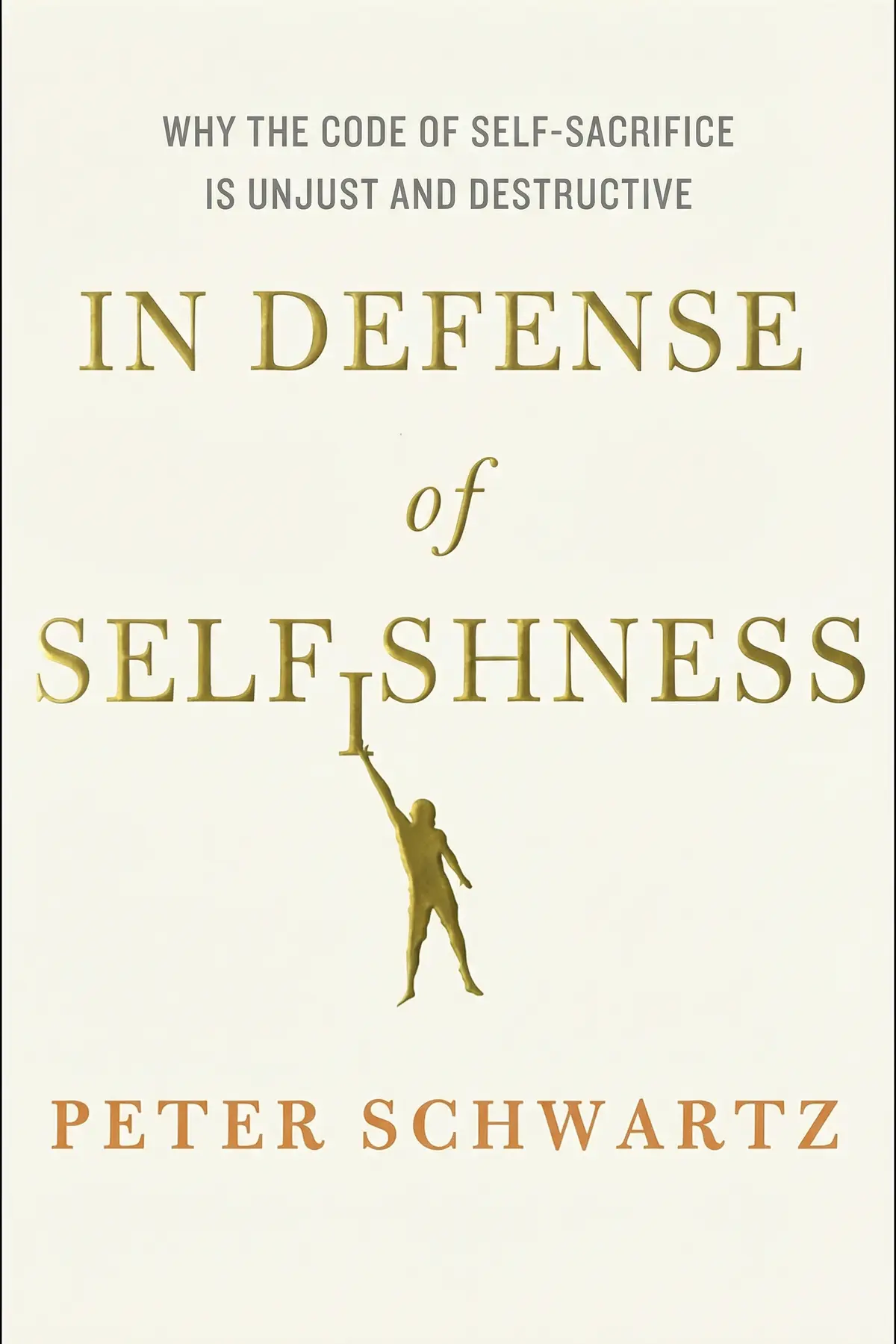
Table of Content
1. Introduction
59 sec
Many people carry a low hum of guilt whenever they put their own goals first, as if wanting things for yourself were a small moral failure. In In Defense of Selfishness, journalist Peter Schwartz argues that the guilt points the wrong way. The code that tells you to sacrifice for others is the real danger, he says, because it treats your time, your money and even your mind as debts owed to the group.
Schwartz writes from an Objectivist viewpoint, and his throughline is blunt. Self-sacrifice, followed all the way, makes individuals servants and societies less free, while a rational selfishness built on fair trade lets everyone keep what is theirs. He is careful to say he does not mean the predatory behavior of a criminal like Bernie Madoff.
By the end, you will be able to tell a gift you choose from a debt someone claims you owe, and to state the case for self-interest without apology, whether or not you accept all of it.
2. Tell a chosen gift from a claimed debt
1 min 49 sec
Helping a stranger in trouble seems like the clearest good there is. Schwartz says something else hides inside the request, and an argument about blind passengers and airplane exit rows shows what it is.
3. Ask who pays for the public good
1 min 48 sec
A city park looks like a gift to all its residents. Schwartz asks a plain question about it, and his answer leads somewhere much darker, to a farmer, his pigs and the modern state.
4. Keep your own judgment when the group wants agreement
1 min 48 sec
Your thoughts feel like the one thing nobody can take. Schwartz argues that a code of total selflessness reaches them too, and a remark by a Nazi leader about simple arithmetic shows how far it can go.
5. Self-interest you can defend in any argument
1 min 48 sec
Say the word selfish and most people picture a cheat or a burglar. Schwartz claims that picture is a mistake, and his reason involves the difference between how animals live and how people decide.
6. Protect your life and your loves first
1 min 54 sec
A thirsty traveler, a poisoned cup and a donated kidney all test the same belief: that giving more makes a better life. Schwartz uses them to argue that survival and even love point the other way.
7. See what a society of free traders looks like
1 min 52 sec
Schwartz carries his ethics from the kitchen table to the constitution. His picture of a just country surprises many readers, especially in what he says about democracy and about who should own the parks.
8. Conclusion
1 min 07 sec
Schwartz’s book reverses a moral habit most people never examine. The duty to put others first, which feels like the very definition of goodness, looks to him like a claim on your goods, your choices and finally your mind. He follows that claim all the way to a state that cares for its citizens the way a farmer cares for his livestock. Against it he sets a selfishness few of us have ever heard defended: reasoned, honest and built on trades both sides want.
You do not have to accept every step of his case to use its sharpest tools. When someone tells you that you owe them, ask whether that debt was ever agreed. When a plan is sold as serving the public, find out who pays and who would have chosen differently. In your own dealings, look for exchanges that no one has to be sacrificed to make, and give credit to the people whose skill won the day.
Schwartz’s image of the selfish person is the thirsty traveler who knocks away the poisoned cup: someone who takes their own life seriously enough to protect it.
About this book
What is this book about?
Most people assume that putting others first is the heart of being good. Even people who behave badly rarely question it. Peter Schwartz does. He argues that altruism, followed consistently, asks for far more than kindness. It claims that your money, time and even your thinking belong to the group, and he follows that claim from airline seating rules and city parks to the totalitarian state. Against it, Schwartz defends a selfishness that most readers have never heard defended. It is reasoned, honest and self-respecting, and it works through voluntary exchange where both sides gain. He separates it sharply from the greed of thieves and fraudsters, and he applies it to survival, to love and to the design of a free, capitalist republic. Readers get a clear, provocative statement of an Objectivist position on ethics and politics. It offers a set of questions to test any demand for sacrifice: whether the debt was ever agreed, who pays for the so-called public good, and whether a deal could be made without anyone giving something up.
Book Information
Who it's for
Professionals guilty about ambition
Professionals who feel guilty putting their own goals first and want a principled argument for doing it.
Into politics and philosophy
Readers of politics and philosophy who want a clear statement of the Objectivist case against self-sacrifice.
Students weighing big ideas
Students weighing ideas about altruism, capitalism and individual rights.
About the Author
Peter Schwartz
Peter Schwartz, born in 1949, is an American journalist who writes opinion pieces and books from an Objectivist viewpoint. He is a former Chairman of the Board of the Ayn Rand Institute and a Distinguished Fellow there. He founded The Intellectual Activist, editing and publishing it from 1979 to 1991, and led Second Renaissance Books from 1987 to 2003. He has lectured and written on ethics, political philosophy, environmentalism and multiculturalism. This book was later reissued as The Tyranny of Need.
Ratings & Reviews
Ratings at a glance
What people think
Listeners find this work exceptionally clear and articulate, with one mentioning it’s not as demanding as reading Ayn Rand's works. The book offers a profound grasp of egoism versus altruism, and one listener characterizes it as a road map to living a guiltless life. Listeners value its stimulating nature and powerful reasoning, with one likening the narrative to an exciting detective story. They prize its moral outlook, with one pointing out its focus on rational self-interest, and find the material enlightening, with one describing it as a blindingly clear revelation.
Top reviews
Komsan
Finally got around to reading this, and it’s a breath of fresh air compared to the dense, often impenetrable prose of some other Objectivist writers. Schwartz offers a road map to a guiltless life that feels both radical and incredibly logical once you sit with the arguments. He breaks down the difference between rational self-interest and the common, messy definition of selfishness we’re all taught to fear in grade school. The writing is highly readable, moving with a pace that makes philosophical inquiry feel more like a detective story uncovering a hidden truth about our culture. While some points about the FDA felt a bit repetitive, the core message remains powerful. If you’ve ever felt weighed down by the constant social pressure to sacrifice your own happiness for others, this book might just set you free. It's a compelling argument for your own life being your primary moral value.
Show moreTom
Schwartz has managed to turn ethics into something as gripping as a thriller, which is no small feat for a book on philosophy. As someone who has dabbled in Rand’s works before, I found this to be a much more accessible entry point into the mechanics of egoism versus altruism. The author presents a blindingly clear revelation: that we have been conditioned to see our own success as a moral failure. Truth is, the way he deconstructs the 'virtue' of sacrifice is both eye-opening and deeply unsettling to everything we’re taught in school. My only real gripe is that he can be quite repetitive, hammering home the same points about collectivism until you feel a bit exhausted. Still, the underlying logic is robust. It's an essential read for anyone looking to build a stronger philosophical foundation for their personal liberty and happiness.
Show morePing
Finding a road map to a guiltless life is not what I expected from a philosophy book, but Schwartz delivers exactly that with surgical precision. It provides a deep understanding of why we feel guilty for succeeding and offers a way to reclaim our moral standing. The way Schwartz explains rational self-interest is far more exciting than I anticipated; it almost felt like an exciting detective story at times. He systematically dismantles the idea that being good requires you to suffer or lose something valuable. Personally, I found the clarity of his logic to be refreshing, even if he does repeat himself to ensure the message sticks. It’s an eye-opening book that I’d recommend to anyone tired of the relentless message of collectivism that pervades our current culture. A five-star read for its boldness.
Show moreCooper
This book is like a blindingly clear revelation for anyone who has struggled with the feeling that they are being 'used' by society's expectations. I was particularly struck by how Schwartz contrasts the end results of actions against the sheer amount of sacrifice involved. Often, we judge a person’s goodness by how much they suffer, rather than what they actually achieve. To be fair, the author’s tone can come across as a bit condescending at times, almost like he’s lecturing a student who just doesn’t get it. However, the examples regarding government entities and their alleged benefits were fascinating to digest. It’s a thought-provoking read that challenges the very foundation of modern ethics. You might not agree with everything, but you will definitely think differently about how you allocate your resources and your time.
Show moreSin
Ever wonder why sacrifice is always treated as the ultimate virtue while personal achievement is met with skepticism? Schwartz dives deep into this paradox, offering a fascinating look at the ethics of rational self-interest. The narrative flow is surprisingly smooth for a philosophy book, making it far more readable than the thousand-page doorstoppers usually associated with these ideas. I appreciated the specific element of how altruism is often used as a tool for political manipulation, though I think some of the religious examples were a bit extreme and isolated. Despite that, the book functions as a powerful guide to living without unearned guilt. It’s an eye-opening perspective that insists your life belongs to you alone. A solid four stars for the clarity of thought and the courage to challenge the status quo.
Show moreWatchara
Look, you don't have to agree with every political point in this book to appreciate the sheer audacity of Schwartz's thesis. He argues that altruism is not just overrated but actually destructive to a functional society. This perspective is so at odds with everything I was taught that it genuinely had my head spinning for a few days. The chapter regarding the FDA was particularly illuminating, showing how 'protection' can often lead to stagnation. I did feel that he plays 'hide the ball' with some of the more complex issues in Objectivism, and his dismissal of other philosophers like Locke felt a bit hand-wavy. Nevertheless, it serves as a compelling argument for a life lived for one's own sake. It is well-written and far more engaging than a standard textbook. Definitely worth a look if you want your assumptions challenged.
Show morePot
The information in this fascinating book is so different from the status quo that it’s almost shocking to read. Schwartz writes simply and clearly, making complex philosophical constructs understandable for the average reader. I loved the way he framed the 'ethics of rational self-interest' as a necessary strength rather than a moral weakness. It’s a much more readable alternative to diving straight into Ayn Rand’s fiction. I will say that the author’s tone can be a bit 'jerk-ish' in some sections, which might distract from his otherwise solid points. But if you can get past the occasional name-calling, there is a lot of wisdom here about property rights and individual agency. It encouraged me to consider a completely alternative approach to my resources and time. A very thought-provoking and worthwhile read for the modern era.
Show moreGai
Not what I expected when I picked this up, and frankly, I have mixed feelings about the execution. While the author makes some valid points about individual rights, the tone is often off-putting and unnecessarily negative. It feels like he’s shouting at the reader rather than inviting them into a conversation. I also found the repetition to be a major hurdle; it felt like a college student trying to hit a word count by rewording the same three paragraphs over and over. The examples he uses to illustrate 'altruism gone wrong' feel like extreme and absurd caricatures that don't really reflect how most people live their lives. I didn’t find myself persuaded to change my worldview, though I can see why fans of Objectivism would find this to be a reinforcing read. It's okay, but proceed with caution if you prefer a more nuanced approach.
Show moreKamol
Picked this up after a recommendation from a philosophy group, but I found it to be a bit of a slog. To keep this review short, the book is essentially a modern-day parroting of John Galt’s speech from decades ago without much new ground being broken. The author's tone is quite harsh, which might alienate anyone who isn't already a hardcore libertarian or Rand devotee. Truth is, I agreed with the premise that we shouldn't be slaves to others, but the way Schwartz sets up altruism as this purely destructive monster felt like a straw man argument. He uses biblical teachings as negative arguments in a way that felt a bit lazy and intellectually shallow. There’s some common sense mixed in here, but you have to dig through a lot of repetition and condescension to find it.
Show moreBoy
I'm frankly disappointed by the lack of nuance in these pages. The author sets up a very extreme version of altruism—one that almost nobody actually practices—and then spends the rest of the book tearing it down with a very negative tone. It felt like a God-less philosophy that misses the human element of compassion and community. While I agree that we shouldn't be forced to help others at the cost of our own survival, Schwartz seems to think any form of sacrifice is an evil. The repetition was also a huge issue for me; I felt like I was reading the same chapter ten times. The examples provided were often so out of date or isolated that they didn't really prove the point he was trying to make. I struggled to finish it because it just felt so angry and one-sided.
Show moreQuestions about this book
What is the main idea of In Defense of Selfishness?
Peter Schwartz argues that altruism, the duty to put others before yourself, is harmful because it claims your money, time, choices and even your thinking as debts owed to the group. He traces it to collectivism and, in the worst case, totalitarianism. His alternative is rational selfishness: valuing your own life and values, never demanding that others sacrifice theirs, and dealing with people through voluntary trade where both sides gain.
What does Peter Schwartz mean by selfishness?
Schwartz separates selfishness from impulse and crime. Satisfying every passing urge, as animals do, does not qualify, and he distances his idea from predatory behavior like Bernie Madoff’s. In his account, true selfishness is guided by reason. Reason shows that trading beats robbing, since robbery might get you killed, so a selfish person deals peacefully with others, guards their own values and asks no one to give theirs up.
Why does Schwartz say the public interest is a myth?
He argues that a public is made of individuals with different wants, so a project called good for everyone simply serves some at others’ expense. His example is a city park versus a shopping mall. The park needs tax money because there is no entry fee, which means residents who never use it, and might prefer the mall, still pay. He would make such places private, so users pay.
How can I apply the ideas in In Defense of Selfishness?
The book suggests some habits of thought. When asked to give something up, ask whether you chose to help or are being told you owe. When a plan is sold as serving everyone, ask who pays and who would have chosen otherwise. Look for deals both sides would accept freely. And, as Schwartz suggests with sports teams, give credit to the particular people whose skill made a success possible.
Who should read In Defense of Selfishness?
It suits readers who want a direct, provocative case against the ethics of self-sacrifice, written from an Objectivist viewpoint. Professionals who feel guilty pursuing their own goals will find a principled defense of self-interest. Students of ethics and politics will find a clear position linking personal morality to capitalism, limited government and individual rights, with examples from airline safety rules, city parks, organ donation and Nazi Germany.
Readers also enjoyed

A Guide to the Good Life: The Ancient Art of Stoic Joy
William B. Irvine

A Little History of Philosophy
Nigel Warburton

A Theory of Justice
John Rawls



Becoming Beauvoir: A Life
Kate Kirkpatrick
AUDIO SUMMARY AVAILABLE
Listen to In Defense of Selfishness in 15 minutes
Get the key ideas from In Defense of Selfishness by Peter Schwartz, plus 5,000+ more nonfiction titles.
- 5,000+ titles
- Listen as much as you want
- 7-day free trial
- Cancel anytime









