

14 min 01 sec
Available in: English
How to Stay Sane
Psychotherapist Philippa Perry shows how to keep your mind steady under pressure by observing your feelings, catching unhelpful patterns and stories, seeking healthy challenges and building relationships based on real self-knowledge.
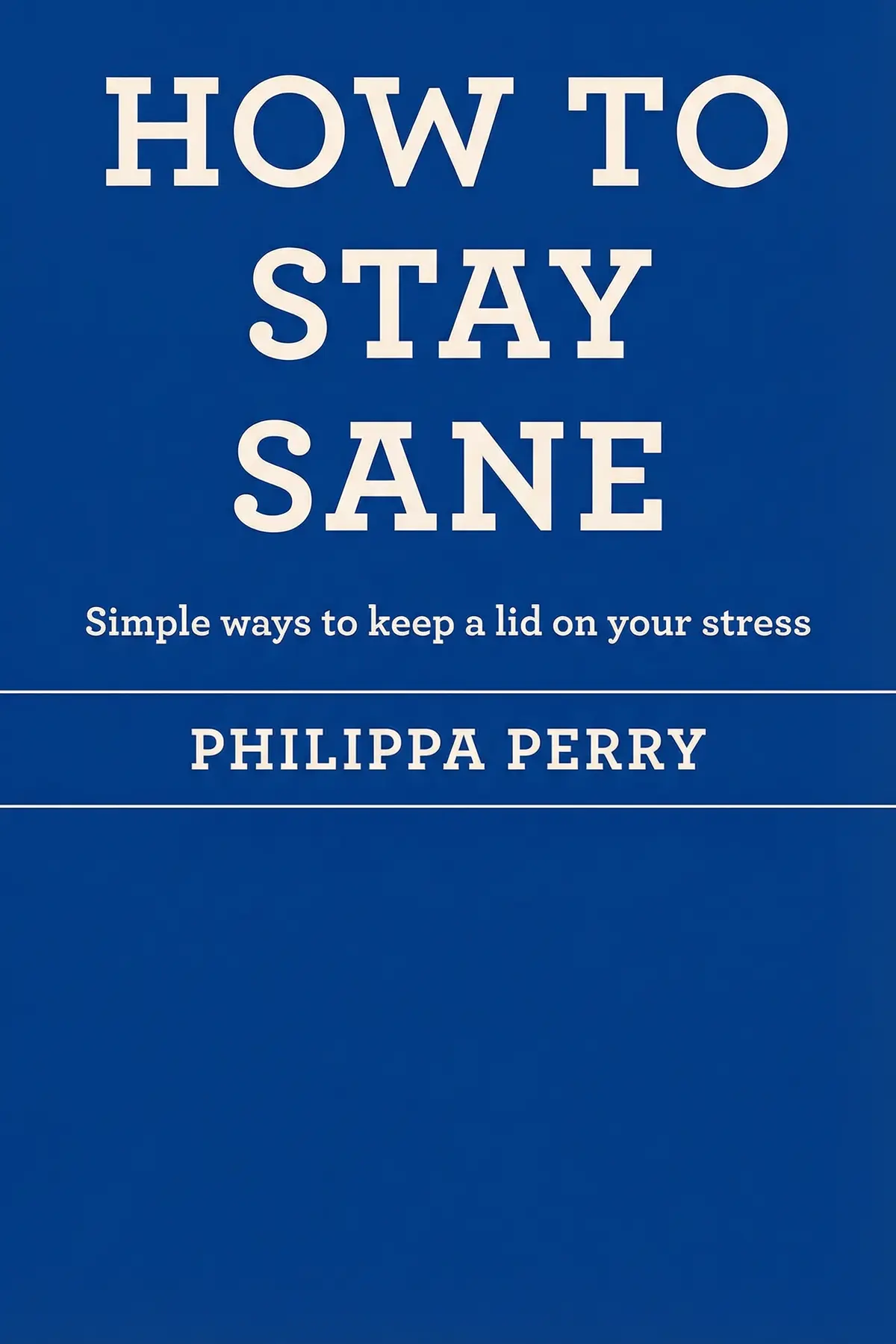
Table of Content
1. Introduction
1 min 01 sec
When stress piles up, it can feel as if you are one bad day away from losing control. In How to Stay Sane, psychotherapist Philippa Perry starts with a humbling fact: the reasoning voice that feels in charge usually arrives late. Emotion makes the call, and logic writes the excuse afterward.
Perry, who trained after volunteering with the Samaritans, does not treat sanity as luck or temperament. She treats it as a set of habits anyone can practice. Her argument is that a steady mind comes from watching your own inner life with calm curiosity, then using what you see to bond with people, take on challenges of the right size and edit the stories you tell yourself.
The tools are small and concrete. By the end, you will have a one-minute breathing drill, a diary method that exposes your repeating patterns, a way to choose a challenge that stretches without scaring you, and a story that turns rejection into progress.
2. Expect feelings to decide before your reasons do
2 min 02 sec
People in one experiment walked when instructed, then offered reasons for a choice they never consciously made. Their explanations were sincere, and the reason behind them changes how much you should trust your own.
3. Calm a racing mind by watching it
1 min 56 sec
Nobody can switch anger or worry off on command. Perry describes something you can do instead, and it takes one minute, a chair and attention to the most ordinary thing your body does all day.
4. Know yourself first to build lasting relationships
2 min 08 sec
A woman named Zara watched romance after romance collapse within months and could not see why. A notebook finally showed her, and the same method can reveal the loop behind your own repeated disappointments.
5. Use a little stress to keep your brain growing
1 min 53 sec
Stress is usually cast as the enemy of a healthy mind. Perry describes a kind that seems to protect the brain and even lengthen life, and a simple way to find the right dose.
6. Catch the story that is steering your reactions
1 min 58 sec
A driver with a flat tire walks miles through the desert toward the only garage around. By the time he arrives, a story in his head has already ruined the help waiting for him.
7. Turn rejection into a step toward yes
1 min 51 sec
An artist kept getting turned down and was close to giving up. One short story about a salesperson changed how she counted her failures, and it can change how you count yours.
8. Conclusion
1 min 12 sec
Perry’s book makes a modest but steady promise: you do not have to be at the mercy of your own mind. Feelings will still lead and reasons will still trail behind, as Sperry’s walkers showed. What changes is that you learn to watch the process, and watching gives you room to choose. That one skill sits under everything else she recommends, from spotting a relationship loop like Zara’s to catching the desert driver’s paranoid story before it costs you help.
Her closing exercise brings the threads together. Set aside 30 minutes with no distractions, a notebook and a pen. Follow your breath. Each time a thought arrives, write it down in a word or two and let it go. At the end, read the list. It shows you how you tend to think, and if the list leans heavily negative, you now know where to start changing it.
Beyond that, pick one challenge from the middle of your comfort zone, and treat your next rejection the way the salesperson treated a lost call. Sanity, on Perry’s account, is not a fixed state you either keep or lose. It is a practice of paying attention, and it can begin with a single breath.
About this book
What is this book about?
Most people believe they are reasonable and decide things logically. Philippa Perry argues that this belief is mostly an illusion. Emotion makes the first move, and the thinking mind supplies a tidy explanation afterward. When stress builds, that gap can leave anyone feeling close to breaking point. Perry's answer is self-observation, the habit of watching your feelings and thoughts from a little distance without judging them. She offers simple tools: a diary that exposes repeating patterns, a one-minute breathing exercise and a 30-minute notebook practice. From there she shows how knowing yourself helps you read other people, why moderate good stress keeps the brain growing, and how the stories in your head can turn a friendly stranger into an enemy. Her examples include Roger Sperry's experiment on how the brain invents reasons, a woman named Zara who finally broke her relationship cycle, a stranded driver undone by his own paranoia and an artist who learned to count rejections as progress. Readers get a short, practical set of habits for staying calm, connected and curious.
Book Information
Who it's for
Professionals near breaking point
Professionals under steady pressure who feel close to breaking point and want simple daily habits.
Repeating relationship mistakes
People who keep repeating the same relationship mistakes and want to see the pattern.
Held back by fear
Anyone held back by fear of rejection or new challenges who wants a gentler way forward.
About the Author
Philippa Perry
Philippa Perry trained as a psychotherapist after volunteering with the Samaritans. Her first book, the graphic novel Couch Fiction, showed how psychotherapy works. How to Stay Sane followed in 2012 as part of a series from The School of Life and Pan Macmillan, and in 2019 she published The Book You Wish Your Parents Had Read. She has written for The Guardian and The Observer and presented documentaries for BBC Radio 4, Channel 4 and BBC4.
Ratings & Reviews
Ratings at a glance

What people think
Listeners find the work educational and clear, with one listener highlighting how it conveys ideas in a way that is simple to grasp. They value its accessible format as a brief yet beneficial listen, and one listener notes it is packed with exercises that help move forward to a more sane and productive life.
Top reviews
Orm
Picked this up because I wanted something straightforward and not too 'woo-woo' for my mental health. This was exactly what I needed. It is informative without being dense, and Perry’s voice is like having a wise, blunt therapist in your pocket. The focus on 'What’s the Story?' was a game-changer for me. It made me realize how much of my stress comes from the outdated patterns I have been carrying around since childhood. The exercises, particularly the ones at the end, are practical and easy to implement into a daily routine. Some people might find it too short, but I think the brevity is its strength. It gives you the core concepts—self-observation, relationship building, and stress management—and then gets out of the way so you can actually do the work. Highly recommended for anyone needing a sanity check-up!
Show moreRoongsak
Wow. I did not expect a book this small to have such a large impact on my daily perspective. It really challenges you to look at the stories you tell yourself and how those stories might be self-defeating. Perry argues that we can 'edit' our narratives at any time, which is such an empowering thought when you feel stuck in a crisis. The writing is incredibly easy to understand, making complex psychological concepts accessible to everyone. Not gonna lie, some of the exercises at the end felt a bit like 'homework' at first, but they really help you move toward a more productive life. The distinction between being defined by your emotions versus observing them is a tool I have started using every day. This isn't just another self-help book; it is a practical manual for the human mind. If you are feeling a bit lost in the noise of the world, give this a read.
Show moreNutnicha
Finally got around to reading this pocket-sized guide from the School of Life series, and it is surprisingly punchy. Clocking in at just about 128 pages, Philippa Perry doesn’t waste any time with academic jargon or filler. The book focuses on four main pillars: self-observation, relationships, stress, and our personal stories. To be fair, some of the advice feels a bit basic if you have done any therapy before—like the suggestion to listen more or keep a journal. However, the way she explains how we get stuck in either 'chaos' or 'rigidity' is incredibly helpful for visualizing mental health. Truth is, the genogram exercise is a bit of a project, but it is eye-opening to see your family patterns laid out clearly. It is a quick, straightforward read that provides a solid framework for anyone looking to understand their own mind a bit better without getting bogged down in a 500-page textbook.
Show moreLayla
Ever wonder why certain situations always trigger the same negative response in you? This book dives straight into that by examining the filters through which we view our lives. Philippa Perry’s style is refreshingly honest and direct, skipping the 'everyone can succeed' American self-help tropes in favor of a more grounded, British sensibility. Frankly, I loved the section on relationships; the idea that self-awareness is the bedrock of connecting with others makes so much sense. The book is tiny—literally fits in your pocket—but the exercises are substantial. I especially liked the focus on 'staying on the path' between chaos and rigidity. It is a very manageable read for anyone who feels overwhelmed by life’s errands and wants to find a bit of calm. It does not offer quick fixes, but it provides the right tools to start editing your own narrative.
Show moreNoi
Philippa Perry has a knack for cutting through the fluff and getting to the heart of how our minds function. The core idea here is that sanity isn't a destination but a continuous process of staying balanced between chaos and rigidity. I found the 'Relationship' chapter particularly insightful because it emphasizes how our own self-awareness dictates how we treat others. The book is part of The School of Life series, which I have always found aesthetically pleasing and intellectually stimulating. While the writing is quite minimalist, it packs a punch. My only real complaint is that some footnotes felt a bit dismissive of the reader’s effort. Regardless, the emphasis on being 'conscious, curious, and in good company' is a beautiful way to frame a healthy life. It is a quick but useful read that I will likely revisit when I feel myself slipping into a rut.
Show moreSom
The chapter on 'What’s the story?' really hit home for me and made the whole book worth it. We all have these filters we use to view the world, and Perry shows us how to identify when those filters are leading us toward despair. I appreciate that she does not use the typical 'cheerful' language of American self-help; there is a certain grit to her advice that feels more authentic. The book is a fast read, almost like a long essay, but it's full of exercises that actually require you to sit down and reflect. Personally, I found the section on 'good stress' to be a helpful reminder that growth requires a bit of discomfort. It is a straightforward, no-nonsense guide to maintaining your mental wellbeing in a world that often feels like too much to handle. Great for anyone who wants practical steps rather than vague theories.
Show moreSomrutai
After hearing so much about The School of Life series, I finally dove into this one. It is incredibly informative and stays very close to the practical side of psychotherapy. Perry focuses on four areas: self-observation, relationships, stress, and personal story. Each section is illustrated with quick anecdotes that make the concepts easy to grasp. The writing is to the point—some might even say blunt—but I found it refreshing. It is a great book for someone who does not have the time to wade through a massive volume but wants high-quality advice. Truth is, you have to be willing to do the work; the exercises are essential to getting anything out of it. It is not about quick fixes but about developing the 'sanity' muscles over time. A very solid read that I would recommend to anyone looking for a straightforward way to improve their mental resilience.
Show moreRyan
As someone who has always been fascinated by psychotherapy, I found this to be a decent, if somewhat elementary, introduction to the field. The writing is to the point, which is great for busy people, but sometimes it feels almost too brief to be truly transformative. Perry divides the book into logical sections, and I found the chapter on 'Stress' particularly interesting because it distinguishes between the good kind that helps us grow and the bad kind that breaks us down. Look, the genogram exercise is definitely a time-consuming commitment that some might find tedious, but there is value in it. My main gripe is that it feels a bit generic at times—challenging yourself is good, empathy is important, we get it. Still, the message about 'editing our story' is powerful. It is a solid 3-star read that acts as a good reminder to stay curious about our own internal filters.
Show moreSara
To be fair, this is a very tiny book that you can finish in a single sitting. If you have read a lot of psychology research or popular science articles, most of the content will feel very familiar. The advice to get more exercise, practice mindfulness, and listen empathically is pretty standard fare. I did not find the 'blunt' writing style as charming as others did; at times it felt a bit rushed. However, the exercises are where the real value lies. Even if you do not do the massive genogram project, the focus on self-observation is a useful tool for catching yourself before you spiral into old habits. It is a helpful enough primer, but do not expect it to solve all your problems overnight. It is a decent 'how-to' guide that stays grounded in reality rather than promising the moon.
Show moreFelix
Not what I expected from all the hype surrounding Perry’s work. While I appreciate the blunt, no-nonsense tone, the book felt incredibly thin on actual substance. Most of the concepts—like mindfulness and the importance of exercise—are things you can find in any basic health blog. I found the 'self-observation' focus a bit navel-gazing, and I am still not convinced it is the ultimate key to staying sane. Also, that footnote about Googling genogram software because she had not tried it herself? It felt a bit lazy and unprofessional. Personally, I found the exercises to be more of a chore than a help, especially the family tree stuff which requires way more time than a 'quick read' should demand. If you are looking for deep psychological insights, this is not it. It is more of a deck of cards with some generic advice printed on them.
Show moreQuestions about this book
What is the main idea of How to Stay Sane by Philippa Perry?
Perry argues that a steady mind comes from observing your own inner life calmly and without judgment. Because emotion drives most decisions and reason explains them afterward, she recommends watching feelings rather than fighting them. That self-knowledge then helps you build trusting relationships, seek moderate good stress outside your comfort zone and rewrite unhelpful stories into more hopeful ones.
What is self-observation in How to Stay Sane?
Self-observation means watching your feelings and thoughts from a little distance instead of being swept up by them. If a friend’s remark makes you furious, you notice the anger rather than simply acting it out, which Perry says calms you. Her tools include a diary you reread for repeating patterns and focused attention, such as one minute of following your breath.
What does Philippa Perry mean by good stress?
Good stress is the moderate pressure that comes from doing something new and challenging. Perry says it stimulates the brain, helps neural pathways grow and may support a longer life, citing researcher David Snowden’s finding that lifelong learners lived longer with less dementia. Her method is to pick a task that makes you a little nervous, like starting a blog, rather than one that terrifies you.
What is the 30-minute exercise in How to Stay Sane?
Sit for 30 minutes without distractions, with a notebook and pen, and pay attention to your breathing. Whenever a thought appears, write it down in one or two words and let it go. At the end, review the list. Perry says it reveals your thinking patterns and gives you a starting point for changing them if they are mostly negative.
Who should read How to Stay Sane?
It suits people who feel overwhelmed by stress and want practical habits rather than theory, as well as those who keep repeating painful relationship patterns or avoid challenges out of fear. Its tools are short and simple: a breathing minute, a diary, a comfort zone map and a story that reframes rejection as progress toward success.
Featured in

Readers also enjoyed






Alcoholics Anonymous
Alcoholics Anonymous World Services

A Liberated Mind: How to Pivot Toward What Matters
Steven C. Hayes


AUDIO SUMMARY AVAILABLE
Listen to How to Stay Sane in 15 minutes
Get the key ideas from How to Stay Sane by Philippa Perry, plus 5,000+ more nonfiction titles.
- 5,000+ titles
- Listen as much as you want
- 7-day free trial
- Cancel anytime









