

14 min 10 sec
Available in: English
How to Make Money in Stocks: A Winning System in Good Times and Bad
Shows how to pick stocks the way the market's past winners suggest: look for soaring earnings, industry leaders and fund buying, time the purchase with chart patterns, and sell fast when a trade goes wrong.
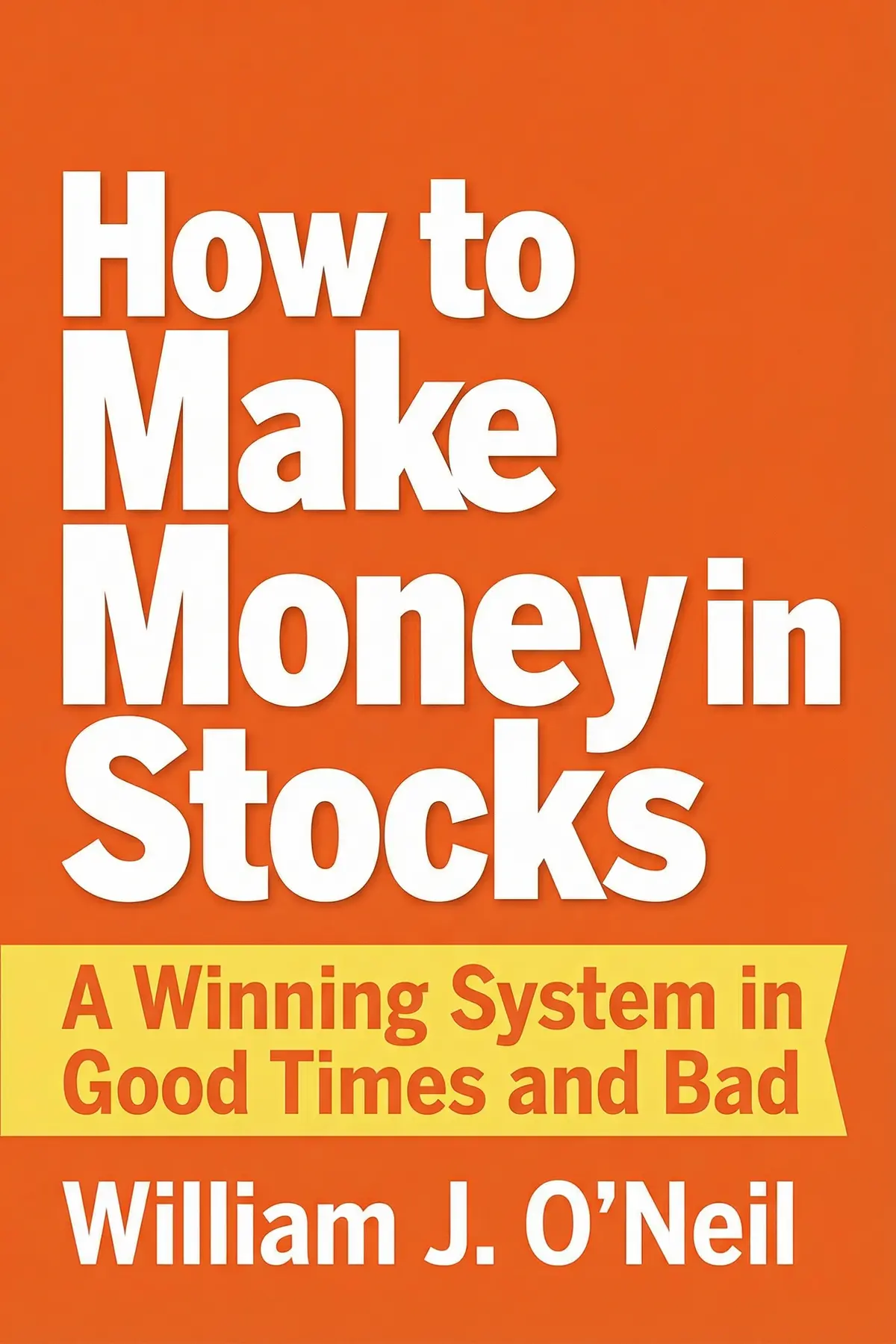
Table of Content
1. Introduction
59 sec
Most people who stay out of the stock market fear two things: buying a dud while other stocks soar, and watching a crash wipe out their savings. In How to Make Money in Stocks, William J. O’Neil, the stockbroker who founded Investor’s Business Daily, argues that history shrinks both fears, because the market’s biggest winners have looked strikingly alike just before their big climbs.
The same signs appear in a railroad stock of 1900 and in Apple a century later. O’Neil’s case is that you can learn them, buy strong companies at the right moment and step aside before small losses become large ones. His clues are concrete: fast-rising earnings per share, leadership in an industry, a new product, a tight supply of shares, buying by the best funds and a chart shape called the cup with handle. All of them depend on a healthy overall market. What you get is a checklist to run on any stock you hold or want, and a fixed number that tells you when to sell.
2. Spot the earnings jump that comes before the rise
1 min 46 sec
A famous name and an exciting story can still hide a poor investment. Two of the biggest stock runs of the 2000s had one thing in common just before they started, and it was not hype.
3. Back the number one company in its field
1 min 54 sec
Loyalty to a beloved brand feels safe, and it can cost you dearly. A bull market four decades ago showed what happens when investors stick with familiar giants while newcomers race ahead.
4. Buying at a new high can be smart
1 min 43 sec
Buy low, sell high is the oldest advice in investing. The record of the most inventive companies of the past century suggests that following it can mean missing the biggest gains entirely.
5. Use share counts and insider stakes to judge risk
1 min 42 sec
Two promising companies can react to the same wave of buyers in completely different ways. The difference lies in a number most investors never check, and in who holds the shares.
6. Follow the big funds, but check their work
1 min 37 sec
The largest investors move prices with every purchase, so riding along with them sounds like an easy win. One celebrated stock of the 1970s shows why their favorites can still let you down.
7. The chart shape that tells you when to buy
1 min 46 sec
A great company bought at the wrong moment can still lose you money. Doctors and geologists solve a similar problem by reading patterns, and one shape on a price chart has repeated for decades.
8. Protect your gains by watching the whole market
1 min 34 sec
In 2008, careful stock pickers lost money alongside careless ones. O’Neil explains what decided who survived, which daily signals hint at a turn, and the simple selling rule that keeps a mistake small.
9. Conclusion
1 min 09 sec
O’Neil’s method treats the market as a place with a memory. The stocks that soared from 1900, from 1990 and from 2004 showed features you could have seen in advance, and he bets that the next big winners will show them too. That turns stock picking from hope into detective work. You are looking for earnings that are jumping, a company leading its field with something new, a limited supply of shares, strong funds moving in and a chart that has finished its cup and handle, all while the broader market is rising.
The discipline matters as much as the clues. The dotcom crash and 2008 punished people who bought on excitement or held on out of habit. O’Neil’s answer is to check EPS growth before anything else, to compare a stock with its rivals and choose the leader, and to read the indexes every day instead of the forecasts. Most of all, decide your exit before you buy: 8 percent below your entry, treated as a rule.
Carnegie’s oyster belongs to whoever arrives first with real strength. The winners show their signs before they run, so be watching when they do, and step aside the moment you are wrong.
About this book
What is this book about?
Many people avoid the stock market because they fear a crash or fear backing the wrong company while better ones climb. William J. O'Neil, a stockbroker and the founder of Investor's Business Daily, argues that those fears can be managed by studying history. Across more than a century, the biggest winning stocks have shared recognizable traits before their big runs, and the losers have shown warning signs too. O'Neil builds a practical checklist from that record. He ranks growth in earnings per share above everything else, then looks for the leader in each industry, a genuinely new product, a limited supply of shares, managers who own stock and buying by the strongest mutual funds. A chart pattern he calls the cup with handle tells you when to buy, and the direction of the overall market tells you whether to buy at all. Readers get a clear way to judge any stock, examples from Northern Pacific and General Motors to Cisco, Google and Apple, and a firm selling rule designed to keep small losses from turning into large ones.
Book Information
Who it's for
Beginners wary of stocks
Beginner investors who avoid stocks because they fear a crash or a bad pick.
Professionals managing their portfolios
Professionals managing their own portfolio who want a clear checklist for choosing growth stocks.
Investors slow to sell
Active investors who buy well but hold losing positions far too long.
About the Author
William J. O'Neil
William J. O'Neil (1933 to 2023) was an American businessman, stockbroker and writer. He studied business at Southern Methodist University and served in the United States Air Force. In 1963 he set up the brokerage firm William O'Neil and Co., and he later started the financial newspaper Investor's Business Daily. He developed the CAN SLIM investment strategy, and he also wrote How to Make Money in Stocks.
Ratings & Reviews
Ratings at a glance
What people think
Listeners view this work as a required guide for investors, offering thorough explanations and actionable tips on stock market fundamentals. They appreciate the many chart samples that help clarify market patterns and see it as a foundational resource for value investing, with one listener reporting 15% returns on their investments. Although many find the logic straightforward, some listeners believe the material is too technical for newcomers.
Top reviews
Sam
Finally got around to reading this classic, and I wish I had done it years ago. While some people complain about the complexity, the visual examples of chart patterns like the 'cup and handle' are absolute gold for anyone trying to time their entries. I applied the CAN SLIM principles to my small portfolio over the last six months and have already seen a 14% return, which is incredible considering how volatile the market has been lately. You have to ignore the constant plugs for his newspaper, but the core philosophy of buying leaders rather than laggards is a game-changer. It is not a get-rich-quick scheme; it is a rigorous methodology that requires you to actually do the homework every weekend. If you are willing to put in the effort, this book provides the most comprehensive system available for navigating the stock market.
Show moreAmara
The chapter on market direction is worth the price of the book alone. Most investors focus only on what to buy, but O'Neil correctly emphasizes that the when is just as important, especially during market corrections. I used to be a pure value investor, always looking for 'cheap' stocks, but this book taught me that cheap stocks are often cheap for a reason. By switching my focus to momentum and institutional sponsorship, I have avoided several value traps that would have sunk my portfolio this year. It is definitely dense and requires multiple readings to fully grasp the nuances, but it is the most practical manual I have ever found. If you want to understand how the big players actually move money, this is your roadmap. Just don't expect it to be an easy weekend read.
Show moreSuthinee
Wow, this completely changed how I look at price charts. I used to think technical analysis was just a bunch of people seeing shapes in the clouds, but O'Neil explains the psychology behind the base patterns in a way that actually makes sense. It is not just about lines on a screen; it is about supply and demand among institutional players. Since reading this, I have become much more disciplined about my exit strategy, which has saved me a ton of money during recent downturns. Every serious trader needs a copy of this on their shelf, even if they only use half of the suggested techniques. The numerous charts are great for pattern recognition. This is easily one of the most essential books for anyone who wants to beat the market averages consistently.
Show moreWilliam
In my experience, most trading books are fluff, but this one is packed with actionable data. The emphasis on leading stocks helped me stop buying those laggards that look like a bargain but never actually recover. I particularly liked the advice on how to spot the top of a market cycle, as that is usually when most retail investors get crushed. Is it a bit of a sales pitch for his company? Sure. But when the advice actually works and helps you protect your capital, it is hard to complain too much about the marketing. This book is a must-read for value investors who want to learn when to actually pull the trigger. It offers a clear, unemotional method for determining exactly when to enter and exit a position, which is priceless.
Show moreNim
As a casual investor, I found O'Neil's approach both fascinating and a bit intimidating. The CAN SLIM mnemonic is easy enough to memorize, but applying it to real-time data requires a level of dedication that most hobbyists probably won't have. I really appreciated the sheer volume of graphs included in the text, as they help illustrate what a breakout actually looks like beyond just theoretical descriptions. My only real gripe is that the book feels like a giant funnel for his paid subscription services, which can be a bit distracting when you are just trying to learn. Still, the advice on cutting losses early at 7% or 8% is probably the most valuable lesson any trader can learn. It is a must-read for anyone looking for practical advice that goes beyond the usual index fund mantra.
Show moreVera
Pick this up if you are serious about active trading, but stay away if you just want to set it and forget it with index funds. The author's strategy is essentially a hybrid of fundamental and technical analysis, which provides a much more holistic view of the market than most books offer. I found the section on institutional sponsorship particularly enlightening, as it explains why some stocks move so much faster than others. There is a lot of jargon to wade through, and some of the advice regarding new management feels a bit dated now. Regardless, the core principles of seeking out high-growth leaders remain timeless in any economic cycle. To be fair, the book is quite long and could have been edited down by about a hundred pages, but the sample graphs remain essential learning material.
Show moreGift
Ever wonder why certain stocks take off while others just sit there despite having great products? This book answers that question by focusing on the 'S' and the 'M' of the CAN SLIM system—supply/demand and market direction. I appreciated the historical perspective, as O'Neil goes all the way back to the early 20th century to show that market psychology has not really changed that much. It is a bit of a slog to get through the middle sections, and the tone is a bit arrogant at times, but the information is undeniably useful. Just be prepared to spend a lot of time staring at tiny graphs until your eyes hurt. It is not exactly for rookies who are afraid of math or charts, but it is extremely rewarding for the diligent student.
Show moreMan
Truth is, the learning curve is steep and this isn't for the faint of heart. You won't become a master trader just by skimming these pages once; you really have to study the examples and then watch the market every day to see these principles in action. I found the 'N'—New product or service—to be a great way to filter through the noise of the thousands of stocks available. It is more of a textbook than a casual read, so don't expect to be entertained. However, if you're tired of losing money by following hot tips from social media, this provides a much-needed dose of reality. Personally, I think the technical rules are a bit rigid, but they provide a necessary structure that most retail investors desperately lack.
Show moreDimitri
While the technical strategies are sound, the writing style can be quite repetitive and overly promotional. It is clear that O'Neil knows his stuff, but he presents the CAN SLIM system as the only way to make money, which is objectively false if you look at the success of indexers. The book is heavily weighted toward his own successes, and I would have liked to see more discussion about the risks and common pitfalls when the patterns fail. It is a decent resource for learning how to read charts, but you have to filter out a lot of the marketing noise. To be fair, the section on annual earnings growth did help me refine my stock screener. It is a 5-star strategy trapped in a 2-star sales pitch, so it averages out to a 3 for me.
Show moreElla
Look, I wanted to like this book because of its legendary status, but it felt more like a 400-page advertisement for Investor's Business Daily than a helpful guide. O'Neil basically tells you that you cannot succeed unless you use his specific tools and data sets, which feels incredibly predatory toward beginners. The technical analysis sections are filled with cherry-picked historical charts that make his 'cup and handle' pattern look foolproof, but try finding those in real-time without his software. If you have a massive amount of capital and time to burn, maybe there is some value here, but for regular folks, you are better off seeing a professional broker. It lacks the intellectual depth of something like The Warren Buffett Way. Frankly, it is a tedious read that overcomplicates things just to sell you a subscription.
Show moreQuestions about this book
What is the main idea of How to Make Money in Stocks?
William J. O’Neil argues that the market’s biggest winners have shared the same traits before their big rises, so investors can learn from history. He looks for strong growth in earnings per share, industry leadership, a new product, a limited supply of shares and buying by top funds. He times purchases with a chart pattern called the cup with handle, buys only when the overall market is healthy and sells quickly when a stock falls.
What is the cup with handle pattern?
It is a price chart shape O’Neil considers one of the most important. After rising, a stock falls in a rounded curve and levels off into a flat base, which shows a solid group of believing investors. The price then climbs back up to form the cup’s other side and dips slightly, forming the handle. O’Neil says that dip is the moment to buy, and he traces the pattern from Sea Containers to Apple.
Why does O'Neil say earnings growth matters most?
Profitable businesses tend to see their shares rise, and the big winners showed it first. Google posted earnings gains of 112 and 123 percent before its stock climbed from $85 to $700, and Apple’s earnings rose 350 percent in the quarter before its run. During the dotcom crash, speculative firms without earnings fell hardest, while AOL and Yahoo!, which had real profits, suffered much less.
When should you sell a stock according to William O'Neil?
O’Neil gives a firm rule: sell when a stock falls 8 percent below the price you paid. Keeping losses small protects your money while you wait for big winners. He also stresses watching the overall market daily, since three out of four stocks fall when it falls. Stocks that keep opening high and closing low can signal a coming bear market.
Should you buy stocks that are already at a high price?
Often yes, in O’Neil’s view. He rejects the habit of buying only what looks cheap, arguing that truly inventive companies keep growing past forecasts. By 2000, Cisco had risen 75,000 percent from a 1990 level that was already a record peak, and research from Investor’s Business Daily showed that stocks reaching new highs in bull markets tend to keep reaching them. The key is buying once a solid base has formed.
Readers also enjoyed





Cashing Out: Win the Wealth Game by Walking Away
Julien Saunders
Charlie Munger: The Complete Investor
Tren Griffin
Big Mistakes: The Best Investors and Their Worst Investments
Michael Batnick
AUDIO SUMMARY AVAILABLE
Listen to How to Make Money in Stocks in 15 minutes
Get the key ideas from How to Make Money in Stocks by William J. O'Neil, plus 5,000+ more nonfiction titles.
- 5,000+ titles
- Listen as much as you want
- 7-day free trial
- Cancel anytime









