
14 min 12 sec
Available in: English
How to Find Fulfilling Work: The School of Life
Shows why money and status rarely make work satisfying, and how meaning, flow and freedom do. Offers practical ways to get past fear, test careers through small experiments and let a vocation grow over time.
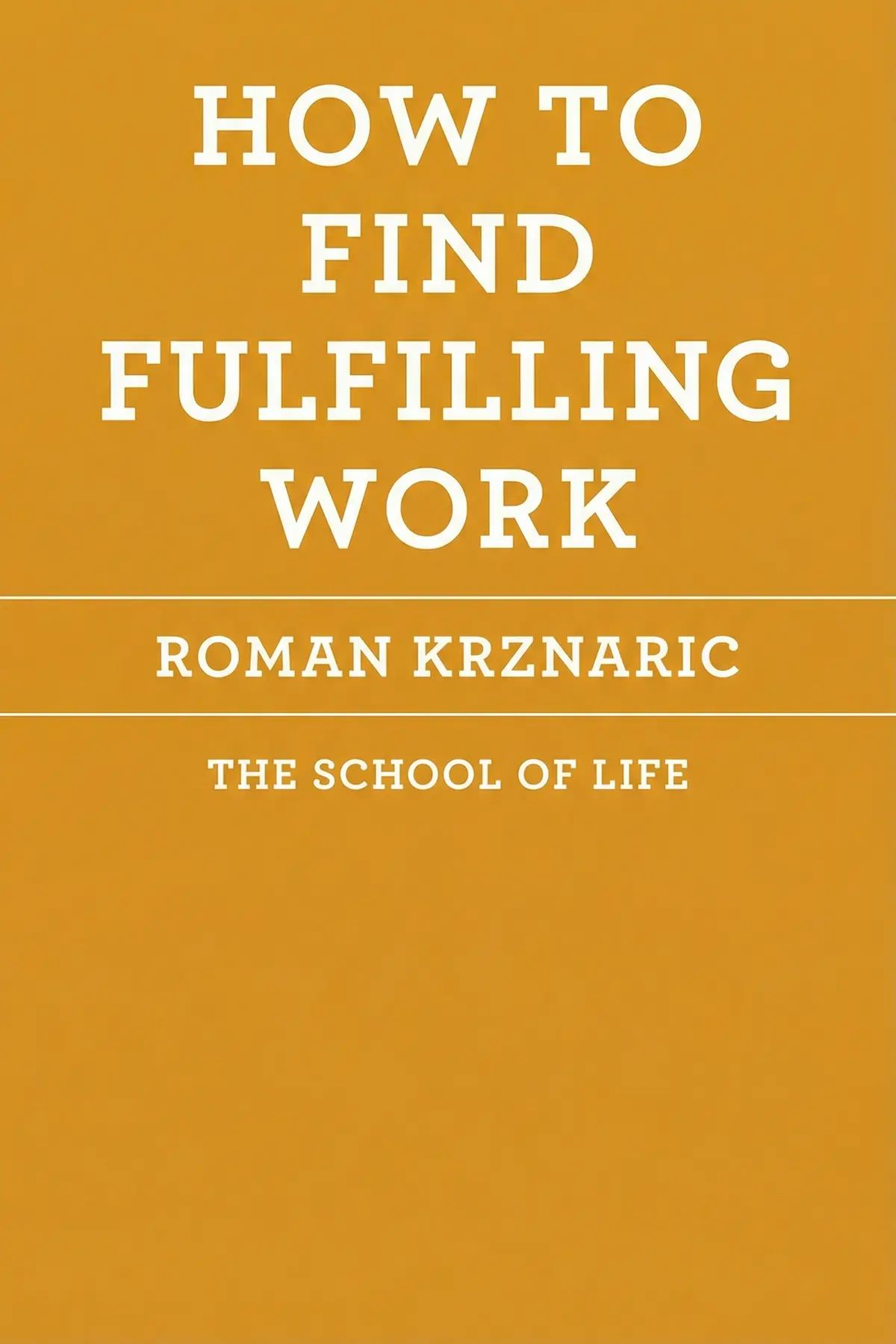
Table of Content
1. Introduction
1 min 05 sec
If your job pays the bills but leaves you counting the hours, you have plenty of company: at least half of workers in the Western world say they are unhappy at work. In How to Find Fulfilling Work, sociologist Roman Krznaric traces much of that unhappiness to a change in what we ask of a job. Our grandparents were mostly glad of a roof and food on the table. We want purpose, and a use for our passions and talents.
Krznaric does not tell anyone to lower their sights. His argument is that fulfilling work rests on three things, meaning, flow and freedom, and that the way to find it is to face your fear, test real options and let a vocation grow over time. Along the way come a boy whose father chose printing for him, a woman who tried 30 jobs in one year and a single father who became a beekeeper. By the end you will have a way to judge any job, and small experiments to run before you quit anything.
2. Understand why decent jobs feel empty and fix it
1 min 26 sec
Most people would pick a different career if they could start again, even with steady pay and a good title. Two forces our grandparents never faced help explain the restlessness, and naming them changes how you read your own.
3. Pick the regret you can live with
1 min 23 sec
Years of study and a lot of money can make a wrong career feel impossible to leave. Krznaric reframes the decision as a contest between two regrets, and research suggests one of them does far more damage.
4. Stop expecting raises and promotions to satisfy
1 min 23 sec
A bigger salary and a better title look like the obvious markers of a good career. Krznaric shows how both work like a moving staircase, and why climbing faster can leave you exactly where you started.
5. Do good work without giving up on business
1 min 28 sec
Wanting to make a difference often collides with the belief that ethics and profit cannot share a building. One founder built a company that challenged that belief from the very first day.
6. Follow the tasks that make time disappear
1 min 33 sec
Do what you love is easy advice and hard to act on, because most people cannot say what they love. Surgeons in the middle of difficult operations offer a clue about where to start looking.
7. Buy back freedom at work and at home
1 min 36 sec
Coming home drained, knowing tomorrow will look exactly the same, is the most common complaint about work. A study of self-employed workers and a beekeeping father suggest ways out, each with a price.
8. Test careers before you commit to one
1 min 34 sec
Career advisers love a detailed plan, yet plans built on paper tend to collapse on contact with real work. One woman in her late twenties tried a bolder method, and there are gentler versions for everyone else.
9. Let a vocation grow instead of waiting for it
1 min 30 sec
Many people expect their true calling to arrive in a single flash, or to turn up after enough searching. The early years of a penniless student in Paris suggest a very different and more hopeful picture.
10. Conclusion
1 min 14 sec
What Krznaric finally offers is permission to stop hunting for the one right answer. Franklin’s father found him a trade by walking the streets with him and watching people work, and that world is gone. Fulfilling work now gets assembled: from a sense that the work does some good, from hours that vanish in absorption, from enough freedom to shape your days, and from a vocation that deepens the longer you stay with it. Money and status pay the bills, yet they never finish the job.
The book closes on an exercise you could do this week. Draft a job ad for yourself. Lay out your qualities, passions and talents along with the bare minimum you need from your next job, but leave out any specific role. Mail it to ten people from very different walks of life, say a cartoonist and also a police officer, and invite each of them to propose three jobs that would fit you. While the replies come in, start a flow diary and plan one small trial.
Thirty suggestions from ten people will not decide for you. They give you thirty places to start, and a vocation begins wherever you start working.
About this book
What is this book about?
At least half of workers in the Western world say they are unhappy with their jobs, and many would choose another career if they could start over. Roman Krznaric argues that this is partly a sign of progress. Once basic needs are met, people want work that gives life meaning. Thousands of possible careers, early decisions that are hard to undo and a natural fear of loss make that kind of work hard to find. Krznaric, writing for The School of Life, sets money and status aside as weak sources of satisfaction. He builds fulfilling work from three ingredients instead: the sense that your work does some good, the absorbed state psychologists call flow, and enough freedom to shape your own time. His examples range from Anita Roddick's ethical business at The Body Shop to a woman who tried 30 jobs in one year. His method favors acting first and reflecting later. Readers get concrete tools to try: a flow diary, conversations with people in other jobs, weekend trials of a new career, a thought experiment about five parallel lives, and a job advertisement written for yourself and sent to ten friends.
Book Information
Who it's for
Graduates in unfulfilling jobs
Graduates a few years into a job that looks fine on paper but feels empty.
Professionals weighing career change
Professionals tied to a career they chose at eighteen and wondering whether to change.
Parents and side-project hopefuls
Parents and side-project dreamers trying to fit meaningful work, freedom and family into one life.
About the Author
Roman Krznaric
Roman Krznaric was born in Australia in 1970 and grew up in Sydney and Hong Kong. He holds a PhD in political sociology and has taught sociology and politics at Cambridge University and City University London. He was a senior research fellow at Oxford's Centre for Eudaimonia and Human Flourishing, and he is a research fellow of the Long Now Foundation and a member of the Club of Rome. His books include The Good Ancestor, How Should We Live? and History for Tomorrow.
Ratings & Reviews
Ratings at a glance

What people think
Listeners find this book to be an efficiently paced, high-quality listen that offers valuable perspectives and actionable tips for discovering satisfying employment. They enjoy its motivational quality; one listener points out its reflective and contemplative style, while another emphasizes the useful list of questions meant for self-assessment. The content earns praise for its concepts, with one listener highlighting its excellent experiments, and listeners appreciate how approachable it is, with one observing that it works for people of any age.
Top reviews
Luckana
Picked this up during a particularly bleak Tuesday at my corporate desk, and it felt like a total breath of fresh air. I’ve been feeling stuck in the same "money vs. happiness" loop for years, and Krznaric tackles this head-on without being preachy or unrealistic. I especially loved the concept of "radical sabbaticals"—the idea of actually testing out a new life rather than just daydreaming about it is truly revolutionary. Truthfully, the book is a quick read, but it's packed with meditative prompts that forced me to look at my skills through a completely different lens. I’m not quite ready to become a "Renaissance generalist" yet, but the "flow" state he describes is something I’m definitely missing in my current role. It is a wonderfully accessible guide for any age, providing a clear roadmap for anyone tired of the standard 9-to-5 grind. Highly recommended for the lost souls in cubicles.
Show moreTom
Ever wonder why you're staying in a job that drains your battery every single day? This book finally gave me the language to describe that feeling of being "enslaved" by a paycheck. Krznaric’s writing is incredibly accessible, making complex psychological barriers feel manageable. I was particularly moved by the stories of people who took huge risks to find meaning, even if it meant a steep pay cut. The "flow" concept is something I’m now actively looking for in my daily tasks. I loved the "wonderful experiments" suggested; they are practical ways to test the waters without quitting your job on a whim. It is a very introspective journey that doesn't just ask what you want to do, but who you want to be. This is easily one of the most inspiring things I've read this year. It gave me a much-needed push.
Show moreKae
The chapter on "radical sabbaticals" alone makes this worth the price of admission. It’s so easy to get caught in a loop of "I'll change careers when I have more money/time/experience," but Krznaric argues that action precedes clarity. I’ve already started implementing some of the "pointed questions" into my weekly journaling, and the results have been eye-opening. The book is incredibly well-written and serves as a great companion for anyone going through a mid-life or quarter-life crisis. I love how it treats work not just as a way to get paid, but as a giant issue of self-worth and contribution. It's an accessible, meditative, and ultimately very hopeful look at what it means to spend our time wisely. If you're looking for inspiration to finally make a change, start here. It’s a wonderful, life-affirming little book.
Show morePrapaiwan
Is it even possible to find a job that feels like a calling instead of a chore? Krznaric seems to think so, and his arguments are backed by some surprisingly deep psychological insights. This is a hallmark of The School of Life series—clear, thoroughly researched, and intellectually stimulating. I found the section on Marie Curie particularly inspiring because it frames career growth as a slow, deliberate evolution rather than an overnight miracle. Gotta say, the "bespoke career" idea really clicked for me. My only gripe is that it occasionally feels a bit too polished, perhaps lacking a certain raw "soul" you find in more personal memoirs. Still, the practical advice on navigating the fear of failure is worth its weight in gold. If you're feeling stagnant, these experiments will give you plenty to think about over your next coffee break.
Show moreFatou
After hearing a friend rave about this author for months, I finally decided to dive into this slim volume. Personally, I found the chapter on the history of work to be the most eye-opening part of the whole experience. We often forget that our modern obsession with "fulfillment" is a relatively new phenomenon. Krznaric is a gifted writer who balances historical context with a very modern, introspective approach. He includes these pointed questions throughout the text that actually make you put the book down and think. It’s not just a passive read. While I’m skeptical of the more "bohemian" career examples—like the screenwriting cellist—the core message about seeking "flow" and freedom is undeniable. It’s a well-written, meditative piece that helped me prioritize what I actually value in a workplace. Definitely a solid four-star read for the soul-searching professional.
Show moreWatcharaporn
This book doesn't hand you a magic solution on a silver platter, but it does ask the right questions to get you moving. I've been feeling like a QA tester when I really want to be a poet, and Krznaric perfectly captures that duality of self. The idea of the "secret you"—the hobbies and passions we hide from our coworkers—was a real lightbulb moment for me. In my experience, most career books are either too dry or too "woo-woo," but this one hits a nice middle ground. It’s introspective without being flaky. I particularly liked the section on creating a bespoke career through small, incremental changes rather than one giant leap. It’s a quick, insightful read that provides a much-needed perspective shift. Not every suggestion is a winner, but there’s enough wisdom here to make it worth the time.
Show moreFatima
Finally got around to reading this, and I have to say, the structure is brilliant. Each chapter feels like a mini-meditation on a different aspect of our working lives, from the history of the 9-to-5 to the psychology of choice. Not gonna lie, I was skeptical about the "School of Life" branding, but the research here is top-notch. The author pushes you to get out and interact with the world through these small experiments rather than just making lists in your room. I found the discussion on how failure is more potent than success to be especially grounding. It’s a quick, well-written book that provides practical advice for anyone feeling stuck. It might not solve your life's problems in 150 pages, but it will definitely point you in the right direction. A very solid, helpful guide for the modern worker.
Show moreNitaya
The truth is, some of the career examples provided here—like the "sculpting cellist" on a remote island—feel a bit like a pipe dream for those of us with actual mortgages. While Krznaric is a fantastic writer, I found his suggestions a little disconnected from the reality of corporate life. Look, the "puppy quote" from the sample reviews rings true here; you need money to buy the puppy! I appreciated the research and the clear structure, but the book feels a little clinical at times, almost like a very high-end textbook for life. However, I can't deny that the set of questions for self-reflection was helpful. It's a quick read that functions more as a philosophical nudge than a step-by-step manual. If you’re looking for a grit-and-grind guide, this might be too "School of Life" for you, but it’s still a decent starting point.
Show moreKai
To be fair, I expected a bit more tactical advice and a bit less philosophy. The book is undoubtedly well-written and provides some extremely satisfying solutions to the existential dread of work, but it leans heavily into the "money isn't everything" trope. As someone who has taken a pay cut for a "passion project" before, I know those radical sabbaticals can be incredibly expensive in the long run. I did enjoy the sections on being a Renaissance generalist, as it validated my desire to have multiple hobbies like bridge and poetry alongside my day job. It’s a meditative read that encourages you to act, but I wish it addressed the financial barriers to change with more empathy. It’s a good book for a weekend of reflection, just don’t expect it to write your resume for you.
Show moreNina
Not what I expected, as the advice seems geared toward people who already have enough money to stop worrying about bills. Frankly, I found the "money can’t buy happiness" arc a bit exhausting after a while. My reality involves paying rent and supporting a family, not becoming a "wide-achieving Renaissance generalist" on a whim. While the writing is clear and the School of Life aesthetic is nice, it lacks the grit of real-world career struggles. The examples of people quitting everything to become tai chi instructors or bar owners on tiny islands felt more like fiction than practical advice. It's a well-written book, sure, but it ignores the massive financial safety net required to take these "radical sabbaticals." If you're struggling to make ends meet, this will likely just frustrate you. It’s too cool for its own good.
Show moreQuestions about this book
What is the main idea of How to Find Fulfilling Work?
Roman Krznaric argues that people now expect work to give life meaning, not just pay. Money and status satisfy only up to a point. Fulfillment comes from three ingredients: the sense that your work does some good, flow experiences of deep absorption, and freedom over your time. The way to find such work is to test real options and let a vocation grow, not to plan everything in advance.
Why are so many people unhappy with their jobs, according to Krznaric?
He points to rising expectations and too many options. At least half of Western workers are unhappy, and a European survey found 60 percent would pick another career. Once basic needs are met, people want purpose. Meanwhile one careers website lists around 12,000 careers, and, drawing on Barry Schwartz, Krznaric notes that too much choice can paralyze people and leave them doubting whatever they decide.
How can I find out what kind of work gives me flow?
Krznaric suggests two methods. Keep a flow diary, noting the moments when you were so absorbed that time seemed to vanish, whether writing a report or cooking for guests. And do conversational research: ask people about their jobs, specifically whether and when they experience flow. Both help you spot patterns that point toward work where you can use your full potential.
How do you change careers without quitting your job?
Krznaric favors acting first and reflecting later. Besides a full radical sabbatical, like Laura van Bouchet’s 30 jobs in a year, he describes temporary assignments: trying new work on the side, such as teaching yoga on weekends, and growing it before leaving your job. Conversational research, asking people to describe their daily work, is a lighter test still.
Who should read How to Find Fulfilling Work?
It suits people who feel stuck in work that pays but does not fulfill them, especially those who chose a field young and now doubt it. It also helps anyone weighing self-employment or a shorter week, and parents trying to balance career and family. Its tools are practical, from a flow diary to a self-written job advertisement sent to ten varied friends.
Readers also enjoyed


60 Seconds & You’re Hired!
Robin Ryan



Be A Free Range Human: Escape the 9 to 5, Create a Life You Love,
Marianne Cantwell
Be the Unicorn: 12 Data-Driven Habits That Separate the Best Leaders from the
William Vanderbloemen
AUDIO SUMMARY AVAILABLE
Listen to How to Find Fulfilling Work in 15 minutes
Get the key ideas from How to Find Fulfilling Work by Roman Krznaric, plus 5,000+ more nonfiction titles.
- 5,000+ titles
- Listen as much as you want
- 7-day free trial
- Cancel anytime









