

15 min 52 sec
Available in: English
How to Be an Anticapitalist in the 21st Century
A clear case for moving beyond capitalism without repeating Soviet mistakes. Wright judges the system by shared values and shows how cooperatives, public services and basic income could gradually build a democratic alternative.
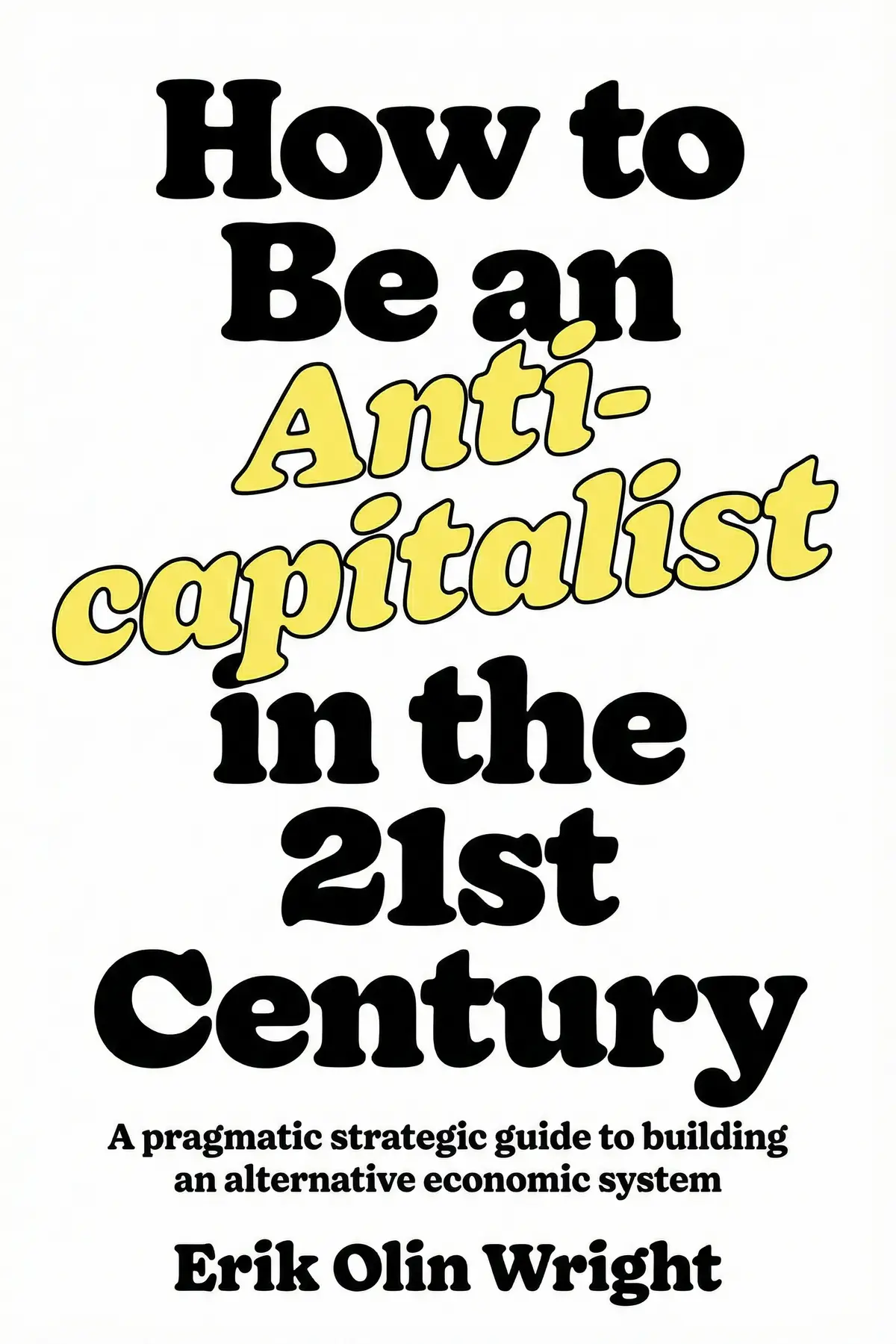
Table of Content
1. Introduction
1 min 04 sec
Capitalism may leave you uneasy while the collapse of Soviet communism makes every alternative sound naive. Erik Olin Wright stakes out a third position. In How to Be an Anticapitalist in the 21st Century, the sociologist argues that capitalism has never existed in pure form. It already holds pieces of the economy that could replace it, from worker cooperatives to public libraries.
Wright wrote the book to make Analytical Marxism, a school that blends history, economics, sociology and philosophy, readable for anyone, and he died of leukemia shortly after finishing it. His argument runs like this: capitalism fails values most people share, and the way beyond it is to grow the democratic alternatives already among us, inside markets and with help from the state, until they outweigh it. Along the way he offers a method for arguing about economics from shared values, a clean line between socialism and state control, and four strategies built to work in combination.
2. Weigh both sides of capitalism's scorecard
1 min 52 sec
Capitalism’s defenders can point to washing machines, longer lives and booming productivity. Wright accepts all of it, then asks one quiet question about those gains that turns the whole debate around.
3. Learn why class interest alone falls short
1 min 54 sec
Marx expected workers to rise up out of pure self-interest once they saw the facts. Wright explains why that prediction misreads most people living in rich countries today, including many who would call themselves workers.
4. Reach people through the values they already hold
1 min 56 sec
One of history’s most famous anticapitalists was the son of a wealthy factory owner. His story reveals two forces that move people more strongly than money, and how a movement can speak to both.
5. Judge any economy with three pairs of values
1 min 59 sec
Pointing out that poverty exists is not yet an argument against anything. Wright supplies the missing yardstick, then holds capitalism up against it, including inside the place where most of us spend our working days.
6. Tell democratic socialism apart from the Soviet model
2 min 00 sec
For many skeptics, socialism means the Soviet Union, with its oppressive rule and an economy that failed. Wright draws a sharp line that separates three systems by who holds power and how they use it, and the market survives.
7. Spot the alternative already growing around you
2 min 00 sec
Feudal kings once seemed permanent, until a scattered group working in the margins outgrew them. Wright sees the same pattern starting again, in organizations you may pass every day without noticing.
8. Combine four strategies instead of one revolution
1 min 52 sec
The old plan was to smash the system in a single blow, and the twentieth century showed where that led. Wright replaces it with a mix of approaches, including a Swedish proposal that left-wing politicians tried to carry out in the 1970s.
9. Conclusion
1 min 15 sec
Wright’s book changes the shape of the question. The usual debate offers two choices, capitalism or a failed Soviet past. Wright replaces that with three kinds of power: money that bribes, a state that coerces, and people who persuade one another and vote. Every real economy mixes all three. The political question is which one grows.
That view also changes how to talk about economics. Appeals to class alone leave most people on the fence, because their interests pull both ways. Appeals to equality, democracy and community reach further, and they link economic concerns to struggles over race, gender and identity that matter to people just as much.
Some of this can start now. Test the institutions in your life, your workplace included, for access, voice and mutual concern. When an argument about economics heats up, grant the real gains first, then ask who receives them. And notice the cooperatives, participatory budgets and public libraries around you, because in Wright’s account they play the part the merchant stalls once played under feudalism.
Feudalism also looked permanent, until the people working in its cracks outgrew it.
About this book
What is this book about?
Since the 2008 financial crisis, movements from Occupy Wall Street to Podemos and Syriza have claimed that capitalism can be replaced. Skeptics answer that the twentieth century already tried, and failed. Sociologist Erik Olin Wright takes both sides seriously and argues that a better system is possible and worth wanting. His starting point breaks with classical Marxism. Most people today hold mixed class positions, with reasons both to defend and to oppose capitalism, so appeals to class interest leave them on the fence. Wright builds his argument on three pairs of values instead: equality and fairness, democracy and freedom, community and solidarity. Measured against them, capitalism falls short. He then separates democratic socialism from the Soviet model, which he calls statism, and shows that markets can survive in a socialist economy. The most hopeful part of the book is its strategy. Every real economy is already a mix, Wright argues, and just as merchants once grew in the cracks of feudalism, worker cooperatives, participatory budgets and public services can grow until they outweigh capitalism. Readers come away with a vocabulary for economic debate and four strategies that work together.
Book Information
Who it's for
Uneasy about capitalism
Professionals uneasy about capitalism who want a serious alternative, not a slogan.
Organizers, unionists, co-op founders
Organizers, union members and cooperative founders looking for a long-term strategy.
Politics and economics students
Students of politics and economics who want Marxist ideas updated for mixed modern economies.
About the Author
Erik Olin Wright
Erik Olin Wright was a sociologist at the University of Wisconsin–Madison and a leading figure in Analytical Marxism, which sought to connect classical Marxism with modern social science. Born in Berkeley, California, in 1947, he earned his doctorate at the University of California, Berkeley, in 1976 and served as president of the American Sociological Association in 2012. His research focused on social class, and his ten books include Envisioning Real Utopias and Understanding Class. He died in 2019.
Ratings & Reviews
Ratings at a glance
What people think
Listeners find this work to be an easy-to-understand and transparent introduction for those exploring alternative economic structures, even if opinions are mixed on the author’s integration of market features and his move away from standard revolutionary strategies. A large number of listeners value the logically organized look at modern capitalism's defects, calling the narrative style composed, logical, and intellectually stimulating. Additionally, they see the "eroding capitalism" concept as an uplifting and positive model for societal evolution. They also highlight how well the book's practical metaphors work, as one listener points out that the discussion of public libraries offers a touching example of anticapitalist ideals that are already functioning.
Top reviews
Carlos
Finally got around to reading Wright's last work, and it left me feeling surprisingly optimistic. He moves away from the violent rhetoric of "smashing" the system and instead proposes a strategy of "eroding" it. It's a much more grounded way of looking at things. I loved the section on public libraries; it’s a brilliant real-world analogy for how we already have successful non-market institutions functioning right under our noses. The prose is incredibly calm and reasonable, which makes the radical suggestions feel like simple common sense. It's heartbreaking to think he passed away before expanding this into a larger volume. For anyone tired of the typical doom-and-gloom leftist theory, this is a necessary read. It provides a hopeful framework that doesn't rely on a singular revolutionary break. The clarity here is unmatched.
Show moreVilaiporn
Wow, Wright really managed to make radical ideas feel common-sense in this pithy little volume. He argues for "democratizing democracy," which is such a powerful way to frame the struggle against elite control. The way he breaks down libraries as existing anticapitalist institutions was an "aha!" moment for me. We often think socialism is some alien concept, but he shows how we’re already living parts of it every day. The tone is gentle and inviting, never condescending or overly academic. It’s tragic that we lost such a clear-headed thinker just as he was refining these "real utopias." This book should be required reading for anyone who feels that the current system is broken but doesn't know where to start looking for a way out. It’s a beautiful, final gift to the movement. Extremely clear and broken down perfectly.
Show morePenelope
There’s a profound sadness in these pages knowing it’s a posthumous release. You can feel Wright’s urgency to communicate his vision of a more humane world. He masterfully blends top-down state strategies with bottom-up grassroots activism, arguing that we need both to actually succeed. The book doesn't just complain about capitalism’s flaws; it actually tries to build a bridge to what comes next. His "eroding" strategy feels much more feasible in the 21st century than a 1917-style insurrection. Personally, I found the section on Universal Basic Income and its potential to change capital-labor relations to be the most compelling argument in the book. It’s a thin volume, but it packs a serious intellectual punch. It makes the prospect of a post-capitalist world feel like a project we can actually participate in today. Highly recommend for the clarity alone.
Show moreEmma
The concept of "eroding" capitalism as an ecosystem is what stuck with me most after finishing this. Wright doesn't treat the economy as a monolith but as a habitat where different species of economic activity—like co-ops and state-funded services—can eventually outcompete the predatory capitalist ones. Truth is, I was skeptical about his inclusion of market elements at first, but his "no-bullshit" approach won me over by being so practical. The book is well-structured and moves quickly through different strategies like taming, resisting, and escaping. Some chapters feel slightly truncated, likely because he was finishing this while battling cancer, but the core message remains powerful. It’s a great primer for anyone who wants to see past the "there is no alternative" mantra. It makes the transition to a democratic socialist future feel achievable rather than just a pipe dream.
Show moreNutnicha
As someone who finds traditional Marxist jargon impenetrable, this was a breath of fresh air. Wright explains complex ideas without falling back on "seizing the means of production" every five seconds. I found the distinction between the "99%" and the actual working class very insightful. He acknowledges that our lives are fragmented now, making old-school organizing much harder. My favorite part was the "eroding" strategy—using things like Universal Basic Income to shift the power balance between labor and capital. It’s a pragmatic, hopeful vision for social change. Look, it’s not a perfect manual, and some of his concessions to markets will annoy the radicals, but it’s the most readable book on the subject I’ve found in years. It’s more about the "how" than just the "why," which I appreciate.
Show morePaiboon
After hearing about his "real utopias" for years, this feels like a concise summary of his life's work. I love how he uses the library as a proof of concept for an egalitarian economy. It shows that we don't have to start from scratch. His rejection of traditional revolutionary tactics is controversial, but his argument that they lead to "brutal regimes" is hard to ignore. Wright is looking for a path that preserves democracy while dismantling the dominance of profit. The writing style is incredibly accessible; he really succeeded in writing for a non-academic audience. I do wish there were more footnotes for further reading, but for a 150-page booklet, it covers a surprising amount of ground. It’s a calm, thought-provoking defense of a better world. Essential for anyone interested in the Scandinavian model or similar social democratic reforms.
Show moreNim
Ever wonder why libraries are so beloved yet so "un-capitalist" in nature? Wright uses them as a starting point to explain how we can expand non-market logic into other parts of our lives. It’s a brilliant way to ground the theory. I gotta say, his analysis of capitalism's modern flaws is spot on, especially how it creates "fragmented class structures." The book is structured like a conversation, which makes the radical content much easier to digest. While some might find his "taming" and "resisting" categories a bit too reformist, he makes a strong case for why a "mixed economy" is a necessary stepping stone. It’s a very hopeful read that rejects unhelpful dichotomies. A solid four-star guide for anyone interested in the future of the left. It avoids reductive oversimplification while remaining totally accessible.
Show moreLaor
Is it a masterpiece or just a really good syllabus? Wright’s final book works best as a survey of modern thought, but I found myself wanting more depth in several areas. He lists these five methods of overcoming capitalism—smashing, dismantling, taming, resisting, and escaping—which is a helpful taxonomy, but the analysis of why revolution failed felt a bit shallow. Frankly, it reads like he was in a hurry to get his thoughts down, which is understandable given the circumstances of his health. While the library analogy is poignant, I'm not convinced that "eroding" capitalism from within is enough to stop the massive accumulation of power we see in big tech today. No co-op is going to compete Google out of existence. It’s a useful introductory text for a student, but seasoned Marxists might find the lack of a class-struggle focus frustrating.
Show moreSupachai
To be fair, I appreciate the optimism even if I can't quite get behind the market elements Wright insists on keeping. He tries to bridge the gap between social democracy and full-blown socialism, but the result feels a bit like a "light" version of the real thing. He admits himself that he’s taking a "no-bullshit" approach, yet he avoids some of the harder questions about how the ruling class would actually react to being "eroded" out of existence. Do we really think the billionaires will just let us build co-ops until they disappear? The chapter on state power was interesting but felt unfinished. Still, the structure is excellent and it’s a very quick read for a train commute. It’s a decent introductory text, though you’ll want to pair it with something more rigorous if you want to understand the deeper mechanics of global exploitation.
Show morePiyanart
I'm genuinely baffled by the praise for this book. Calling this "anticapitalist" feels like total false advertising when the author goes out of his way to defend markets and wage labor. Wright dismisses the possibility of a revolutionary break almost immediately, opting instead for a reformist social democracy that has historically failed to address the core contradictions of capital. He relies on abstract moral guidelines like fairness and solidarity rather than a rigorous materialist analysis. If you're looking for an actual critique of capitalism, read Silvia Federici or Nancy Fraser instead. This book is symptomatic of a Western left that has lost its way and is now trying to make its peace with the status quo. To be fair, the writing is clear, but that only makes the flawed premises more obvious. It’s basically a distillation of everything wrong with mainstream liberalism.
Show moreQuestions about this book
What is the main idea of How to Be an Anticapitalist in the 21st Century?
Erik Olin Wright argues that capitalism fails three pairs of widely shared values: equality and fairness, democracy and freedom, community and solidarity. He proposes democratic socialism, in which ordinary people make economic decisions through democratic associations such as worker cooperatives. Instead of a revolution, he describes a gradual erosion of capitalism, growing democratic alternatives that already exist until they outweigh it.
Does Erik Olin Wright think the Soviet Union was socialist?
No. Wright calls the Soviet system statism, an economy run by politicians and bureaucrats who rely on coercion, meaning rules enforced by punishment. Democratic socialism differs because decisions rest with ordinary people organized democratically, who use social power, persuading one another and voting, as members of a worker cooperative do when they decide whether to expand.
Can democratic socialism keep a market economy?
Wright says yes. He treats a market as a way of coordinating economic activity without central planning, through prices, voluntary exchange and supply and demand. State and worker-owned firms already trade in today’s markets. Under democratic socialism they would keep doing so, with worker-owned enterprises matching or outnumbering capitalist and state-owned ones, helped by public banks, training programs and a universal basic income.
What are Wright's four strategies against capitalism?
Taming reduces capitalism’s harms, for example through a universal basic income. Resisting fights its damaging tendencies, as labor unions do against low pay. Escaping builds non-capitalist ways of working, such as worker cooperatives. Dismantling gradually replaces capitalist structures, as Sweden’s Meidner Plan in the 1970s would have shifted corporate ownership to labor unions. Wright calls the combination eroding capitalism.
Why does Wright say class interest is not enough to win people over?
Modern class structure is fragmented. Skills, pay and autonomy vary widely among people such as a grocery clerk, an office manager and a creative professional, and Wright says most occupy contradictory class locations, with reasons both to back and to resist capitalism. So he argues that anticapitalists must appeal to shared moral values and to people’s wider identities, such as race and gender.
Readers also enjoyed









AUDIO SUMMARY AVAILABLE
Listen to How to Be an Anticapitalist in the 21st Century in 15 minutes
Get the key ideas from How to Be an Anticapitalist in the 21st Century by Erik Olin Wright, plus 5,000+ more nonfiction titles.
- 5,000+ titles
- Listen as much as you want
- 7-day free trial
- Cancel anytime









