

15 min 02 sec
Available in: English
 ไทย
EnglishไทยHow Children Succeed: Grit, Curiosity, and the Hidden Power of Character
By Paul Tough
Shows why grit, self-control, curiosity and optimism shape a child's future alongside early academics, how chronic childhood stress undermines them, and how attentive adults, schools and honest work on mistakes can build them.
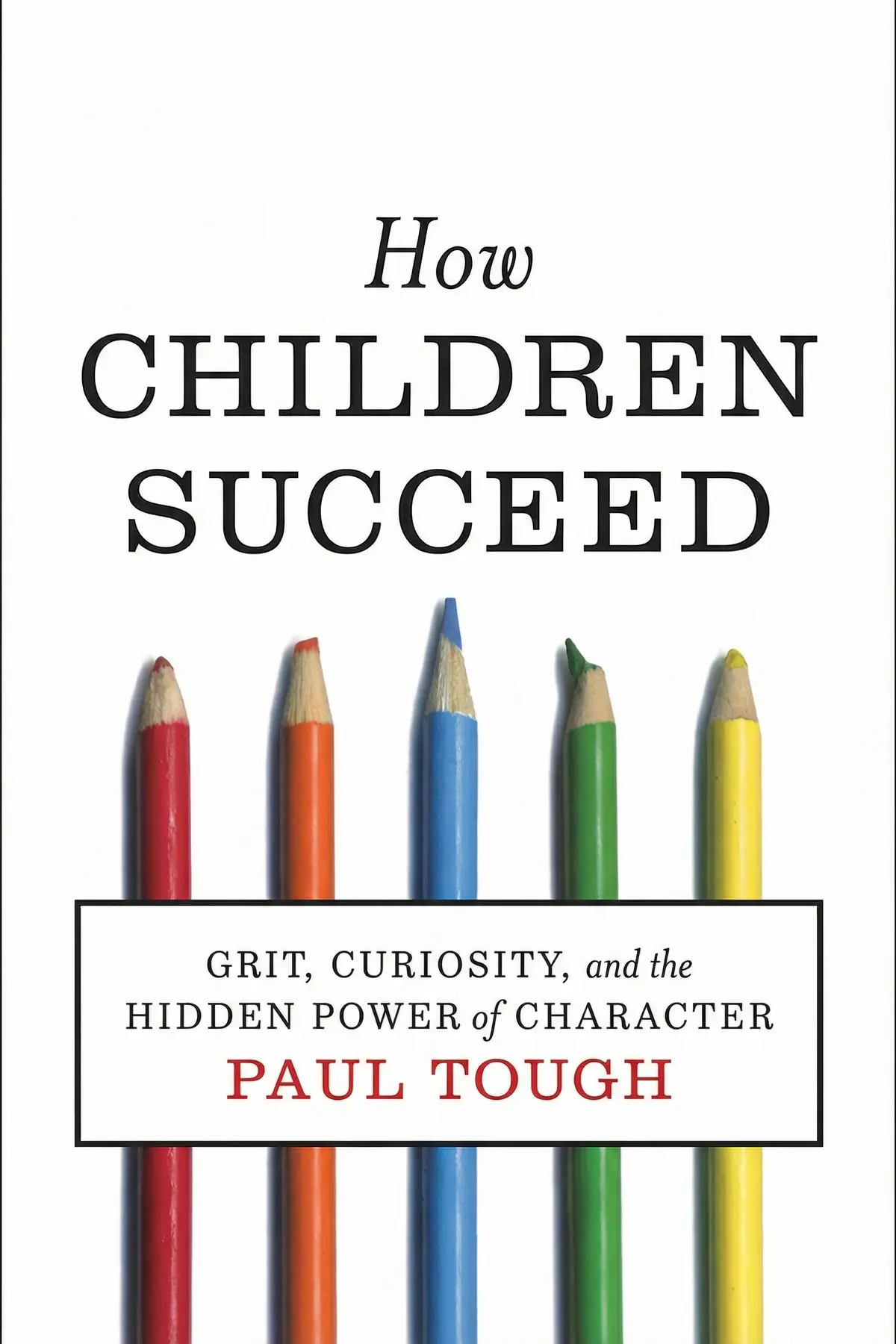
Table of Content
1. Introduction
1 min 10 sec
A shelf of flash cards and baby genius videos promises a brighter child, but some of the skills that best predict a good life are ones no video can train. In How Children Succeed, journalist Paul Tough argues that perseverance, self-control, curiosity and optimism shape a child’s future in ways early drilling in numbers and letters cannot replace. Those qualities are usually called character, and Tough’s case is that they can be shaped.
His argument has two halves. Stress and trauma in childhood wear down the very capacities a child needs, while warm, attentive adults can shield them. And character grows when children are allowed to struggle, fail and learn from their mistakes, instead of being protected from every setback.
The evidence runs from a juvenile detention center to a marshmallow left on a table, a New York chess team and a school that prints a character score beside its grades. Anyone who raises, teaches or manages young people will finish with a sharper sense of where to put their effort.
2. A hard childhood echoes for decades, so learn the signs
2 min 10 sec
A simple questionnaire about childhood trauma turns out to be linked with trouble in class, juvenile delinquency and even heart disease in adulthood. The reason sits in a body system built for a very different world.
3. Calm a child's stress with steady attention
1 min 41 sec
Researchers could measure stress in children’s bodies, and in some tough environments it was almost absent. The difference came from one source, and parents who lack it can still learn it.
4. Look past IQ to the skills that last
1 min 44 sec
Children from one prestigious preschool lost their IQ head start within a few years, yet still outperformed their peers decades later. Something else the school gave them kept paying off into their forties.
5. Bet on grit, diligence and self-control
1 min 44 sec
A boring number task given to teenagers predicted who would do well with money years later. It belongs to a set of three traits that can outperform raw intelligence as a guide to the future.
6. Teach character with habits children can name
1 min 56 sec
Most of one school’s students made it through high school, yet only about one in five finished college. The ones who did were not its best students, and that discovery changed how the school taught.
7. Spare comfortable kids the fear of failing
1 min 37 sec
Wealth buys tutors, safety and every advantage, yet affluent teenagers show more anxiety and substance abuse than their peers. Two common parenting habits explain it, and the effects show up in career choices years later.
8. Turn a child's mistakes into lessons
1 min 45 sec
A public school in a poor neighborhood built one of the strongest chess programs around by dwelling on its players’ worst moves. The same habit, applied to everyday setbacks, decides whether failure teaches or wounds.
9. Conclusion
1 min 15 sec
Tough moves the question of a child’s future away from what they know and toward who they become under pressure. Stress can erode a young person’s self-control from the inside, and warm, attentive adults can hold that erosion back. The traits that carry children forward, grit, diligence and the ability to wait, are not fixed at birth. Schools like KIPP make them visible and measured, and teachers like Elizabeth Spiegel turn losses into lessons. The dangers at the two ends of the income scale tend to look different: children facing too much stress, or children shielded from every failure.
For anyone who raises, teaches or manages young people, the book supports a few plain moves. Be the steady base a child returns to after a hard day. Name the character strengths you want to see and notice them as often as grades. When a mistake happens, walk through it together and ask what would work better next time.
And listen to how the mistake gets explained. Described as personal, permanent and pervasive, a failure becomes a verdict. Described as specific and temporary, it becomes the next move on the board.
About this book
What is this book about?
Many parents pour money into educational toys and videos, convinced that early mental stimulation is the surest route to a successful child. Paul Tough argues that this bet misses half the picture. Cognitive skills matter, but so do traits usually called character: perseverance, conscientiousness, self-discipline, curiosity and optimism. Tough follows both sides of the story. He shows how trauma and chronic stress wear down a young person's capacity for self-control, with effects that reach into adult health, and how warm, attentive parenting can block much of that damage. He then turns to the evidence that character predicts success, from a grit questionnaire for college students to the famous marshmallow experiment, and to schools trying to teach it, including KIPP in New York and a chess program in a poor neighborhood that treats every loss as a lesson. Readers get a clear account of what helps children thrive, why both neglect and overprotection backfire, and practical ways to help a child, or anyone, learn from failure instead of being defined by it.
Book Information
Who it's for
Parents eyeing educational toys
Parents tempted by educational toys who want to know what really predicts a child's success.
Educators and coaches
Teachers, coaches and school leaders looking for practical ways to build grit, self-control and optimism.
Bosses and mentors
Managers and mentors who want young people to learn from failure instead of fearing it.
About the Author
Paul Tough
Paul Tough, born in Toronto in 1967, is a contributing writer for the New York Times Magazine whose work has also appeared in the New Yorker, the Atlantic and GQ. How Children Succeed has been translated into 27 languages and spent over a year on New York Times best-seller lists. He also wrote Whatever It Takes and The Inequality Machine, worked as an editor at the New York Times Magazine and Harper's Magazine and as a reporter and producer for This American Life, and speaks on education, parenting, equity and student success.
Ratings & Reviews
Ratings at a glance
What people think
Listeners find this book exceptionally clear and readable, loaded with applicable research that distills complicated theories into straightforward ideas. They prize its instructional significance, specifically how it guides teachers and parents toward understanding the roots of student success, and they describe the content as deeply moving and insightful. The work earns praise for its use of narrative, mixing student accomplishments with vivid real-life anecdotes, and for its focus on cultivating character by identifying 24 key character skills that adults can help develop in children.
Top reviews
Scarlett
This book completely reframed how I think about child development and the American education system. Paul Tough argues convincingly that our obsession with IQ and cognitive testing is missing the mark. Instead, he points toward 'non-cognitive' traits like grit, curiosity, and self-control as the real predictors of long-term success. The storytelling is incredibly moving; I found myself tearing up at some of the anecdotes about kids overcoming immense trauma through the help of dedicated mentors. To be fair, some might find the 'brain science' sections a bit dense, but Tough does a great job translating complex neuroscience into something accessible for the average parent. It’s an inspiring look at how character isn't just something you're born with, but a set of skills that can be nurtured and taught. If you’re an educator or a parent, this is essential reading. It really challenges the status quo of how we define a 'successful' student.
Show moreCharles
Picked this up after seeing it on every 'must-read' list for teachers, and it lived up to the reputation. The way Tough interweaves the stories of individual students with neurobiological research is masterful. It helps you understand the 'why' behind student behavior, particularly for those coming from high-stress backgrounds. The focus on character skills—like zest, gratitude, and self-control—provides a much more holistic view of education than the standard curriculum. I’ve already started implementing some of the ideas about 'malleable intelligence' in my own classroom. Truth is, we've focused on the wrong metrics for far too long. This book provides a necessary corrective, emphasizing that persistence is a skill that can be coached. It’s enlightening, packed with relevant research, and surprisingly easy to digest given the complexity of the subject matter. Highly recommended for anyone who works with youth.
Show moreLaor
Not what I expected at all, but in a good way. I thought this was going to be a dry academic text, but it's actually a series of rich stories that happen to be backed by cutting-edge science. The way it explains the link between early childhood trauma and later academic failure is a revelation. It shifts the blame away from 'lazy' kids and puts the focus on their physiological responses to stress. This is an inspiring and empowering book for parents because it suggests that we can actually shape our children’s character through the way we respond to their challenges. It’s not just about what’s in their DNA. The insights into the 24 key character skills are incredibly practical. Even if you don't agree with every conclusion Tough reaches, the book will absolutely change the way you look at every child you meet. A truly powerful and educational piece of work.
Show moreRome
Why do some children from disadvantaged backgrounds thrive while others fall behind? Tough explores this question by looking at everything from the physiological effects of cortisol to the intensity of high-stakes middle school chess. The chapter on Elizabeth Spiegel’s chess program was easily the highlight for me, showing how learning to manage failure is more important than the game itself. My only real gripe is that the book sometimes feels like a collection of magazine articles rather than a cohesive thesis. He bounces from KIPP schools to private academies like Riverdale without always bridging the gap perfectly. Still, the core message about 'performance character' is powerful. It’s a thought-provoking read that suggests our current policy of 'testing everything' is fundamentally broken. I appreciated the honesty regarding how difficult it is to move the needle for kids in high-stress environments. Definitely worth your time.
Show moreRungtip
Wow, Paul Tough really digs into the 'hidden' factors that keep kids from reaching their potential. I was particularly struck by the discussion on how 'helicopter parenting' in wealthy communities like Riverdale actually hinders character development by protecting kids from the very failures they need to experience. On the flip side, the description of how poverty-induced stress literally re-wires a child's brain was eye-opening and heartbreaking. The writing is lively and the pacing is excellent, making what could be dry social science feel like a compelling narrative. I do think he leans a bit too heavily on the 'grit' narrative without fully addressing the systemic barriers that grit alone can't overcome. However, the book succeeds in making the reader rethink the entire concept of intelligence. It’s a great choice for a book club because there is so much to debate regarding the role of the family versus the role of the school.
Show morePruet
To be fair, I went into this thinking it would be another 'pull yourself up by your bootstraps' manual, but it’s much more nuanced than that. Tough acknowledges that while character matters, the environment plays a massive role in whether those traits can even develop. He highlights the OneGoal program in Chicago, which was fascinating to read about. My main critique is that he focuses almost exclusively on the extremes—either the very poor or the very rich—leaving the middle class largely out of the equation. Also, his definition of 'success' is very tied to the American class structure and upward mobility. Despite that, the book is incredibly well-researched and converts complex psychological theories into simple, actionable concepts. It makes you realize that being a 'good' student involves a lot more than just being smart. It’s about how you handle the moments when things go wrong.
Show moreSaranya
After hearing a lot of hype, I finally dived in and found Tough’s exploration of the 'character' gap to be genuinely enlightening. The writing style is unpretentious and honest, which makes the stories of the kids he follows feel authentic rather than exploitative. I liked the comparison between the KIPP model and more traditional approaches. It’s clear that character development isn’t just about being a 'nice person,' but about building the internal tools to navigate a difficult world. Personally, I would have liked to see more follow-up on the students after they finished college to see if these traits actually translated into career success. As it stands, the book stops right at the finish line of graduation. Nevertheless, it is a very readable and important contribution to the debate on how we fix our schools. It's a solid 4-star read for its ability to make social science feel personal.
Show moreOoi
The chapter on chess was the most engaging part of the book, but I struggled with the rest of the narrative. Frankly, the title 'How Children Succeed' feels like a bit of a misnomer because Tough never actually defines what success looks like beyond graduating from a four-year university. Is a kid who skips college but starts a small business a failure? The book doesn't say. I also found the constant use of the word 'non-cognitive' to describe things like persistence and optimism quite annoying—aren't those mental processes too? While the research on early childhood trauma and its impact on the brain is fascinating, the book offers very few concrete policy solutions for people who aren't in experimental charter programs. It’s an interesting starting point for a conversation about income inequality, but it leaves a lot of questions unanswered. It felt a bit repetitive by the final third.
Show moreZoey
Look, we've been told for decades that IQ is everything, so I appreciate the attempt to change the subject to 'character.' However, this book feels a bit lopsided. Tough spends hundreds of pages talking about grit and conscientiousness but barely touches on the importance of actual content knowledge. You can have all the grit in the world, but if you can't read at grade level, you're going to struggle. The sections on brain science and cortisol are great, yet the transition to policy implications feels a bit weak. It’s a collection of interesting ideas that don't quite add up to a unified theory. The chess section was the highlight for me, but it also highlighted the book's problem: the boy who was a chess genius still struggled with basic academics. It left me wondering if these 'non-cognitive' skills are really the silver bullet the author wants them to be.
Show moreDarawan
As someone who was looking for evidence-based strategies for child-rearing, I was deeply disappointed by the lack of proven results here. Tough spends way too much time hanging out at specialized schools and telling touching 'Hollywood' stories that don't necessarily scale to the national level. He mentions programs that 'seem' to work, but where is the hard data? He glosses over successful metropolitan areas like Raleigh in favor of trendy 'grit' theories and studies involving lab rats. Not gonna lie, I expected something much more solid than a series of anecdotes about KIPP and the Gates Foundation, especially since many of those interventions haven't lived up to the hype. Calling behaviors 'character' just muddies the water. It’s a well-written book, sure, but it feels more like a collection of interesting observations than a roadmap for actual success. I wanted a manual; I got a travelogue of educational experiments.
Show moreQuestions about this book
What is the main idea of How Children Succeed?
Paul Tough argues that a child’s success depends on character as well as cognitive skill. Traits such as perseverance, conscientiousness, self-discipline, curiosity and optimism predict later outcomes, sometimes better than IQ. Chronic stress and trauma can wear these capacities down, attentive parenting can protect them, and schools and parents can build them deliberately, partly by helping children face and learn from their mistakes.
What does the marshmallow test show in How Children Succeed?
In the experiment Tough describes, four-year-olds were left alone with a marshmallow and told they could eat it now or get two if they waited 15 minutes. The children who resisted longest later had higher SAT scores, fewer health problems, fewer money troubles and fewer conflicts with the law. Tough uses it to show that self-discipline can predict success, at times more accurately than IQ.
How does childhood stress affect children according to Paul Tough?
Tough explains that the body’s stress system, the HPA axis, evolved for short dangers but stays switched on under long-term stress. In young people this wears down the prefrontal cortex, which governs self-control, leading to risky behavior in adolescence. High scores on the Adverse Childhood Experience questionnaire link to trouble in school, delinquency, and adult problems such as heart disease. Warm, attentive parenting can offset much of this damage.
How can parents help children learn from mistakes?
Following the chess teacher Elizabeth Spiegel, review mistakes openly and ask what could have been done better, while teaching that losing is something a child does rather than who they are. Then check how the child explains a setback. Martin Seligman found that pessimists see failures as personal, permanent and pervasive, while optimists see them as impersonal, specific and temporary, and Tough reports that this optimism can be taught.
Featured in
Readers also enjoyed




AUDIO SUMMARY AVAILABLE
Listen to How Children Succeed in 15 minutes
Get the key ideas from How Children Succeed by Paul Tough, plus 5,000+ more nonfiction titles.
- 5,000+ titles
- Listen as much as you want
- 7-day free trial
- Cancel anytime









