

14 min 52 sec
Available in: English
Hit Makers: How to Succeed in an Age of Distraction
Explains why some songs, products and ideas catch on while equally good work stays unknown. Thompson shows how exposure, a mix of familiar and new, repetition with variation and plain luck decide what becomes popular.
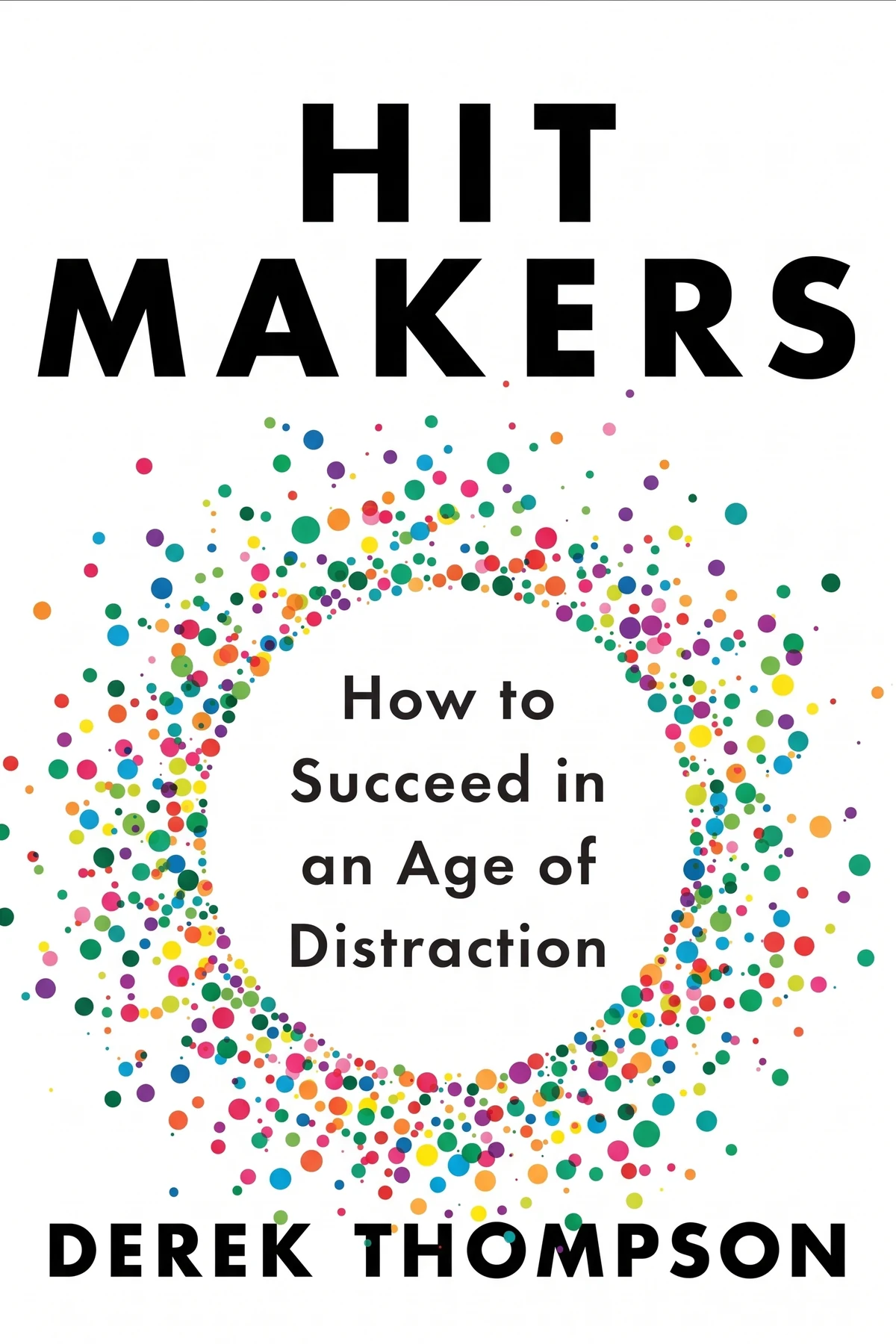
Table of Content
1. Introduction
1 min 02 sec
If you make things for other people to notice, such as a product, a song, a pitch or a post, it is tempting to believe the best work rises on its own. In Hit Makers, Derek Thompson, a senior editor at The Atlantic, argues that it often does not. One of the most gifted impressionists stayed obscure largely because his paintings were left out of a single exhibition. Popularity grows from exposure, from a careful mix of the familiar and the new, and from a large share of luck.
That is the claim everything here supports. You can raise the odds of a hit by getting seen and by making things that feel fresh yet recognizable, but chance and the way audiences connect always get a vote. The evidence includes the designer behind the first Coca-Cola fountains, mice that listen like pop fans, the rise and fall of the laugh track, and a study of shared tweets. What remains is a clear sense of which parts of success you can shape and which you can stop agonizing over.
2. Put your work where the spotlight falls
1 min 42 sec
Two French painters were equally gifted, worked in the same circle and lived in the same decades. One draws crowds in museums today and the other is barely known. The difference came down to one exhibition.
3. Design things that feel new yet familiar
1 min 44 sec
Make something too ordinary and people ignore it. Make it too strange and they reject it. A French orphan who reshaped American trains, cigarette packs and soda fountains found the space in between.
4. Hold attention with repetition and one twist
1 min 45 sec
People claim to want novelty, yet the bulk of their listening is to songs they already know. A simple experiment with mice and a few musical notes explains how pop songs keep us listening.
5. Use shared laughter to make jokes land better
1 min 41 sec
For decades, American TV shows played recorded laughter at key moments, and audiences felt safe laughing along. Then the sound almost vanished from television. Its rise and fall show how other people decide what we feel safe enjoying.
6. Know the hidden costs of being popular
2 min 10 sec
Winning a prize should bring better reviews, yet a 2014 study of reader reviews on a book website found the reverse. Popularity also has a darker habit: it rewards the stories audiences already expect, including the unfair ones.
7. Plan for the luck no one controls
1 min 54 sec
A pop star’s label promoted an album aggressively and still could not save it. A computer simulation of thousands of people found that even perfect conditions rarely spark a craze. So what is left for creators to do?
8. Find a broadcaster instead of chasing viral
1 min 36 sec
Everyone talks about videos and posts that spread from friend to friend until millions have seen them. When researchers traced how content actually travels online, that story fell apart, and a much older force took its place.
9. Conclusion
1 min 18 sec
Thompson’s picture of success is humbler than the usual advice, and more useful for it. Caillebotte had the talent. What he was missing was a place on the walls of the Musée du Luxembourg in 1897. The line between fame and obscurity often comes down to who saw what, and when.
Inside that uncertainty, some things still respond to effort. Audiences reward what they can recognize and still find fresh. They return to what repeats with a twist. They feel safer enjoying what others visibly enjoy. And the largest audiences arrive through broadcasters, the outlets that already hold the crowd.
So treat exposure as part of the work itself, and look for the outlet that already reaches the people you want. Hold each design to Loewy’s standard, most advanced yet acceptable, and make sure every repetition carries one small change. When something you made falls flat, remember that Rock Around the Clock was a dud for a year before a film carried it everywhere.
Popularity, Thompson reminds us, is neither a fair judge of quality nor a permanent prize. Some of the finest work ever made never found the audience it deserved. Make yours anyway, and then make sure it gets seen.
About this book
What is this book about?
Most people assume the best work wins. A great painting ends up in the famous museum, a great song tops the charts and a great product sells itself. Derek Thompson, a senior editor at The Atlantic, argues that popularity works differently. Quality matters, but exposure, timing and the habits of the human brain matter at least as much. Thompson draws on art history, design, music, comedy and network science. He explains why one impressionist became world famous while an equally gifted friend was forgotten, and how the designer Raymond Loewy built his career on a rule he called most advanced yet acceptable. He also covers an experiment showing that mice respond to musical patterns much like pop fans do, why award-winning books get worse reviews, and why the laugh track ruled television and then disappeared. The book also takes apart a favorite internet idea: that content goes viral by passing from person to person. Readers learn which parts of success they can shape, how to design and present work so it feels fresh yet recognizable, and why some luck will always be part of the outcome.
Book Information
Who it's for
Founders, marketers, product teams
Founders, marketers and product people trying to understand why some launches spread and others vanish.
Creators of all kinds
Musicians, writers, designers and creators who want their work to feel fresh yet easy to embrace.
Curious about cultural hits
Curious readers who wonder why certain songs, shows and trends take over the culture.
About the Author
Derek Thompson
Derek Thompson is a senior editor at The Atlantic, where he covers media and economics. He studied journalism, political science and legal studies at Northwestern University, graduating in 2008, and has worked as a weekly news analyst for NPR's Here and Now. His 2015 cover story, A World Without Work, looked at how technology may change the future of jobs, and Forbes named him to its 30 Under 30 list. Hit Makers is his first book.
Ratings & Reviews
Ratings at a glance

What people think
Listeners find the content absorbing and relatable, highlighting the well-researched observations and high-quality writing style. The narrative approach is also quite captivating; one listener specifically noted the way the author integrates familiar stories into a logical framework. Furthermore, the work is valued for its applicable examples and usefulness to entrepreneurs. However, reactions to the pacing are mixed, as some listeners feel that certain anecdotes tend to linger for too long.
Top reviews
Wachira
Picked this up because I’m obsessed with how trends explode, and Thompson didn't disappoint. The exploration of the MAYA principle—Most Advanced Yet Acceptable—was a total revelation for me. It explains why we crave something new but only if it feels safe enough to understand. His breakdown of how 'Rock Around the Clock' became a hit through pure chance and a movie placement was genuinely thrilling. To be fair, some chapters lean heavily on anecdotes, but they are so well-told that I didn't mind the detour. This isn't just a marketing book; it's a deep dive into the psychology of our collective tastes. If you're a creator trying to find an audience, the chapters on 'dark broadcasters' will change how you view social media entirely. It's brilliant, relatable, and deeply researched.
Show morePun
The chapter on Gustave Caillebotte and the Impressionists was worth the price of the book alone. I never realized how much our 'canon' of art depends on the estate planning of one wealthy individual rather than just pure talent. Thompson weaves these historical deep-dives into modern contexts, like how Bumble managed to thrive in Tinder's shadow. The prose is elegant and fast-paced, though I can see why some might find the stories a bit long-winded. For me, the storytelling is the best part. He takes these familiar cultural touchstones and peels back the layers to show the luck and the logic underneath. It’s a brilliant look at why some things stick while others, arguably better things, fade into the background. A must-read for any history or art lover.
Show moreKevin
Finally got around to reading this, and I’m kicking myself for waiting so long. As a founder, I found the insights into 'distribution over content' to be incredibly grounding. We often think that if we make something 'great,' the world will find it, but Thompson proves that the 'hit maker'—the network or the enabler—is just as important as the product itself. The tone is casual yet authoritative, making complex psychological concepts accessible without dumbing them down. I particularly loved the section on Disney’s growth; it’s a masterclass in brand building through familiarity. Some might say it’s anecdote-heavy, but that’s exactly what makes it so engaging. It’s a book that invites you to look at your own consumption habits with a much more critical and informed eye.
Show moreRapee
Wow. The 'Interlude' chapter where Thompson visits the Strand Bookstore and compares it to the data-driven world of Chartbeat was incredibly moving. It highlights the central conflict of the modern creator: do we make art for the feedback loop, or for ourselves? This book is full of these philosophical gems hidden inside what looks like a standard business text. I loved the variety of examples, from the rise of vampires in fiction to the success of cable news. Thompson’s voice comes through clearly—he’s curious, slightly skeptical, and deeply observant. It’s rare to find a book that is this informative while also being a genuine pleasure to read. It definitely gave me a new perspective on how to navigate this 'Age of Distraction' without losing my mind.
Show moreBunyarit
As someone who works in digital media, the myth of 'going viral' is something I deal with every single day. Thompson does a fantastic job of debunking the idea that things just magically spread like a flu. Instead, he points toward massive distribution hubs and influencers that we often don't see. The writing style is very much in line with his Atlantic articles—crisp, intelligent, and filled with 'aha' moments. I did feel like the book was a bit too American-centric at times, focusing almost exclusively on US brands and pop culture. However, the core logic holds up regardless of where you live. It’s a great read for anyone curious about the hidden machinery behind the songs and movies we all love. Definitely useful for entrepreneurs trying to cut through the noise.
Show moreWitthaya
Ever wonder why we all seem to like the same five songs at once? This book offers a fascinating look at the tension between our desire for self-expression and our need to belong. Thompson argues that we don't just buy things because they are popular; we buy them because they represent who we want to be. I appreciated the nuance he brought to the table, especially regarding 'homophily' and how our social circles dictate our tastes. My only gripe is that the pacing is a bit uneven; some sections fly by while others feel like they are over-explaining the obvious. Still, for an entrepreneur or a creative, there is a lot of tactical value here. It makes the 'black box' of fame feel a little more transparent and manageable.
Show moreWoravit
Look, this isn't a textbook, and it shouldn't be treated as one. If you go in expecting raw data and mathematical proofs for popularity, you’ll be disappointed. But if you want a smart, engaging narrative about how culture actually works, this is top-tier. I found the discussion on the 'hidden side' of successes like E.L. James to be eye-opening. It’s all about the architecture of audiences rather than just pure chance. The book is definitely US-centric, which is a valid critique, but the psychological triggers he describes are universal. It’s a bit information-dense at times, and I had to take breaks to digest some of the more complex sections, but the payoff is worth it. It’s definitely earned a permanent spot on my bookshelf.
Show moreJack
To be fair, Thompson is an excellent writer who knows how to package old ideas in a very shiny, new wrapper. Much of what is discussed here—familiarity, network effects, the power of a few key nodes—isn't necessarily groundbreaking if you've already read books like 'Outliers' or 'Contagious.' However, the way he connects Brahms’s Lullaby to 50 Shades of Grey is undeniably clever and kept me turning the pages. My main issue is the lack of a strong, centralized conclusion; after all those stories, I still felt like the practical 'how-to' was missing. It’s a fun read for a plane ride or a weekend, but don’t expect a rigorous academic study. It’s more of a cultural commentary with some psychology peppered in to give it weight.
Show moreBella
Not what I expected after seeing so many five-star reviews on my feed. While the premise is strong, the execution feels like a series of long-form articles that don't quite mesh together into a cohesive argument. The stories drag on for pages and pages—sometimes I’d skip three paragraphs and realize I hadn't missed the actual point. It feels like Thompson is trying to be the next Malcolm Gladwell, but he lacks the tight narrative structure that makes Gladwell's books so readable. There is very little actionable 'science' here, and the heavy focus on American pop history makes it feel repetitive. It's not a terrible book, but it definitely could have been about 100 pages shorter without losing any substance. It was a chore to finish.
Show moreLook
This book is essentially a collection of Wikipedia entries masquerading as scientific analysis. I found it incredibly frustrating that Thompson promises a 'science of popularity' but provides nothing but survivorship bias and disjointed anecdotes. Every single example is about a massive American brand like HBO or the NYT, making it feel very narrow and dated for a global reader. Where is the data? Where are the failure stories that actually prove his theories? Frankly, it’s a slog to get through because the author spends more time talking about his own writing process than actually delivering on his thesis. If you want a rigorous look at market dynamics, look elsewhere. This is just high-level fluff for people who like name-dropping. I am angry I wasted my time on something that never leads to a conclusion.
Show moreQuestions about this book
What is the main idea of Hit Makers by Derek Thompson?
Thompson argues that popularity is not a simple reward for quality. Things become hits through exposure, through a balance of the familiar and the new, and through repetition with small variations. Chance and well-connected broadcasters also decide a great deal. His opening example is Gustave Caillebotte, a painter as gifted as Monet who stayed obscure after his own paintings were left out of a key exhibition in the 1890s.
What is the MAYA principle in Hit Makers?
MAYA stands for most advanced yet acceptable, a rule coined by the designer Raymond Loewy. People like things they recognize but tire of anything too familiar, so successful designs mix both. Loewy’s streamlined locomotives were clearly trains yet looked futuristic. A 2011 study by Dutch professor Paul Hekkert found that people preferred cars and phones that combined typical and novel features.
Does Hit Makers say going viral is real?
Thompson calls going viral a myth. A 2012 Yahoo study of content on platforms like Twitter found that 90 percent of tweets were never shared. Among the 1 percent shared more than seven times, none spread from person to person in the viral way people imagine. Big reach usually comes from broadcasting, where one source like the Super Bowl or the New York Times reaches millions at once.
How can I apply the ideas from Hit Makers?
Start by treating exposure as part of the work and finding outlets that already reach your audience. Test each design for one recognizable element and one new one, following Loewy’s MAYA rule. Repeat your core message, but change something each time, as the mouse experiments suggest. And keep good work in circulation, since Rock Around the Clock flopped in 1954 before a film made it famous.
Why do award-winning books get lower ratings, according to Hit Makers?
A 2014 study of goodreads.com reviews by Balazs Kovacs and Amanda J. Sharkey found that prize winners were rated lower than books without awards. An award raises expectations and attracts readers who would not normally choose that kind of book, so many are disappointed. Very popular books also face backlash from readers who decide something so widely liked cannot be good.
Readers also enjoyed



Age of Propaganda: The Everyday Use and Abuse of Persuasion
Anthony Pratkanis



59 Seconds: Change Your Life in Under a Minute
Richard Wiseman


AUDIO SUMMARY AVAILABLE
Listen to Hit Makers in 15 minutes
Get the key ideas from Hit Makers by Derek Thompson, plus 5,000+ more nonfiction titles.
- 5,000+ titles
- Listen as much as you want
- 7-day free trial
- Cancel anytime









