
15 min 09 sec
Available in: English
 ไทย
EnglishไทยGuns, Germs and Steel: The Fates Of Human Societies
Explains why Eurasian societies, and not those of the Americas, Africa or Australia, ended up with the weapons, diseases and ships of conquest, tracing the gap to domesticable species and the shape of continents.
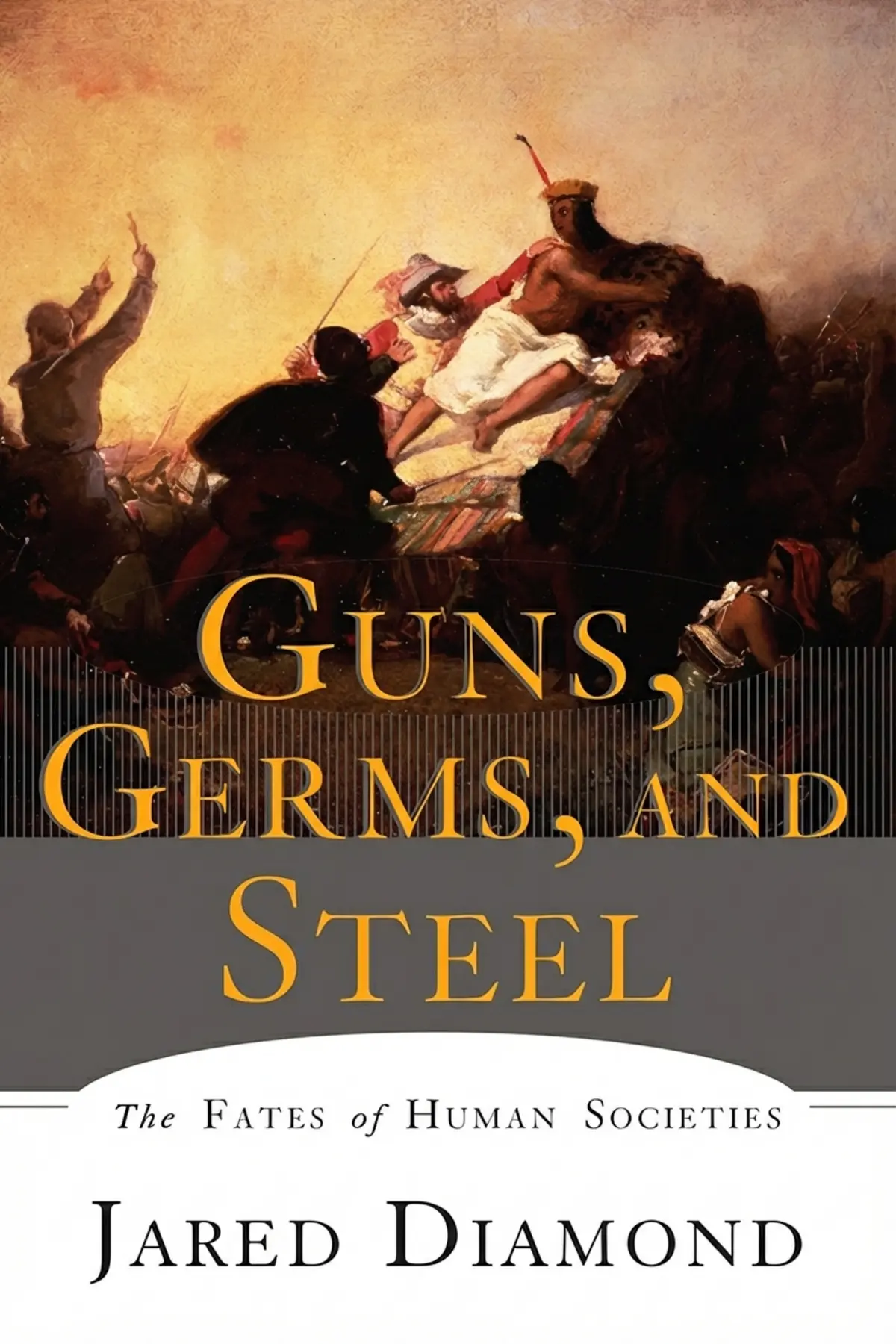
Table of Content
1. Introduction
1 min 13 sec
If the usual explanations for why a few societies came to rule the world have never satisfied you, Jared Diamond offers one that starts with wheat, cattle and the shape of a continent. In Guns, Germs and Steel, the geographer and biologist notes that around 11,000 BC, people in what are now Peru, Poland and Papua New Guinea lived in much the same way, as small bands of foragers with stone tools. By 1492, the lands between Portugal and Japan held states, writing, iron and standing armies, while much of Australia, Africa and the Americas did not.
Diamond’s case is that the gap owed nothing to the talents of different peoples. Eurasia drew more plants and animals worth taming and a sideways shape that let them travel, and that early lead compounded over millennia into the guns, germs and steel of conquest. Follow his reasoning and you gain a sharper habit of looking past the visible cause of any outcome, plus a lesson about why rival groups that stay in contact tend to out-invent both isolated groups and single unified ones.
2. Tell the spark of an event from its root
1 min 58 sec
Fewer than two hundred Spaniards captured an emperor guarded by tens of thousands of soldiers. The weapons that won that day are easy to name. What put them in Spanish hands rather than Inca ones is the harder question.
3. Follow the spare food to find power
2 min 10 sec
No society of hunters and gatherers ever produced a king, a metal tool or a written word. Planting crops changed that, and the reason begins in a storehouse long before anyone picks up a sword.
4. Learn why Eurasia drew the best plants and animals
2 min 18 sec
New Guineans knew their forests plant by plant, and Africa was home to famous big mammals. Neither knowledge nor abundance was enough. A strict test of temperament and a table of seed sizes explain much of what followed.
5. Read a map to see how ideas travel
2 min 06 sec
Two landmasses of nearly equal length gave their farmers very different odds. The decisive factor lay in which way the land happened to point, and it offers a test for anyone copying an idea from somewhere else.
6. See why germs did most of the conquering
2 min 04 sec
One carpenter stepping off a boat infected almost an entire island within three months. The same arithmetic of crowds and cattle explains why the deadliest weapon in the conquest of the Americas was never aimed at anyone.
7. Build rival teams that still share ideas
2 min 04 sec
Japan once made guns as well as anyone, then let them nearly vanish. China ended its own great fleets. Divided, quarrelsome Europe kept moving. The pattern holds a lesson for anyone who organizes people to invent.
8. Conclusion
1 min 16 sec
Diamond’s search began on a New Guinea beach in 1972, while he was studying how birds evolve. A local politician named Yali, who was readying his people for self-government, asked why white people had come with so much cargo, the local word for manufactured goods from steel axes to umbrellas, while his own people had produced so little. Diamond had no answer then. The book is his reply, and it rests on the ground beneath people’s feet: their environments differed, and the peoples themselves did not. He insists this is no counsel of fate. Explaining the past, he says, gives us power to shape the future, and he points to Malaysia, Singapore, Taiwan and Mauritius, tropical countries that were once poor.
The book leaves habits worth keeping. When someone credits a success to talent alone, ask what raw material and what connections stood behind it. Before copying a practice from elsewhere, check whether its conditions travel with it, the way crops travel along a line of latitude. And when you organize people, keep enough rivalry to spark ideas and enough contact to share them.
Yali asked about cargo. The answer turned out to be wheat, cattle and the direction a continent happens to face.
About this book
What is this book about?
Thirteen thousand years ago, every human society lived in roughly the same way, as small bands of hunters and gatherers using stone tools. By 1492, Eurasia had states, writing, iron and armies, and its peoples went on to conquer much of the world. Jared Diamond sets out to explain that divergence without falling back on the idea that some peoples were smarter than others, an explanation he rejects as both despicable and factually wrong. His answer begins with food. Farming produces far more per acre than foraging, and the surplus feeds the specialists, cities and armies that build complex societies. Eurasia started farming earliest because it held the richest set of wild plants and large mammals worth taming, and its east-west shape let crops and livestock spread quickly across similar climates. Dense populations living beside their herds also bred diseases that later devastated the Americas. Diamond, a biogeographer, draws on botany, zoology, microbiology and the social sciences, from the capture of an Inca emperor at Cajamarca to the stubborn temper of zebras. Readers get a clear long-run account of why history unfolded as it did, and a lesson about how connection and competition drive invention.
Book Information
Who it's for
Asking why societies dominated
Curious readers who want a clear, evidence-driven answer to why some societies came to dominate others.
Students seeking deep causes
Students of history, geography or economics looking for the deep causes behind conquest and the wealth gap between nations.
Managers and founders
Managers and founders interested in what history teaches about competition, connection and how new ideas spread.
About the Author
Jared Diamond
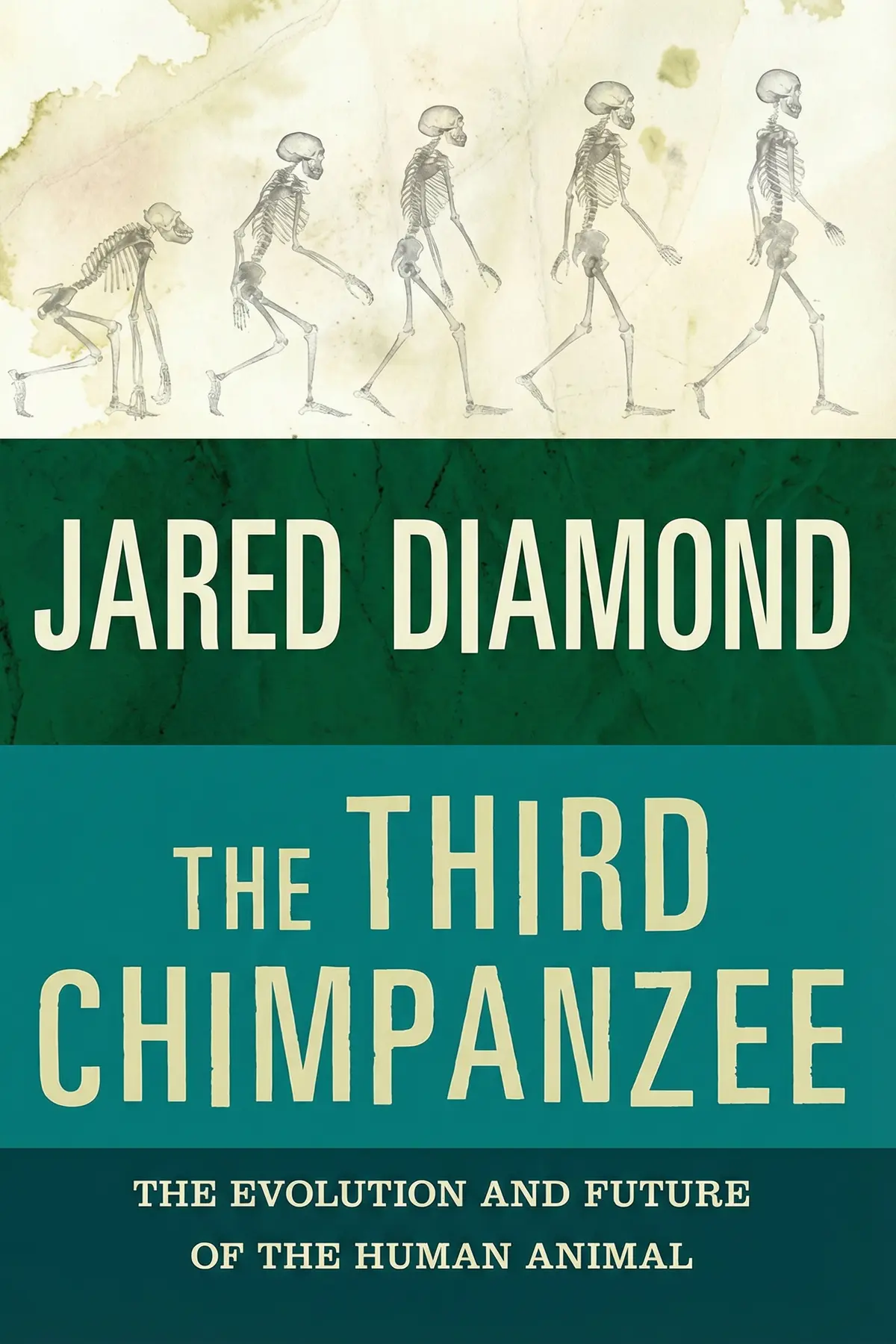
Jared Mason Diamond was born in Boston in 1937 and trained first in biochemistry and physiology before publishing across anthropology, ecology, geography and evolutionary biology. That range suits a book built on plants, animals and germs as much as on history. He taught geography at the University of California, Los Angeles until he retired in 2024. Guns, Germs and Steel won the 1998 Pulitzer Prize for general nonfiction, and he has also received a MacArthur Fellowship and the National Medal of Science. His other books include The Third Chimpanzee, Upheaval and Why is Sex Fun?
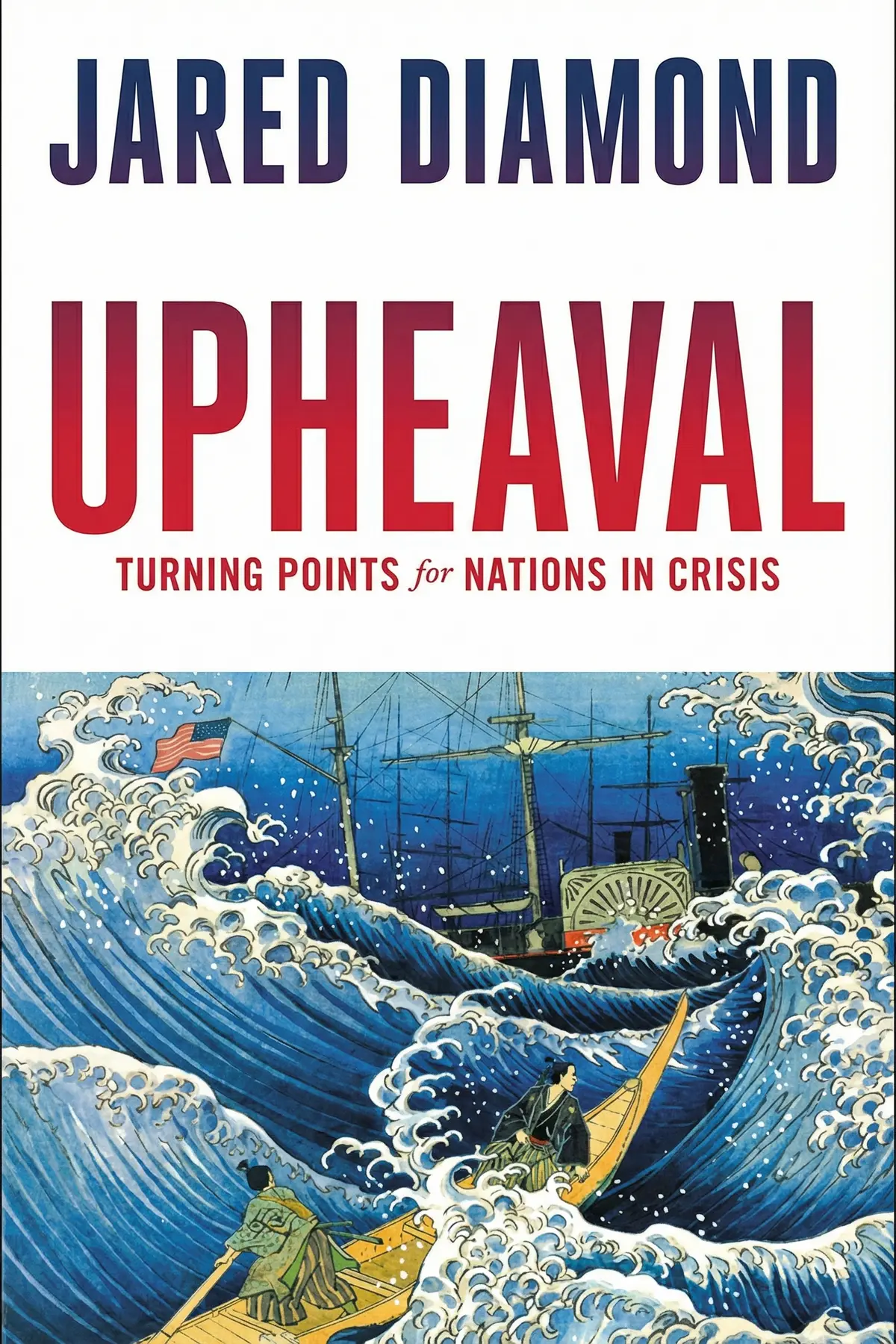
Upheaval: Turning Points for Nations in Crisis
Jared Diamond

Why is Sex Fun?: The Evolution of Human Sexuality
Jared Diamond
Ratings & Reviews
Ratings at a glance
What people think
Listeners consider the work exceptionally engaging and expertly crafted, noting its transparent and approachable prose. They value the exhaustive investigation and detailed presentation, viewing it as essential reading for anyone fascinated by historical and cultural developments. The text provides an alternative viewpoint on global history and delivers a compelling account of how human civilizations have progressed. Listeners characterize the content as stimulating, with one review highlighting its use of multiple academic disciplines to examine the human past.
Top reviews
Patcharaporn
Ever wonder why certain civilizations flourished while others remained isolated for millennia? Jared Diamond tackles this massive question by looking at geography rather than biology. It’s a dense read, yet incredibly rewarding because it dismantles any notion of racial superiority with cold, hard data about crop availability and animal domestication. Truth is, the broad east-west axis of Eurasia allowed for much faster transmission of ideas and technologies compared to the north-south orientations of the Americas or Africa. This isn't just a history book; it's a structural breakdown of human existence. While the 'Steel' section felt a bit rushed, the overall thesis is mind-blowing. I finished this feeling like the entire map of the world finally made sense.
Show moreAkira
Wow. I haven’t looked at a map the same way since I put this book down. Diamond starts with a simple question from a man named Yali in New Guinea and proceeds to build a massive, multidisciplinary framework to answer it. The way he links the availability of wild wheat and barley to the eventual rise of empires is nothing short of brilliant. Look, some people call it deterministic, but the logic regarding how latitude affects the spread of agriculture is hard to argue against. It’s a thick book, but the style is conversational enough that I never felt buried in jargon. This is essential reading for anyone trying to understand the 'why' behind the modern world's power imbalances.
Show moreDiego
The chapter on the 'Spaced-out' effect of continental axes is worth the price of admission alone. Diamond argues that it was much easier for crops and animals to spread across the similar climates of Eurasia than it was to move through the varying latitudes of the Americas. This insight explains so much about why certain civilizations hit technological milestones earlier than others. Not gonna lie, the book requires a lot of focus, but it’s the kind of work that rewards your patience with a total paradigm shift. It is a masterful synthesis of biology, geography, and archaeology that manages to be both academic and accessible. I highly recommend it to anyone who enjoys 'big history' books like Sapiens.
Show moreSangduan
Direct and powerful, this book provides the most logical explanation for global inequality that I’ve ever encountered. Diamond avoids the trap of focusing on politics or religion and instead looks at the literal dirt and animals that humans had to work with. It works. The truth is that some people simply got a better head start because of their local flora and fauna. It’s a massive, sweeping narrative that manages to stay grounded in scientific facts rather than cultural myths. While the text is quite long, the chapters are structured in a way that makes the logic easy to follow. This is a must-read for anyone who wants a deeper understanding of how we all ended up where we are today.
Show moreWanida
After hearing so much hype about this Pulitzer winner, I finally dove into the world of environmental determinism. Diamond is remarkably thorough, perhaps even to a fault, as he spends a massive amount of time on grain types and the domestication of large mammals. Personally, I found the chapter on the evolution of germs and their impact on indigenous populations to be the most gripping part of the entire narrative. The writing is accessible for a layman like me, though the middle sections definitely start to feel repetitive after the third or fourth example of continental orientation. To be fair, he needs that evidence to support such a sweeping claim about why Europe and Asia dominated. It’s a solid, thought-provoking read.
Show moreJom
Picked this up on a recommendation and found myself surprisingly sucked into the history of domesticated pigs and cattle. Diamond does a great job of explaining how food surpluses lead to specialized classes like soldiers and bureaucrats, which eventually allows for conquest. My only real gripe is that he occasionally treats humans like they are just pawns of their environment with no choice in their own destiny. That being said, the research presented is staggering and the prose flows much better than your average academic text. In my experience, most history books focus too much on 'Great Men,' so it was refreshing to see a focus on environmental factors instead. It's a comprehensive and very readable piece of non-fiction.
Show moreHang
Finally got around to reading this classic and I can see why it’s so polarizing. On one hand, the evidence for how geography shaped the early stages of civilization is absolutely compelling and well-researched. On the other hand, Diamond is a bit of a 'Monday morning quarterback' who fits every historical event into his specific theory. I loved the section on why Australia remained hunter-gatherer based on its lack of domesticable species—harnessing a kangaroo is a hilarious image. The book is definitely thought-provoking, even if you don't agree with every single conclusion he draws. It’s a meaty, dense, and ultimately enlightening look at the foundations of our modern society.
Show moreMethinee
Not what I expected given the punchy title. If we are being precise, the book should really be called 'Grains, Germs, and Geographic Luck' because the discussion of weaponry is surprisingly thin. I appreciated the deep dive into why some societies developed immunity to lethal diseases, but the pacing is all over the place. One moment you are learning something fascinating about the QWERTY keyboard, and the next you are trapped in fifty pages of botanical data that feels like a textbook. Gotta say, it's an important work, but it definitely didn't need to be this long to prove its core point. It’s worth a skim if you’re interested in anthropology, but don't expect a fast-paced history of warfare.
Show morePalm
As someone who studied anthropology, I found Diamond’s take on cultural materialism to be a bit reductive. While his focus on geography is a necessary counter to older, racist theories of history, he swings too far in the opposite direction. He treats every cultural development as an inevitable result of the landscape, which ignores the complex social dynamics that actually drive human behavior. The writing is clear and the Pulitzer was likely deserved for the sheer scale of the project, but the repetition makes it a chore to finish. To be fair, his explanation of the 'Spanish Conquest' and the role of germs is quite powerful. Just take his 'predestined' conclusions with a massive grain of salt.
Show moreYulia
This book is essentially what happens when a biologist decides he can explain every single nuance of human history through a single lens. Diamond ignores the agency of individual cultures and boils everything down to where you happen to live on a map. It’s boring. Frankly, it’s a bit of a slog to get through because the prose is incredibly dry and the 'Steel' part of the title is barely addressed. If you enjoy reading 400 pages about why you can't domesticate a zebra or a rhino, then this is for you. Otherwise, it feels like a very long exercise in speculation that ignores actual archaeological proof in favor of a neat, materialistic theory. It's just too simplistic for such a complex subject.
Show moreQuestions about this book
What is the main idea of Guns, Germs and Steel?
Jared Diamond argues that Eurasian societies conquered those of the Americas, Africa and Australia because of geography, with no innate difference between the peoples involved. Eurasia had more wild plants and large mammals that could be domesticated, so it began farming earliest. Food surpluses then supported cities, specialists, writing, metal tools and armies. Its east-west shape let crops and know-how spread quickly, and the lead compounded for thousands of years.
Why does Jared Diamond say the shape of continents mattered?
Regions on the same latitude share day length, seasons and climate, so crops adapted to one usually grow in another. Eurasia runs east to west, and farming spread out of southwest Asia at about 0.7 miles a year. The Americas and Africa run north to south across climate bands, deserts and jungle, so a crop like Mexican maize needed heavy genetic change before it could serve farmers in the Andes.
How did germs help Europeans conquer the Americas?
Many of the worst human diseases, including measles and smallpox, began in animals and survive only in large, dense populations. Eurasia had both crowded cities and big herds, so its people built up resistance over centuries. The Americas had few herd animals, so the traffic of disease ran mostly one way. By Diamond’s estimate, Eurasian germs killed about 95 percent of the pre-Columbian population, far more than Spanish weapons did.
Is Guns, Germs and Steel geographic determinism?
Critics in anthropology and geography, including anthropologist Jason Antrosio and writers in a 2003 series of the journal Antipode, say the book leaves too little room for human choice and politics. Economic historian Joel Mokyr called Diamond a geographical determinist, though far from a crude one, and judged the book essential for long-run global history. Diamond replies that the label works as an insult, not a refutation, and grants that single people and odd cultural habits can shape events inside limits set by environment.
How can the ideas in Guns, Germs and Steel be applied today?
In a later afterword Diamond extends his argument to business, asking why some German or Japanese industries are highly productive while others in the same country lag. His lesson is that groups innovate best when several units compete while still communicating openly, much as Europe’s rival states did. Readers can also borrow his habit of separating the visible causes of a success from the deeper conditions that made those causes possible.
Featured in

Readers also enjoyed

Alexander Hamilton
Ron Chernow

Alexander the Great
Philip Freeman

A History of Iran: Empire of the Mind
Michael Axworthy

A History of the World in 6 Glasses
Tom Standage

A Long Way Gone: Memoirs of a Boy Soldier
Ishmael Beah


AUDIO SUMMARY AVAILABLE
Listen to Guns, Germs and Steel in 15 minutes
Get the key ideas from Guns, Germs and Steel by Jared Diamond, plus 5,000+ more nonfiction titles.
- 5,000+ titles
- Listen as much as you want
- 7-day free trial
- Cancel anytime









