Guns, Germs and Steel: The Fates Of Human Societies
Jared Diamond
 English
 ไทย
Shows how seven nations, from Finland to Japan to Australia, survived modern crises through selective change, and how the same honest sorting of what to change and what to keep works for people too.
1 min 09 sec
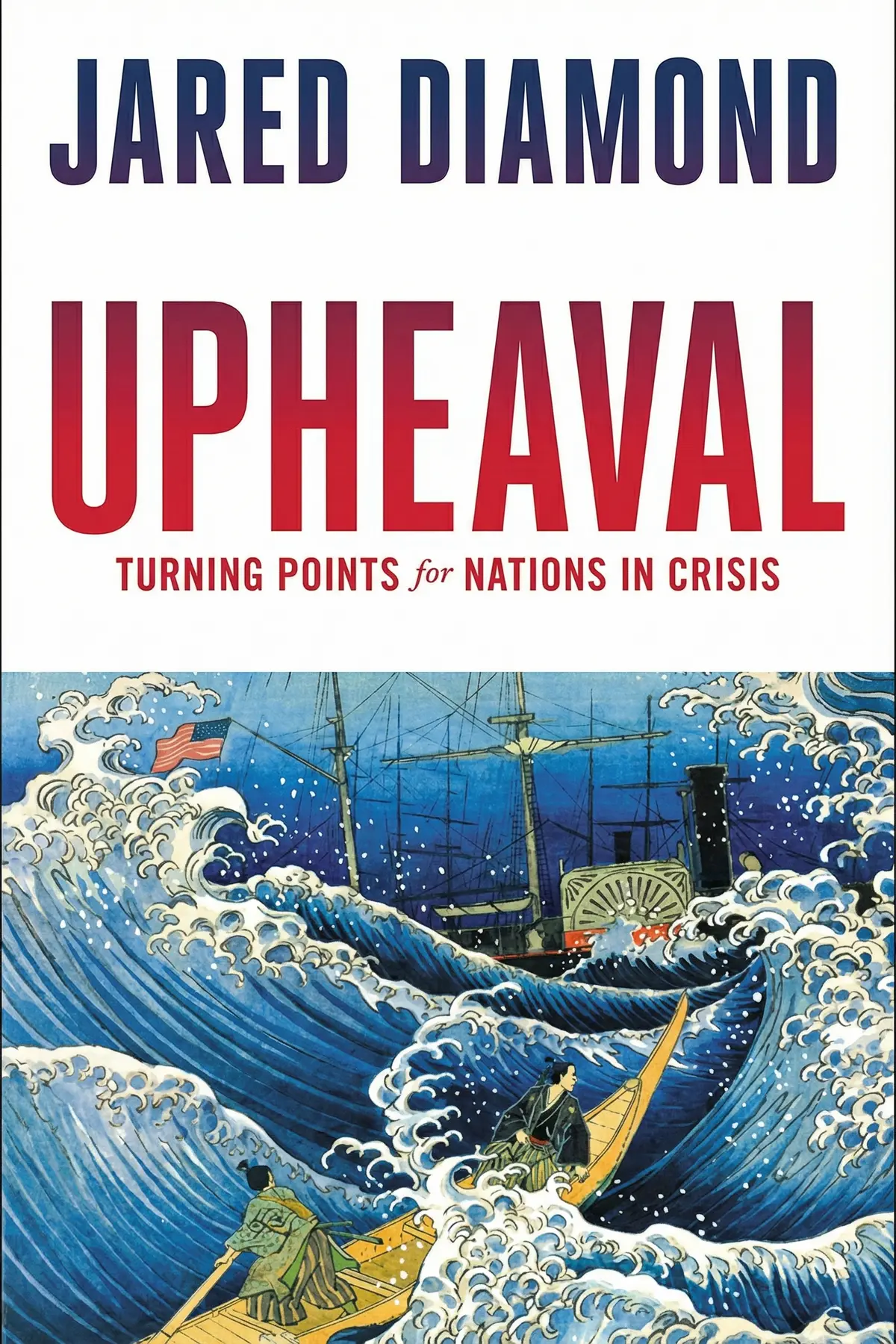
When a career stalls or a relationship ends, the instinct is either to change everything or to change nothing. In Upheaval, geographer Jared Diamond argues that both instincts fail, for people and for whole countries, and that recovery comes from selective change: deciding precisely what must go and what is too central to touch.
Diamond, the Pulitzer Prize-winning author of Guns, Germs and Steel, tests that idea against seven nations in modern crisis, from Finland facing Stalin to Japan staring at American warships. Each had to see its situation honestly, accept that nobody else would rescue it, and work around limits it could not escape. The thread through every case is simple enough to carry with you: nations survive upheaval the way people do, by naming the problem, owning it and changing only what must change. The seven stories add up to a working checklist for your own hard stretches, and a sharper way to read the news about democracies under strain.
1 min 57 sec
A midlife collapse and a military coup look like they belong to different worlds. Diamond insists they call for the same first moves, and the step most people skip is the one that matters most.
2 min 18 sec
Finland fought the Soviet army to a standstill and still ended the war owing its enemy a fortune. What it did next turned a bill it could barely pay into the start of its prosperity.
2 min 09 sec
Nine American warships forced Japan into a deal its leaders considered shameful. Within fifty years the same country stunned a European power at sea, by copying the West in a very particular way.
2 min 20 sec
Chile had decades of stable democracy, then fell to a brutal dictator whom many citizens came to support. Indonesia followed a similar path, and both stories hold an uncomfortable lesson about crisis and economics.
2 min 15 sec
One leader asked his country’s former victims for forgiveness. Another admitted his nation had been abandoned by its parent. Both turned an embarrassing truth into the foundation for something stronger.
1 min 58 sec
The country that sees itself as democracy’s model shows some of the same warning signs that came before Chile’s coup. And the biggest crisis of all belongs to no single nation.
1 min 14 sec
None of Diamond’s seven nations had a perfect option. Finland could not move away from Russia, Japan could not keep the warships out, and Australia could not make Britain care again. What separated recovery from collapse was the willingness to see the situation without flattering it, then to change narrowly and deliberately. The countries that managed this kept their character. Those whose politics would not bend got change anyway, imposed by generals and paid for in disappeared citizens.
That gives you a way to meet your own upheavals. When a job, a relationship or a business starts failing, resist both panic and denial. Write down honestly what is wrong and whose job it is to fix it. Sort what must change from what defines you, and find someone who has already solved a similar problem, the way Japan studied German law and British ships. Then give it years rather than weeks.
Whitlam had the right instinct. Most of the change a crisis demands has already happened in the world. The hard part, for a nation or a person, is finally recognizing it.
Everyone faces a crisis sooner or later: a career that stalls, an illness, a relationship that ends. Whole countries face them too, and Jared Diamond argues that the way out is much the same at both scales. He calls it selective change: admitting the problem, accepting responsibility for it, and deciding carefully what must change and what is too central to touch. Diamond tests this idea on seven nations in modern crisis. Finland held off Stalin and then built peace with its giant neighbor. Japan answered American warships by borrowing Western methods while keeping its traditions. Chile and Indonesia fell into dictatorship when politics refused to compromise. West Germany and Australia rebuilt their identities after the Second World War. He then turns the same lens on the United States and on threats the whole planet shares, from voting restrictions to climate change. Readers get a practical checklist for any crisis and a clearer way to read the history and news of nations under strain.
Professionals in a career or personal crisis who want a clear method for deciding what to change.
History and politics readers curious how Finland, Japan, Chile, Germany and Australia survived turning points.
Citizens worried about polarization and the health of democracy today.
Jared Diamond, born in Boston in 1937, trained in biochemistry and physiology before publishing across anthropology, ecology, geography and evolutionary biology. He taught geography at UCLA until he retired in 2024. His book Guns, Germs and Steel won the Pulitzer Prize for general nonfiction in 1998, and he has also received a MacArthur Fellowship and the National Medal of Science.

Listeners find this an essential read that showcases remarkable academic depth and high-quality writing, as one listener points out its ability to simplify complex subjects. Furthermore, they value the historical significance of the text, with one listener emphasizing its focus on major historical episodes and pivotal moments. The book also earns praise for being accessible and intellectually stimulating; listeners also admire the tempo, with one review mentioning its concise treatment of significant events. Nevertheless, opinions on the narrative style are somewhat divided.
Jared Diamond has this incredible knack for blending disciplines that usually don't talk to each other. By applying the principles of crisis therapy to the history of entire nations, he gives us a completely fresh lens through which to view global stability. It’s truly fascinating to see how the 12 success factors—things like acknowledging a problem and separating core values—play out in places like Finland or Germany. Frankly, the influence of his wife’s psychological background is evident throughout the narrative and adds a layer of empathy often missing in history books. While some might find the scholarly research a bit dense, I found the way he breaks down complicated geopolitical shifts to be masterful. It’s not just a history book; it’s a manual for survival in an increasingly polarized world. This is a thought-provoking read that stays with you long after the final page.
Show moreAfter loving Guns, Germs, and Steel, I had high expectations for this new volume, and Diamond mostly delivers on that promise. He has a way of taking these massive, sweeping historical turning points and making them understandable for the average reader without dumbing them down. The section on Japan and the arrival of Commodore Perry was particularly enlightening, showing how a nation can pivot toward modernity without losing its cultural soul. I'll admit, the pacing is a bit uneven in the later chapters, but the scholarly research remains top-notch throughout. It’s a thought-provoking look at how we handle external threats and internal malaise in the modern era. Not gonna lie, I was worried it would be a total 'downer' like his previous work on collapse, but this feels much more hopeful. It shows that there is a path through the fire if we choose to take it.
Show moreFinally got around to reading this and I'm walking away feeling unexpectedly optimistic about our global future. Diamond doesn't shy away from the massive challenges we face—climate change, political polarization, and economic inequality—but he shows that history is full of examples where things looked just as bleak. The influence of his wife Marie Cohen adds a layer of human empathy to the book that I really appreciated. It’s a refreshing change from the usual doom-and-gloom of modern non-fiction that offers no solutions. The way he examines turning points in Germany and Japan proves that we aren't stuck in our current ruts forever. Frankly, it’s a thought-provoking call to action for every citizen. It breaks down the complicated barriers we put up against change and shows that selective reform is the only way forward for a healthy democracy.
Show moreThe chapter on Finland alone is worth the price of admission for any history buff. I never fully realized how precarious their position was during the Winter War, yet they managed to maintain their democracy through sheer realism and strategic sacrifice. Truth is, Diamond’s 12-part model is a useful tool, though checking off every single point for every single country gets a bit repetitive by the third case study. You might find yourself skimming the structural bits once you get the hang of his rhythm and can anticipate the next factor. However, the historical value here is undeniable because he takes these massive turning points, like the Meiji restoration or the coup in Chile, and makes them feel personal. It’s a well-written exploration of how societies can choose to evolve rather than collapse under pressure.
Show moreEver wonder if a country can actually learn from its own breakdowns? Diamond argues that they can, provided they drop the myth of exceptionalism and look outward for better models. I loved how he challenged the idea that the United States has nothing to learn from places like Canada or Western Europe regarding healthcare and education. The comparison between personal crisis management and national survival is actually quite brilliant once you get past the initial oddity of the concept. To be fair, the book is quite long, but the pacing usually keeps things moving at a brisk clip through the various case studies. It’s a necessary read for anyone feeling anxious about the current state of American political polarization. This book really forces you to ask hard questions about which of our national values are worth keeping and which are just bad habits.
Show morePicked this up on a whim and was surprised by how accessible the prose is for such a heavy, multi-disciplinary subject. Diamond avoids the dry, academic jargon that usually plagues these kinds of massive history tomes, making it perfect for a casual reader. Instead, he treats the reader to a series of fascinating case studies that feel like deep-dive documentaries into the heart of national identity. The insights into how Finland navigated its relationship with the Soviet Union were eye-opening and felt very relevant to today’s headlines. To be fair, some of the political conclusions felt a little too neat, as if he was forcing the facts to fit his specific model. But overall, it’s an impressive work of research that successfully breaks down complicated topics. It really forces you to look at the current state of the world with a more analytical eye.
Show moreNot what I expected, but in a good way. I thought this would be a standard history book, but the focus on 'national psychology' makes it something else entirely. Diamond’s 12 success factors provide a really clear way to break down complicated topics that usually feel overwhelming to the average person. I found the section on Australia’s identity shift particularly interesting, especially the way they moved away from being a 'little Britain' to embrace their own geography. The pacing is quite good, and he manages to cover a lot of ground without getting bogged down in tiny details. My only real complaint is that the narrative quality can be a bit hit-or-miss depending on which country he’s discussing. Some chapters feel much more researched than others. Still, it’s a must-read for anyone interested in why some nations thrive while others stall.
Show moreWhile the premise is brilliant, the execution felt a bit like a slog in the middle sections of the book. Diamond is clearly a brilliant scholar, and his ability to synthesize complex topics into a readable format is impressive as always. However, the 12-factor checklist becomes a rigid cage that stifles the natural flow of the historical stories he is trying to tell. Each case study—be it Japan or Indonesia—starts to feel like a repetitive exercise rather than a living history after a while. I appreciate the concise way he covers key events, but the mixed narrative quality made it hard to stay engaged for all five hundred pages. Personally, I think he could have made his point with half the word count and a less formulaic structure. It’s still a solid piece of research, but it lacks the organic spark that made his earlier work so revolutionary.
Show moreTo be fair, the metaphor of individual therapy applied to geopolitical entities is a bit of a stretch for me. Diamond is a great writer, but at times it feels like he’s trying to fit a square peg into a round hole with his 12 factors. Is a nation really like a person mourning a death or facing a mid-life crisis? I’m not entirely convinced that societies function with that kind of singular emotional logic. That said, the historical value of the individual case studies is high and very informative. I learned a lot about the Indonesian transition and the Meiji era that I simply didn't know before reading this. The book is scholarly and well-written, even if the central thesis feels a little thin at times. It’s an interesting experiment in discipline-bending, but I found myself more interested in the raw history than the psychological framework.
Show moreI found this deeply problematic from a historical standpoint, even if the prose flows well enough. While Diamond is an impressive polymath, his analysis of the Chilean coup and the Indonesian massacres feels dangerously one-sided and sanitizes the reality of those events. He paints Allende as the primary cause of his own downfall while treating Pinochet’s sadistic regime with a bizarre level of 'flexibility' and pragmatism. It’s a bit of a Cold War warrior rant that ignores the role of outside interventions in making these developing economies 'scream' through sanctions. Look, the research is extensive, but the narrative quality suffers when you realize how much is being omitted to fit his 12-factor psychological framework. If you’re looking for a balanced view of 20th-century political upheaval, you might want to supplement this with more critical sources. It’s readable, sure, but the underlying bias is hard to ignore.
Show moreDiamond argues that nations get through crises much as individuals do, through selective change. That means admitting the crisis, accepting responsibility for it, and separating what must change from what is too central to give up. He extracts twelve factors from his case studies and tests them against the experiences of Finland, Japan, Chile, Indonesia, Germany and Australia, along with the United States, then applies them to global threats such as climate change.
Selective change is Diamond’s name for sorting what must change from what is so bound up with identity that it should stay. Meiji Japan is his clearest case: it copied Germany’s constitution and army and Britain’s navy, yet adapted dress, law and business to its own traditions. Finland did the same by accepting its border with Russia and changing only its foreign policy.
Start by admitting the crisis and accepting that responding is your job. Then make two lists: what must change and what you refuse to lose. Look for people who have solved a similar problem and adapt their approach to your situation, as Japan adapted Western models. Expect setbacks, stay flexible, and remember how you got through past crises.
Diamond sees warning signs that echo Chile before its 1973 coup. He points to voter ID laws that make voting harder for poorer citizens, campaign fundraising that can take up 80 percent of a politician’s time, and a growing refusal to compromise, such as Republican efforts to block President Obama’s initiatives. He suggests campaign finance reform and removing voting restrictions.

Masaji Ishikawa

William J. Bernstein

John Rawls

Ben Macintyre




James Shapiro

Miles Taylor

Ben Macintyre
AUDIO SUMMARY AVAILABLE
Get the key ideas from Upheaval by Jared Diamond, plus 5,000+ more nonfiction titles.