


14 min 58 sec
Available in: English
Getting to Zero: How to Work Through Conflict in Your High-Stakes Relationships
Shows how to resolve conflict with a partner, relative, friend or colleague by spotting your reactions, steadying your emotions, listening until the other person feels understood and speaking with ownership until you reconnect.
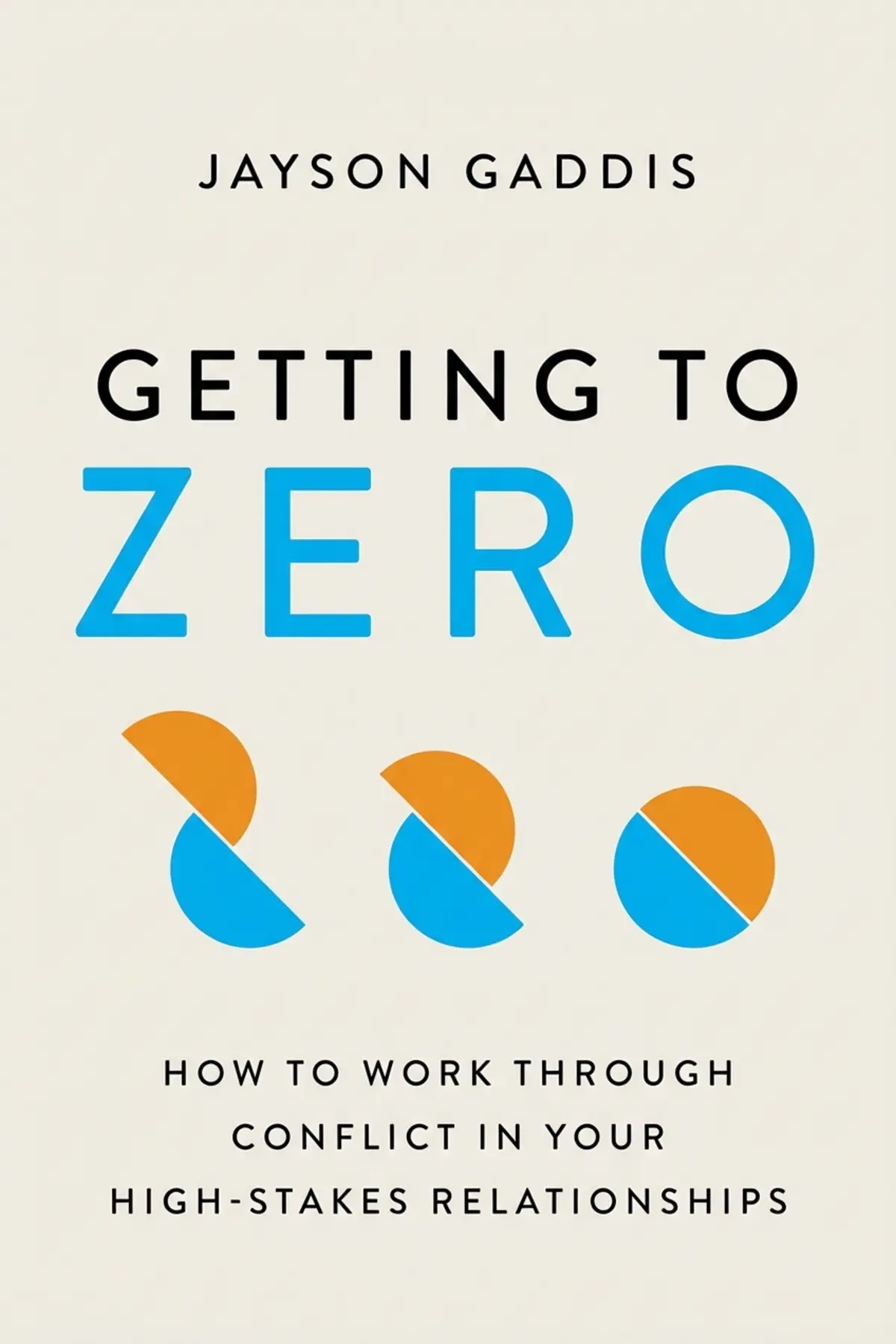
Table of Content
1. Introduction
1 min 11 sec
A fight with a partner, a parent or a close colleague can sit in your chest for days. Jayson Gaddis offers a clearer explanation than bad luck or bad character. In Getting to Zero, the relationship coach argues that most clashes between people who matter to each other start the same way: someone feels threatened because the other came too close or drifted too far. Zero is his name for the connection you return to once a conflict is truly settled.
Gaddis treats disconnection as a normal part of any close relationship. The problem is that few of us were ever taught the repair. His method rebuilds it in steps: notice how you react, map the conflict honestly, steady your own feelings, listen until the other person feels understood, then speak with ownership and agree on what comes next.
Each step comes with a tool to try on a real disagreement, from a nine-row box drawn on paper to matching eight-move scripts for listening and speaking.
2. Catch the moment closeness or distance sets you off
1 min 43 sec
A raised voice and an unanswered message seem like opposite problems. Gaddis shows they trigger the same alarm, and that each of us answers it with one favorite reflex that usually makes things worse.
3. See how old family patterns still shape your fights
1 min 49 sec
Some people panic when a text goes unanswered, while others crave a locked door. Gaddis traces both reactions to something laid down long before your first argument as an adult.
4. Put one stuck conflict on paper and face it
1 min 49 sec
Keeping the peace feels like the safe choice with a difficult person. A single sheet of paper with nine rows reveals what that peace is really costing you, and who it is protecting.
5. Stay steady when your feelings run high
1 min 43 sec
Relationships rarely end over big betrayals alone; small bumps sink them too. Gaddis names the hidden limit that decides how much a hard conversation can hold, and a five-minute practice for raising it.
6. Make the other person feel truly heard first
1 min 51 sec
Most of us start defending ourselves within seconds of a complaint. Gaddis offers an eight-move way of listening that deliberately leaves one thing out, and he explains why an early apology can backfire.
7. Speak your truth without starting a new fight
1 min 47 sec
You finally get your turn, and the urge is to lead with everything that hurt. Gaddis’s speaking method puts your complaint somewhere surprising, and the placement is what lets it be heard.
8. Name the kind of fight you're having and resolve it
1 min 45 sec
The argument about the toothpaste cap is rarely about toothpaste. Gaddis sorts most conflicts into five types, and one of them will keep returning no matter how well you talk.
9. Conclusion
1 min 20 sec
What Gaddis offers is a way to treat conflict as a loop you can learn to close. You first learned that loop by watching adults. Now it is your responsibility, which means dropping the common escape routes: blaming the other person, which moves the solution somewhere over there, or blaming yourself, which is collapse in another form. Owning your part answers both.
He also urges putting agreements in place early in high-stakes relationships, so you react less and reach zero faster. Some are formal, like a prenuptial agreement, a coparenting plan for pickups and drop-offs, or a legal agreement between business partners. Others are simple promises to own your part next time and to speak with respect. Gaddis even suggests an agreement to make clear agreements, so nobody ends up fighting over what one meant.
Begin with a single name at the top of a conflict box, and run NESTR before you pick up the phone. If you and a partner stay stuck, he recommends sessions with a trained couples therapist, as long as you both truly want to be there, and patience if issues have been bottled up for years. Conflict will keep arriving. Zero is the place you learn to return to, a little faster each time.
About this book
What is this book about?
Most people either avoid conflict with the people closest to them or fight in ways that leave everyone more hurt. Jayson Gaddis argues that disconnection is a normal part of any relationship that matters. The real skill is repair: getting back to zero, his word for a state of connection. He explains where conflict comes from, a sense of threat triggered by too much closeness or too much distance, and how your childhood relationships shaped the way you react today. Then he offers a set of tools. A nine-row conflict box maps one stuck issue. The NESTR practice steadies your own emotions. Two matching eight-step processes, LUFU for listening and SHORE for speaking, carry you through the conversation itself. Readers also learn to recognize five common types of fight, from arguments over the dishwasher to clashes of values, and to make agreements that keep old conflicts from coming back. The result is a practical method for partners, families, friends and colleagues who want honesty without losing the relationship.
Book Information
Who it's for
Couples with recurring arguments
Couples who keep having the same argument and want a way to actually finish it.
Putting off hard conversations
People who avoid hard talks with a parent, sibling or old friend and feel the cost building.
Repairing work relationships
Team leads and business partners who need to repair working relationships without blame.
About the Author
Jayson Gaddis
Jayson Gaddis is a writer and speaker focused on interpersonal conflict and how people can work through it. As founder of The Relationship School, he runs a company that helps individuals, couples and teams settle their differences, and he hosts the Smart Couple Podcast. He developed Interpersonal Intelligence, Present Centered Relationship Coaching and the Getting To Zero Method. He lives with his wife and two children in Boulder, Colorado.
Ratings & Reviews
Ratings at a glance

What people think
Listeners find the book’s suggestions both pragmatic and effective for settling disputes, describing the work as a game-changer in relationship and conflict management. The writing style is straightforward, and listeners value the deep impact, with one noting it's life-altering from start to finish. They prize how simple it is to use, with one mentioning it's easy to apply principles to everyday situations, and its power to cultivate more meaningful connections.
Top reviews
Orawan
This book is a masterclass in human interaction. Instead of just preaching vague concepts about 'loving more,' Gaddis provides a concrete roadmap that centers on neurobiology and actual developmental psychology. The truth is, most of us were never taught how to resolve friction properly. We either explode or shut down. I found the NESTR meditation particularly grounding because it forces you to deal with your own internal storm before you try to fix the other person. It’s a game-changer for anyone in a high-stakes relationship. The writing is down-to-earth and devoid of that annoying self-help fluff. You really have to be willing to look at your own role in the mess to see results. If you are ready to stop the cycle of recurring arguments, this is your manual. It is life-altering from start to finish.
Show moreKatya
Wow, I didn’t realize how much I was sabotaging my own connections until I reached the chapter on roadblocks to reconciliation. Personally, I’ve always been a 'bottler,' and this book showed me exactly why that leads to disaster. Gaddis doesn't offer any illusions or shortcuts here. He is very clear that you have to do the work. The concept of 'getting to zero' by understanding how to listen during the heat of the moment has transformed how I talk to my partner. We are finally having the difficult conversations we avoided for a decade. It’s refreshing to read a book where the anecdotes are used sparingly and the actionable advice takes center stage. This feels like a user guide for humans that should have been handed out in high school.
Show morePatcharaporn
The concept of 'getting to zero' isn't just a catchy title; it's a profound shift in how we approach the inevitable friction of life. Standing on the shoulders of giants in the psychology field, Gaddis has distilled complex relational studies into something graspable for the average person. I loved the lack of fantasy here. He admits that even he and his wife struggle, which makes the advice feel authentic and achievable. No perfection, just a dance with occasional foot-stomping. The nuggets of gold found in the chapter about easing conflict through agreements have saved us so much time and energy. It’s a veritable wealth of experience packed into a few hundred pages. If you want to build a relationship that actually lasts through the trials, buy this book immediately.
Show moreJirapat
Ever wonder why the same arguments keep happening over and over again in your house? This book finally gave me the answer. Jayson’s approach to resolving conflict is hands-on and requires deep reflection. There are no shortcuts offered, which I actually found very refreshing. The specific detail about recognizing roadblocks was a game-changer for me. It helped me see that my 'apologies' were actually making things worse. In my experience, if you actually do the workshops and don't just skim them, you will see a massive shift in your dynamics. It’s a powerful tool for anyone looking for personal growth and more meaningful connections. I would recommend this book to anyone who is tired of the cycle of fighting and wants real, lasting peace.
Show moreRod
Jayson Gaddis has managed to distill decades of relational science into what feels like a user guide for the human heart. There is no illusion of this being easy. He presents a roadmap that leads through discomfort to something truly fabulous. I found the section on making agreements to be the most actionable part of the book. It’s not about winning an argument; it’s about getting back to a place of connection. To top it off, his honesty about his own 'foot-stomping' moments in his marriage makes the whole thing feel human. There is grace and kindness in his tone, but he doesn't shy away from the hard truths. This book is a veritable gold mine of nuggets for anyone who wants to stop fighting and start relating.
Show moreFon
Finally got around to reading this after a friend recommended it for my marriage. I opted for the audiobook initially, but I quickly realized that was a mistake. This isn't a passive listen while you fold laundry; it’s a rigorous workbook. To be fair, you need a physical copy so you can actually journal through the workshops and exercises provided at the end of the chapters. The advice on making specific agreements to ease conflict was incredibly practical for us. It helped us move past some major roadblocks that had been lingering for years. My only gripe is that it can feel a bit repetitive in the middle sections, but the core message is vital. It’s a very informative and easy-to-follow guide for building more meaningful relationships. Just make sure you are prepared to do the heavy lifting.
Show moreRosa
As someone who usually avoids conflict like the plague, 'Getting to Zero' felt like a necessary, albeit uncomfortable, wake-up call. Jayson Gaddis has a way of explaining triggers and reactions that makes you feel seen rather than judged. I really appreciated the focus on 'getting outside help' if you're stuck. It’s a realistic take that acknowledges a book can’t solve everything if both partners aren't fully onboard. The breakdown of how to recognize your own role in a fight was a springboard for some much-needed personal growth. While some of the neurobiology felt a bit dense at times, the overall impact on my daily interactions has been huge. It’s down-to-earth and incredibly effective for conflict resolution. Definitely a solid addition to my shelf.
Show morePenelope
After hearing about the NESTR meditation technique on a podcast, I picked this up to help manage my own emotional triggers during heated moments. The writing style is very accessible and the advice is practical enough for everyday situations. I particularly liked how he broke things down by types of conflict. It’s not just for romantic relationships; I’ve used these tools with my coworkers and parents too. Frankly, some of the exercises are quite challenging and force you to look at parts of yourself you’d rather ignore. But that’s where the growth happens. It’s a solid user guide for humans that focuses on the reality of being in relationship with others. My only wish is that it had a few more diverse examples of relationship structures.
Show moreIsabella
To be fair, the content here is solid, but the pacing felt a bit bogged down by the sheer number of workshops and repetitive analogies. I found the NESTR meditation to be a bit difficult to integrate into my actual life during a real-time argument. It sounds great on paper, but in the heat of the moment, I just wanted a quick fix. However, I gotta say that the sections on identifying triggers were very eye-opening. The book is informative, but it requires a level of dedication that might be a bit much for some people. If you aren't ready to spend hours reflecting on your childhood and patterns, this might feel a bit tedious. It’s a good resource, but definitely not a light read.
Show moreAisha
Look, I really wanted to love this, but it felt a bit repetitive for me personally. The author spends a lot of time on his own experiences, and while some anecdotes are okay, I felt like the core message could have been half the length. Not gonna lie, I struggled to finish it. I do think the advice on listening and speaking during conflict is okay, but I’ve seen similar things in other self-help books. If you’ve never read anything on relationship psychology, you’ll probably find it life-altering, but for me, it didn't offer enough new perspective to justify the time commitment. It’s easy to apply in theory, but the execution of the book itself felt a bit dry.
Show moreQuestions about this book
What is the main idea of Getting to Zero by Jayson Gaddis?
Gaddis argues that conflict in close relationships is a normal cycle of connection, disconnection and reconnection. Most fights start when someone feels threatened by too much closeness or too much distance. Getting to zero means returning to connection, and he teaches it in steps: know your reflexes, map the conflict, steady your emotions, listen until the other person feels understood, speak with ownership and make agreements.
What is the LUFU method in Getting to Zero?
LUFU stands for Listen Until they Feel Understood. It has eight moves: be curious, reflect back what you hear, check you are on the same page, pause to take it in, empathize, validate with words like that makes sense, own your part without justifying it, and confirm a shared reality by asking whether the other person now feels understood. Only after a yes do you speak.
How does Getting to Zero help with your own emotions during a fight?
Gaddis says others trigger your feelings rather than cause them, and the discomfort you can tolerate is your emotional discomfort threshold. To raise it he teaches NESTR, a five-minute practice: rate your discomfort with a number from zero to ten, name the emotion, notice body sensations and thoughts, then find a grounded, resourced place in yourself. With practice, your number stays nearer zero.
What are the five common conflicts Jayson Gaddis describes?
He names surface fights over small things like the dishwasher, childhood projections where old experiences color the present, security fights when someone doubts the other’s commitment, often about money or sex, value differences over matters like religion or parenting, and resentments that grow when one person tries to change the other. Identifying the type shows what the conflict is really about.
Featured in
Readers also enjoyed









AUDIO SUMMARY AVAILABLE
Listen to Getting to Zero in 15 minutes
Get the key ideas from Getting to Zero by Jayson Gaddis, plus 5,000+ more nonfiction titles.
- 5,000+ titles
- Listen as much as you want
- 7-day free trial
- Cancel anytime









