

13 min 37 sec
Available in: English
Process!: How Discipline and Consistency Will Set You and Your Business Free
Shows growing businesses how a handful of simple, written processes, backed by training, measurement and a disciplined culture, free founders from daily firefighting and give them time to innovate, as long as those processes keep evolving.
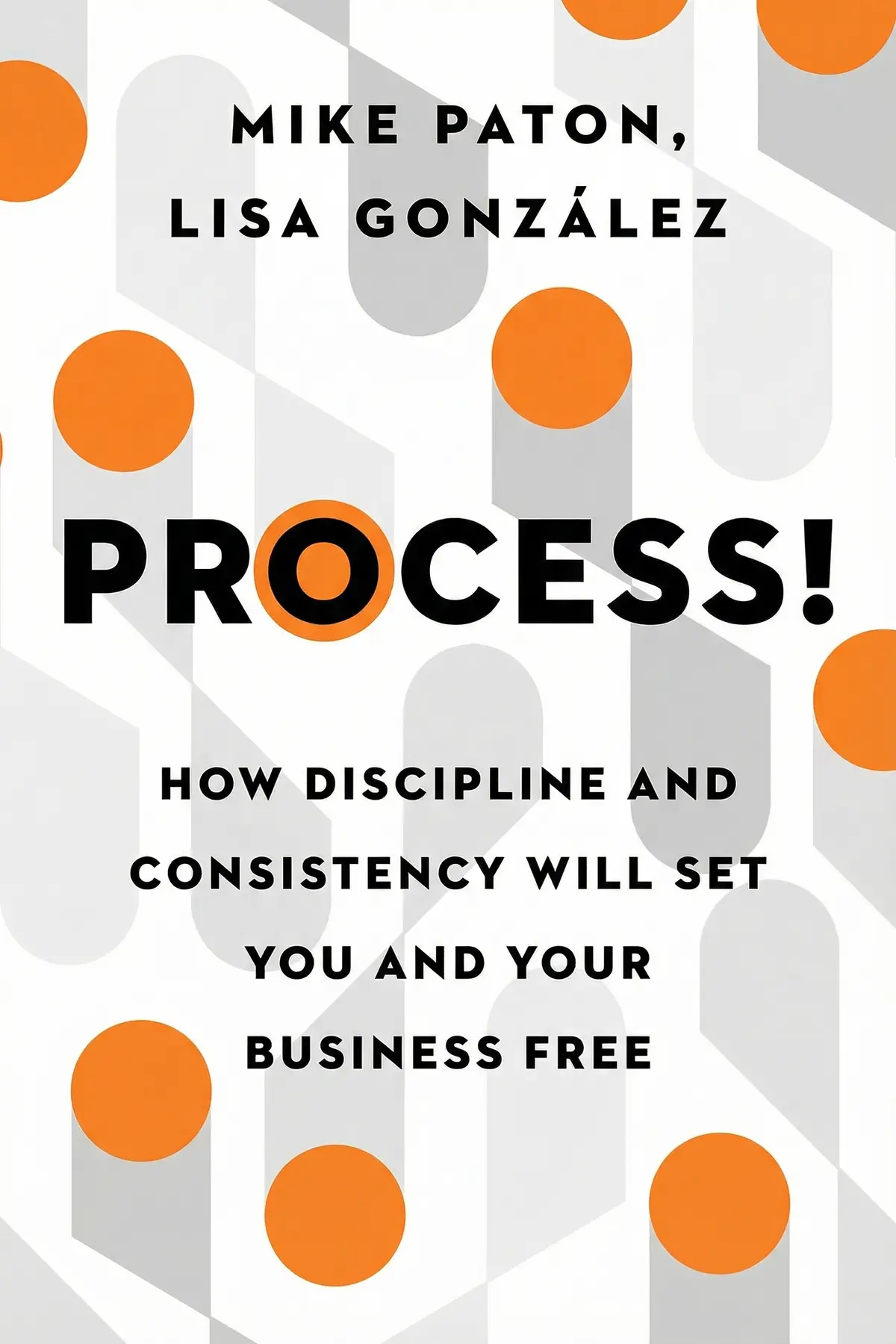
Table of Content
1. Introduction
1 min 00 sec
If your company still runs on your own energy and late nights, growth probably feels heavier with every new hire. In Process!, Mike Paton and Lisa González argue that the fix is the very thing many founders resist: a small set of simple, written processes that everyone follows. The passion behind Henry Ford’s first Model T in 1908, or behind Sara Blakely taking Spanx to $4 million in its first year, gets a business off the ground, they say, but it stops working as the company climbs. Something steadier has to take over.
Their case is that discipline, done well, is what frees a leader to create. The book shows how to choose the few processes that matter, write them so people can use them, train and measure until they hold, build a culture that keeps them alive, and refresh them before the market leaves them behind. Each step comes with a business that got it wrong or right, from a fintech startup to a family print shop.
2. Turn routine work into room to create
1 min 48 sec
Two startups chase the same payments market. One runs on brilliant founders fighting fires; the other looks almost dull. Only one of them can survive its own growth, and the reason upends what most founders believe about rules.
3. Build your core processes in three steps
2 min 00 sec
A busy app team fears that writing things down will bury it in paperwork. The authors show a route that ends with far fewer documents than most leaders expect, and a surprising rule about the first step.
4. Get your team to actually use the checklists
1 min 54 sec
A landscaping firm wrote perfect checklists, and six months later its crews were still making costly mistakes. The missing piece had nothing to do with the documents themselves, and it is the one most companies skip.
5. Use a stopwatch to speed up your team
1 min 47 sec
An operations manager swore the loading dock could not move any faster. Then the boss walked down with a simple tool and said one number out loud, and the drivers did the rest.
6. Make discipline a habit by going first
1 min 54 sec
An accounting firm had strong processes and well-trained staff, yet people kept cutting corners in the busy season. What finally made the change stick started at the very top of the firm.
7. Keep perfect processes from sinking your business
2 min 02 sec
A family print shop was admired for decades of flawless discipline. That same discipline was steering it toward irrelevance, and the fix it found offers a yearly habit any business can borrow.
8. Conclusion
1 min 12 sec
Process! makes a claim that sounds backward to many founders: the way to keep a company inventive is to make most of its work plain and repeatable. Passion starts a business, as it did for Ford and Blakely, but passion alone cannot carry a growing team. A few simple, written routines can, provided people are trained in them, can see their numbers, watch their leaders follow the same rules and revisit the whole system before it ages. Skip any of those and the checklists turn into decoration, or worse, into a careful way of doing obsolete work.
The book points to a modest place to begin. List the five to 12 processes that drive most of your results, and give each one an owner who watches it run before changing anything. Write the result on a single page and put it where people work. Then pick one number, time it the way that CEO timed his loading dock, and share it every week.
The payoff the authors describe is personal as much as commercial: a leader who no longer spends every night putting out fires, and finally has time for the next idea.
About this book
What is this book about?
Passion gets a company started, but it rarely carries one through growth. As teams expand, founders end up fighting fires, knowledge lives in a few people's heads and every new hire adds confusion. Many leaders still resist process, fearing it will smother the creativity that built the business. Mike Paton and Lisa González argue that the reverse is true. Well-designed processes take routine decisions off the leader's desk and make the business run consistently, which leaves room for strategy and new ideas. Their method starts with identifying the five to 12 core processes that drive most results, then simplifying, documenting and packaging them so people can find them. From there the authors turn to what makes processes hold: training, a few visible metrics, leaders who follow the rules themselves and an annual review that keeps every process current. Readers follow businesses from a fintech startup and a meal-planning app to a landscaping crew, an accounting firm and a family printing company, and get practical steps for building a system that frees them from the daily grind.
Book Information
Who it's for
Founders and owners
Founders and owners of growing small companies who spend their days fighting fires.
Operations managers
Operations managers asked to make a fast-growing team work consistently.
Team leads
Team leads whose written procedures exist on paper but rarely get followed.
About the Author
Mike Paton
Mike Paton started in banking and went on to run or help run four growing small companies. He discovered the Entrepreneurial Operating System, known as EOS, while leading a $7 million company in Minneapolis. He later succeeded its creator Gino Wickman as Visionary at EOS Worldwide, has led more than a thousand full-day EOS sessions and hosts the podcast The EOS Leader. Lisa González practiced law in Denver before joining a start-up remodeling firm, where she put EOS in place as it grew past $20 million in revenue and became consistently profitable. She is now a professional EOS Implementer.
Ratings & Reviews
Ratings at a glance

What people think
Listeners find this book highly informative, and one listener remarks that it acts as a gold standard for process establishment. The writing is praised for its readability, with one listener noting that the guide is a must-read for owners.
Top reviews
Daranee
This book serves as the gold standard for any entrepreneur who feels like their business is running them rather than the other way around. Paton and González provide an incredibly clear roadmap for implementing the Entrepreneurial Operating System (EOS) specifically through the lens of process documentation. I’ve always been skeptical of rigid rules, but the authors successfully argue that discipline actually creates more freedom for innovation. The '20/80' approach is a total game-changer because it prevents you from getting bogged down in useless minutiae. Instead of a 500-page manual, you focus on the 5 to 12 core processes that actually move the needle for your company culture. While some might find the lack of storytelling a bit dry, the sheer volume of actionable templates and checklists makes it worth every penny. It’s a fast read, but the impact on your operational efficiency will be long-lasting if you actually do the work.
Show moreMoon
As someone who has always prioritized creativity over rigid structure, I was pleasantly surprised by how much I enjoyed 'Process!' and its systematic approach. The authors do a fantastic job of simplifying complex business improvement strategies into turnkey resources that you can use tomorrow. One of my favorite takeaways was the Isadore Sharp quote about systematizing the predictable to humanize the exceptional. It changed my entire perspective on what a manual should be. The book is dense with knowledge, and even though it lacks a narrative arc, the motivation it provides is real. We are currently using the 'Federal Way' approach to train our new hires, and the leading indicators on our scorecard are already looking better. This is a must-read for owners who want to scale without losing their minds. It's essentially a toolkit for long-term success and uniformity across multiple departments.
Show moreBond
Wow, Paton and González really nailed the struggle between founder freedom and organizational discipline in this volume. I bought a copy for my entire leadership team because we were all struggling with how to maintain our 'secret sauce' while we grow. The book makes a compelling case that robust processes are the foundation of a vibrant company culture, not a hindrance to it. I loved the emphasis on 'KISS'—Keep It Simple, Stupid—when documenting core workflows. We’ve already started our first 90-day cycle of identifying our 5-12 most important repeatable processes. The turnkey templates provided at the back are worth the price of the book alone. If you are serious about enhancing your business operations to ensure long-term success, you need this on your desk. It’s a quick, high-impact read that cuts through the fluff and gets straight to the results.
Show moreKwan
Ever wonder why your business feels like a chaotic fire drill every single Monday morning? This book finally gave me the language to explain why our scaling efforts were failing despite having a great team. The authors break down the three-step process of identifying, documenting, and packaging your core workflows in a way that feels achievable for a busy founder. I particularly appreciated the distinction between 'back stage' and 'front stage' processes, which helped us rethink our customer service strategy. Look, it isn't a thrilling beach read, and the tone is very 'standard business manual,' but the clarity it provides is immense. We’ve already started drafting our 'Secret Sauce' processes using their templates. My only gripe is that it assumes you have a leadership team ready to jump on board immediately, which isn't always the reality for struggling startups.
Show moreNadia
Picked this up because our company is hitting those painful growth walls where everything starts breaking. I’ve read a lot of business theory, but Paton and González keep things refreshingly practical and concise. They tackle the common founder objection that 'process kills creativity' head-on, proving that systems actually allow employees to focus on the exceptional work. The 3-Step Process—Identify, Document & Simplify, and Package—is easy to remember and even easier to explain to a skeptical staff. I did feel that some of the sections on tech and ERPs were a bit rushed, and I would have liked more advice on handling 'process rebels' in the workplace. However, the focus on 'Followed By All' is exactly the kick in the pants our management team needed. It’s a solid, functional guide for anyone looking to build a sustainable company culture rooted in discipline.
Show moreSumalee
Finally got around to reading this after my business coach kept harping on the 'Followed By All' principle. I was worried it would be too dry, but the authors keep it moving quickly with a focused and concise approach. The case studies, while brief, do a good job of illustrating how to identify the 20% of activities that produce 80% of the results. I especially liked the 'Package' step, which emphasizes making processes easy for employees to find and use in the field. It’s one thing to have a manual on a shelf, and quite another to have a 'living' document that actually drives day-to-day work. I’ll admit it’s a bit of a 'how-to' manual for a specific system, but the logic is sound regardless of your software. It provides much-needed clarity for founders who are drowning in the 'how' of their daily operations.
Show moreWittaya
After hearing about this title from several other founders in my network, I decided to see if it lived up to the hype. Personally, I think it’s a vital addition to the EOS library, even if it feels a bit like a 'glorified article' at certain points. The focus on making processes 'Followed By All' is where most businesses fail, and this book gives you the actual tools to fix that. I really appreciated the tips on how to integrate these systems during L10 meetings and one-on-ones. It’s not just about writing things down; it’s about the 'Measure' and 'Manage' steps that ensure people actually use what you’ve built. My only complaint is that some of the advice feels slightly repetitive if you’ve already read 'Traction.' Still, for a small business looking to create uniformity and scale, this is an excellent, actionable resource that provides immediate clarity.
Show moreGung
Not what I expected in terms of depth, though the practical templates are undeniably useful for anyone already committed to the EOS framework. The truth is, I thought I knew everything about documenting workflows, but this book showed me I was overcomplicating things way too much. The advice to keep core processes between one and five pages is a great tip that I will definitely be implementing. However, the writing style is very repetitive, and it often feels like it’s checking boxes rather than exploring the nuances of business operations. It’s a helpful guide for a small business looking to create scale, but it lacks the 'wow' factor of more comprehensive leadership books. It’s a functional tool, not a revolutionary manifesto. If you want a quick checklist to get your team on the same page, buy it; if you want deep strategy, look elsewhere.
Show moreYindee
The truth is, while the 20/80 approach to documenting core processes is smart, the writing itself is incredibly dry and feels a bit like a textbook. I appreciate that it’s part of the EOS ecosystem, but for those of us not fully immersed in that world, some of the jargon can be a bit off-putting. To be fair, the advice provided for startups and early-stage companies poised for high growth is solid and easy to follow. I found the section on 'Leading Indicators' to be the most helpful part of the entire book. It’s definitely a handy manual if you need a step-by-step guide to creating repeatable procedures. I just wish there were more real-world stories to break up the technical instructions. It took me longer to get through than I expected because it’s just a lot of pure information without much 'soul' to the writing.
Show moreLars
Frankly, I found this to be more of a glorified article than a full-fledged business book. While the core message that processes are important is undeniably true, the content felt incredibly thin and narrowly focused on those already deep into the EOS ecosystem. If you aren't already using their specific terminology, a lot of this might feel like marketing material for their consulting services. To be fair, the 'Followed By All' (FBA) checklist is a decent tool for accountability, but I expected more depth for the price. The book is very small and doesn't offer much in the way of case studies or narrative to keep the reader engaged. It’s a handy manual if you want a quick summary, but don’t expect a deep dive into complex organizational behavior. It basically boils down to: document your stuff and make people follow it.
Show moreQuestions about this book
What is the main idea of Process! by Mike Paton and Lisa González?
The authors argue that well-designed processes free a business instead of constraining it. When routine work is simplified, documented and followed by everyone, founders stop firefighting and gain time for strategy and new ideas. That only works, they say, when processes are backed by training, a few visible metrics, leaders who follow the rules themselves and regular updates as the market changes.
How many core processes should a business document?
Paton and González recommend five to 12 core processes, chosen with the 80/20 rule: the few that drive most of your results, spread across departments such as onboarding, accounting and customer support. Each gets an owner who first observes how it runs today, then decides what to add, cut or change, and writes it up as a one-page checklist kept where people work.
Why do documented processes often fail to stick?
In the book’s landscaping example, the checklists existed but nobody had been trained to use them, so mistakes continued for months. The authors recommend walk-throughs, mentoring, role-play and videos of top performers. Even then, an accounting firm saw people slip until leaders held weekly check-ins, praised process wins and reviewed their own checklists before every client meeting.
How often should a company update its processes?
At least once a year, according to the authors. Gather feedback from frontline staff, customers and industry peers, look for new pain points and technology, then improve one or two processes per quarter and test changes on a small scale first. A family printing company that did this after decades without change recovered its position within a year.
Who should read Process!?
It suits founders and owners of growing small businesses who feel trapped in daily operations, operations managers trying to bring consistency to an expanding team, and team leads whose procedures are written but ignored. Its examples range from a fintech startup and a meal-planning app to a distribution company that cut loading times with a stopwatch and a 30-minute target.
Readers also enjoyed





A Year with Peter Drucker: 52 Weeks of Coaching for Leadership Effectiveness
Joseph A. Maciariello



Acting with Power: Why We Are More Powerful Than We Believe
Deborah Gruenfeld

All In: How Great Leaders Build Unstoppable Teams
Mike Michalowicz

AUDIO SUMMARY AVAILABLE
Listen to Process! in 15 minutes
Get the key ideas from Process! by Mike Paton, plus 5,000+ more nonfiction titles.
- 5,000+ titles
- Listen as much as you want
- 7-day free trial
- Cancel anytime









