
Chaos: Making a New Science
James Gleick
 English
 ไทย
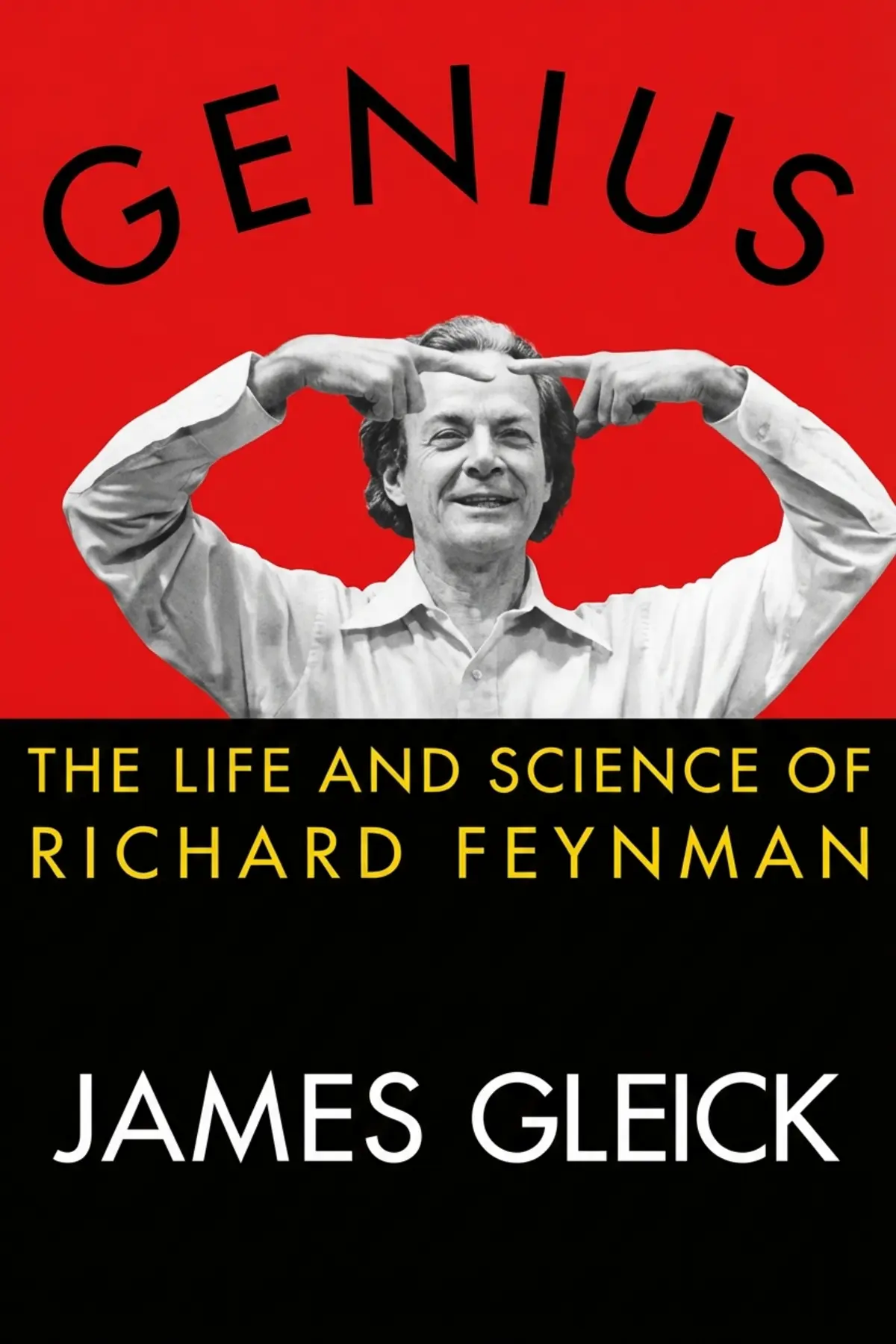
Follows physicist Richard Feynman from a childhood spent learning how things really work to the atomic bomb, the Nobel Prize and legendary lectures, revealing the thinking habits behind his originality and what they cost him.
1 min 00 sec
Most of us learn the names of things and mistake that for understanding them. In Genius, former New York Times reporter James Gleick tells the life of Richard Feynman, a physicist who learned as a small boy that knowing a bird’s name in three languages tells you nothing about the bird. That lesson, drilled in by his father, became a way of thinking that carried Feynman from math contests to the atomic bomb, a Nobel Prize and lectures that professors still study.
Feynman is not a household name, and Gleick explains why. He left no single grand theory. What he left was a method: picture problems from the inside, insist on knowing how things actually happen, and work everything out for yourself. Follow his life and you get more than a portrait of a brilliant eccentric. You get habits for thinking clearly that travel far beyond physics, along with an honest look at what they cost.
1 min 45 sec
Before he could talk, Feynman’s father was already shaping how he would think. A walk spent naming birds in three languages taught him a lesson about knowledge that later made him furious at school textbooks.
1 min 42 sec
A hat drops off a rowboat, and the puzzle hands contestants speeds and times to work with. Feynman ignored them all and answered almost at once, using a trick he kept for the rest of his career.
1 min 39 sec
The same mind that hunted for physics problems in the hallways of MIT scored worst in English and art history, and its owner nearly paid for that with his future.
1 min 54 sec
At 25, Feynman was put in charge of a team at the secret heart of the atomic bomb effort. Older physicists doubted his strange ideas, until something kept happening.
1 min 55 sec
Feynman saw equations in color and drew pictures that changed how quantum physics was written. Yet when reporters arrived at his door after the Nobel announcement, he could not make them understand his work.
1 min 48 sec
Students dropped out of Feynman’s introductory course, and professors rushed to take their seats. The books made from those lectures failed as textbooks, yet many teachers say they changed how they saw physics.
1 min 45 sec
He played bongos in Brazil and told tall tales that became best sellers. His strangest habit, though, was refusing to read the one page of a scientific paper that most people read first.
1 min 21 sec
Feynman never gave physics one famous theory, which is part of why his name means little outside the field. Gleick’s case is that he gave it something harder to see: a way of looking. The boy who learned that a bird’s name says nothing about the bird grew into the man who imagined himself as an electron, drew diagrams that spared physicists pages of calculation, and helped professors see their own subject again. Every scientist who met him counted him among the sharpest minds in physics, and his methods still sit inside how experiments are judged.
His life also shows the cost of thinking this way: weak marks in English and art history, a near rejection from Princeton, and fine ideas that never reached print.
What is worth keeping is the habit, used with more care than he sometimes showed. When an explanation only names a cause, push for what actually happens, the way he rewrote the line about worn shoe soles. When a problem is thick with numbers, put yourself in the place of the thing that moves and see which ones fall away. And before reading how someone else cracked it, try it yourself. A name, as Feynman learned on that mountain walk, is only where understanding begins.
Richard Feynman helped shape twentieth-century physics, especially quantum physics and superfluidity, yet most people have never heard of him. In Genius, James Gleick explains why. Feynman left no single landmark theory. What he gave physics was a way of seeing problems and a set of practical methods for solving them, and those methods still shape the field today. Gleick traces that way of seeing back to Feynman's father, a salesman who taught his son that names explain nothing and that knowledge means understanding what things do. The story follows the habit through timed math contests and a lopsided education at MIT. It continues with a leading role on the Manhattan Project at 25, the diagrams that simplified quantum physics, a Nobel Prize in 1965 and lectures that professors still treasure. Readers get a vivid portrait of an original and sometimes difficult mind. They also get thinking habits they can borrow: picture a problem from the inside, demand the real mechanism behind any explanation, and try to solve things yourself before reading someone else's answer.
Professionals who know the jargon of their field but want to understand how things really work.
Teachers, trainers and team leads who want to build problem solvers instead of memorizers.
Science-curious readers who want the human story behind Feynman diagrams and the atomic bomb.
James Gleick was born in New York City in 1954 and studied English and linguistics at Harvard College. He worked for a decade as a reporter and editor at the New York Times and later wrote the Fast Forward technology column for its magazine. Chaos, his 1987 international bestseller, made the Butterfly Effect a household phrase. Three of his books were finalists for both the Pulitzer Prize and the National Book Award, and in 2012 The Information earned the Royal Society Winton Prize for Science Books.
James Gleick
James Gleick

Listeners find this biography compelling and expertly crafted, featuring accessible descriptions of intricate scientific theories. This volume delivers an absorbing perspective on Feynman's journey, with one listener highlighting how it merges his life story with his professional achievements. They admire the author's study of brilliance and the individualistic nature of the physicist.
This biography is a masterful blend of personality and hard science. Gleick doesn't just list achievements; he weaves the development of quantum electrodynamics into the very fabric of Feynman's eccentric character. Frankly, it’s rare to find a science writer who can explain path integrals and the Challenger disaster without losing the human element. The prose is sharp, reflecting the subject's own high standards for clarity and truth. While some parts of the physics might be dense for a casual reader, the narrative momentum never falters. You walk away with a profound sense of what it means to be a "genius" in a world of mere smart people.
Show moreWow, what an incredible journey through the life of a man who refused to fool himself. The way Gleick synthesizes the technical brilliance of the Feynman diagrams with the raw grief of losing Arline is nothing short of poetic. This isn't just a dry list of dates and discoveries; it's a vibrant portrait of a human being who valued honesty above all else. Personally, I found the section on the Challenger investigation to be the most compelling part of the entire narrative. Seeing Feynman use a simple C-clamp and ice water to dismantle a bureaucratic disaster was the perfect illustration of his genius. It’s a thick book, but every page feels essential to understanding the man's legacy.
Show moreFinally got around to reading this classic, and I’m struck by how modern Feynman’s ideas still feel. He was thinking about nanotechnology and quantum computing decades before they became buzzwords. Gleick does a fantastic job of capturing the "boy who fixed radios by thinking" and turning that childhood curiosity into a grand scientific narrative. Not gonna lie, some of the math-heavy sections went over my head, but the overall message about curiosity and integrity resonated deeply. He was a hazardous role model, sure, but his sweeping skepticism is something we need more of today. This is easily one of the best biographies I’ve ever encountered.
Show moreJust finished Gleick’s biography and I’m still buzzing from the sheer intellectual energy of it. It’s a brilliant exploration of how one man’s refusal to succumb to "emeritus disease" kept his mind agile until the very end. The book captures his anti-pretension perfectly, showing a Nobelist who would rather solve a puzzle than attend a fancy gala. While I agree with some critics that he could be insufferable at parties, his honest search for truth is genuinely inspiring. This is a must-read for anyone interested in the limits of human intelligence and the joy of discovery. Truly a masterclass in biographical writing.
Show moreEver wonder why Richard Feynman is still the ultimate poster boy for physics? Gleick explores this beautifully, balancing the iconoclastic bongo player with the man who helped build the atomic bomb. Truth be told, I was more captivated by the chapters on Los Alamos and his heartbreaking relationship with Arline than the actual Nobel-winning QED work. The book illustrates how his "disregard for what others are doing" was both his greatest strength and his most hazardous trait. Sometimes the author gets a bit too technical, but he usually pulls back just in time to show us the man. It’s an engrossing look at a mind that truly operated on a different frequency.
Show moreAs someone who usually finds physics intimidating, I was pleasantly surprised by how accessible Gleick makes the "un-visualizable" world of quantum mechanics. He treats Feynman not just as a person, but as a specific phenomenon of the 20th century. Look, the guy was clearly an arrogant jerk at times, and Gleick doesn't entirely hide the "pickup-artistry" or the scientism that can be so grating. But the book successfully argues that his anti-authoritarianism was a necessary catalyst for the breakthroughs he made. It’s a fascinating study of how a single mind can reframe an entire field of knowledge. I particularly loved the detail about his perfect physics GRE score vs. his mediocre grades in everything else.
Show moreThe chapter on the "War of the Magicians" at Los Alamos is worth the price of admission alone. Gleick provides a stunningly detailed look at how the pressures of WWII shaped the future of physics. It’s fascinating to see how Feynman navigated a world filled with other giants like Oppenheimer and Bethe, yet still stood out. I gotta say, the explanation of how he visualized electrons going backward in time as positrons was a lightbulb moment for me. The biography is balanced, though it leans heavily into the idea that Feynman was "different" from other first-rank minds. If you want to understand the 20th century's scientific evolution, this is the book to read.
Show moreAfter hearing Feynman speak at conferences years ago, I wanted to see if a biographer could capture his manic energy on the page. James Gleick succeeds by treating the science as a character in its own right. The narrative moves through the history of physics with a grace that is rare for such a complex subject. Personally, I think the book's greatest achievement is showing how Feynman’s "applied epistemology" allowed him to bypass the rigidity of his peers. He wasn't just solving equations; he was reinventing how we perceive reality. Even the bits about his "self-spun legend" felt authentic to the man I remember seeing on stage.
Show morePicked this up hoping for a light collection of anecdotes, but it turned out to be a much deeper, more rigorous examination. To be fair, Gleick falls into a bit of hagiography at times, occasionally glazing over Feynman’s more questionable social behaviors in favor of his scientific brilliance. The writing style is dense but incredibly rewarding if you’re willing to sit with the concepts of particle physics. I appreciated how the book tackled the "emeritus disease" and Feynman’s refusal to stop being an active, curious scientist. However, the pacing slows significantly in the middle sections concerning academic politics. It’s a solid 3-star read for me—highly informative but a bit of a slog in places.
Show moreNot what I expected after hearing all the "fun" stories about the bongo-playing genius. After finishing this, I've come to realize that Feynman was basically the original "douchebag" who used his high IQ to justify treating people like subhumans. Gleick tries to paint his "cheeky scientism" in a positive light, but the truth is that his behavior toward women and his disregard for his colleagues’ work is just icky. To be honest, the book made me lose a lot of respect for him as a person. While the writing itself is decent, I couldn't get past the subject's arrogance and his habit of not publishing important work. It’s a frustrating read that proves you can get away with anything if you're smart enough.
Show moreGenius is a biography of physicist Richard Feynman, born in 1918. Gleick follows him from a childhood in which his father trained him to think scientifically, through timed math contests, MIT and Princeton, leading a team on the Manhattan Project, inventing Feynman diagrams and winning the Nobel Prize in 1965, to his legendary Caltech lectures. The thread is a way of thinking: understand what things actually do, picture problems from the inside, and solve them yourself.
According to Gleick, Feynman left no single major theory that the public could attach to his name. His contribution was a different way of looking at the world and a set of practical methods for solving problems. Physicists still use his tools, for example to measure the light an atom gives off, and his analytical methods shape how experimental data is judged, but that kind of influence rarely makes someone famous.
Feynman introduced the diagrams in 1947, in work on how electromagnetic fields interact with charged particles. They gave physicists a far simpler way to grasp complicated equations, and in quantum physics they removed the need for every article to include long, painful calculations. Gleick connects them to Feynman’s lifelong habit of visualizing objects interacting across space and time, a habit that also helped earn him the Nobel Prize.
The book suggests a few habits. When an explanation only names a cause, ask what physically happens, as Feynman did with a textbook line about shoe soles. When a problem is full of data, imagine being the thing that moves, the way he pictured himself as a drifting hat. And before reading someone else’s solution, try the problem on your own first, as he did by skipping the results page of scientific papers.
It suits readers curious about how an original mind works, from students and engineers to managers who train others. Teachers and team leads will find value in how Feynman taught the process of solving problems over fixed routes to answers. Science-minded readers get the human story behind the atomic bomb, Feynman diagrams and the red books, including the costs of his independence.

Jonathan Eig

Lisa Kaltenegger

J. Craig Venter


Ishmael Beah

James Herriot


Barack Obama

AUDIO SUMMARY AVAILABLE
Get the key ideas from Genius by James Gleick, plus 5,000+ more nonfiction titles.









