
14 min 57 sec
Available in: English
Future Skills: The 20 Skills and Competencies Everyone Needs to Succeed in a Digital World
By Bernard Marr
Shows which skills will keep people valuable as AI takes over routine work, from reading data and spotting misinformation to empathy, creativity, adaptability and curiosity, with practical steps for building each one.
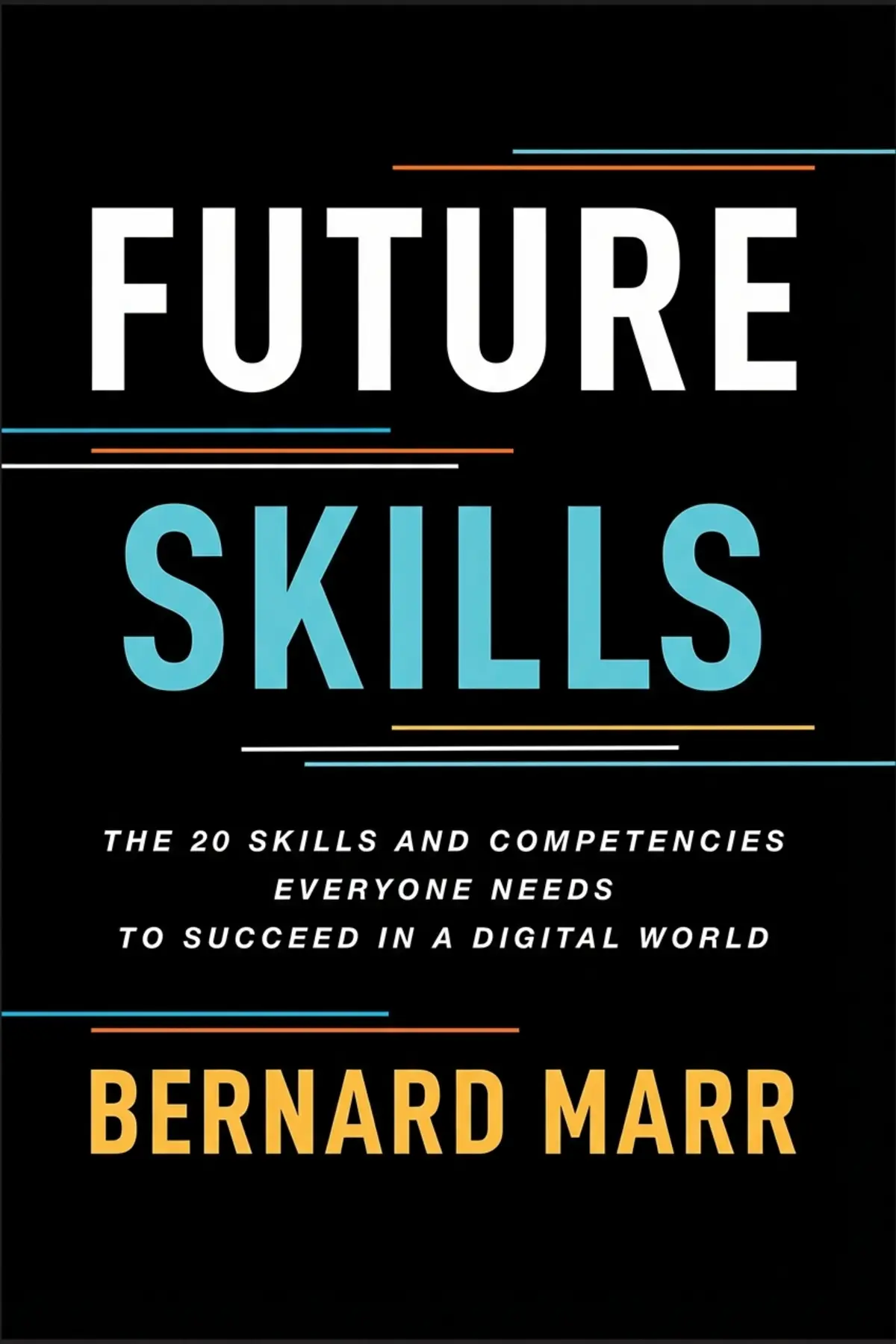
Table of Content
1. Introduction
58 sec
If you worry that software is coming for your job, Bernard Marr’s advice in Future Skills is to look at what software leaves behind. Marr, a futurist and advisor to companies and governments, cites a Dell and Institute for the Future forecast that 85 percent of the jobs on offer in 2030 have not been invented yet, and he reads that as good news. Whatever machines can automate, he argues, will be automated, and the work left over will need creativity, empathy, judgment and clear communication.
That is the line the whole book proves. The people who thrive will understand technology well enough to work beside it, then invest in human skills that anyone can learn. Marr lays out twenty of them. The ideas that follow gather the ones that matter most, from questioning data and spotting fake news to building a reputation and staying curious, each with a step you can take this week.
2. Find the work machines will hand back to you
1 min 48 sec
Millions of jobs will disappear and millions more will appear, yet the biggest change happens inside the jobs that survive. A digital double of the author shows what that looks like in practice.
3. Question data before it steers your decisions
1 min 46 sec
The world’s data is multiplying toward numbers with 21 zeros. Knowing how to question it, and how to protect your own accounts, turns out to matter more than knowing how to write code.
4. Think straight when your feed is lying
1 min 47 sec
Democrats wildly overestimate how many Republicans are wealthy, and more than half of Facebook users cannot spot a fake story that confirms their beliefs. A few plain habits keep you out of those statistics.
5. Read the feelings behind every message
1 min 56 sec
Software can now hear stress in a voice and read emotion in a heartbeat. Yet the salespeople who sold twice as much had something detection cannot supply, and screens strip most of it away.
6. Train creativity like any other skill
1 min 55 sec
Plenty of adults decided long ago that they are not the creative type. Employers are betting the other way, and the habits that build creativity are small enough to start before tomorrow’s first meeting.
7. Build a career that bends without breaking
1 min 44 sec
A third of American workers now take gigs, and your real reputation may be whatever a search engine shows. Handling that kind of world takes habits that most careers never taught anyone.
8. Curiosity is the one skill worth keeping
1 min 50 sec
Asked to keep a single skill out of twenty, the author picks one that costs nothing at all. It rests on a three-letter word, and it comes with a warning about the device in your pocket.
9. Conclusion
1 min 13 sec
Marr insists his book is no warning about robots stealing jobs, and he believes the future of work is bright. His case rests on a simple division of labor. Machines will automate whatever they can, from filming a video to scanning an X-ray, and hand people back the parts that need judgment, empathy, imagination and trust. The digital Bernard reads his articles aloud, yet the real Bernard still decides what they say.
That division gives an ordinary professional something steady to hold while job titles shift. You do not need to become a programmer. You need to be comfortable with the tools, skeptical of the numbers and posts that cross your screen, attentive to the people you work with and curious enough to keep learning.
Begin where the book is most concrete. Write down what the digital revolution means for your own job and how you will build the skills to meet it. Before you next share a post or quote a figure, trace it to its source and check its date. And keep a running list of things you don’t know yet, working through one each month.
The machines are learning fast. Marr’s wager is that people who keep learning about each other, and about themselves, will stay ahead of them.
About this book
What is this book about?
Work has changed enormously over the last twenty years, and Bernard Marr expects it to change faster still. Automation and AI are reshaping almost every job, and many of the roles today's students will hold have not been invented yet. Marr sets out to answer one question: how can an ordinary professional thrive in that world instead of just keeping their head above water? His answer is a set of human skills, with only a modest dose of technical ones. Machines will automate whatever they can, he argues, and the work left for people will need judgment, empathy, creativity, communication and critical thinking. He describes twenty future skills, from digital and data literacy and online safety to emotional and cultural intelligence, gig working, personal branding, time management and looking after yourself. He insists that every one of them can be learned. For each skill he explains what it is and why it matters, then gives practical steps and resources for building it. Readers get a clear sense of where they stand, which abilities employers are likely to value at a premium, and what to practice first.
Book Information
Who it's for
Professionals worried about AI
Professionals worried that AI will make their role obsolete and unsure what to learn first.
Planning to reskill teams
Managers, HR and learning leads planning how to reskill their teams for digital work.
Wanting skills that last
Career switchers, freelancers and students who want skills that will still matter in ten years.
About the Author
Bernard Marr
Bernard Marr advises companies and governments on strategy, business performance and digital transformation. His work covers artificial intelligence, big data, key performance indicators and analytics, and he coaches organizations on how to use them. He writes a regular column for Forbes and often contributes to the World Economic Forum, which keeps him close to the questions leaders are asking about technology and the future of work.
Ratings & Reviews
Ratings at a glance

What people think
Listeners value the book’s thorough and practical look at the skills required to succeed in the age of AI, although some feel the material acts more as a high-level overview than a detailed exploration. The practical tips are highlighted as especially useful, with one listener pointing out that every chapter ends with distinct "to-do lists" designed for both staff and leadership. Furthermore, they like how the author presents technological progress as a chance to enhance specific human traits such as critical thinking and emotional intelligence. They also observe that the writing is straightforward and avoids jargon, making intricate subjects like data literacy easy to understand for anyone aiming to protect their professional future.
Top reviews
Isaiah
Bernard Marr has a knack for taking intimidating technological shifts and making them feel like massive opportunities rather than threats. This book is a masterclass in accessibility, breaking down twenty essential competencies into digestible chapters that never feel like "fluff." I was especially struck by the focus on cultural intelligence and ethics, areas that are often sidelined in tech-heavy discussions. The distinction between what can be automated and what requires a human touch—like complex judgment and creativity—is handled with real nuance. Instead of fearing the coming wave, Marr encourages us to lean into our humanity to augment the tools we use. The dual-perspective advice for employees and managers ensures that the book remains relevant regardless of where you sit on the corporate ladder. It's an optimistic, realistic guide for anyone feeling anxious about the 2030 job market.
Show moreGioia
It’s rare to find a business book that manages to be this comprehensive without drowning the reader in corporate jargon. Marr tackles the looming shadow of AI by highlighting how it can actually augment our humanity rather than replace it. The focus on data literacy as a foundational skill—not just for data scientists but for everyone—is spot on. I appreciated the realistic tone; there's no magic pill here, just a lot of hard work and continuous learning. My only real criticism is that the "Looking After Yourself" chapter felt a bit tacked on at the end, even if the advice was sound. Overall, it’s a very solid roadmap for anyone feeling a bit lost in the digital revolution. It provides enough structure to start making changes today without being overwhelming.
Show moreDarius
Picked this up hoping for a roadmap through the AI hype, and it delivered a very solid framework. The structure is incredibly practical, especially the way Marr concludes each chapter with actionable "to-do lists" for both individual contributors and leadership. It’s not just about learning to code; it’s about refining the "soft" skills like empathy and critical thinking that machines still struggle to replicate. While some of the 20 skills feel like common sense, the way they are framed within the digital economy makes them feel urgent and new. I particularly appreciated the section on digital threat awareness, which often gets overlooked in these kinds of career guides. It’s a fast, jargon-free read that focuses more on the human element than the technology itself. Definitely a worthy addition to your professional development shelf if you want to stay relevant.
Show moreLillian
The chapter on EQ and empathy really changed how I view my daily interactions at my remote job. Marr argues convincingly that as we move further into a digital-first world, these "human" traits become our greatest competitive advantages against AI. I loved that the book doesn't just preach about technological literacy but balances it with the need for self-care and adaptability. The writing style is punchy and direct, avoiding the dense academic language that usually plagues books about the future. One minor gripe is that the "Brand of You" chapter felt a bit dated, echoing advice from the early 2010s social media boom. Still, the overall message about continuous learning is one that every professional needs to hear right now. It’s a grounded, realistic look at how to navigate a world that won't stop changing.
Show moreEmily
Finally got around to reading this and I must say the pragmatic approach is refreshing. Most books about the future of work are either overly dystopian or way too "Silicon Valley" for the average person to relate to. Marr strikes a perfect balance by focusing on skills that are actually attainable, like critical thinking and ethical awareness. The emphasis on diversity as a driver for innovation was particularly well-handled and felt integrated rather than just a checkbox. I found the "to-do lists" at the end of each section to be the book's strongest feature, providing a clear path forward. It’s not a revolutionary text, but it’s a very competent guide for anyone trying to future-proof their career without getting a PhD in computer science. Clear, concise, and mostly very helpful.
Show moreWitthaya
Frankly, I didn't expect to enjoy this as much as I did given how many business books I've slogged through lately. The 20 chapters are short, which makes the book feel fast-paced and prevents it from becoming a boring lecture. Marr is very clear that technical skills aren't enough; you need the cultural intelligence to work in global teams and the flexibility to jump into the gig economy. Some people might say it's too basic, but in my experience, most workers actually lack a formal framework for these soft skills. I really liked how it addresses the competition with AI by showing us how to use data as a tool rather than seeing it as a threat. It is a very realistic manual for the modern worker who wants to stay competitive without losing their mind. Highly recommended for a quick but effective career tune-up.
Show moreRoo
After hearing Marr on a podcast, I wanted to see if his written work held the same level of insight. The book is definitely an excellent overview of the landscape we are all heading toward, regardless of our industry. What sets it apart is that it isn't just aimed at the individual; it acknowledges that management needs to foster a culture where these skills can actually flourish. You can't ask employees to be creative and adaptable if the company culture is rigid and punishes failure. The discussion on Cultural Intelligence was particularly timely given how globalized even small businesses have become through remote work. It’s an easy read that manages to cover a lot of ground without feeling rushed. A few chapters felt like fillers, but the core message is vital for the modern era.
Show moreChatchai
Not what I expected given the hype around Marr’s other work. To be fair, the book serves as a decent high-level introduction to the future of work, but seasoned professionals might find it a bit elementary. It feels like it’s written for someone who hasn’t been paying attention to tech trends for the last decade. Many of the concepts, like interpersonal communication and time management, are perennial favorites that don't offer much new insight here. However, the chapter on data literacy was a highlight, explaining complex ideas in a way that anyone can understand without feeling overwhelmed. It’s a quick read, but I wish it went deeper into the "how" rather than just listing the "what." Good for a weekend skim, but don’t expect a deep dive into advanced strategy.
Show moreManika
As someone who works in tech, I found this to be a bit of a mixed bag. On one hand, the categorization of 20 distinct skills is useful for auditing your own professional gaps. On the other hand, I felt like the book was missing a more rigorous discussion on systems thinking or how these skills intersect in complex environments. Marr is a great writer and explains things like data interpretation and digital literacy with incredible clarity, making it perfect for non-technical readers. But for those looking for advanced tactics on how to leverage AI, you might find this a bit too introductory. It’s a solid enough list with executable recommendations, but it lacks the "bite" I was looking for. I’d recommend it to a junior employee or someone re-entering the workforce, rather than a senior leader.
Show moreLayla
Ever wonder why so many business books feel like they could have been a series of blog posts? This title unfortunately falls into that category for me. While the list of twenty skills is comprehensive on paper, the execution is quite thin and lacks the granular detail needed to actually master them. I found the tone a bit patronizing at times, as if the author assumes the reader has never heard of curiosity or working in teams before. Look, the intent is noble, but the insights are surface-level at best and don't offer much for those already working in digital spaces. It might be helpful for someone completely transitioning careers from a non-tech background, but for the rest of us, it’s mostly stuff we’ve heard a thousand times. I wanted more data and fewer generalizations about the Fourth Industrial Revolution.
Show moreQuestions about this book
What is the main idea of Future Skills by Bernard Marr?
Marr argues that technology automates some jobs, augments others and creates new ones, so whatever machines can automate will be automated. The work left for people needs distinctly human skills such as critical thinking, emotional intelligence, creativity, communication and judgment. He lays out twenty future skills, explains why each matters and gives practical steps for building them, insisting that every one can be learned.
Do I need to learn to code to be ready for the future of work?
No, according to Marr. He calls the belief that coding or technology skills are all people will need badly mistaken, and he says digital literacy does not require coding or a job in tech. Workers should be comfortable with tools, understand data and know how to stay safe online, then concentrate on human strengths like creativity, critical thinking, communication and leadership.
Which skill does Bernard Marr think matters most?
If he could choose only one skill for everyone, Marr says it would be curiosity and continuous learning. He names humility and a growth mindset as its two main drivers and values the word yet, as in admitting you don’t know something yet. Because job titles keep changing, the habit of learning whatever comes next offers the most lasting protection.
How can I apply the ideas in Future Skills?
Start by writing down what the digital revolution means for your job and how you will build the skills to work with it. Vet information before sharing it, checking the source and date. Practice listening to words and body language, keep an ideas journal, use a separate password for every account, and build a reputation across your sector by sharing what you learn.
Who should read Future Skills?
The book suits professionals anxious about automation who want to know what to learn, as well as company leaders, managers, HR professionals and educators planning how people should be trained. Freelancers and career switchers will find chapters on gig work, personal branding, adaptability and time management, and anyone feeling drained by technology gets advice on digital addiction and looking after themselves.
Featured in
Readers also enjoyed

21 Lessons for the 21st Century
Yuval Noah Harari



60 Seconds & You’re Hired!
Robin Ryan



AI 2041: Ten Visions for Our Future
Kai-Fu Lee

AUDIO SUMMARY AVAILABLE
Listen to Future Skills in 15 minutes
Get the key ideas from Future Skills by Bernard Marr, plus 5,000+ more nonfiction titles.
- 5,000+ titles
- Listen as much as you want
- 7-day free trial
- Cancel anytime









