

12 min 50 sec
Available in: English
Faster Than Normal: Turbocharge Your Focus, Productivity, and Success with the Secrets of the ADHD Brain
Shows people with ADHD how to make a fast, restless brain work for them. The method is personal structure: rituals that remove choices, steady habits for sleep, food and exercise, clear distance from triggers, and uncluttered tools.
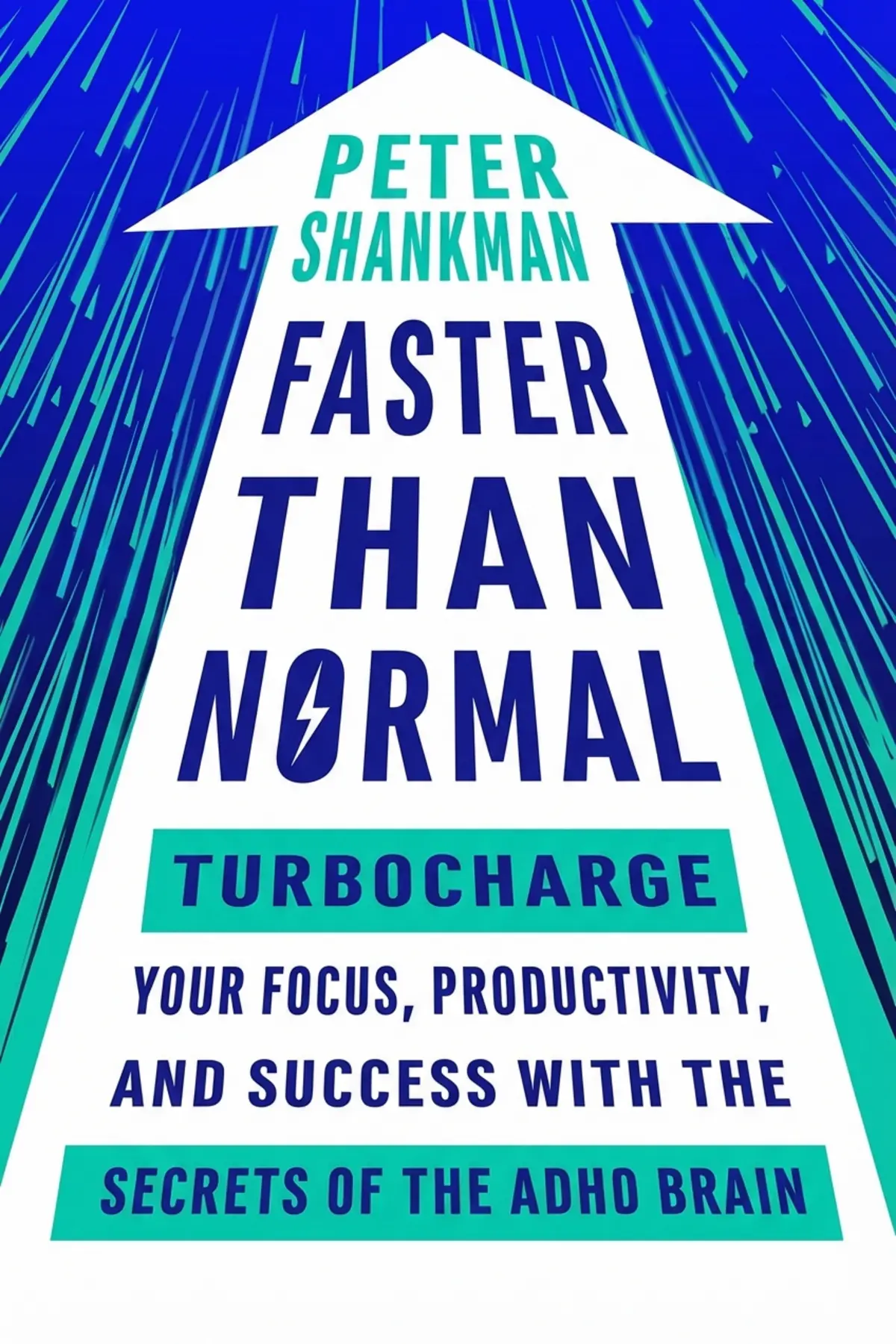
Table of Content
1. Introduction
1 min 05 sec
Maybe your mind races ahead, drifts off in meetings, then locks onto one project for hours, and you have been told this is a problem to fix. In Faster Than Normal, entrepreneur Peter Shankman argues it can be a strength, as long as you learn how your brain runs and build rules around it. Shankman, who was not diagnosed with ADHD until his mid-30s, once finished writing a whole book while on a flight to Tokyo that lasted 30 hours. He has also built and sold businesses and finished Ironman triathlons.
He doesn’t ask you to copy him. His claim is that an ADHD brain turns from liability to asset once you surround it with structure of your own: rituals that take away choices, a clear map of the triggers to avoid, and tools and tidy spaces that keep distraction out. What follows is that structure, piece by piece: the specific rules Shankman lives by, the reasons behind them, and ways to shape versions that fit your own days.
2. See your restless mind as an advantage
1 min 52 sec
A therapist lost patience and threw a book at a client who kept repeating the same mistakes. What he read in it made him cry, and it changed how he saw every one of his failures.
3. Give your fast brain rules so it pays off
1 min 39 sec
The same restless energy that produces bold ideas can also produce forgotten promises, sleepless nights and worse. Shankman traces both outcomes to one shortage, and that shortage points to where the fix must begin.
4. Take away the choices that trip you up
1 min 41 sec
Shankman’s speaking contracts are simple, except for one city, where he insists on terms most speakers would never think to ask for. His reason reveals a habit anyone can borrow for an ordinary Tuesday.
5. Build rituals that outlast any resolution
1 min 52 sec
Most people promise themselves an early alarm and give up within a week. Shankman says they are aiming at the wrong moment of the day, and he offers a different place to point the effort.
6. Map your triggers and steer around them
1 min 43 sec
Shankman has never lost a fortune at a poker table, yet he treats gambling as off limits. His reasoning, and the surprising list of everyday situations he guards against, can change how you protect yourself.
7. A phone and a room that keep you focused
1 min 42 sec
The device meant to organize your life is often the biggest source of distraction in it, and the same goes for the room you work in. Shankman’s fixes are simple enough to try tonight.
8. Conclusion
1 min 16 sec
Underneath its energy, Faster Than Normal is a book about being honest with yourself. From the outside, Shankman’s rules look odd: an eight-hour limit on one city, two outfits, a seven-hour eating window, half an hour early for everything. Each one comes from knowing exactly where his fast brain goes wrong and closing that door before he gets there. The speed stays. The damage doesn’t.
That is the trade he offers anyone whose mind runs ahead of them. Begin with the body, since sleep, food and movement feed the chemicals an ADHD brain runs short of: twenty minutes outdoors, an earlier night with the television off, and a simple log of all three. Choose one daily decision that keeps derailing you and settle it permanently, tying the change to how you want to feel when the day is over. Name the place, substance or situation that sets you off, and arrange your life so you rarely meet it. And whenever someone says a task is due soon, ask them for a date.
The boy who was sent to the principal’s office for blurting things out grew into a man who wrote a whole book on one long flight to Tokyo. His brain never changed. He changed the structure around it.
About this book
What is this book about?
Peter Shankman spent his childhood blurting things out and his early adult life going through one failed relationship after another, without knowing why. The answer came in adulthood, after yet another breakup, when a therapist threw a book about ADHD at him. Reading it, he saw his condition as a gift that needs careful handling, and he stopped treating it as a defect. Faster Than Normal sets out the rules Shankman built to turn that gift into results. Some are surprising. He limits himself to eight hours in Las Vegas, wears two uniforms, eats only within a fixed daily window and lives half an hour early. Each rule comes from knowing exactly where his brain goes wrong and closing that door in advance. The rules sit on a simple model: ADHD brains run short of dopamine, serotonin and adrenaline, and exercise, sleep and food help regulate them. Readers get a practical frame they can adapt. Build rituals backward from the feeling you want and drop resolutions. Name your own triggers and keep away from them. Track the basics and insist on hard deadlines. Keep your phone screen and your rooms clear enough that a fast mind has fewer places to wander.
Book Information
Who it's for
Adults with ADHD
Adults with ADHD, diagnosed or suspected, who want practical rules to harness a restless mind.
Self-employed without deadlines
Founders and freelancers whose ideas outrun their follow-through and who struggle without deadlines.
Fighting distraction and lateness
Anyone fighting distraction, lateness or self-destructive habits who wants to stop relying on resolutions.
About the Author
Peter Shankman
Peter Shankman is an American entrepreneur and author, born in 1972, who founded HARO, Help a Reporter Out, an online service that lets journalists gather input from the public. HARO was his third company, after two others he started and sold. He was diagnosed with ADHD only in his mid-30s, and after selling HARO he set out to understand his own brain, which led to the Faster Than Normal podcast and this book. He also wrote Zombie Loyalists and speaks internationally.
Ratings & Reviews
Ratings at a glance
What people think
Listeners find this work to be useful and pragmatic, offering concrete advice along with straightforward material. Furthermore, they view it as essential reading for students and individuals with ADD/ADHD, commending its inspiring perspectives and transformative method for comprehending ADHD. The book also earns acclaim for its excellent writing, engaging style, and efficiency advantages, assisting listeners in increasing their daily output.
Top reviews
Natnicha
Ever wonder why your brain feels like a Ferrari engine with bicycle brakes? Shankman’s take on ADHD as a 'gift' rather than just a disorder was the exact paradigm shift I needed during my final semester. While some of his lifestyle choices are clearly for the high-earner crowd, the core philosophy about dopamine management through early morning exercise and 'pre-making' decisions is gold. I started using his 'uniform' idea to cut down on morning decision fatigue, and it’s surprisingly effective for keeping my focus where it belongs. The writing is punchy, fast-paced, and never gets bogged down in dense clinical jargon. Frankly, it’s the first book on productivity that didn’t make me feel like a failure for having a non-linear brain. If you’re a student or a professional struggling to harness your chaotic energy, this is a must-read for bettering your daily output.
Show morePakinee
After hearing so many people recommend this for students with ADD, I decided to give it a shot, and it did not disappoint. The way Peter explains the dopamine deficiency in our brains made so many of my past 'failures' suddenly make sense. It’s not about being lazy; it’s about understanding how to fuel the engine properly. The focus on physical activity as a tool for mental clarity is something I’ve started implementing, and the results have been life-changing for my study habits. I love how he frames ADHD as a 'faster than normal' brain rather than a broken one. It’s incredibly motivational and filled with a kind of raw, kinetic energy that keeps you turning the pages. This isn't just a book; it's a blueprint for anyone who has ever felt 'too much' for the world around them.
Show moreSuda
Truth is, I was skeptical about the 'ADHD is a superpower' thing, but Shankman won me over with his sheer enthusiasm and practical results. This book is a masterclass in radical self-awareness. He doesn't sugarcoat how messy life can get if you don't have rules in place. By admitting his own struggles with impulsivity and addiction, he creates a safe space for the reader to own their traits without shame. I’ve started using the 'pre-morning' routine he describes, setting everything out the night before, and it has practically eliminated my morning anxiety. It’s a fast-paced, high-intensity guide that feels like a pep talk from a friend who actually understands why you can't just 'sit still and focus.' Truly life-changing stuff for the neurodivergent community.
Show moreFord
Reaction: this book is an absolute game-changer for anyone who has spent their life feeling 'broken' because of their ADD. While Shankman's lifestyle is definitely high-octane and involves some perks most of us don't have, the underlying systems he teaches are universal. The focus on dopamine-seeking behavior and how to redirect that energy into healthy habits like exercise and structured routines is brilliant. I’ve started implementing his 'uniform' strategy and the 'launchpad' idea, and my daily productivity has skyrocketed. It’s a fast-paced, high-intensity guide that feels like a pep talk from a friend who actually understands the struggle. If you want to stop apologizing for your brain and start using it as the asset it is, buy this book immediately.
Show moreSeksan
Finally got around to reading this after hearing Peter on a few podcasts, and I have to say, the guy’s energy is infectious. The book is packed with actionable strategies that go beyond the typical 'just buy a planner' advice that usually fails neurodivergent people. I particularly resonated with the section on eliminating choices; having a 'uniform' and a strict eating window has helped me reclaim so much mental bandwidth. To be fair, there is a certain level of privilege that leaks through—not everyone can hire an assistant or fly to Tokyo just to finish a manuscript. However, if you can look past the bragging about speaking fees, there are genuine nuggets of wisdom about using exercise as a medication alternative. It’s an entertaining read that actually helped me restructure my workday for much better focus.
Show moreRin
The chapter on 'loving someone with ADHD' was actually quite insightful, providing a perspective I hadn't considered before regarding my partner's needs. On the practical side, the science behind dopamine and the benefits of a rigid routine are explained in a way that is easy to understand and apply immediately. To be fair, the tone can be a bit much at times; Shankman spends a lot of time talking about his expensive headphones and high-priced speaking gigs. However, if you can filter out the occasional ego trip, there are genuine productivity gems in here. I've already seen an improvement in my focus just by implementing his 'pre-morning' setup. It's an entertaining, high-energy read that offers more than your typical self-help book, provided you can handle the author's intense personality.
Show moreNongnuch
As someone who has spent years trying to 'fix' my brain, reading this felt like getting a permission slip to just be myself. Peter’s approach to ADHD is refreshingly positive, focusing on how we can weaponize our hyper-focus rather than just suppressing it. The advice on sleep hygiene and the importance of a 'launchpad' at the front door to prevent losing keys has saved me so much morning stress. I do think he leans a bit too hard into the 'superpower' narrative, which can feel dismissive of the genuine disability aspects of the condition. Not every squirrel-chasing moment is a gift, and the rigidity he suggests might not work for everyone. Still, the entertainment value is high, and the strategies for limiting distractions are some of the most practical I’ve come across.
Show moreNuk
Picked this up on a whim and ended up finishing it in two sittings because the writing style is just so engaging. It’s rare to find a productivity book that actually accounts for the way an ADHD brain jumps from topic to topic. Peter doesn’t waste time with fluff; he gets straight to the point about why we do what we do and how to hack our environment for better results. The 'staying in the zone' tips, especially regarding noise-canceling tech and ritualizing the workday, have significantly boosted my daily output. My only gripe is that it feels a bit repetitive toward the end, and some of the app recommendations feel like they might be dated soon. Overall, though, it’s a solid resource for anyone looking to turn their chaotic thoughts into a streamlined system.
Show moreLeah
This book comes off as a bit of a slap in the face for the average person living with ADHD. While Shankman is clearly successful, his 'solutions' often involve having a massive disposable income or a support staff that 99% of readers simply don't have. Suggesting a round-trip international flight as a way to find a 'quiet space' to work is absurd and wildly out of touch with the reality of neurodivergent struggles. I also found the constant self-promotion for his websites and various affiliate-link products to be incredibly distracting. It felt more like a long-form marketing brochure than a helpful guide for those of us struggling to pay rent, let alone hire personal trainers. There are a few decent points about routine and exercise, but they’re buried under layers of humble-bragging and 'hustle culture' nonsense.
Show moreAnucha
Wow, I have never felt more alienated by a book that was supposedly written for people like me. Shankman’s advice essentially boils down to: 'Be rich, be a CEO, and have no life outside of work.' The level of fatphobia and casual derision toward anyone who isn't a marathon-running workaholic is frankly disgusting. He acts like ADHD is only a problem if you aren't using it to make millions of dollars. The 'tips' are either common sense (eat better) or completely inaccessible (fly to Asia to write). It’s a vanity project disguised as a self-help book. If you’re looking for actual, empathetic strategies for managing your life without a personal assistant and a six-figure travel budget, look elsewhere. Absolute garbage that promotes a very toxic, narrow version of success.
Show moreQuestions about this book
What is the main idea of Faster Than Normal?
Peter Shankman argues that ADHD is a gift that needs management, and he refuses to treat it as a curse. In his account, ADHD brains make too little dopamine, serotonin and adrenaline, which can cause poor focus and destructive choices. Personal structure turns that fast brain into an asset: rituals that remove choices, good habits for exercise, sleep and food, firm distance from triggers, and tracking tools and clutter-free spaces.
Who should read Faster Than Normal?
It suits adults who have ADHD or think they might, especially entrepreneurs, creatives and professionals who swing between deep focus and distraction. Shankman, diagnosed only in his mid-30s, writes from his own experience of failed relationships, an addictive personality and a mind that moves very fast. Readers who want concrete rules, such as eating within a fixed window or living 30 minutes early, will find plenty to adapt.
What is the difference between rituals and resolutions in Faster Than Normal?
Shankman calls resolutions mere words, as flimsy as a shack built on air, while rituals rest on repeated action and stand like a brick house. He builds rituals backward from the reason behind them. If you want to wake up early, focus on how satisfied you will feel after a productive day instead of on the alarm itself. That feeling is what keeps the routine going.
How does Peter Shankman manage his ADHD triggers?
He identifies what sets off his self-destructive behavior and avoids it completely. He avoids alcohol and gambling because of his addictive personality, and he limits visits to Las Vegas to eight hours. He handles time-related triggers by living 30 minutes early, doing tasks now instead of later, and insisting on hard deadlines, because a due date of soon means the work will not get done.
How can I apply Faster Than Normal in daily life?
Start small. Settle one recurring decision in advance, as Shankman does with two clothing uniforms and identical weekly meals. Get 20 minutes of activity beyond your normal each day, six days every week, outdoors when you can, trim late-night television to get more sleep, and eat more vegetables. Track these habits with an app, keep all your apps on one home screen, clear clutter from your rooms, and always ask for a specific deadline.
Readers also enjoyed





Alcoholics Anonymous
Alcoholics Anonymous World Services
168 Hours: You Have More Time Than You Think
Laura Vanderkam

A Liberated Mind: How to Pivot Toward What Matters
Steven C. Hayes
AUDIO SUMMARY AVAILABLE
Listen to Faster Than Normal in 15 minutes
Get the key ideas from Faster Than Normal by Peter Shankman, plus 5,000+ more nonfiction titles.
- 5,000+ titles
- Listen as much as you want
- 7-day free trial
- Cancel anytime









