
11 min 25 sec
Available in: English
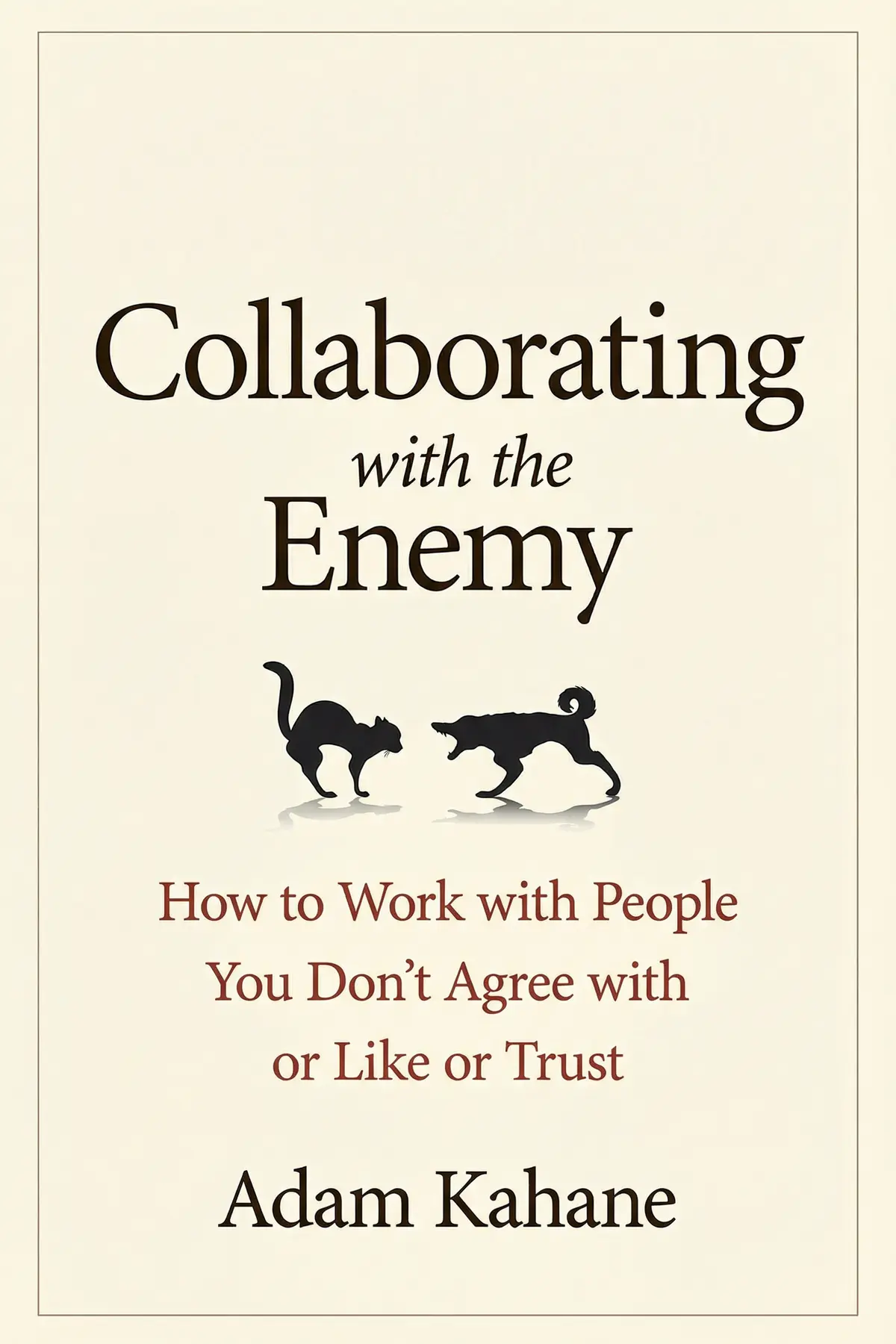
Facilitating Breakthrough: How to Remove Obstacles, Bridge Differences, and Move Forward Together
By Adam Kahane
Shows how to help a divided group work together by balancing top-down and bottom-up voices, setting up an equal room, serving rather than leading, and recognizing your own role in the conflict.
Table of Content
1. Introduction
1 min 00 sec
When a group is stuck, the usual instinct is to push harder, with more agenda, more pressure and more speeches from the person in charge. In Facilitating Breakthrough, Adam Kahane, a facilitator who has worked in more than fifty countries, argues that a stuck group rarely needs pushing at all: it needs its blockages removed, the way a stream flows again once the debris is cleared.
That picture organizes everything in the book. The blockages come from a few places: an imbalance between leaders and the people they lead, a setting that tells some people they matter more, and a facilitator who forgets their own part in the problem. Kahane’s cases range from a losing basketball team to South Africa after apartheid, Ethiopia and a healthcare workshop in Canada that went wrong.
By the end, you will have specific moves for your next meeting or workshop: how to arrange the room, how to share speaking time, and when to step out of the way entirely.
2. Keep both the boss and the team heard
1 min 55 sec
A team can win by following its coach, or by trusting its players. Kahane shows why either path works for a while and then quietly breeds the frustration that sinks it.
3. Set up a room where nobody outranks anyone
1 min 53 sec
Rivals whose feuds had lasted for decades eventually found themselves strolling side by side. The change started long before any formal session, with details most organizers would never think to plan.
4. Serve the group the way a conductor serves music
1 min 51 sec
One Ethiopian organizer spent nearly two years just getting fifty political leaders to agree to sit together. What finally convinced them had nothing to do with his skill at running sessions.
5. Win back a group that has rejected you
1 min 48 sec
A simple timing tool that worked smoothly in one country opened an old wound in another. Kahane’s response to being openly distrusted shows that what a facilitator stops doing can matter most.
6. Turn blame into ownership with two short essays
1 min 48 sec
Most stuck groups agree on one thing: the problem is somebody else’s fault. A plain writing exercise asks people to describe the same situation twice, and the second version tends to change the conversation.
7. Conclusion
1 min 10 sec
Kahane’s book is about restraint as much as technique. The stream picture holds throughout: the facilitator’s work is clearing the way for a flow the group already has. Sometimes the blockage is a coach who talks too much, or players who stopped listening. Sometimes it is a seating plan, or meals eaten apart. And sometimes it is the facilitator, with a familiar bell and a blind spot about history.
That last case is what lifts the book above a set of meeting tips. Kahane’s dependable tool, the timed introduction with its small bell, worked in Colombia and hurt people in Manitoba. What rescued the workshop was his willingness to go quiet, pick up litter and let others lead.
For your own next session, check before it starts whether anything in the room ranks people, and fix it. While it runs, keep asking whose voice is missing and shift the balance toward them. When things stall, look at your own part in the stall before asking anyone else to change.
The elder’s gift on the third day went to a man who had stopped trying to be in charge, and that was the breakthrough.
About this book
What is this book about?
Anyone who has run a tense meeting knows the two ways it fails. The senior person talks and everyone else goes quiet, or everyone talks and nothing gets decided. Adam Kahane, who has guided groups in more than fifty countries, argues that a stuck group rarely needs more pushing. Like a blocked stream, it starts moving once the obstacle is gone. Kahane calls his approach transformative facilitation. It means switching between top-down and bottom-up leadership until everyone feels heard, and removing what stands in the way before a session even begins. He draws on workshops in South Africa after apartheid, in Colombia, in Ethiopia and in Manitoba, Canada, where his own trusted methods caused offense and he had to step back. Readers get practical moves for any group: equal seating and speaking time, the humility of a conductor who serves the music, the discipline of stepping outside a conflict while admitting your own part in it, and a two-essay exercise that turns blame into ownership.
Book Information
Who it's for
Managers with stuck meetings
Team leads and managers whose meetings are dominated by a few voices or stall in conflict.
Workshop leaders and trainers
Workshop leaders and trainers bringing together people who distrust each other.
Leading across opposing interests
Founders and organizers trying to get partners, staff or communities with opposing interests to move forward together.
About the Author
Adam Kahane
Adam Kahane is an author and facilitator who has worked in more than fifty countries, with people ranging from business executives and trade unionists to clergy and artists. In the early 1990s he led scenario work at Royal Dutch Shell in London. He studied physics at McGill University and energy and resource economics at the University of California, Berkeley. He is a Member of the Order of Canada, and in 2022 the Schwab Foundation named him Social Innovation Thought Leader of the Year.
Ratings & Reviews
Ratings at a glance

What people think
Listeners describe the work as both helpful and impactful. They value the book's perceptive ideas, as one listener points to its focus on presence and experimentation, while another remarks on its foundation in systems and complexity science.
Top reviews
Sofia
Adam Kahane has a remarkable ability to articulate the subtle mechanics of human interaction that usually remain invisible to the untrained eye. In this book, he masterfully deconstructs the 'two poles' of facilitation—the vertical drive for alignment and the horizontal need for inclusion. I’ve often felt the tension between these two during high-stakes meetings, but I never had the vocabulary to describe it until now. The concept of transformative facilitation isn't about choosing one side; it’s about moving fluently between them to remove the 'rocks' from the stream. Truth is, we often try to force change through command-and-control methods that simply don't work in our current era of complexity. By focusing on contribution, connection, and equity, Kahane offers a way to move forward even when participants don't see eye-to-eye. This is essential reading for anyone trying to navigate the messy reality of social change.
Show moreSomsri
Wow, this was exactly the perspective shift I needed for my current community building project. The idea that a facilitator should serve the group like a conductor serves the music really resonated with me. I’ve often felt the pressure to have all the answers, but Kahane argues that our role is actually to remove the structural obstacles to collaboration. This requires a level of humility that is rarely discussed in leadership books. The story of Aklilu’s patience in Ethiopia was particularly moving and served as a great reminder that meaningful change takes time. I loved the emphasis on 'presence' and being mindful of when to step back and when to lean in. This book doesn't just give you tools; it challenges you to change how you show up in the room. It is a powerful, reflective, and deeply inspiring guide for anyone working in complex systems.
Show morePloy
Finally, a book that acknowledges the messy reality of trying to change systems from the bottom up! Kahane doesn't offer a magic wand, but he does provide a very clear theory for how to navigate the inevitable friction of group work. The way he describes 'transformative facilitation' as a series of choices rather than a single event is spot on. I’ve already started using the 'advocating vs. inquiring' cycle in my workshops, and the results have been immediate. People feel more heard, and the solutions we're coming up with feel much more robust. The writing style is gentle yet authoritative, reflecting the very humility the author encourages in his readers. This is an essential contribution to the field of leadership. If you want to move past simple 'command-and-control' and actually empower your team, you need to read this.
Show moreSun
As someone who spends most of their week navigating tense boardroom dynamics, I found the framework of 'shifting gears' between advocating and inquiring incredibly grounding. Kahane’s writing is crisp, and he avoids the usual corporate jargon, which makes the heavier concepts of systems science much more digestible. I particularly appreciated the specific examples, like the basketball team analogy, which perfectly illustrates why relying solely on a top-down approach leads to team burnout. The book emphasizes that you don't always need total agreement to make progress. Sometimes, just staying in a relationship while acknowledging differences is the breakthrough itself. My only minor gripe is that some of the more abstract sections on 'standing inside' the problem felt a bit repetitive by the end. However, the practical advice on using physical tools like flip charts and toy bricks to facilitate new configurations of thought is something I’ll implement immediately.
Show morePick
Picked this up on a recommendation and finished it in a few sittings because the writing is surprisingly fast-paced for a business book. Look, most people assume that someone needs to be in control to get things done, but Kahane shows why that mindset fails in volatile environments. He introduces 'transformative facilitation' as a way to balance the need for direction with the need for individual autonomy. I found the section on 'paired walks' to be a simple yet genius way to help people connect as humans rather than just as representatives of their interests. It’s not always about reaching a perfect consensus; it’s about finding a way to advance despite the friction. While some of the case studies felt a little removed from my daily office life, the core principles of equity and contribution are universal. It’s a very useful addition to any leader's toolbox.
Show moreSai
After hearing Kahane speak on a podcast, I wanted to dive deeper into his ideas about how we define success in groups. The truth is, most of us are addicted to the 'forcing' method because it feels faster and more predictable. This book challenges that habit by showing how horizontal moves—like allowing for nonagreement—actually create more sustainable results in the long run. I was particularly struck by the lesson he learned in Canada about cultural insensitivity; it takes guts to admit when you’ve failed as a professional. That level of honesty makes his advice feel much more authentic and earned. The frameworks for 'mapping and discovering' provide a great way to think about project timelines that aren't just rigid Gantt charts. It’s a thoughtful, well-anchored look at the science of complexity and human connection.
Show moreViolet
The chapter on defining success really changed how I approach my team’s weekly alignment meetings. We often get stuck in a loop of trying to reach a perfect agreement that never comes, which just leads to gridlock and frustration. Kahane’s advice to cycle between 'concluding' and 'advancing' is a game-changer for maintaining momentum. It allows us to move forward with partial agreement while still staying in a healthy relationship with each other. The book is full of these little shifts in perspective that make a big difference in practice. I also appreciated the discussion on how to handle situations where you don't even like or trust the people you have to work with. It's a very realistic take on collaboration. Highly recommended for managers who are tired of the usual 'rah-rah' teamwork books and want something with more substance.
Show morePhu
Is this a groundbreaking manual or just a collection of nice-to-have anecdotes for consultants? To be fair, Kahane is a legend in the field, and his experience in South Africa and Colombia is undeniably impressive. But I found myself wishing for more granular, step-by-step instructions on how to handle specific conflict scenarios. While the theory of vertical versus horizontal facilitation is brilliant, the actual 'how-to' can feel a bit elusive when you're in the heat of a meeting. It’s a solid read for someone wanting to break into the consulting world, and it certainly helps you think differently about group dynamics. I just felt that some of the lessons were a bit simplified for the sake of the narrative. It’s a good addition to the shelf, but you'll still need plenty of real-world practice to make these techniques actually work.
Show moreHarper
It’s a solid read, but maybe not the total revolution the title suggests to those already familiar with systems thinking. I enjoyed the distinction between vertical and horizontal facilitation, and the 'two poles' framing is definitely a helpful mental model. However, I felt like the book repeated its main thesis quite a few times without adding much new depth in the later chapters. The examples of Open Space Technology and using toy bricks were nice touches, but they felt like minor mentions rather than deep dives. Not gonna lie, I found some of the sections a bit dry, especially when he gets into the philosophical weeds. It’s a good primer for beginners, and the emphasis on experimentation is valuable. I’ll keep it on my shelf for reference, but it didn't blow my mind.
Show moreNatnicha
Frankly, I struggled to stay engaged with this one despite the interesting premise. The author clearly knows his stuff, but the book feels way too theoretical to be truly useful on a Monday morning in a standard corporate environment. There is a lot of talk about 'removing rocks from the stream' and 'standing inside the situation,' which sounds poetic but lacks the tactical edge I was looking for. I was hoping for more concrete frameworks on dealing with difficult personalities or managing tight deadlines. Instead, we get a lot of high-level philosophy about egalitarian cultures and social potential. If you’re working on massive, multi-year social projects, this might be your bible. But if you’re just trying to run more efficient team meetings, you might find this a bit too abstract and detached from day-to-day realities. It’s an okay book, just not what I expected.
Show moreQuestions about this book
What is the main idea of Facilitating Breakthrough?
Adam Kahane argues that a stuck group usually wants to move, much like a blocked stream that flows again once the obstruction is cleared. The facilitator’s job is to remove those blockages. He calls his approach transformative facilitation: switching between top-down and bottom-up leadership until everyone feels heard, setting up an equal environment, serving the group with humility, and recognizing the facilitator’s own part in the situation.
What is transformative facilitation?
It combines two approaches. Vertical facilitation is top-down, getting a group to follow its leader, like players following a coach’s strategy. Horizontal facilitation is bottom-up, getting the leader to listen to the group. Each works for a while but leaves one side ignored and frustrated. Transformative facilitation means watching where power sits and repeatedly shifting the balance toward whoever is not being heard.
How do you remove obstacles before a workshop, according to Kahane?
Make the setting as equal as possible. At a post-apartheid workshop in South Africa, 28 leaders shared small bedrooms, ate together and played volleyball during breaks, and old enemies began talking openly. In Colombia, Kahane arranged chairs in a circle and limited every introduction to one minute, whatever the speaker’s importance. The aim is to remove anything that signals some people count more than others.
What is the two-essay exercise in Facilitating Breakthrough?
Participants write two short essays on the problem at hand. In the first, they describe it as an outside observer, including what those causing it must do. In the second, they describe the same problem as if they were responsible, and what they themselves must do. Kahane says this usually brings new perspectives, more sense of responsibility and agency, and stronger motivation to find solutions.
Who should read Facilitating Breakthrough?
It suits anyone who brings people together and needs them to cooperate: managers whose meetings stall, workshop leaders, trainers, and organizers working with groups that distrust each other. Its examples range from a struggling basketball team to national dialogues in South Africa, Colombia and Ethiopia, so the lessons scale from a single team meeting to much larger conflicts.
Featured in
Readers also enjoyed




A Year with Peter Drucker: 52 Weeks of Coaching for Leadership Effectiveness
Joseph A. Maciariello





Acting with Power: Why We Are More Powerful Than We Believe
Deborah Gruenfeld

AUDIO SUMMARY AVAILABLE
Listen to Facilitating Breakthrough in 15 minutes
Get the key ideas from Facilitating Breakthrough by Adam Kahane, plus 5,000+ more nonfiction titles.
- 5,000+ titles
- Listen as much as you want
- 7-day free trial
- Cancel anytime









