


14 min 43 sec
Available in: English
Emotional First Aid: Healing Rejection, Guilt, Failure, and Other Everyday Hurts
By Guy Winch
A practical kit for the everyday emotional hurts most of us never learned to treat, with specific exercises for rejection, failure, rumination, guilt, loneliness, loss and low self-esteem.
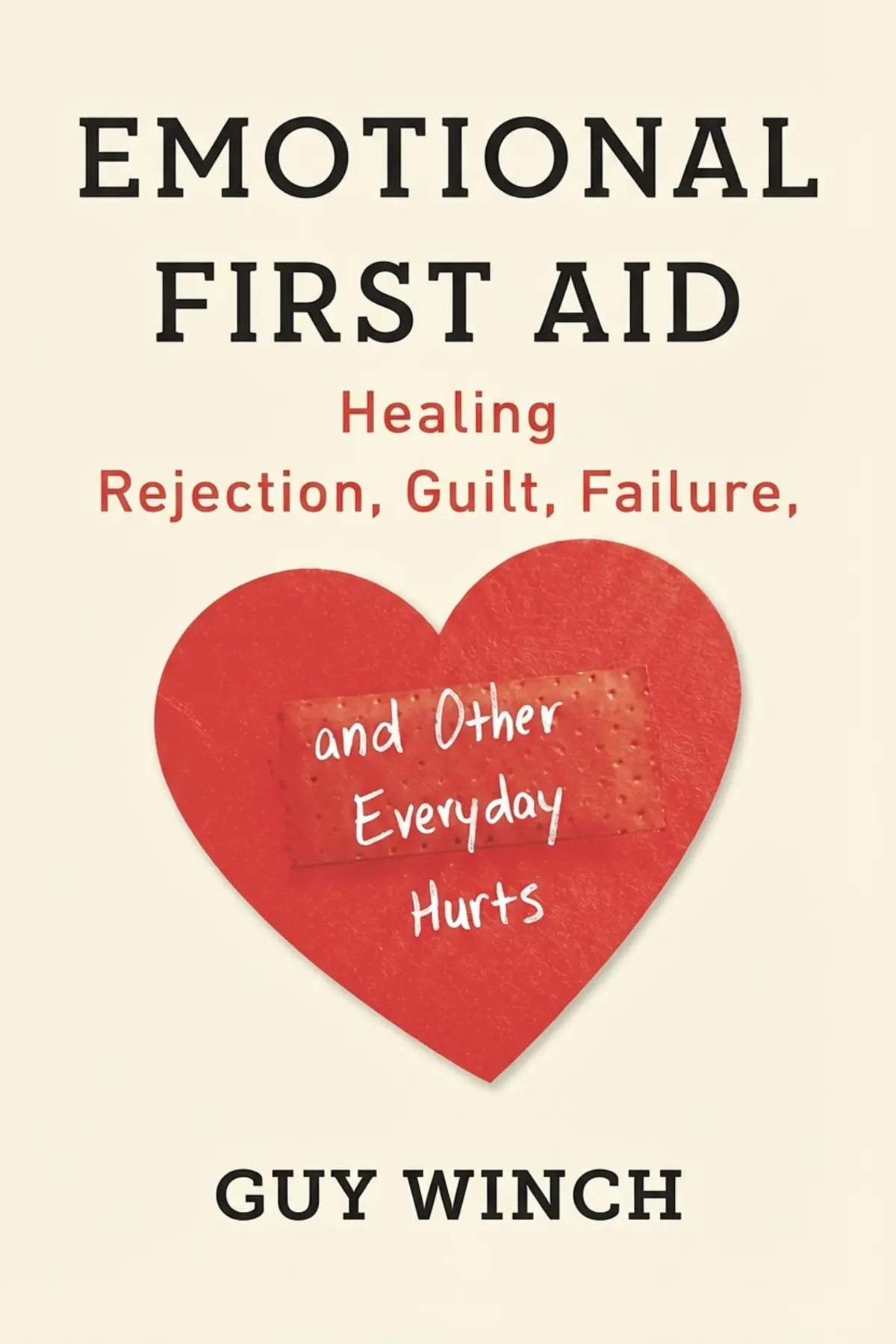
Table of Content
1. Introduction
1 min 02 sec
Most people know exactly what to do with a cut finger, yet a harsh rejection or a nagging sense of guilt usually gets no treatment at all. In Emotional First Aid, clinical psychologist Guy Winch argues that these everyday hurts are injuries in the full sense: small, common, and able to grow into something serious when ignored. A minor rejection can spread into self-doubt the way an untreated scratch can become infected.
Winch’s answer is a medicine cabinet for the mind. For each common wound, from failure and loneliness to rumination, loss and low self-esteem, he offers specific steps that limit the damage and speed recovery. His case is that emotional injuries deserve the same prompt, practical care we give our bodies, and that small exercises done early keep them from causing lasting harm. What follows is that kit, wound by wound, with the exact exercises Winch prescribes and the moment to reach for each one.
2. Stop a rejection from spreading into deeper hurt
1 min 44 sec
Being turned down hurts long after childhood, and the instinct to figure out why can make the damage worse. Winch’s remedy involves a pen, five qualities and the people who already value you.
3. Turn a failure into a plan for next time
1 min 45 sec
A sympathetic friend seems like the obvious comfort after a setback. Winch explains why sympathy on its own can leave you feeling worse, and what has to come with it.
4. Stop replaying the same painful scene
1 min 51 sec
Going over a hurt again and again feels like working through it. Winch compares it to picking at a scab, and a 2010 study points to a surprising change of viewpoint that helps.
5. Apologize in a way that actually repairs things
1 min 45 sec
Saying sorry seems like the obvious cure for a guilty conscience, yet many apologies leave both sides unsatisfied. Winch identifies what they are missing, and what to do when an apology is refused.
6. Break the loop that keeps lonely people alone
1 min 52 sec
You can have hundreds of contacts and still feel completely alone. Winch shows how loneliness trains people to behave in ways that keep others away, and how to spot those habits in yourself.
7. Rebuilding your identity after a loss
1 min 43 sec
A lost job or a divorce can take more than the job or the marriage. Winch explains how loss attacks both your sense of self and your beliefs about the world, and how each can be restored.
8. A stronger self-esteem guards against every hurt
1 min 44 sec
Some people shrug off a setback while others are flattened by it. Winch compares the difference to a weak immune system, and offers a letter-writing exercise that turns your kindness toward friends back on yourself.
9. Conclusion
1 min 17 sec
Winch’s argument comes down to a habit most of us already have, applied to a part of ourselves we usually overlook. Nobody leaves a deep cut untreated just because cuts are common. Rejection, failure, guilt, loneliness and loss are just as common, and left alone they can shape our relationships and quality of life for years. The kit itself is modest: a kinder counterargument, a short essay, an outsider’s view, a complete apology, a list ranked from easy to hard.
The next time a no or a mistake stings, treat it that same day. Answer the harsh thought with one that is kind and accurate, and write out the strengths it called into question. If you catch yourself replaying the scene yet again, step back and watch it as a stranger would, then reach for a distraction that suits where you are. If you owe someone an apology, give the whole thing, with validation, repair and a promise.
Winch is also clear about where first aid ends. When guilt, loneliness or loss will not lift, and especially if hopelessness brings thoughts of harming yourself or others, the right move is a mental health professional. Knowing when a wound needs a doctor belongs in the kit too.
About this book
What is this book about?
Almost every home has bandages and painkillers for small cuts and sprains. Almost nobody has an equivalent for a painful rejection, a failure that shakes your confidence or guilt that will not let go. Clinical psychologist Guy Winch argues that these everyday hurts are genuine injuries, and that, like an untreated scratch, they can grow into deeper psychological problems. Winch goes through the usual hurts in turn, covering failure, guilt, loss, loneliness, rejection, rumination and poor self-worth. For each, he explains how the injury does its damage, for example how loneliness makes people less likely to reach out, or how replaying a hurt from your own point of view only brings the pain back. Then he prescribes concrete treatments: answering harsh thoughts with kinder, accurate ones, writing short essays on your strengths, viewing painful scenes as a stranger would, apologizing in full and ranking the changes you want from easiest to hardest. Readers get a usable emotional first aid kit, plus a clear sense of when a wound is too deep for self-care and needs a professional.
Book Information
Who it's for
Replaying what went wrong
People who replay rejections, mistakes or arguments long after they happen.
After a career setback
Job seekers and professionals knocked back by a failed interview or a lost role.
Struggling after a loss
Anyone feeling lonely, guilty or stuck after a loss who wants concrete steps before things get worse.
About the Author
Guy Winch
Guy Winch is a clinical psychologist who earned his doctorate at New York University in 1991 and runs a private practice in Manhattan. A member of the American Psychological Association and a keynote speaker, he gave the 2015 TED Talk Why We All Need to Practice Emotional First Aid. His other books include The Squeaky Wheel and How to Fix a Broken Heart. He has written for Psychology Today, co-hosted the Dear Therapists Podcast and occasionally performs stand-up comedy in New York City.
Ratings & Reviews
Ratings at a glance
What people think
Listeners find this work to be articulate and easy to follow, providing useful methods for resolving personal challenges. The book also delivers advice on navigating various feelings and features concrete, sequential protocols for improving emotional well-being. Additionally, listeners value the author’s sense of humor and find the material very simple to apply.
Top reviews
Fatima
Finally got around to reading Dr. Winch’s guide, and I’m genuinely surprised by how much I needed these 'bandages' for my brain. We spend so much time sanitizing physical wounds but leave our psychological injuries to fester in the dark. It makes no sense. The way Winch breaks down the seven most common emotional maladies is nothing short of brilliant because he offers tangible, step-by-step instructions rather than vague platitudes. I specifically appreciated the humor woven throughout; it keeps the heavy topics from feeling like a chore. This is an easy-to-use manual that belongs in every household’s actual medicine cabinet. Frankly, I think we'd all be a lot healthier if we took our 'emotional chest colds' as seriously as a fever. If you follow the specific treatment plans, you might actually see real change in how you handle rejection or failure.
Show moreIce
Ever wonder why we treat a scraped knee with more care than a broken heart? Guy Winch challenges that neglect in this fantastic, easy-to-use book. I loved the comparison between emotional chest colds and psychological pneumonia; it’s such a vivid way to describe how small setbacks can spiral into major depressions if left untreated. The instructions are incredibly tangible. I actually tried one of the exercises for rumination—the one about breaking the cycle of 'picking at emotional scabs'—and it worked surprisingly fast. It’s rare to find a self-help book that is both humorous and rigorously evidence-based. Truth is, most of us were never taught how to handle failure or loss in a healthy way. This book fills that gap perfectly. It’s a five-star resource that I’ve already started recommending to my entire friend group.
Show moreRungtip
Wow, I didn't realize how much I was 'picking at emotional scabs' until I read the chapter on rumination. This book is a total game-changer for anyone who overthinks every tiny social interaction or failure. Guy Winch writes with such clarity and humor that you feel like you're talking to a very smart, very kind friend. The tangible, step-by-step instructions for each malady are what set this apart from other self-help titles. It’s not just about 'feeling your feelings'; it's about active, science-based healing. I especially loved the section on building a 'psychological immune system' to ward off the damage of low self-esteem. Not gonna lie, I’ve used the rejection exercises twice this month already. If you want a book that actually tells you *what to do* instead of just describing your problems, this is the one.
Show moreHugo
The metaphor of an 'emotional medical cabinet' is something I’ll be thinking about for a long time. This book is incredibly well-written and serves as a vital resource for anyone looking to bolster their mental immune system. I found the chapter on loneliness particularly insightful, especially the part about how our 'relationship muscles' weaken when we isolate ourselves. Winch provides very clear, actionable techniques that feel grounded in actual science rather than just 'good vibes' and fluff. My only minor gripe is that some of the sections felt a bit like they were meant for people with very mild issues. If you are dealing with deep, chronic trauma, this might only be a starting point. Still, for the daily cuts and scrapes of existence, it is a practical and readable guide that I’ll likely revisit when I'm feeling a bit bruised by life.
Show moreNora
As a therapist, I am always on the hunt for digestible resources to recommend to my clients, and this has moved to the top of my list. The language is accessible and avoids the 'ndakik' or overly medical jargon that usually turns people off from psychology books. Winch identifies rejection, loneliness, and low self-esteem as legitimate injuries that require active treatment. It is a very practical, step-by-step approach. My clients have found the specific exercises for boosting 'emotional immunity' to be particularly helpful. I do think the book can be a bit simplistic at times, but as Winch himself notes, this is just 'first aid.' It isn't meant to replace long-term therapy for deep-seated issues. For what it is—a toolkit for daily resilience—it is exceptionally well-executed and helpful for anyone feeling stuck.
Show moreGung
This book is basically a toolkit for life's inevitable bruises. I appreciated how Winch organizes the chapters into 'treatments' and 'dosages' just like a real medical manual. It makes the advice feel very concrete. Got rejected? Flip to chapter one. Dealing with a blow to your self-esteem? Check chapter seven. Personally, I found the section on rumination the most life-changing. It’s so easy to get caught in a loop of negative thinking, and having a literal plan to stop 'picking at the wound' was exactly what I needed. The writing style is friendly and never feels like it's talking down to the reader. While some of the case studies are a bit dated, the core advice remains timeless and effective. It's a solid four-star guide that I'll keep on my nightstand for those bad days when I just need a quick fix.
Show moreLeila
Picked this up on a whim and found the writing style incredibly inviting and clear. It’s organized so logically that you can use it as a reference guide whenever a specific issue pops up. The treatment plans for failure and rejection were particularly relatable for me. Winch has a knack for taking complex psychological concepts and turning them into easy-to-digest steps. I did find the repetitive structure a bit much after a while, but it’s a minor flaw in an otherwise excellent book. The emphasis on 'emotional hygiene' is a message we all need to hear more often. It’s practical, humorous, and genuinely easy to use. I’ll definitely be keeping this one on my shelf for future 'emergencies.' A very solid 4-star read for anyone looking to improve their daily mental health.
Show moreGai
I wanted to love this more given the constant Buzzfeed hype, but it felt a bit repetitive in the middle chapters. To be fair, the premise is solid. Winch identifies seven key emotional wounds and gives you a roadmap for how to fix them. I enjoyed the layout; you can easily skip to the section that applies to your current situation without feeling lost. However, reading it cover-to-cover was a bit of a slog because the structure of each chapter is almost identical. It works much better as a reference book than as a narrative read. Also, some of the guilt-related advice felt slightly off to me, as if he were suggesting we should prioritize alleviating our own guilt over setting healthy boundaries. It’s a decent three-star read that offers some good 'first aid,' even if it doesn't quite get to the root of the problem.
Show moreWatcharee
Look, the advice here is undeniably helpful, yet I couldn't help but feel some sections were a bit glossed over for the sake of simplicity. I've read a lot of self-help, and while Winch’s presentation is unique, many of the techniques are ones you've likely heard elsewhere if you're a fan of the genre. The 'first aid' metaphor is clever, but it sometimes limits the depth of the discussion. For example, the treatment for loss and trauma felt a little light given the gravity of those topics. It’s a great book for those minor 'emotional scrapes' we all get at work or in social settings, but it might not be enough for the 'broken bones' of life. I’d recommend it as a primer or a gift for someone new to mental health awareness, but seasoned readers might find it a bit basic.
Show morePrapaiwan
To be fair, the science is solid, but the author’s take on certain case studies really rubbed me the wrong way. Specifically, the example of the woman who accidentally ran over her mother’s foot felt poorly handled. Winch focuses entirely on the daughter's guilt and suggests she should offer a 'recompense'—basically promising never to walk away during an argument. In my experience, that sounds like rewarding emotional abuse or a lack of boundaries. He ignores the much deeper, complex dynamics of that relationship to illustrate a simple point about guilt. It felt reductive. While the book is readable and has some helpful tips for minor failure or rejection, it lacks the nuance required for more complicated interpersonal hurts. If you're looking for something that addresses the messy reality of family dysfunction, this 'first aid kit' is probably too shallow for your needs.
Show moreQuestions about this book
What is the main idea of Emotional First Aid by Guy Winch?
Winch argues that everyday emotional hurts such as rejection, failure, guilt, loneliness and loss are real injuries. We know how to treat a cut, but nobody teaches us how to treat these, so they can grow into deeper psychological problems. He offers specific, practical treatments for each wound so that small hurts heal before they cause lasting damage.
How do you apologize properly according to Emotional First Aid?
Winch says saying sorry is not enough. A full apology also validates the other person’s feelings by hearing them out and showing you understand and regret the harm, offers something to make up for it, and states that what you did was unacceptable along with a promise not to repeat it. If the apology is refused, he recommends working toward self-forgiveness.
How can I stop ruminating about a painful event?
Winch suggests three tactics. First, replay the event as a stranger watching from a distance rather than through your own eyes, an approach a 2010 study linked to new insight and closure. Second, reframe it by looking for a lesson, opportunity or good intention. Third, plan absorbing distractions for the places where you tend to brood, such as a run at home.
How does Guy Winch suggest building self-esteem?
He compares self-esteem to the immune system: when it is weak, life’s knocks hit harder. To strengthen it, he recommends self-compassion, including writing about your own setback with the kindness you would show a friend, regularly listing your strengths and writing about why they matter, and feeling more in control by working through changes you want, ranked from easiest to hardest.
Who should read Emotional First Aid?
It suits anyone who struggles to shake off a rejection, a failure or a guilty conscience, and people dealing with loneliness or a loss such as a breakup, a move or a lost job. Its exercises are short and concrete. Winch also notes that some pain is too deep to handle alone, and that persistent hopelessness calls for a mental health professional.
Readers also enjoyed





A Guide to the Good Life: The Ancient Art of Stoic Joy
William B. Irvine




A High-Performing Mind: Strengthen Your Mind and Live Your Best Life
Andrew D. Thompson
AUDIO SUMMARY AVAILABLE
Listen to Emotional First Aid in 15 minutes
Get the key ideas from Emotional First Aid by Guy Winch, plus 5,000+ more nonfiction titles.
- 5,000+ titles
- Listen as much as you want
- 7-day free trial
- Cancel anytime









