

A River in Darkness: One Man’s Escape from North Korea
Masaji Ishikawa
 English
A former federal prosecutor uses real cases, from a fingerprint matched to the wrong man to a hard kidnapping sentence, to show that fair judgment depends on doubt, discretion, careful questioning and treating every person as human.
1 min 01 sec
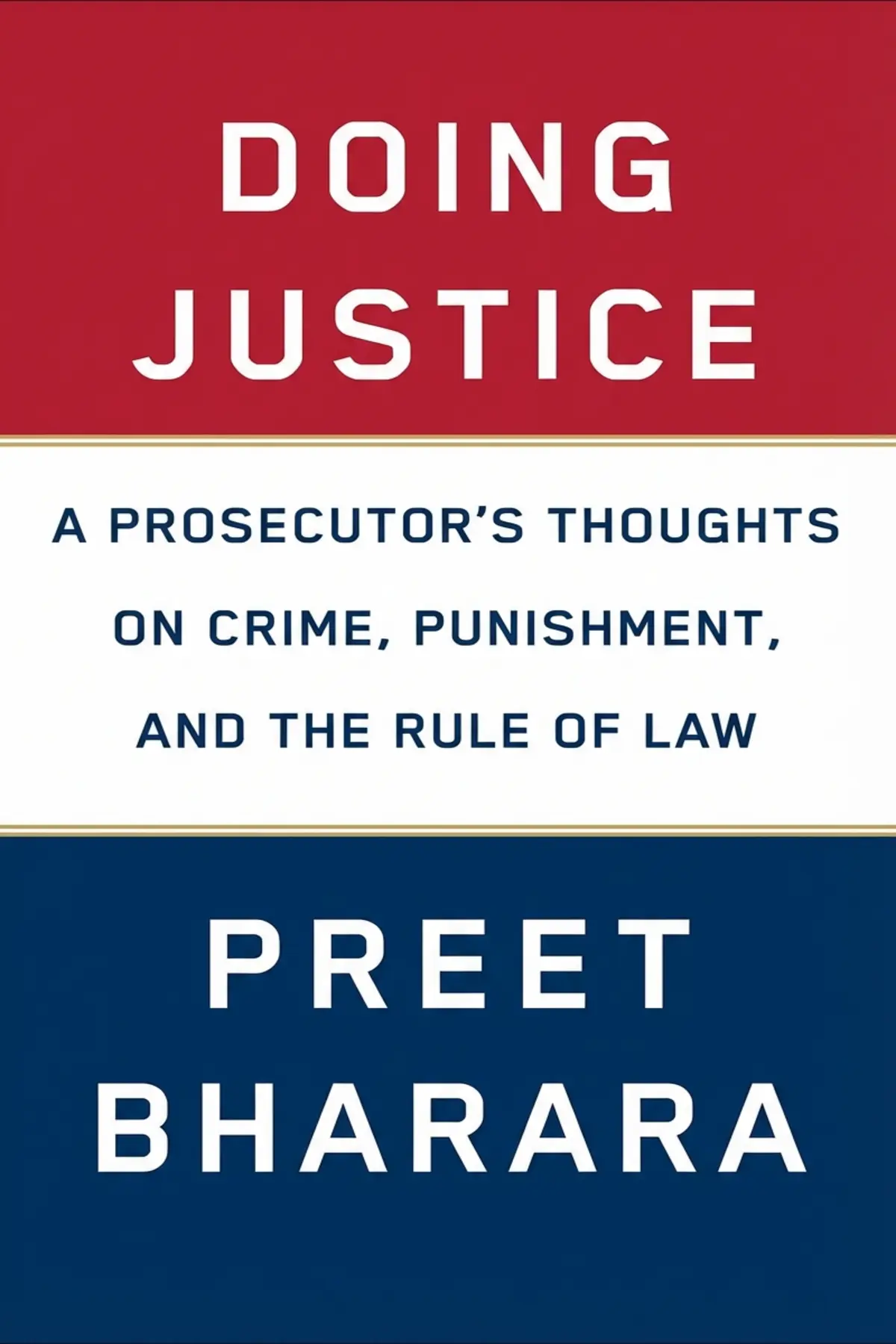
Most of us decide who is to blame, at work or at home, long before the evidence is in. In Doing Justice, Preet Bharara, who led the federal prosecutors of New York’s Southern District, treats that rush as the main threat to fairness. He learned it when a friend swore two sons could never have killed their parents, and they had.
Bharara follows a criminal case through its stages, from inquiry to accusation, trial and punishment. At each one, he argues, justice is only as good as the people doing it. They must doubt their own certainty, resist the pressure to win, use discretion and treat even the guilty as human.
The cases run from a Madrid bombing pinned on the wrong man to a kidnapping that left the prosecutor himself unsure. What carries over to ordinary life is a set of habits for judging fairly: rechecking strong evidence, asking better questions and arguing the other side first.
1 min 52 sec
A woman was certain the police had arrested the wrong people for her friends’ murder. Her certainty taught a future prosecutor his first rule, and a legendary mob detective supplied the second.
1 min 57 sec
Four fingerprint experts agreed that an American lawyer was linked to a terror attack in Spain. Then the Spanish police weighed in, and the FBI had to explain how so much expertise pointed the same wrong way.
1 min 49 sec
Prison guards closed ranks after an inmate was beaten to death, and no one would talk. One investigator broke the silence without threats, using what he had learned about a single guard’s past.
2 min 07 sec
During two huge corruption cases, a whisper reached the boss that his staff feared his anger if they failed. What he said next became one prosecutor’s proudest memory, more than the verdicts themselves.
1 min 46 sec
A prisoner escaped and was caught breaking back in, and a jury let him go. Meanwhile a famous producer’s recorded admission went nowhere for years. Both cases turn on the same unwritten power.
2 min 08 sec
Prosecutors held proof so strong that a quiet deal was the obvious move, and the victim said no. Another team staged a rehearsal trial to learn how a jury would react to a sympathetic defense.
2 min 10 sec
A baby vanished from a Harlem hospital and grew up believing her kidnapper was her mother. When the truth surfaced 23 years later, the sentence satisfied no one, including the prosecutor who saw it handed down.
1 min 22 sec
Bharara’s cases add up to one claim: the law is a set of tools, and fairness depends on the hands that hold them. A fingerprint was wrong, and a woman nobody believed won only because two investigators took her seriously. The powerful have to be held to account and the powerless kept from falling through the cracks, and no rulebook does that alone.
His closing image sits outside any courtroom. After September 11, 2001, a Texas white supremacist, Mark Anthony Stroman, murdered Waqar Hasan and Vasudev Patel and shot Rais Bhuiyan, a Bangladeshi immigrant, in the face with 38 shotgun pellets. Bhuiyan survived, forgave Stroman through his Muslim faith and campaigned to spare him from execution. Stroman was put to death in 2011, though among his final words was an appeal: the world still holds hatred, he said, and it has to end. The law convicted him; another man’s mercy changed him.
The habits travel well. Keep your verdict open until the work is done, ask who outside your circle has checked your best evidence, and tell your team that an honest result beats a win. Then give the people you judge what SueAnn wanted: a real hearing.
People often say the rule of law protects us from the rule of one powerful person. Preet Bharara, who supervised the federal prosecutors of New York's Southern District, argues that laws alone protect no one. Fairness depends on the investigators, prosecutors, judges and guards who apply them. He follows a criminal case through its stages: the inquiry, the decision to accuse, the trial and the punishment. At each stage he shows where judgment goes wrong and what keeps it honest. An FBI fingerprint match points at an innocent lawyer in Oregon. A detective gets a silent guard to talk by learning his life story. Bharara tells his own staff he expects no particular outcome in two major corruption cases. A woman nobody believed insists on her day in court. A judge has to decide how long a kidnapper should spend in prison. Readers get a clear account of how the justice system works from the inside. They also get habits that apply to any job where people judge other people: hold off on verdicts, recheck the strongest evidence, question routines and test the other side's story before arguing your own.
Managers and HR leads who investigate complaints and must judge colleagues fairly.
Law students and readers curious how prosecutors decide whom to charge and how hard to punish.
Anyone who tends to trust strong evidence or first impressions too quickly.
Preet Bharara is an Indian-born American lawyer educated at Harvard College and Columbia Law School. After working in private practice, he served as an assistant US attorney and then as chief counsel to Senator Chuck Schumer. In 2009 President Barack Obama appointed him US attorney for New York's Southern District. There he supervised more than 200 assistant US attorneys on cases involving terrorism, insider trading, public corruption and organized crime, until his dismissal in March 2017. He now teaches at NYU School of Law, hosts the podcast Stay Tuned with Preet and has been named one of Time's 100 most influential people.

Listeners find this work absorbing and skillfully composed, providing deep insights that aid in navigating the complexities of the justice system. The author draws on actual cases to share powerful narratives, and listeners value the frank look at institutional failings alongside a commitment to principles. They find the book’s ethical substance significant, as one listener points out how individual honor is felt in every chapter, and another notes the way it brings a human dimension to the legal world.
This book offers a compelling deep dive into the American legal system that feels both academic and deeply personal. Bharara manages to explain the complexities of the SDNY—the so-called Sovereign Court—without ever losing the human element of the cases he handled. I found the sections on the moral dilemmas of prosecution particularly gripping, especially when he discusses the burden of proof versus the desire for a win. While some might find his focus on integrity a bit heavy-handed, I felt it was a necessary reminder of what justice should look like in an era of political cynicism. The stories about insider trading and cyber-crime were paced like a legal thriller. He doesn't just list facts; he builds a narrative about truth and the pursuit of doing the right thing. It’s a masterclass in how the law works behind the scenes.
Show moreAfter listening to Preet's podcast for years, I had high expectations for his writing, and "Doing Justice" definitely delivers. He has this unique ability to take a dry legal concept like "proffering" and turn it into a high-stakes story about flipping witnesses and seeking the truth. I loved the personal touches, particularly the anecdote about his daughter calling him a "drama queen" after he showed her a glowing article about himself. It humanizes a man who is often seen as a stern, unyielding figure of the law. The book isn't just for lawyers; it’s for anyone who cares about the principles our democracy is supposed to stand on. It’s honest, articulate, and makes you believe that there are still people in the system trying to act with empathy.
Show moreFinally got around to reading this, and I’m struck by how much heart is in these pages. Preet Bharara shows us that the law isn't just a mechanical process; it's a series of human choices made by people who are often just as flawed as those they prosecute. The stories about organized crime and public corruption were incredibly well-written, but it was the focus on empathy that stayed with me. He makes a compelling case that justice isn't just about winning in court, but about ensuring the system remains fair for the powerless. I particularly liked his explanation of why prosecutors must think like the defense to truly be effective. It’s a captivating read that provides a much-needed look into the soul of the judiciary.
Show moreThe chapter on Officer McCabe was a highlight for me, even if some readers found it a bit hagiographic. It served as a vital anchor for the book's central theme: that the system relies on individual decency. Bharara writes with a clarity that makes complex legal procedures like "proffering" easy to understand for a layperson. I found his reflections on the Mafia cases especially interesting, even if he does lean into the "cheery nicknames" a bit much. The truth is, this book isn't just about the law; it's about the values that hold a society together. His personal integrity shines through every chapter, and his narration on the audiobook is excellent. He brings a sense of urgency to the concept of justice that is really inspiring.
Show moreAs a casual follower of legal news, I found this to be the most accessible and honest portrayal of the judicial system I’ve ever read. Bharara’s insights into the power dynamics of prisons and the often-ignored "Punishment" phase of the law were particularly moving. He doesn't pretend the system is perfect; in fact, he spends a lot of time highlighting where it fails. But his commitment to fairness—even when it meant losing a case or facing political backlash—is truly commendable. The book is filled with compelling stories that illustrate the weight of a prosecutor's responsibility. It’s a human look at a world that usually feels very distant and cold. Highly recommended for anyone who wants to understand the true meaning of "doing justice."
Show moreTo be fair, I went into this expecting a political tell-all about the Trump administration, but I was pleasantly surprised to find something much more substantive. Bharara focuses on the mechanics of the justice system—inquiry, investigation, trial, and punishment—and how a prosecutor chooses which cases to bring to light. My only real gripe is that it occasionally feels like a seminar where the speaker is a bit too enamored with his own moral compass. There were moments where the "preachy" tone mentioned by other readers crept in, slowing down the momentum of the otherwise fascinating anecdotes. However, the chapter on prison power dynamics and the role of guards was genuinely eye-opening and provided a perspective prosecutors usually ignore. It’s an insightful look at a flawed system that still strives for integrity.
Show moreLook, I really appreciated the way this book broke down the nuances of being a U.S. Attorney without turning into a dry textbook. Bharara explores the "Sovereign Court" with a level of detail that makes you realize just how much pressure these prosecutors are under. He doesn’t shy away from the sleazier aspects of the job, like dealing with "snitches" or the political games that happen behind closed doors. My main takeaway was the focus on the decision-making process—why some cases are pursued and others are dropped. I do think he spent a bit too much time on the "paean of praise" for certain officers, which felt a little unnecessary. Still, the overall message about maintaining personal integrity in a messy system is something we need to hear right now.
Show moreNot what I expected, but in a good way. I thought this would be a bitter reflection on his firing, but Bharara stays classy and focuses on the bigger picture of legal ethics. He uses real-life cases—from the Menendez brothers to insider trading—to illustrate the weight of the gavel. Frankly, some chapters felt a bit long-winded, and the pacing in the middle dragged a little. But when he’s talking about the "flipping" process or the intensity of a high-profile trial, you can’t put the book down. It gives you a real sense of the "drama queen" energy his daughter teased him about. It’s a solid, thoughtful book for anyone interested in how the American justice system actually functions when the cameras are off.
Show moreEver wonder what it’s like to be lectured by a very smart, very successful teacher for four hundred pages? That was my experience with the first half of this book. While Bharara is clearly brilliant and his career at the SDNY is legendary, the writing often felt like he was wielding a morality hammer. I wanted more of the gritty details of the Mafia cases and less of the "pearls of wisdom" about how to be a good person. That said, the final section on "Punishment" saved the experience for me. His insights into the incarceration system and the responsibilities of the state after a conviction are profound. If the whole book had the same gripping energy as the last hundred pages, it would be a five-star read. As it stands, it’s a bit of a slog to get to the good stuff.
Show moreWhy do public figures like Bharara feel the need to write like they’re our life coaches? I was genuinely excited to read about his time at the SDNY, but I couldn't get past the condescending tone. Instead of just telling the stories of these high-profile cases, he constantly interrupts the narrative to lecture the reader on morality. It felt like being trapped in a never-ending seminar where the speaker won't stop patting himself on the back for "doing the right thing." I'm a grown adult; I don't need a morality hammer banged against my head to understand that corruption is bad. I wanted a legal memoir, not a sermon. I ended up skimming the last half because the "holier-than-thou" attitude was just too much to handle. Disappointing.
Show moreBharara argues that the legitimacy of the justice system can be no greater than that of the people who run it. Following a case from inquiry to accusation, trial and punishment, he shows how fairness depends on investigators who withhold judgment, prosecutors who resist pressure to win, the use of discretion and humane treatment of everyone involved, including prisoners. Laws alone, in his view, cannot guarantee justice.
After the 2004 Madrid train bombings, the FBI matched a fingerprint to Brandon Mayfield, a lawyer in Oregon, and four experts agreed. The Spanish police matched it to an Algerian man, Ouhnane Daoud, who was charged instead. The FBI apologized, paid Mayfield $2 million and admitted overconfidence. Bharara uses the case to show that even strong evidence must be rechecked.
Hold off on deciding who is at fault until the facts are gathered. Ask why routines are done the way they are. Prepare for hard conversations by learning the other person’s background, as investigator Steve Braccini did. Tell your team that a careful result matters more than a win, and test the other side’s best argument before presenting your own.
It suits readers curious about how prosecutors decide whom to charge and how to punish, from law students to fans of true crime. It also serves managers, investigators and anyone whose job involves judging other people, because its lessons on bias, pressure, questioning and discretion apply well outside a courtroom.
He argues that any humane society must care how prisoners are treated. At Rikers Island he found more people with mental illness than in the state’s 24 psychiatric hospitals, and he describes inmate Jason Eschavarria dying after a guard blocked medical help. His office recommended reforms, but he says the culture of violence barely changed, and some believe Rikers should be rebuilt from scratch.
Masaji Ishikawa

John Rawls



Miles Taylor



Fay Bound Alberti


Daniel Goleman
AUDIO SUMMARY AVAILABLE
Get the key ideas from Doing Justice by Preet Bharara, plus 5,000+ more nonfiction titles.









